ChowNow Business Model And How This Commission-Free Platform Is Changing Restaurant Tech

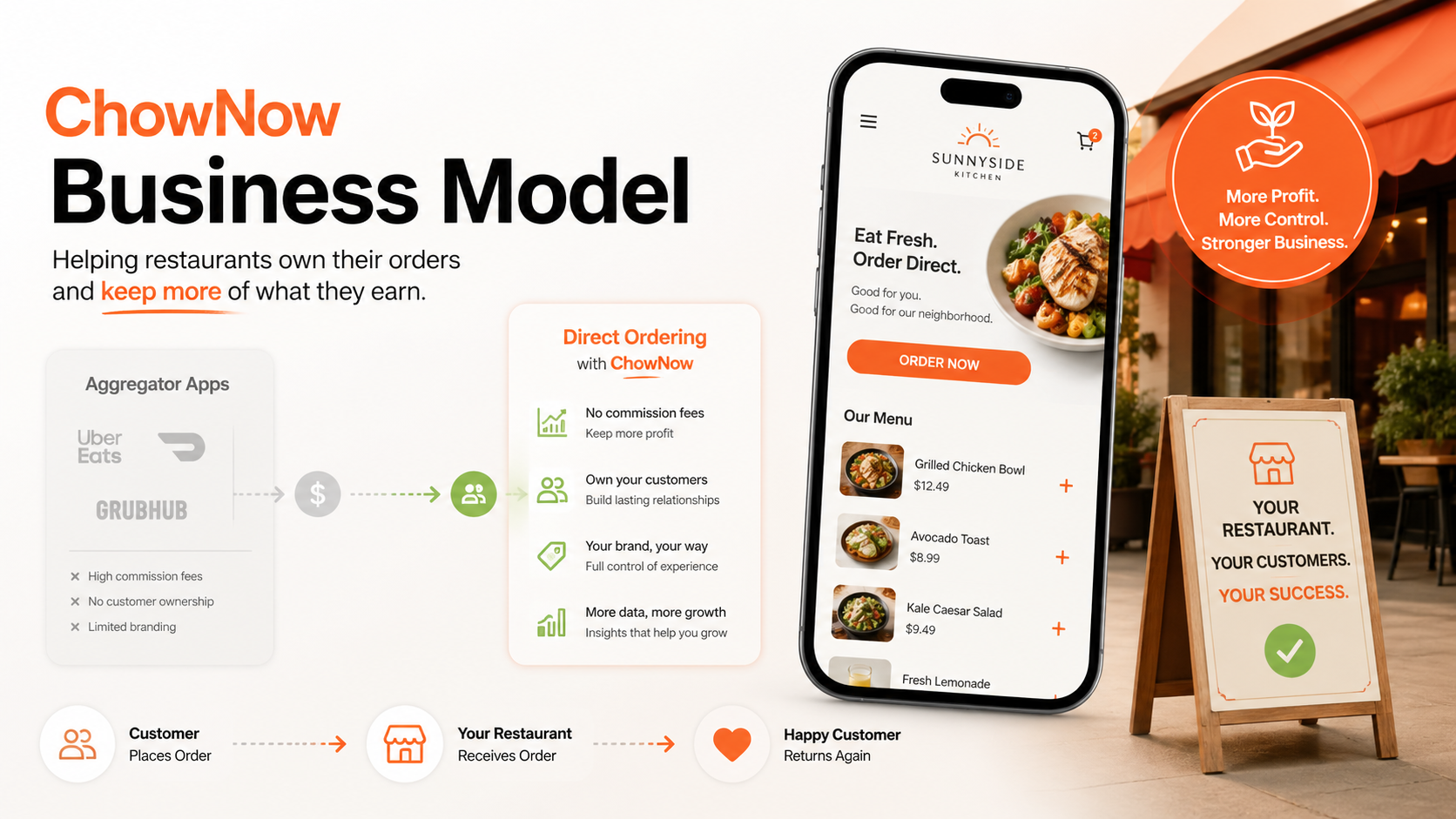
ChowNow is a SaaS-based, commission-free online ordering platform built specifically for restaurants. It charges restaurants a flat monthly or annual subscription fee instead of taking a cut from every order. Restaurants get their own branded ordering system, keep their customer data, and stay off the aggregator treadmill entirely.
In short: ChowNow sells software, not order volume.
The Problem Every Restaurant Owner Knows
Walk into any independent restaurant in America right now and ask the owner about DoorDash or Uber Eats. You’ll get a familiar look. Not gratitude. Frustration.
The math is brutal. Aggregators charge anywhere from 15% to 30% commission on every single order. On a $40 meal, that’s up to $12 gone before the restaurant pays labor, food cost, or rent. Thin margins get razor-thin. Some restaurants actually lose money on delivery orders placed through these platforms.
That’s not the only problem.
Restaurants on aggregator platforms don’t own the customer relationship. The platform does. If someone orders from your restaurant on DoorDash, DoorDash owns that email address, that order history, that behavioral data. You get the order. They get the customer.
And then there’s branding. On a marketplace, your restaurant is one of 300 options on a screen. You look like everyone else. You compete on price. You have no control over how you’re presented.
ChowNow looked at this situation and built something different entirely.
What Is ChowNow?
ChowNow was founded in 2011 and is headquartered in Los Angeles, California. The company was built around a single thesis: restaurants should own their ordering infrastructure, not rent it from platforms that profit from their dependency.
ChowNow is not a marketplace. It does not have a consumer-facing app where people browse restaurants. It builds the ordering technology behind restaurants’ own websites, apps, and digital channels.
Think of it less like DoorDash and more like Shopify. Shopify doesn’t sell products. It gives merchants the tools to sell their own products. ChowNow doesn’t deliver food. It gives restaurants the tools to accept their own orders.
Core products ChowNow offers:
- Branded online ordering system integrated directly into the restaurant’s website
- Mobile app ordering under the restaurant’s own brand
- POS integrations with major point-of-sale systems
- Email marketing tools and customer re-engagement campaigns
- Analytics dashboards that show restaurants their actual customer data
The mission is straightforward: help restaurants own their customer relationships.
The Core Problem ChowNow Solves
Commission Drain
Aggregator commissions are not a minor operational expense. For many independent restaurants, they represent the difference between profitability and loss. When a restaurant processes $50,000 in monthly delivery orders through a 25% commission platform, that’s $12,500 leaving the business every single month. ChowNow eliminates that variable entirely.
Customer Data Lockout
On aggregator platforms, restaurants are blind to who their customers actually are. No emails. No phone numbers. No purchase history. No ability to run a re-engagement campaign or build loyalty. ChowNow flips this. Every order placed through a ChowNow-powered system gives the restaurant full access to that customer’s data.
Platform Dependency
When a restaurant’s revenue depends on being listed on a third-party app, that restaurant is vulnerable. Algorithm changes, fee increases, bad reviews, or being deprioritized in search results can tank revenue overnight. ChowNow removes that single point of failure by routing orders through the restaurant’s own channels.
Branding Invisibility
On a marketplace, you’re a listing. On your own platform, you’re a brand. ChowNow lets restaurants build ordering experiences that match their identity, their colors, their story.
Aggregators vs. ChowNow: Two Different Mindsets
| Aggregators (DoorDash, Uber Eats, Grubhub) | ChowNow | |
|---|---|---|
| Revenue model | Commission per order (15-30%) | Flat subscription fee |
| Customer data | Owned by platform | Owned by restaurant |
| Discovery | Built-in marketplace traffic | Restaurant drives own traffic |
| Branding | Generic listing | Fully branded experience |
| Dependency | High | Low |
| Best for | New customer acquisition | Retaining existing customers |
The mindset difference matters. Aggregators are marketplaces. ChowNow is infrastructure.
How ChowNow Works
Restaurants Sign Up
A restaurant contacts ChowNow and selects a subscription plan. Onboarding includes setup of the ordering system, menu building, and integration with existing tools like POS systems.
ChowNow Builds the Ordering System
The platform creates a branded ordering experience hosted on the restaurant’s existing website or through a dedicated ordering page. This can include integrations with Google, Instagram, Facebook, and other digital touchpoints where customers already interact with the restaurant.
Orders Flow Through Restaurant-Owned Channels
When a customer places an order, they do it directly through the restaurant’s website or branded app, not through a third-party marketplace. The restaurant captures the order data and the customer relationship.
Restaurant Fulfills Orders Directly
Delivery can be handled by the restaurant’s own drivers or through third-party delivery logistics providers. The key distinction: ChowNow is not involved in fulfillment. It handles the technology layer only.
ChowNow Business Model Breakdown
The Core Model Is SaaS
ChowNow operates on a software-as-a-service model. Restaurants pay a recurring subscription fee to access the platform. Revenue is predictable, not tied to order volume, and scales as the restaurant network grows.
This is fundamentally different from how aggregators make money. Aggregators need transaction volume. ChowNow needs subscribers.
Subscription Pricing
ChowNow offers monthly and annual subscription tiers. Annual subscriptions typically offer a discount. Pricing historically has ranged in the low hundreds of dollars per month, making it accessible for independent operators. The exact pricing can vary based on the plan and any bundled features.
No Per-Order Commission
This is the headline USP. Restaurants pay their subscription and that’s it. Whether they process 50 orders a month or 5,000, the fee stays the same. For high-volume restaurants, this is a dramatic cost advantage over commission-based platforms.
Additional Revenue Streams
Setup Fees: Some plans include a one-time setup charge for onboarding, menu building, and integration.
Marketing Services: ChowNow offers add-on marketing tools including email campaign management, customer re-engagement programs, and promotional tools. These can be purchased on top of the base subscription.
Payment Processing Partnerships: ChowNow earns through relationships with payment processors. When restaurants process payments through the platform, ChowNow may receive a share of processing revenue.
Business Model Canvas
Customer Segments
ChowNow focuses on independent restaurants, small regional chains, and local food businesses. These are operators who have existing customer bases but lack the tech resources to build their own ordering infrastructure. They’re also the businesses most hurt by aggregator commissions because they have less negotiating power and thinner margins than large chains.
Value Propositions
Commission-free ordering is the anchor value prop. But it’s backed by three things that actually deliver long-term value: customer data ownership, brand control, and elimination of platform dependency. Together these give restaurants something aggregators structurally cannot offer: independence.
Channels
ChowNow reaches restaurants through a direct sales team, inbound website leads, and word-of-mouth within the restaurant community. Partnerships with restaurant associations and industry groups also drive awareness. The sales cycle is relationship-based because the decision to switch from an aggregator is significant for an operator.
Customer Relationships
ChowNow operates on a long-term SaaS relationship model. Dedicated onboarding support helps restaurants get set up quickly. Ongoing customer success touchpoints are important because restaurant operators are busy and need the technology to just work without friction.
Revenue Streams
Primary revenue is subscription fees. Secondary revenue comes from add-on marketing services and payment processing partnerships. The model is structured for recurring, predictable income rather than transaction-dependent volume.
Key Resources
The technology platform itself is the core asset. ChowNow’s restaurant network and the integrations it has built with POS systems, payment gateways, and digital marketing platforms represent significant competitive infrastructure.
Key Activities
Platform development and maintenance is ongoing. Restaurant onboarding is operationally intensive since each restaurant needs menu setup, integration configuration, and training. Customer support and success programs are also central to retaining subscribers.
Key Partnerships
POS providers like Square, Toast, and others are critical integration partners. Payment gateway relationships handle transaction processing. Marketing platform integrations (email tools, Google, social media) extend ChowNow’s value to restaurants beyond just ordering.
Cost Structure
Technology development and infrastructure represent the largest cost center. Sales and marketing costs are significant because restaurant acquisition requires a direct sales approach. Customer support is another substantial cost, particularly during onboarding.
ChowNow vs. Uber Eats vs. DoorDash vs. Grubhub
The Commission Question
Uber Eats, DoorDash, and Grubhub all charge percentage-based commissions on every order. These commissions fund the platform’s marketing, delivery logistics, and customer acquisition. Restaurants pay every time they make a sale.
ChowNow charges a flat subscription. No percentage. No per-order fees. A restaurant that does $100,000 in monthly orders through ChowNow pays the same subscription as one doing $10,000.
Marketplace vs. Infrastructure
Aggregators are consumer marketplaces. Customers go to DoorDash to find a restaurant. ChowNow is restaurant infrastructure. Customers go to a restaurant’s own website or app to place an order.
This means aggregators drive discovery but take ownership. ChowNow enables ordering but requires restaurants to drive their own traffic.
Ownership vs. Dependency
On aggregator platforms, removing your restaurant from the app can mean losing a significant chunk of revenue overnight because customers find you through the platform, not through you. ChowNow-powered restaurants own the customer relationship, so traffic isn’t dependent on a third-party algorithm.
Who Wins Where
Aggregators are genuinely useful for customer discovery, especially for new restaurants or those entering new markets. ChowNow is better positioned for restaurants with established customer bases who want to stop losing margin on repeat orders.
The sophisticated play is using both: aggregators for discovery, ChowNow for retention.
Why ChowNow’s Business Model Works
Predictable Revenue
Subscriptions create revenue stability that per-transaction models don’t. ChowNow knows roughly what it will earn next month based on its subscriber count. This predictability supports better planning, investment, and growth.
Strong Customer Retention
Restaurants that integrate ChowNow into their websites, train their staff on the system, and build a base of customers ordering through their own channels have high switching costs. Leaving means rebuilding all of that. Retention rates for SaaS businesses like ChowNow tend to be high when the product is embedded in daily operations.
Alignment With Restaurant Success
ChowNow’s incentives are aligned with restaurant success in a way that aggregators’ aren’t. If a restaurant does well and grows, ChowNow benefits through account retention and potential upsell to higher-tier plans. Aggregators benefit from volume regardless of whether the restaurant is actually profitable.
The Trend Is Moving Their Way
The broader shift toward platform independence is real across multiple industries. Direct-to-consumer has taken market share from retail intermediaries. Newsletter platforms are replacing media middlemen. The idea that businesses should own their customer relationships rather than renting access to them is gaining traction. ChowNow is positioned exactly on that trend in the restaurant vertical.
Limitations and Challenges
No Built-In Demand Generation
This is the biggest structural challenge. When a restaurant lists on DoorDash, it gets exposure to DoorDash’s user base immediately. ChowNow provides zero of that. Restaurants have to drive their own traffic to their ordering pages. For operators who lack marketing resources or digital expertise, this is a real barrier.
Restaurants Have to Do More Work
Using ChowNow effectively requires the restaurant to actively market their direct ordering channel. That means email campaigns, social media posts, in-store signage, and training staff to tell customers to order direct. Not every restaurant operator has the time or knowledge to do this well.
Slower Growth Trajectory Than Marketplaces
Aggregators grew explosively because they simultaneously solved demand (consumer discovery) and supply (restaurant onboarding). ChowNow’s growth is more measured because it’s solving only the infrastructure side. It doesn’t create new demand; it redirects existing demand.
Requires Customer Education
Getting customers to change their ordering behavior is hard. If someone is used to opening DoorDash to order from their favorite restaurant, convincing them to go directly to the restaurant’s website requires consistent effort and often a financial incentive like a discount or loyalty reward.
ChowNow’s Growth Strategy
Expanding Restaurant Partnerships
ChowNow has grown by signing more independent restaurants and small chains. The independent restaurant segment in America is massive and largely underserved by technology built for enterprise chains. ChowNow is purpose-built for this segment.
Building the Integration Ecosystem
Every POS system, payment processor, and marketing tool that ChowNow integrates with makes the platform stickier and more valuable. Restaurants are less likely to leave a platform that connects smoothly with everything else they use.
Owning the “Independent Restaurant” Positioning
ChowNow’s brand strategy centers on being the champion of independent restaurants. This is both a marketing position and a genuine product focus. Marketing campaigns around “Own Your Orders” and “Commission-Free” directly target the pain point that resonates most with their customer segment.
Layering on Revenue with Value-Added Services
As the base subscription becomes commoditized, ChowNow’s ability to grow revenue per customer depends on upselling marketing services, analytics tools, and other add-ons. This is a standard SaaS expansion motion: land on the core product, expand with services.
Real-World Use Case: A Restaurant’s Switch to ChowNow
Consider a mid-sized pizza restaurant in Chicago with $80,000 in monthly delivery orders. At a 25% commission rate on an aggregator platform, that’s $20,000 per month going to the platform. $240,000 per year.
After switching to ChowNow and running their own branded ordering system:
- Monthly subscription cost: roughly $150 to $300 per month
- Commission savings: close to $20,000 per month on that volume
- Net savings: $19,700+ per month
Beyond cost savings, the restaurant now has a customer email list of 4,000 people they can market to directly. They run a loyalty program. They control how their brand is presented. When they launch a new menu item, they email their customer base directly instead of hoping the algorithm promotes them on a marketplace app.
The tradeoff is real though. Those customers had to be retrained to order directly. That took time, incentives, and consistent marketing effort. It didn’t happen overnight.
But for a restaurant with an established customer base, the ROI on that effort is significant.
Key Takeaways for Founders and Operators
Owning your distribution beats renting it. Every business that depends on a third-party platform for revenue access is vulnerable to that platform’s pricing decisions, algorithm changes, and business pivots. Building owned channels is harder upfront but more durable long-term.
Subscription models create stability that transaction models don’t. ChowNow’s predictable revenue base allows it to invest in product and customer success without needing to hit volume targets every month. This is a more stable foundation than a business whose revenue fluctuates with order volume.
You don’t need network effects to build a defensible SaaS business. Aggregators win through network effects: more restaurants attract more customers, which attract more restaurants. ChowNow wins through integration depth, switching costs, and genuine alignment with customer success. Different moats, but real ones.
ChowNow is the “Shopify for restaurants” play. Shopify didn’t beat Amazon by out-marketplace-ing Amazon. It built infrastructure for merchants to sell independently. ChowNow isn’t trying to beat DoorDash at being a marketplace. It’s building the infrastructure layer that lets restaurants operate independently of marketplaces. Same strategic logic.
Wrap Up
ChowNow is not in a race to beat Uber Eats or DoorDash. That’s not the play. Those are consumer marketplaces with billions in VC backing and massive brand recognition. Competing head-on with them would be a losing strategy.
ChowNow is doing something more interesting. It’s building a parallel ecosystem where restaurants own their ordering infrastructure, own their customer relationships, and keep their margins. It’s a bet that a meaningful segment of the restaurant industry wants independence more than they want marketplace exposure.
That bet is increasingly looking correct.
The aggregator model made sense when restaurants needed digital ordering infrastructure and customer discovery simultaneously. Now that digital ordering is table stakes and restaurants understand the cost of commission dependency, the value of a commission-free, owned-channel approach is clearer than ever.
The big insight here is not just about restaurants.
The future of business is not just platforms. It’s platform independence.
Whether you’re a restaurant operator, a founder building in the vertical SaaS space, or an investor looking at the restaurant tech category, ChowNow’s model is worth studying. Not because it’s perfect, but because it represents a durable strategic position: serve the people that the dominant platforms underserve, give them ownership instead of dependency, and charge a predictable fee for the privilege.
That’s a business model built to last.
Discover more from Business Model Hub
Subscribe to get the latest posts sent to your email.