Dubizzle Business Model And How It Really Makes Money in Classifieds

Dubizzle is a classifieds marketplace that monetizes through premium listings, business subscriptions, and advertising, while keeping basic listings free to attract massive local demand and supply.
What Is Dubizzle?
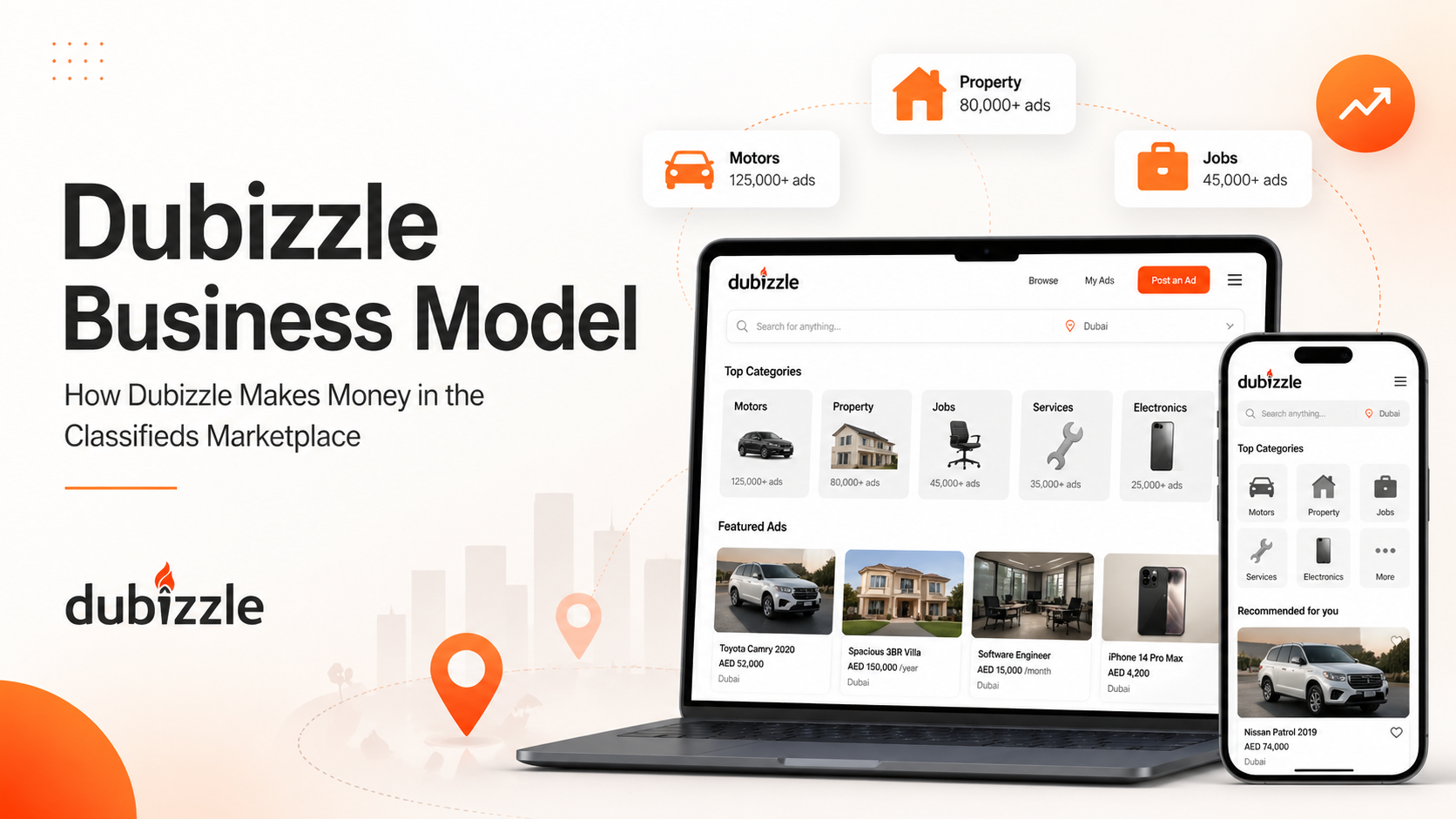
Dubizzle launched in 2005 as a hyperlocal classifieds platform built specifically for the Middle East market. It connects buyers and sellers across everyday categories like real estate, cars, jobs, services, and electronics.
Think of it as the Craigslist or OLX of the Arab world, but with a sharper focus on local trust and high-intent transactions.
It operates across the UAE, Egypt, Lebanon, Bahrain, and other MENA markets. The platform has grown into one of the most visited classifieds sites in the region, primarily because it solves a simple problem: connecting local buyers with local sellers, fast.
Key categories on Dubizzle:
- Real estate (rentals and sales)
- Cars and vehicles
- Jobs and recruitment
- Electronics and appliances
- Furniture and home goods
- Services
The platform positions itself as a hyperlocal demand-supply connector. Businesses want local leads. Individuals want quick deals. Dubizzle sits right in the middle and monetizes that connection.
The Core Idea Behind the Dubizzle Model
Dubizzle is not really a classifieds site. It is a lead marketplace disguised as one.
Every listing posted on Dubizzle is essentially a lead. A real estate agent posting fifty properties is not just listing apartments. They are buying access to a pool of high-intent buyers who are actively searching right now.
That is the insight that makes Dubizzle’s business model work.
Three things drive the core logic:
Buying and selling is easier locally. When someone in Dubai searches for a used car, they want options within driving distance. Dubizzle delivers that. The geographic filter is not a feature. It is the product.
Trust improves with proximity. People feel more comfortable transacting with someone nearby. Local listings feel more real, more verifiable, and lower risk than a national or global marketplace.
Businesses need ready-to-convert leads. A car dealer or a real estate agency does not want brand awareness. They want someone who is actively searching to buy right now. Dubizzle delivers exactly that audience, and businesses pay for that access.
How Dubizzle Actually Works
The mechanics are straightforward.
A user creates a free account and posts an ad. They add photos, write a description, set a price, and publish. The listing goes live immediately in the relevant category.
Buyers search using filters. They narrow down by location, price range, category, and keywords. They browse results, click on listings that match, and contact the seller directly through the platform’s chat or by phone.
The deal happens offline. Dubizzle steps back once the connection is made.
What Dubizzle does not do:
- It holds no inventory
- It handles no payments or transactions
- It manages no logistics or delivery
- It takes no commission per sale
This is critical to understanding why the model is so profitable. Dubizzle captures value without touching the transaction itself. It is a pure platform play.
The Freemium Foundation
Every successful classifieds business is built on freemium. Dubizzle is no exception.
Free listings attract the supply side. When sellers can post at no cost, they flood the platform with inventory. That inventory attracts buyers. More buyers attract more sellers. The cycle reinforces itself.
This is the network effect in action. Dubizzle’s core asset is not its technology. It is the volume of active listings at any given moment. And that volume is only possible because posting is free.
Once the platform has enough users on both sides, it can layer paid features on top without disrupting the core experience. Sellers who want more visibility pay. Businesses that want more leads subscribe. Advertisers who want eyeballs buy placements.
The free tier is not a loss leader. It is the growth engine.
Dubizzle Business Model Canvas
Customer Segments
Dubizzle serves three distinct customer groups, and understanding how each one interacts with the platform is key to understanding the revenue model.
Individual sellers are the backbone of supply. These are everyday people selling used items, old cars, furniture, or electronics. They post for free and rarely pay anything. Their value is not in revenue. Their value is in content. Every free listing they post makes the platform more useful for buyers.
Individual buyers are the demand side. They search, browse, and connect with sellers. They also generate the traffic and engagement metrics that make the platform attractive to the third group.
Businesses are where the money comes from. Real estate agencies, car dealerships, and recruiters all rely on Dubizzle as a lead generation channel. They need consistent visibility. They post in volume. And they have marketing budgets to spend.
Value Propositions
For individual sellers:
- Post for free in minutes
- Reach local buyers instantly
- No commissions on sales
- Simple self-service interface
For individual buyers:
- Large inventory of local listings
- Easy filtering by price, location, and category
- Direct contact with sellers
- No fees or account requirements to browse
For businesses:
- Access to high-intent, purchase-ready local buyers
- Bulk listing capability
- Featured placements to stand above competitors
- Analytics and lead management tools
- Subscription-based pricing with predictable costs
Channels
Website: The primary channel, optimized heavily for search engine traffic. Millions of listing pages get indexed and ranked on Google, driving organic traffic at scale.
Mobile app: A large portion of Dubizzle’s traffic comes from mobile. The app is designed for quick browsing and fast listing creation.
SEO: This is arguably Dubizzle’s most powerful channel. Every listing page is a potential search result. Someone searching “used Toyota Camry Dubai” might land directly on a Dubizzle listing. This creates a massive organic traffic engine that compounds over time.
Paid advertising: Dubizzle runs performance marketing campaigns to acquire new users and re-engage existing ones, particularly in competitive categories like real estate and cars.
Customer Relationships
Dubizzle operates primarily as a self-service platform. Users sign up, post, search, and connect without any human interaction from Dubizzle’s side.
The model is:
- Automated listing submission
- Algorithmic search and ranking
- In-app messaging between users
- Automated payment for premium features
For business clients on subscription plans, there may be account management support. But for the mass of individual users, the relationship is entirely platform-driven.
This keeps operational costs low and allows the platform to scale without proportionally scaling its headcount.
Revenue Streams
This is where the model gets interesting. Dubizzle has built multiple monetization layers on top of its free core.
Featured and boosted listings are the simplest form of monetization. A seller pays a small fee to push their listing to the top of search results. Higher visibility means more clicks. More clicks mean faster sales. The value is obvious and the conversion to paid is relatively easy.
Subscription plans for businesses are the core revenue driver. Real estate agencies, car dealerships, and recruiters pay monthly fees for access to bulk listing capacity, analytics dashboards, lead management tools, and priority support. This is recurring, predictable revenue with high retention because switching costs are real.
Display advertising generates revenue from third-party advertisers who want to reach Dubizzle’s audience. Banner ads, sponsored placements, and category-level ad inventory are sold to brands targeting buyers in specific categories.
Category-specific listing fees apply in certain high-value categories. Jobs listings often carry a per-post fee. Real estate listings may require a subscription to post at volume. These fees reflect the commercial value of the leads being generated.
Key Resources
The platform itself is the foundation. The technology stack that powers search, filtering, listing management, messaging, and payments is core infrastructure.
The user base is the real asset. Dubizzle’s listings, its traffic, its network of sellers and buyers, are what make the platform valuable. These cannot be replicated quickly by a competitor.
Brand trust matters enormously in classifieds. Users need to trust that listings are real, that the platform is safe, and that their information is protected. Dubizzle’s years of operation in the Middle East have built that trust.
SEO authority is a durable competitive advantage. Years of indexed listing pages, backlinks, and domain authority make it very hard for a new entrant to compete on organic search.
Key Activities
Platform development is ongoing. Search quality, mobile experience, listing tools, and payment systems all require continuous investment.
Content moderation is critical and expensive. Fake listings, scam ads, and low-quality content destroy user trust. Dubizzle invests in both automated and human moderation to keep listing quality high.
Traffic acquisition involves both organic SEO and paid performance marketing. Keeping the top of the funnel full is a constant operational priority.
Business onboarding means actively signing up real estate agents, car dealers, and recruiters to subscription plans. This is a sales-driven activity that requires dedicated business development resources.
Key Partnerships
Real estate agencies are among the highest-value partners. Large agencies post hundreds of listings and pay significant subscription fees. Dubizzle often has direct commercial relationships with major real estate brands in the UAE and Egypt.
Car dealerships operate similarly. A dealership with a large inventory needs consistent exposure and will pay for premium placement.
Recruiters and HR platforms use Dubizzle’s jobs category to post openings and find candidates. This is a recurring use case that maps well to subscription pricing.
Advertisers and brands who want to reach Dubizzle’s audience buy display inventory, creating an additional revenue stream that is separate from listings.
Cost Structure
Technology infrastructure is the largest fixed cost. Hosting, development, cloud services, and engineering talent all add up at Dubizzle’s scale.
Marketing and user acquisition is a significant variable cost. Keeping traffic growing requires ongoing investment in both paid and organic channels.
Salaries across engineering, product, sales, moderation, and operations represent the largest people cost.
Customer support and content moderation are ongoing operational expenses that scale with user growth.
The business model works well because revenue scales faster than costs. Each new subscription customer or premium listing adds revenue with minimal incremental cost. That is the leverage of a platform model.
How Dubizzle Makes Money: A Detailed Breakdown
Featured Listings
Featured listings are the most accessible monetization tool. Any individual or business can pay to boost a specific listing.
What they get:
- Top placement in category search results
- Higher click-through rates
- A “Featured” badge that signals credibility
- Faster time to sale or inquiry
Pricing varies by category and duration. A featured car listing might cost a few dollars for a week. A featured property listing might cost significantly more given the lead value.
This model works because the value proposition is clear and immediate. Sellers who boost their listings get more calls. The feedback loop reinforces repeat payment.
Subscription Plans
Subscriptions are the engine of Dubizzle’s revenue.
Businesses, particularly in real estate and automotive, cannot rely on occasional listing boosts. They need consistent, high-volume visibility. That is what subscription plans deliver.
A typical business subscription on Dubizzle includes:
- Bulk listing allowances (post dozens or hundreds of listings per month)
- Analytics on listing performance and lead volume
- Lead management tools (track inquiries, mark leads as closed, etc.)
- Priority customer support
- Company profile or branded page on the platform
Subscription pricing is tiered based on volume and features. A small real estate agency might pay one price. A large national developer pays significantly more.
The key advantage of subscriptions for Dubizzle is predictability. Monthly recurring revenue is far more stable than transaction-based income. And churn is low because businesses embedded in the platform, with their listings, analytics, and workflows built around it, do not leave easily.
Display Advertising
Dubizzle’s traffic volume makes it an attractive advertising platform for brands that want to reach people who are actively in a buying mindset.
Someone browsing car listings is likely in the market for a car. A car insurance company or auto loan provider would pay a premium to reach that person at that moment.
Ad inventory on Dubizzle includes:
- Banner placements across listing pages
- Sponsored listings that appear within organic search results
- Category-level takeovers and branded placements
- Email and push notification campaigns for advertisers
This revenue stream is largely passive from an operational standpoint. Once the ad inventory is built and the targeting is set up, it runs on autopilot. The scale of Dubizzle’s traffic makes even modest CPMs (cost per thousand impressions) translate into meaningful revenue.
Paid Listing Categories
In certain categories, posting itself is not free. This is most common in:
Jobs: Employers pay per job post or subscribe to a recruitment package. The logic is simple. Each job post is a lead-generation tool for a company that has clear budget for hiring.
Real estate: Posting above a certain volume threshold typically requires a subscription. This filters out hobbyists and ensures the listings come from genuine agents with serious inventory.
High-value listings: In some markets, categories like luxury items, boats, or commercial equipment may carry listing fees that reflect the higher value of the lead being generated.
Why the Dubizzle Model Works
The Hyperlocal Advantage
Hyperlocal is not a feature. It is a defensible market position.
Dubizzle does not try to be a global marketplace. It wins by being the best classifieds platform in a specific geography. That focus means the platform understands local languages, local regulations, local pricing expectations, and local user behavior.
A global competitor trying to enter the Middle East classifieds market would need years to build comparable local relevance. That is a real moat.
High-Intent Users
Traffic quality on Dubizzle is exceptional from an advertiser’s perspective.
Users are not browsing casually. They are looking for specific things to buy or specific properties to rent. That intent makes every click and every impression more valuable than equivalent traffic on a general interest site.
High intent translates to higher conversion rates for businesses, which justifies higher subscription prices and stronger advertiser CPMs.
Low-Cost Operating Model
Dubizzle does not hold inventory. It does not process payments. It does not manage logistics. The platform connects two parties and steps back.
This means the cost structure is dominated by technology and people, not by cost of goods or fulfillment operations. As the platform scales, revenue grows faster than costs. That is the definition of operating leverage.
Network Effects
Every new seller who joins makes the platform more useful for buyers. Every new buyer who joins makes the platform more attractive for sellers. Every business that subscribes adds more listing volume, which attracts more buyers, which justifies higher subscription prices.
These reinforcing loops make the platform increasingly difficult to displace as it grows. Network effects are the most powerful economic moat in marketplace businesses.
Dubizzle vs OLX: A Quick Comparison
| Feature | Dubizzle | OLX |
|---|---|---|
| Geographic focus | Middle East and MENA | Global, multi-market |
| Primary revenue | Business subscriptions | Advertising and listings |
| Strongest categories | Real estate and automotive | General classifieds |
| Market position | Dominant regional player | Global scaled platform |
| Monetization depth | High (B2B subscriptions) | Moderate (ad-driven) |
Dubizzle’s sharper geographic and category focus has allowed it to build deeper monetization in its core verticals. OLX trades breadth for depth. Dubizzle has chosen depth, and that choice shows in the subscription-heavy revenue mix.
Challenges in the Model
Fake Listings and Scams
The open nature of classifieds platforms creates an ongoing fraud problem. Fake listings, scam sellers, and misleading ads erode user trust.
Dubizzle invests in moderation, but scale makes it hard to catch everything. One bad experience can drive a user to a competitor permanently.
No Transaction Control
Because Dubizzle does not handle payments or logistics, it has no visibility into whether deals actually close. It cannot guarantee outcomes for buyers or sellers. It cannot resolve disputes over product quality or payment.
This limits both user protection and Dubizzle’s ability to monetize the transaction layer.
User Trust Dependence
The entire model depends on users trusting the platform enough to post genuine listings and contact strangers. Any erosion of that trust, through scams, bad user experiences, or platform failures, directly threatens the supply of quality listings.
Competition From Social Platforms
Facebook Marketplace has emerged as a direct competitor in many of Dubizzle’s markets. It leverages existing social connections to add a layer of trust to transactions, and it is completely free. Competing with a free product backed by Facebook’s distribution is a genuine strategic challenge.
Future Growth Opportunities
Payment Integration
The most obvious expansion is to own the transaction layer. If Dubizzle could process payments between buyers and sellers, it could take a small percentage of each deal.
Given the volume of transactions that flow through the platform each day, even a one or two percent transaction fee would generate substantial incremental revenue.
Escrow Services
Escrow would address the trust problem directly. Buyers deposit funds into an escrow account. Sellers ship or transfer the item. Funds are released once the buyer confirms receipt.
This would be particularly valuable for high-value categories like cars and electronics, where the stakes are high enough to justify a small escrow fee.
AI-Powered Recommendations
Most classifieds platforms still rely on basic keyword search. An AI-powered recommendation engine could surface listings based on user behavior, historical searches, and preference patterns.
Better recommendations mean longer sessions, more listings viewed, and higher probability of conversion. That benefits both buyers and the businesses paying for premium placement.
Vertical Expansion
Dubizzle could launch dedicated vertical platforms for specific categories. A standalone real estate portal. A dedicated automotive marketplace. A jobs-only platform.
Each vertical could have a deeper feature set tailored to that category’s specific needs, with its own subscription pricing and advertiser base.
Key Takeaways
Freemium drives growth. Free listings attract supply. Supply attracts demand. Demand creates the audience that businesses pay to reach. Never charge for the thing that creates your network.
B2B subscriptions drive revenue. Individual users rarely pay. Businesses always need to pay because their livelihood depends on consistent visibility. Build the product for the masses but monetize the professionals.
Local trust is the real moat. Technology can be copied. Brand trust built over years in a specific market cannot. Dubizzle’s decade-plus presence in the Middle East is harder to replicate than its codebase.
Platform economics favor the model. No inventory, no logistics, no transaction handling. Pure margin expansion as the platform scales.
Network effects compound over time. The more listings, the more buyers. The more buyers, the more sellers. The cycle self-reinforces and makes displacement increasingly difficult.
What I Would Do If Building This Today
Start with one niche. Pick one category in one city. Cars in Dubai. Apartments in Cairo. Do not try to be everything to everyone from day one.
Build trust systems before scaling. Verified listings, seller ratings, and identity checks create the foundation for a marketplace people actually use. Trust is infrastructure.
Monetize businesses early. Do not wait for massive scale to charge. Get real estate agents and car dealers on paid plans from the beginning. Their willingness to pay validates your value proposition.
Invest in local SEO from day one. Listing pages that rank on Google are free traffic that compounds for years. Every listing is a potential landing page. Structure your platform accordingly.
Add transaction capability as soon as the network is established. The platform that controls the payment layer captures more value and has much stronger retention. Build toward owning the full transaction, not just the introduction.
Discover more from Business Model Hub
Subscribe to get the latest posts sent to your email.