
Tesla, Inc. has revolutionized the automotive industry since its inception in 2003, transforming from a Silicon Valley startup into the world’s most valuable car manufacturer. Under the leadership of CEO Elon Musk, who has served as the company’s driving force and public face since 2008, Tesla has become synonymous with electric vehicles and sustainable transportation.
Today, Tesla isn’t just an automaker it’s a technology company, energy innovator, and cultural phenomenon that has forced the entire automotive industry to accelerate its transition to electric mobility. The company’s market capitalization has at times exceeded that of all major legacy automakers combined, making it one of the most discussed and debated companies globally.
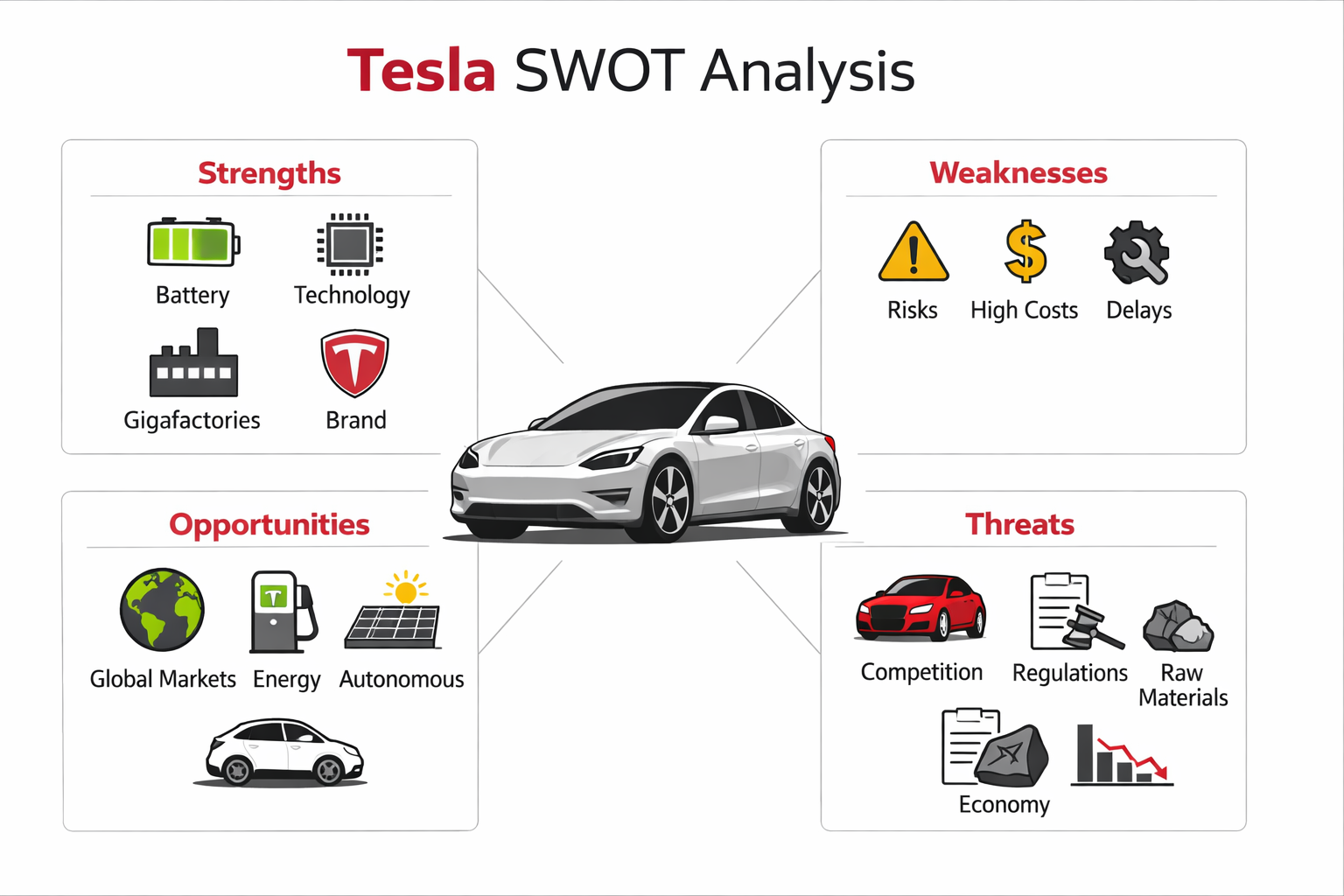
This comprehensive SWOT analysis examines Tesla’s strategic position in 2026, exploring the internal strengths and weaknesses that define its operations, alongside the external opportunities and threats that will shape its future. Whether you’re an investor evaluating Tesla’s stock, a founder studying disruptive business models, or an industry analyst tracking the EV revolution, this analysis provides the strategic insights you need to understand where Tesla stands today and where it’s headed tomorrow.
What is a SWOT Analysis?
SWOT analysis is a strategic planning framework that evaluates four critical dimensions of a business:
Strengths are internal capabilities and resources that give a company competitive advantages—what it does exceptionally well.
Weaknesses are internal limitations and vulnerabilities that hinder performance or create risks—where the company falls short.
Opportunities are external factors and emerging trends that a company can capitalize on for growth—favorable conditions in the market environment.
Threats are external challenges and risks that could negatively impact the business—forces beyond the company’s control that pose dangers.
For investors, SWOT analysis provides a balanced framework to assess risk and potential return. It reveals whether a company’s strengths can overcome its weaknesses and whether opportunities outweigh threats. For founders and entrepreneurs, studying Tesla’s SWOT offers lessons in building competitive moats, managing operational challenges, and navigating disruptive innovation. For industry analysts, it contextualizes how Tesla maintains its leadership position amid intensifying competition and evolving market dynamics.
Understanding Tesla’s strategic position through SWOT helps stakeholders make informed decisions based on facts rather than hype, separating the company’s genuine competitive advantages from its very real challenges.
Tesla Strengths
Strong Brand Positioning
Tesla has achieved what few automotive companies manage in a century: it has built a brand that transcends its products. The Tesla name evokes innovation, sustainability, and cutting-edge technology in ways that resonate far beyond the EV market. While traditional automakers spend billions on advertising, Tesla has relied almost entirely on word-of-mouth, social media presence, and Elon Musk’s personal brand to build one of the most valuable automotive brands in history.
The company occupies the premium segment of the EV market with an aspirational appeal that combines environmental consciousness with performance and luxury. Tesla owners often become brand evangelists, creating organic marketing that money can’t buy. This brand strength translates directly into pricing power—Tesla can command premium prices while maintaining strong demand, even as competitors enter the market with cheaper alternatives.
The innovation-driven identity sets Tesla apart from traditional automakers who are often perceived as conservative and slow-moving. Tesla represents the future, while legacy brands carry the baggage of the past. This positioning attracts not just customers but also top engineering talent who want to work on transformative technology rather than incremental improvements to internal combustion engines.
Technological Leadership
Tesla’s technological edge remains one of its most formidable competitive advantages. The company doesn’t just assemble electric vehicles—it has fundamentally rethought how cars should be designed, manufactured, and updated.
Battery technology represents Tesla’s crown jewel. Through years of research and development, Tesla has achieved industry-leading energy density, thermal management, and cost efficiency in its battery packs. The company’s 4680 battery cells promise further improvements in energy capacity and manufacturing efficiency. Unlike competitors who primarily source batteries from suppliers, Tesla manufactures batteries in-house through partnerships and its own production facilities, giving it greater control over this critical component.
Tesla’s in-house software development creates a seamless, smartphone-like user experience that traditional automakers struggle to replicate. The company treats its vehicles as platforms that improve over time through over-the-air updates, adding new features and capabilities to cars already on the road. This software-first approach extends from the infotainment system to core vehicle functions, creating a technological ecosystem rather than just a transportation product.
Autopilot and Full Self-Driving capabilities, while still evolving and controversial, represent a massive investment in autonomous driving technology. Tesla has accumulated billions of real-world miles of driving data from its fleet, creating a data advantage that competitors cannot easily match. Whether this translates into true Level 4 or 5 autonomy remains to be seen, but Tesla’s lead in data collection and neural network training is undeniable.
Vertical Integration Model
Tesla’s approach to manufacturing breaks from automotive industry norms in ways that provide both cost advantages and quality control. The company produces many components in-house that traditional automakers source from suppliers—from seats and battery packs to electric motors and charging systems.
This vertical integration allows Tesla to optimize the entire production process, eliminating inefficiencies that arise when coordinating with dozens of suppliers. It enables faster innovation cycles, as engineering teams can iterate on designs without negotiating changes through complex supply chains. During periods of supply chain disruption, Tesla’s in-house production has provided resilience that many competitors lacked.
The direct-to-consumer sales model eliminates the traditional dealership network, allowing Tesla to control the customer experience from initial interest through delivery and service. This approach bypasses dealer markups, reduces conflict over inventory allocation, and ensures consistent brand representation. While this model has faced legal challenges in states with franchise laws, it provides significant margin advantages and customer satisfaction benefits where it operates.
Tesla’s service centers and mobile service fleet extend this control through the ownership experience, though service capacity remains a weakness the company continues to address.
Gigafactory Network
Tesla’s global Gigafactory network represents one of the largest private investments in manufacturing capacity in recent history. These massive facilities in Nevada, Texas, Shanghai, Berlin, and beyond provide the production scale necessary to compete with established automakers.
The Gigafactory strategy serves multiple purposes. First, it provides the manufacturing capacity to produce millions of vehicles annually, a requirement for competing in the global automotive market. Second, it brings production closer to major markets, reducing logistics costs and tariff exposure. The Shanghai Gigafactory, for instance, serves both the Chinese market and exports to Europe and Asia, while the Berlin facility supplies European demand.
These facilities also house battery production, creating integrated operations that reduce costs and improve efficiency. The co-location of battery and vehicle manufacturing minimizes transportation costs for heavy, bulky battery packs while enabling tighter coordination between engineering teams.
The scale of these investments creates barriers to entry for competitors and demonstrates Tesla’s commitment to the EV transition. While the capital requirements are enormous, the Gigafactories provide the foundation for Tesla’s growth ambitions and its ability to reduce costs through manufacturing scale.
Strong Market Capitalization & Investor Confidence
Tesla’s market valuation, which has at times exceeded $1 trillion, reflects investor confidence that extends far beyond current production volumes or profitability. The market values Tesla not just as an automaker but as a technology company positioned to benefit from the global transition to sustainable energy.
This high valuation provides strategic advantages. Tesla can raise capital more easily and on more favorable terms than competitors, funding expansion, research, and development without the constraints faced by legacy automakers. The company can attract top talent through equity compensation that has created significant wealth for employees. High stock prices facilitate acquisitions and strategic partnerships on favorable terms.
The valuation also reflects a forward-looking view of Tesla’s opportunities in autonomous driving, energy storage, and software services. Investors are betting that Tesla’s technological leadership will translate into dominant positions in multiple high-growth markets beyond just vehicle sales.
While critics argue the valuation is excessive compared to production volumes, the market continues to price in Tesla’s potential rather than just its present, providing a vote of confidence that translates into real strategic flexibility.
Tesla Weaknesses
Heavy Dependence on EV Sales
Despite ambitions in energy storage and solar, Tesla remains overwhelmingly dependent on vehicle sales for revenue. This concentrated focus creates vulnerability that diversified competitors don’t share. Traditional automakers sell vehicles across multiple categories—sedans, trucks, SUVs, commercial vehicles—and many maintain profitable financing divisions that generate steady cash flow regardless of vehicle sales cycles.
Tesla’s product lineup, while expanding, remains limited to premium passenger vehicles. The company lacks the trucks, vans, and commercial vehicles that provide stable revenue for competitors, especially during economic downturns when consumers delay luxury purchases but businesses continue operating vehicle fleets.
This concentration also means Tesla cannot offset weakness in one segment with strength in another. When EV demand softens or competition intensifies in the premium segment, Tesla has few alternatives to maintain revenue growth. The promised Cybertruck, Semi, and Roadster aim to diversify the product portfolio, but delays in bringing these vehicles to market at scale highlight the execution challenges.
The energy business, while growing, remains a small fraction of Tesla’s total revenue and has struggled with profitability and project execution. Until Tesla successfully builds substantial non-automotive revenue streams, the company’s fortunes rise and fall almost entirely with EV sales.
Production Delays & Operational Challenges
Tesla has consistently struggled to meet production timelines and volume targets, a pattern that dates back to the Model 3 “production hell” and continues with newer vehicle programs. The Cybertruck, originally announced in 2019 with production expected in 2021, faced years of delays before limited deliveries began in late 2023. The Semi, Roadster, and other promised vehicles have similarly slipped far beyond initial timelines.
These delays stem from multiple factors. Tesla’s ambition to innovate manufacturing processes—such as the Cybertruck’s stainless steel exoskeleton and structural battery pack designs—introduces complexity and unforeseen challenges. The company’s relatively young manufacturing expertise shows when bringing radically new designs to production scale.
Supply chain management has proven challenging, particularly during periods of global disruption. While vertical integration provides some insulation, Tesla still depends on suppliers for critical components and raw materials. Bottlenecks in single components can halt entire production lines, a vulnerability that becomes more acute as production scales.
Quality control during production ramps has repeatedly surfaced as an issue, with early production vehicles experiencing higher defect rates than later production models. This pattern suggests Tesla prioritizes speed to market over refinement, a strategy that builds volume but risks brand reputation.
These operational challenges translate directly into financial impact—delayed production means delayed revenue, while operational inefficiencies increase costs and reduce margins.
High Pricing vs Mass Market
Tesla’s vehicles occupy the premium segment with pricing that places them beyond reach for most global consumers. While the Model 3 and Model Y represent Tesla’s more “affordable” offerings, their pricing still positions them as premium purchases in most markets, particularly when compared to traditional internal combustion vehicles or competing EVs from Chinese manufacturers.
This pricing strategy maximizes margins but limits addressable market size. In developing economies where vehicle adoption is growing fastest—India, Southeast Asia, parts of Latin America and Africa—Tesla’s vehicles are luxury goods accessible only to the wealthy elite. Competitors offering EVs at half Tesla’s price point can capture mass market demand that Tesla cannot serve.
Even in developed markets, Tesla’s pricing creates affordability barriers during economic uncertainty. Premium vehicles are discretionary purchases that consumers delay during recessions or periods of financial stress. The lack of a true mass-market offering limits Tesla’s resilience during economic downturns.
Elon Musk has repeatedly promised a $25,000 Tesla to serve the mass market, but this vehicle remains in development with no clear production timeline. Until Tesla can profitably produce vehicles at price points accessible to middle-class consumers globally, the company will remain a premium brand with the volume limitations that implies.
The reliance on government tax credits to reach effective price points also creates vulnerability, as subsidies can change with political winds and may not be available in all markets.
Leadership Risk
Tesla’s fate is uniquely intertwined with Elon Musk in ways that create both advantages and significant risks. Musk’s vision, technical insights, and relentless drive have been instrumental in Tesla’s success, but the company’s over-reliance on a single individual creates vulnerabilities that most large corporations have learned to mitigate.
Musk’s attention is divided across multiple companies—SpaceX, Twitter/X, Neuralink, The Boring Company, and others—raising questions about his bandwidth to lead Tesla effectively. His controversial public statements and behavior, particularly on social media, have at times damaged Tesla’s brand and attracted regulatory scrutiny. Some potential customers have explicitly cited Musk’s polarizing persona as a reason to avoid Tesla vehicles.
The lack of a clear succession plan creates uncertainty. While Tesla has strong executives in various functions, there is no obvious heir apparent who could maintain investor confidence and operational effectiveness if Musk were to step away. The company’s valuation reflects, in part, the market’s faith in Musk personally, creating risk if that faith wavers.
Musk’s management style, while effective at driving innovation and urgency, has also contributed to executive turnover, public relations missteps, and occasional operational chaos. The company’s ability to professionalize its operations and build institutional strength that doesn’t depend on any single individual remains a work in progress.
This leadership concentration represents a unique risk factor that competitors simply don’t face to the same degree.
Quality Control Concerns
Tesla’s vehicles have consistently ranked below industry average in quality and reliability surveys, a weakness that undermines the premium brand positioning. J.D. Power initial quality studies and Consumer Reports reliability ratings have repeatedly highlighted issues with build quality, panel gaps, paint imperfections, and electronic glitches.
The company has issued numerous recalls for issues ranging from problematic seatbelts and faulty cameras to touchscreen failures and suspension problems. While recalls affect all automakers, the frequency and variety of Tesla’s recalls suggest systematic quality control challenges rather than isolated issues.
Customer complaints about service wait times, parts availability, and responsiveness compound quality concerns. As Tesla has scaled production, service capacity has not kept pace, leaving owners frustrated when problems arise. The direct sales model eliminates dealer service networks, placing the entire service burden on Tesla’s own infrastructure.
These quality issues matter because they directly contradict Tesla’s premium positioning and high prices. Customers paying luxury prices expect luxury quality, and when Tesla falls short, it creates dissatisfaction that spreads through word-of-mouth and social media, potentially deterring future buyers.
As competition intensifies, traditional luxury automakers entering the EV market bring decades of quality expertise. If Tesla cannot close the quality gap, it risks losing customers who want both electric powertrains and the fit-and-finish quality they expect from premium brands.
Tesla Opportunities
Global EV Adoption Growth
The worldwide transition from internal combustion engines to electric vehicles represents a multi-trillion-dollar opportunity that is still in its early stages. Government policies accelerating this transition create a powerful tailwind for Tesla and the entire EV industry.
Major economies have announced bans on new internal combustion engine vehicle sales ranging from 2030 to 2040, creating regulatory certainty that is driving both consumer adoption and competitor investment. The European Union, United Kingdom, California, and other jurisdictions have committed to timelines that will require automakers to transition their fleets to electric powertrains.
Government subsidies and tax incentives make EVs more affordable, effectively reducing the price gap with traditional vehicles. The U.S. Inflation Reduction Act, European green initiatives, and Chinese EV subsidies provide billions in support for EV adoption. While these incentives may phase out over time, they are accelerating the transition during the critical adoption curve period.
The sustainability movement among consumers, particularly younger buyers, creates preference for electric vehicles independent of government policy. Environmental consciousness is becoming a purchasing factor, and Tesla benefits from being perceived as the authentic leader in sustainable transportation.
Charging infrastructure expansion reduces range anxiety, historically one of the primary barriers to EV adoption. As fast-charging networks proliferate and charging times decrease, practical barriers to EV ownership diminish, expanding the addressable market.
Tesla, as the established leader in EVs, is positioned to capture significant share of this growing market, even as its percentage of total EV sales declines due to increased competition.
Expansion in Emerging Markets
Tesla’s presence in emerging markets remains limited, representing significant untapped opportunity. India, with its massive population and growing middle class, could become one of the world’s largest automotive markets, yet Tesla has no manufacturing presence and limited sales due to high import tariffs.
The Indian government has signaled willingness to provide incentives for EV manufacturing investment, creating an opportunity for Tesla to establish local production that would enable competitive pricing. Success in India could provide a blueprint for other developing markets in Southeast Asia, Latin America, and Africa.
Southeast Asian markets including Indonesia, Thailand, and Vietnam are investing heavily in EV infrastructure and offering incentives to attract manufacturing investment. These markets represent hundreds of millions of potential customers as they transition from two-wheelers and public transportation to private vehicle ownership.
Local manufacturing in these markets would not only avoid tariffs but also enable development of lower-priced models tailored to local preferences and purchasing power. The mythical $25,000 Tesla would find enormous demand in emerging markets if Tesla can deliver it profitably.
These markets also offer opportunities for Tesla’s energy products, as many developing countries lack established electrical grids and could leapfrog to distributed solar and battery storage solutions, similar to how mobile phones enabled these markets to skip landline infrastructure.
First-mover advantage in emerging markets could position Tesla as the default EV brand as these economies develop, much as it has achieved in developed markets.
Energy Business Growth
Tesla’s energy division remains underdeveloped relative to its potential, representing an opportunity to diversify revenue beyond vehicle sales. The Powerwall home battery, Powerpack and Megapack utility-scale storage, and solar roof products address the complementary market of sustainable energy generation and storage.
The global energy storage market is growing rapidly as renewable energy penetration increases. Solar and wind generation create intermittency challenges that battery storage solves, making energy storage essential infrastructure for the renewable transition. Tesla’s expertise in battery technology positions it well to capture share in this growing market.
Integration between Tesla’s automotive and energy businesses creates synergies—battery technology developed for vehicles transfers to stationary storage, while software and AI developed for vehicle management applies to grid-scale energy optimization. Vehicle-to-grid technology could eventually allow Tesla vehicles to serve as distributed storage, creating additional revenue streams.
The regulatory environment increasingly favors renewable energy and storage through mandates, incentives, and carbon pricing. Utilities and grid operators need storage solutions to meet renewable energy targets, creating a customer base with large capital budgets and long-term contracts.
Tesla’s brand strength in sustainability makes it credible in energy markets in ways that traditional energy companies or industrial conglomerates are not. Customers who want Tesla vehicles for environmental reasons are natural customers for Tesla’s energy products.
If Tesla can execute successfully in energy, it could become a diversified sustainable energy company rather than just an automaker, fundamentally changing its business model and reducing concentration risk.
Autonomous Driving & AI
Full autonomous driving represents perhaps Tesla’s largest potential opportunity—the possibility of transforming its fleet of vehicles into revenue-generating assets through a robotaxi network. If Tesla achieves genuine Level 4 or 5 autonomy, the business model implications are revolutionary.
The robotaxi concept envisions Tesla owners earning income by allowing their vehicles to operate as autonomous ride-sharing services when not personally in use. Tesla would take a percentage of this revenue, creating a recurring software services business model entirely separate from vehicle sales. This “transportation as a service” market could be larger than vehicle sales themselves.
Tesla’s data advantage from billions of miles driven by its fleet provides training data for its neural networks that competitors cannot easily replicate. While the path to full autonomy has proven longer than Musk’s optimistic predictions, Tesla’s real-world data collection continues to compound, potentially creating an insurmountable lead if the technology proves achievable.
Beyond robotaxis, autonomous technology enables new use cases and revenue streams. Fully autonomous vehicles could command premium pricing or subscription fees for the autonomy feature itself. Fleet customers could eliminate driver costs, making electric vehicles economically compelling even without fuel savings.
The AI and machine learning capabilities Tesla is developing for autonomous driving also have applications beyond automotive—these technologies could be licensed or applied to other problems, creating additional business opportunities.
While regulatory approval, liability questions, and technical challenges remain substantial, the potential rewards of successful autonomy are enormous enough to justify Tesla’s continued investment despite repeated delays in delivering the promised functionality.
Battery Innovation & Cost Reduction
Battery technology remains the key constraint and opportunity in the EV transition. Batteries represent the largest cost component of electric vehicles, and breakthroughs in energy density, charging speed, longevity, and manufacturing cost will determine EV competitiveness with traditional vehicles.
Tesla’s investment in next-generation battery technology, including the 4680 cell format and exploration of alternative chemistries, positions it to capture gains from technological advancement. Even incremental improvements in energy density enable longer range or smaller, cheaper battery packs for equivalent range.
Manufacturing innovation through technologies like dry electrode coating and structural battery packs could significantly reduce production costs while improving performance. The structural battery pack concept, where the battery serves as a structural element of the vehicle, reduces weight and part count while increasing rigidity.
As battery costs decline through manufacturing scale and technological improvement, Tesla can either maintain prices and expand margins, or reduce prices to access mass-market segments previously out of reach. The flexibility to choose between margin expansion and market expansion provides strategic optionality.
In-house battery production reduces dependence on suppliers, improving margins and supply chain resilience. Tesla’s partnerships with Panasonic, CATL, and LG, combined with its own production capacity, create a hybrid approach that balances control with scale.
Battery technology leadership also enhances Tesla’s energy storage business, as improvements developed for vehicles transfer directly to stationary storage products. A breakthrough in cost or performance benefits both business segments simultaneously.
The company that achieves significant battery cost advantages will have pricing flexibility that enables market share gains, making continued innovation in this area critical to Tesla’s competitive position.
Tesla Threats
Intense Competition
The competitive landscape has transformed dramatically as legacy automakers and new entrants flood the EV market. Every major automaker now has electrification strategies with significant investment, ending Tesla’s period of limited direct competition.
Traditional automakers bring formidable advantages: established manufacturing expertise, global dealer and service networks, brand loyalty, diversified product portfolios, and the financial resources to sustain losses during the EV transition. Companies like Ford, GM, Volkswagen, Mercedes, and BMW are launching competitive EV models across all segments, from affordable compact cars to luxury performance vehicles.
Chinese EV manufacturers represent particularly fierce competition, especially BYD, which has surpassed Tesla in total EV sales by some measures. Chinese companies benefit from government support, lower manufacturing costs, vertical integration including battery production, and aggressive pricing strategies. BYD, NIO, XPeng, and others are expanding beyond China into European and other markets.
Korean manufacturers Hyundai and Kia have launched well-reviewed EVs at competitive prices with extensive warranty coverage. Japanese automakers, while slower to embrace full electrification, are now committing resources to catch up.
As competition intensifies, Tesla’s first-mover advantages erode. The company can no longer rely on being the only credible EV option in many segments. Competitors can learn from Tesla’s pioneering work while avoiding its mistakes, potentially leapfrogging with newer technology and manufacturing approaches.
Market share erosion is inevitable as the EV market grows but Tesla’s share of it declines from historical highs. The question is whether Tesla can maintain premium pricing and margins as it becomes one of many EV options rather than the dominant choice.
Regulatory & Legal Risks
Tesla faces regulatory scrutiny across multiple dimensions that create compliance risks and potential constraints on growth.
Safety regulations, particularly concerning Autopilot and Full Self-Driving features, have attracted investigation from NHTSA and other regulators worldwide. Accidents involving Tesla vehicles operating with driver assistance features active have led to recalls, regulatory requirements for enhanced driver monitoring, and potential restrictions on how these features can be marketed and deployed. Any fatal accidents attributed to Tesla’s autonomous technology create liability exposure and regulatory risk.
Labor regulations pose challenges as Tesla has faced allegations of workplace safety violations, union organizing efforts, and disputes over working conditions. The company’s resistance to unionization conflicts with pro-labor regulatory trends in some jurisdictions.
Environmental regulations, ironically, could constrain Tesla’s operations. Battery production, lithium mining, and manufacturing facilities face environmental scrutiny. Tesla’s Nevada Gigafactory has faced water usage concerns in a drought-prone region. As operations scale, environmental compliance becomes more complex.
Data privacy regulations, particularly in Europe with GDPR, create requirements for how Tesla collects, stores, and uses the vast amounts of data its vehicles generate. Chinese regulations requiring data localization pose challenges for global data integration and learning from Tesla’s Chinese fleet.
Trade policy and tariffs create uncertainty, particularly as US-China tensions persist. Tesla’s significant manufacturing presence in China and sales in both markets create exposure to trade restrictions, tariffs, or forced technology transfer requirements.
The direct sales model faces ongoing legal challenges in states with dealer franchise laws, limiting Tesla’s ability to control the customer experience uniformly across the U.S. market.
Regulatory risk is amplified by Elon Musk’s confrontational approach to regulators, which has created adversarial relationships that might otherwise be more collaborative.
Economic Slowdown & Demand Risk
Premium vehicles are discretionary purchases that consumers delay during economic uncertainty, making Tesla vulnerable to recession and economic cycles despite the secular EV growth trend.
Rising interest rates increase the cost of vehicle financing, making expensive Tesla vehicles less affordable. Many buyers finance their purchases, so monthly payment sensitivity creates demand elasticity. As rates rise, the effective price of a Tesla increases even if list prices remain stable.
Inflation pressures on household budgets force prioritization of necessities over luxury purchases. When consumers face rising costs for food, energy, and housing, new vehicle purchases—particularly premium EVs—become harder to justify.
Wealth effects from stock market declines disproportionately impact Tesla’s customer base, which skews toward higher-income households with investment portfolios. Market downturns reduce the perceived wealth that enables discretionary luxury purchases.
The expiration or reduction of government EV subsidies creates effective price increases that could dampen demand. As tax credits phase out or become more restrictive, the price advantage over traditional vehicles narrows, particularly for buyers who are price sensitive.
Geopolitical instability, from regional conflicts to great power tensions, creates economic uncertainty that causes consumers and businesses to postpone major purchases. The war in Ukraine, Middle East tensions, and US-China relations all contribute to an uncertain global economic environment.
While the long-term EV adoption trend remains strong, short to medium-term economic headwinds could significantly impact Tesla’s sales volumes and pricing power, particularly given its premium positioning and lack of lower-priced alternatives to maintain volume during downturns.
Raw Material Dependency
Battery production requires substantial quantities of lithium, cobalt, nickel, and other materials with concentrated supply chains that create vulnerability to price spikes, supply disruptions, or geopolitical complications.
Lithium supply, while abundant geologically, faces processing bottlenecks and concentration in a few countries. Most lithium processing occurs in China, creating supply chain risk if geopolitical tensions escalate. The race to secure lithium supplies has driven prices up and created competition among automakers for long-term supply contracts.
Cobalt, sourced primarily from the Democratic Republic of Congo, faces ethical concerns around mining conditions and child labor, creating reputational risk. While Tesla has reduced cobalt content in its batteries, it remains dependent on this controversial supply chain.
Nickel supply faces constraints as high-purity nickel suitable for batteries represents a small fraction of total nickel production. Indonesia’s dominance in nickel production and processing creates geographic concentration risk.
Rare earth elements used in electric motors face supply constraints and are dominated by Chinese production, creating both pricing risk and geopolitical vulnerability.
Price volatility in these commodities directly impacts battery costs and Tesla’s margins. The company’s ability to pass these costs through to customers depends on competitive dynamics and demand elasticity. During the transition period when EVs are establishing mass-market penetration, absorbing commodity price spikes without raising vehicle prices could pressure profitability.
Environmental regulations and permitting challenges slow development of new mines in developed countries, potentially constraining supply growth even as demand surges with EV adoption.
While Tesla is investing in securing supply through long-term contracts and potentially direct involvement in mining and refining, the company remains fundamentally exposed to commodity markets that it cannot fully control.
Technology Risks
Tesla’s valuation and strategy rest heavily on achieving technological breakthroughs that remain uncertain, creating the risk that promised capabilities never fully materialize or arrive far later than anticipated.
Full Self-Driving technology has proven far more difficult than Elon Musk’s repeated predictions suggested. Despite years of development and billions of miles of data, Tesla has not achieved Level 4 or 5 autonomy, and it remains unclear whether the camera-based approach will succeed where lidar-equipped competitors have also struggled. If genuine autonomy proves unachievable, or requires hardware that current Tesla vehicles lack, the robotaxi vision and significant revenue projections would evaporate.
Battery technology breakthroughs, while likely over time given sustained R&D investment across the industry, may not deliver the step-change improvements Tesla hopes for. Competing technologies like solid-state batteries could leapfrog Tesla’s current approach if developed successfully by competitors. If Tesla’s battery technology bets fail to deliver advantages, its cost structure and performance edge could erode.
Manufacturing innovation, particularly the ambitious 4680 battery production and structural pack designs, have faced production challenges. If these innovations cannot scale cost-effectively, Tesla must fall back on conventional approaches that offer less differentiation.
Cybersecurity risks increase as vehicles become more connected and software-defined. A significant security breach or hack that compromises vehicle safety or customer data would be catastrophic for brand reputation and could trigger regulatory intervention.
The rapid pace of change in EV technology creates risk that Tesla’s current vehicle designs and production investments could be superseded by newer approaches before fully amortizing the capital invested. The automotive industry’s traditional model involves long production runs that spread development costs across many units; rapid technological change disrupts this model.
Tesla’s aggressive timelines and ambitious technical goals, while driving innovation, also create the risk of overpromising and underdelivering, which erodes credibility with customers and investors over time if the pattern continues.
Tesla SWOT Summary Table
| Strengths | Weaknesses | Opportunities | Threats |
|---|---|---|---|
| Brand Power & Premium Positioning | Heavy Dependence on EV Sales | Global EV Adoption Acceleration | Intensifying Competition from Legacy & Chinese Automakers |
| Technological Leadership in Batteries & Software | Production Delays & Scaling Challenges | Emerging Markets Expansion (India, SE Asia) | Regulatory Scrutiny on Safety & Autonomy |
| Vertical Integration & Direct Sales Model | High Pricing Limits Mass Market Access | Energy Storage & Solar Business Growth | Economic Downturn Impact on Premium Demand |
| Global Gigafactory Manufacturing Network | Leadership Risk & Elon Musk Dependence | Autonomous Driving & Robotaxi Revenue Potential | Raw Material Supply Chain Vulnerability |
| Strong Market Capitalization & Investor Confidence | Quality Control & Service Capacity Issues | Next-Gen Battery Cost Reduction & Innovation | Technology Execution Risks & Overpromising |
Strategic Insights from Tesla’s SWOT
Tesla’s SWOT analysis reveals a company at an inflection point, transitioning from disruptive upstart to established incumbent facing its own disruption. The strategic priorities that emerge from this analysis suggest where Tesla must focus to maintain its leadership position.
Operational Excellence Must Match Technological Ambition: Tesla’s greatest strategic vulnerability is the gap between its technological vision and operational execution. Production delays, quality issues, and service capacity constraints undermine the premium brand positioning and create opportunities for competitors to capture frustrated would-be Tesla customers. The company must professionalize its operations, bringing the same innovative thinking to manufacturing and service that it has applied to product design. This may require cultural evolution from “move fast and break things” toward “move fast and build things right.”
Diversification Beyond Premium EVs Is Critical: Tesla’s concentration in premium EV sales creates vulnerability to both economic cycles and competitive pressure in that specific segment. The company needs to successfully launch the promised affordable model to access the mass market, while also diversifying into commercial vehicles, energy storage, and services. The energy business deserves greater investment and focus as a genuinely complementary business that leverages Tesla’s core competencies while providing revenue diversity.
The Autonomy Bet Requires Realistic Timelines: Full Self-Driving represents either Tesla’s greatest opportunity or its most overhyped distraction, depending on whether the technology achieves its promises. The strategic risk is not in pursuing autonomy—clearly this is the industry’s future—but in the gap between promised timelines and delivered capability. Tesla would benefit from more conservative public projections while continuing aggressive private development. If autonomy proves elusive, Tesla needs alternative visions for how its technological advantages create value beyond vehicle sales.
First-Mover Advantages Are Eroding—Innovation Must Continue: Tesla’s early lead in EVs provided years of limited competition, but this period has ended. The company cannot rely on competitor complacency or technological gaps that no longer exist. Continuous innovation in battery technology, manufacturing efficiency, software features, and user experience is essential to justify premium pricing as capable competitors offer compelling alternatives. The next generation of vehicle designs, batteries, and features must deliver meaningful improvements, not just iterations.
Emerging Markets Offer Growth But Require Different Approaches: Tesla’s current strategy of premium positioning works in developed markets with affluent customers, but emerging markets demand different products, pricing, and go-to-market strategies. Success in India, Southeast Asia, and other developing regions requires affordable products, local manufacturing, and patience to build brand awareness and infrastructure. These markets represent Tesla’s largest growth opportunity but require investment and strategic patience that may conflict with short-term margin goals.
The Elon Musk Factor Needs Mitigation: While Musk’s vision and drive have been instrumental to Tesla’s success, the company’s excessive dependence on a single individual creates risk that mature organizations must address. Building stronger institutional leadership, clearer succession planning, and decision-making processes that don’t require Musk’s personal involvement in every detail would reduce key-person risk. This doesn’t mean removing Musk from leadership, but rather building the organizational strength to withstand his divided attention or eventual departure.
From an Investor Perspective: Tesla’s valuation reflects high growth expectations that become harder to meet as the company scales. The stock offers leveraged exposure to the EV adoption trend and potential upside from autonomy and energy business growth, but carries significant execution risk. Investors must decide whether Tesla’s technological advantages and brand strength justify premium valuations relative to competitors, particularly as profitability comes under pressure from competition and necessary price reductions. The investment thesis depends heavily on views about autonomy timelines, China risk, and whether Tesla can maintain margins as it scales.
Founder Lessons from Tesla’s Strategy: For entrepreneurs, Tesla demonstrates the power of vision, technical excellence, and willingness to challenge industry orthodoxy. The company succeeded by solving hard technical problems rather than incremental improvements, by vertically integrating to control critical components, and by building a brand that transcends the product. However, Tesla also illustrates the costs of overpromising, the challenges of scaling from prototype to mass production, and the difficulty of maintaining quality and customer service during hypergrowth. Founders should study both Tesla’s successes in disruption and its struggles with execution as cautionary tales.
Conclusion
Tesla stands as one of the most remarkable business stories of the 21st century—a company that forced an entire industry to change course and proved that electric vehicles could be desirable, performant, and profitable. Elon Musk’s audacious vision transformed what could have been a niche manufacturer into a company worth hundreds of billions of dollars and a brand synonymous with the future of transportation.
Yet the Tesla of 2025 faces challenges that differ fundamentally from those of its first decade. The company is no longer an underdog fighting for survival against incumbent skepticism; it is the incumbent defending leadership against motivated competitors. The question is no longer whether EVs will succeed the industry has answered that definitively but rather whether Tesla will dominate the EV era the way Ford dominated the early automotive age or General Motors dominated the postwar period, or whether it will be one of many successful EV manufacturers in a diverse competitive landscape.
Is Tesla Still Ahead in the EV Race?
Tesla maintains significant advantages in brand recognition, technological sophistication, vertical integration, and manufacturing scale. The company’s battery technology, software capabilities, and charging network remain industry-leading in many respects. The data accumulated from its fleet provides an edge in autonomous driving development that competitors cannot easily replicate. These strengths are real and substantial.
However, Tesla’s lead has narrowed considerably. Competitors have launched compelling EVs that match or exceed Tesla’s offerings in specific dimensions—longer range, superior build quality, more interior space, faster charging, or lower prices. Chinese manufacturers have achieved cost structures that enable profitable EVs at prices Tesla cannot match. Legacy automakers bring quality, service, and brand loyalty that appeal to customers hesitant about relatively young Tesla.
Tesla remains ahead, but the gap is closing, and the company must continue innovating to stay ahead rather than coasting on historical advantages. The next five years will determine whether Tesla becomes the Apple of automotive a premium brand that maintains leadership through continuous innovation—or loses share to the Android ecosystem of diverse competitors.
Discover more from Business Model Hub
Subscribe to get the latest posts sent to your email.