Inside the Foodora Business Model And How the Food Delivery Giant Worked

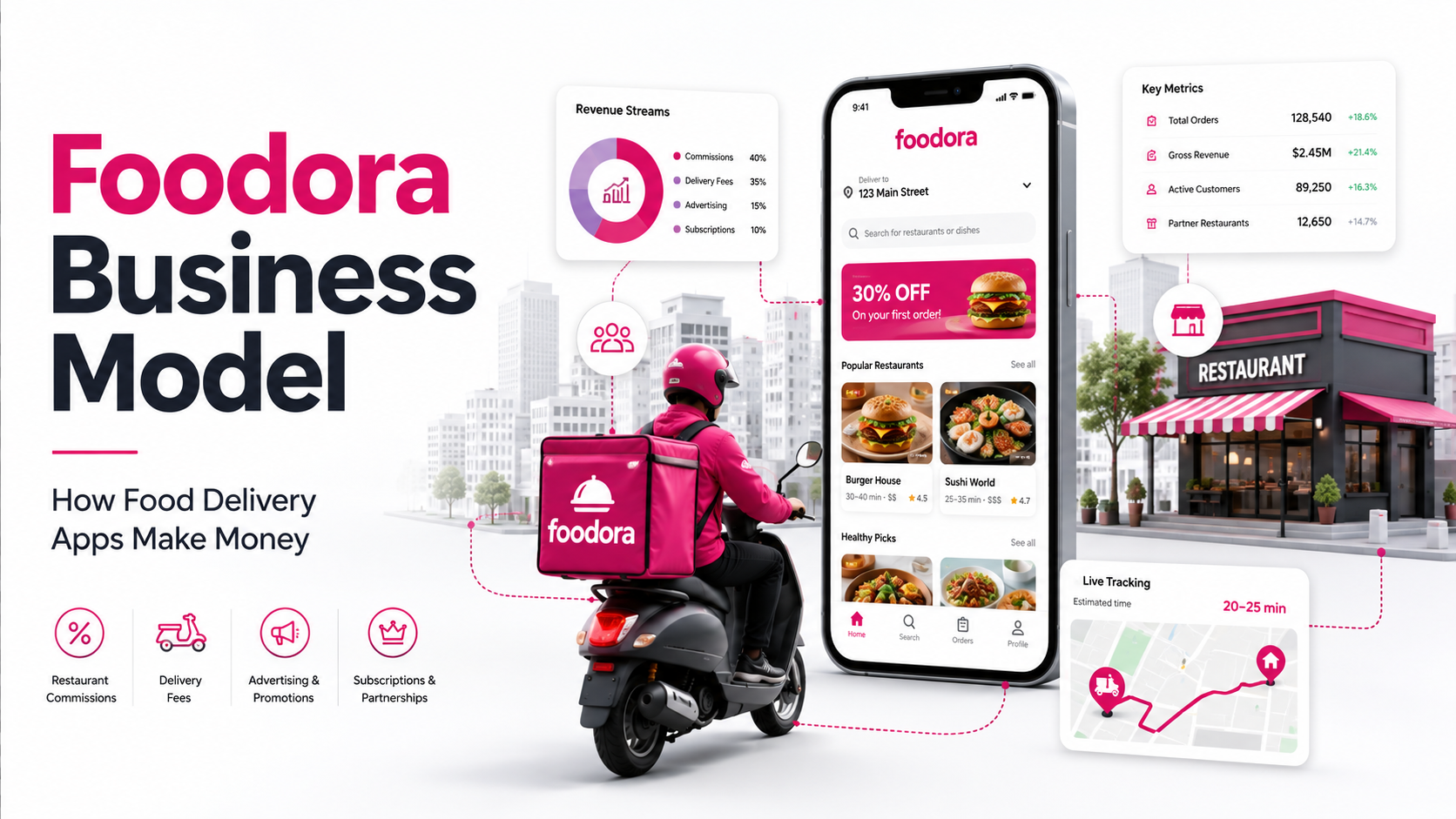
Foodora operated as an online food delivery marketplace connecting customers, restaurants, and delivery riders through a mobile app. The company mainly earned money through restaurant commissions, delivery fees, advertising, surge pricing, and partnership programs. Its business model focused on convenience, hyperlocal logistics, and fast last-mile delivery operations.
Introduction
The food delivery industry exploded over the past decade. What started as a simple idea of ordering pizza over the phone transformed into a multi-billion dollar digital ecosystem.
Foodora became one of the major players in this space, operating across multiple continents and serving millions of hungry customers. The platform showed how technology could revolutionize the way people eat and how restaurants reach their customers.
For founders and startup builders, the Foodora story offers valuable lessons. It demonstrates both the opportunities and pitfalls of marketplace businesses. You’ll learn how the platform generated revenue, managed logistics, and eventually faced the harsh realities of unit economics.
This article breaks down every aspect of the Foodora business model. You’ll understand how the company made money, acquired customers, handled deliveries, and why profitability remained elusive despite massive scale.
What is Foodora?
Foodora was an on-demand food delivery platform that allowed users to order food from nearby restaurants through its app and website while managing delivery through gig workers and logistics systems.
What Foodora Actually Did
Foodora created a digital bridge between three key groups: hungry customers, local restaurants, and delivery riders looking for flexible work.
The platform operated through a mobile-first approach. Customers downloaded the app, browsed nearby restaurants, placed orders, and tracked deliveries in real time.
Restaurants received digital orders without maintaining their own delivery infrastructure. This was huge for smaller establishments that couldn’t afford their own delivery teams.
Delivery riders worked as independent contractors, accepting delivery requests through their own rider app and earning money per delivery completed.
Background of Foodora
Foodora launched in Munich, Germany in 2014. The company quickly expanded across Europe, including markets like Sweden, Norway, Finland, and France.
The platform also entered Asian and Australian markets, competing directly with established players in each region.
Delivery Hero, a German food delivery giant, acquired Foodora and integrated it into their portfolio of delivery brands. This acquisition strategy was common in the consolidating food delivery market.
In some markets, Foodora operated independently. In others, it rebranded or merged with sister companies under the Delivery Hero umbrella.
Understanding the Food Delivery Industry
The food delivery industry works by digitizing restaurant ordering and delivery operations, making convenience the core product for urban consumers.
Why Food Delivery Apps Became Popular
Smartphone penetration changed everything. By 2015, most urban consumers carried powerful computers in their pockets with GPS, payment capabilities, and constant internet connectivity.
Modern lifestyles demanded convenience. People worked longer hours, had less time to cook, and valued the time saved by having food delivered directly to their door.
The convenience economy took off. Consumers started paying premiums for services that saved them time and effort, from grocery delivery to ride-sharing.
The COVID-19 pandemic accelerated adoption dramatically. Restaurants closed their dining rooms, and delivery became not just convenient but essential for survival.
Digital payments made transactions seamless. Users could pay with saved cards, Apple Pay, or Google Pay without fumbling for cash.
Major Competitors
Foodora competed in an increasingly crowded market. Uber Eats leveraged their existing ride-sharing network and technology infrastructure to enter food delivery.
DoorDash dominated the North American market with aggressive expansion and restaurant partnerships.
Deliveroo competed directly in European markets with similar business models and customer acquisition strategies.
In Asian markets, players like Swiggy and Zomato built massive operations serving hundreds of millions of users.
Each competitor fought for market share through heavy discounting, exclusive restaurant partnerships, and massive marketing budgets.
Foodora Business Model Explained
Foodora used a three-sided marketplace business model where customers ordered food, restaurants received digital orders, and delivery riders fulfilled deliveries while Foodora earned commissions and service fees.
Core Components of the Business Model
Customer Side
Foodora obsessed over user experience. The app needed to be fast, intuitive, and reliable. Customers could browse restaurants by cuisine, rating, delivery time, or promotions.
The platform offered constant discounts and deals. First-time users got massive discounts to try the service. Regular users received promotional codes to keep them ordering.
Real-time tracking became a killer feature. Customers could watch their delivery rider’s location on a map, reducing anxiety about when food would arrive.
Restaurant Side
Restaurants gained immediate access to digital customers without building their own apps or websites. This was especially valuable for independent restaurants with limited tech resources.
Foodora provided the entire delivery infrastructure. Restaurants didn’t need to hire, train, or manage delivery staff. They just prepared the food and handed it to Foodora riders.
The platform expanded restaurant reach significantly. Customers who would never visit a restaurant’s physical location could now order from them regularly.
Delivery Partner Side
The gig economy model attracted workers seeking flexible schedules. Riders could log in whenever they wanted and accept deliveries on their own terms.
Per-delivery earnings meant immediate income. Riders got paid for each completed delivery, with bonuses for peak hours and completing multiple deliveries.
Incentive structures kept riders engaged. The platform offered bonuses for completing certain numbers of deliveries per week or maintaining high acceptance rates.
How Foodora Worked
Foodora’s platform processed orders digitally, assigned nearby riders, coordinated restaurant preparation, and completed deliveries using logistics algorithms and real-time tracking systems.
Step-by-Step Workflow
Customer Places an Order
The customer experience started with app browsing. Users searched for restaurants, filtered by cuisine or features, and reviewed menus with photos and descriptions.
Restaurant discovery happened through various methods. The app featured popular restaurants, showcased promotions, and used algorithms to suggest relevant options based on past orders.
The cart and payment process needed to be frictionless. Users added items, customized orders, applied promo codes, and checked out with saved payment methods in under a minute.
Restaurant Accepts the Order
Order notifications hit restaurant tablets or integrated POS systems immediately. Staff saw the full order details, preparation time expectations, and special instructions.
The preparation workflow kicked in. Kitchens prioritized delivery orders alongside dine-in customers, aiming to have food ready exactly when the rider arrived.
Delivery Rider Gets Assigned
Foodora’s algorithm assigned the nearest available rider automatically. The system calculated factors like rider location, current deliveries, and restaurant preparation time.
Delivery optimization happened behind the scenes. The platform could batch multiple orders from the same restaurant or along similar routes to improve efficiency.
Delivery Completion
Tracking updates kept customers informed throughout the process. They received notifications when the restaurant accepted the order, when the rider picked it up, and when delivery was imminent.
Final delivery included contactless drop-off options when needed. Riders marked orders as delivered in their app.
The ratings and review system closed the loop. Customers could rate both the food and delivery experience, feeding data back into the platform’s algorithms.
How Foodora Made Money
Foodora generated revenue mainly from restaurant commissions, delivery fees, promotional advertising, and surge pricing during high-demand periods.
Restaurant Commission Fees
This was the primary revenue source. Foodora took a percentage cut from every order processed through the platform.
Typical commission rates ranged from 20% to 35% of the order value. Higher-volume restaurants could negotiate lower rates, while smaller restaurants paid standard platform fees.
Restaurant partnerships were critical to this model. The more restaurants on the platform, the more orders flowed through, generating more commission revenue.
These commissions needed to cover platform costs including technology development, customer support, and marketing expenses.
Delivery Charges
Customers paid separate delivery fees on top of their food orders. These fees typically ranged from two dollars to eight dollars depending on distance and demand.
Distance-based pricing charged more for deliveries further from the restaurant. This helped ensure riders were compensated fairly for longer trips.
Dynamic pricing models adjusted fees based on demand, weather conditions, and rider availability. Customers saw higher fees during busy periods.
Advertising and Sponsored Listings
Restaurants could pay for increased visibility within the app. Featured placements put restaurants at the top of search results and category pages.
Promotional campaigns allowed restaurants to reach customers with targeted offers. A new restaurant might run a discount campaign to generate initial orders and reviews.
This advertising revenue became increasingly important as platforms looked for high-margin revenue streams beyond commissions.
Surge Pricing
During peak hours like Friday dinner or Sunday brunch, delivery fees increased automatically. This surge pricing served two purposes: incentivizing more riders to work and managing customer demand.
Weather-based pricing kicked in during rain, snow, or extreme heat. Higher fees compensated riders for working in difficult conditions.
High-demand events like major sports games or holidays triggered surge pricing. The platform balanced supply and demand through price signals.
Subscription or Membership Models
Some markets offered premium delivery programs. Customers paid a monthly fee for benefits like free delivery on all orders or exclusive discounts.
These subscription models created predictable recurring revenue while increasing customer order frequency. Subscribers ordered more often because they’d already paid for delivery.
Customer Acquisition Strategy
Foodora focused heavily on discounts, app marketing, partnerships, and referral systems to rapidly acquire customers in competitive urban markets.
Marketing Strategies Used by Foodora
Discount Campaigns
First-order offers were extremely aggressive. New users might get 50% off or ten dollars off their first order, making the initial transaction nearly irresistible.
Coupon systems kept users engaged after the first order. The platform sent regular promotional codes via email, push notifications, and SMS.
Referral Programs
The invite-and-earn strategy turned customers into marketers. Existing users received credits for referring friends, while new users got discounts for signing up through referral links.
This created viral customer growth at relatively low acquisition costs. Each satisfied customer became a potential source of multiple new customers.
Performance Marketing
Social media advertising targeted urban consumers with relevant creative. Platforms like Instagram and Facebook allowed precise targeting by location, age, and interests.
Google Ads captured intent-based searches. Users searching for “food delivery near me” saw Foodora ads immediately.
App install campaigns optimized for mobile conversions. The goal was getting the app downloaded and the first order placed as quickly as possible.
Local Partnerships
Restaurant tie-ups created mutual benefits. Foodora worked with popular local restaurants to create exclusive launch offers and drive initial demand.
Event sponsorships increased brand visibility. Foodora sponsored music festivals, sports events, and community activities to reach potential customers offline.
Logistics and Delivery Operations
Foodora’s logistics system depended on efficient rider allocation, route optimization, and hyperlocal delivery networks to reduce delivery time and operational costs.
Key Logistics Components
Rider Network
The gig economy model provided a flexible workforce that scaled with demand. More riders logged in during peak hours naturally, without Foodora needing to manage complex scheduling.
Flexible work arrangements attracted diverse workers. Students, part-time workers, and people seeking supplemental income all participated in the delivery network.
Delivery Optimization
Route algorithms calculated the fastest paths considering real-time traffic, weather, and other factors. The system constantly improved through machine learning.
Time estimation systems predicted delivery times based on historical data, current conditions, and restaurant preparation speeds. Accurate estimates managed customer expectations effectively.
Real-Time Tracking
GPS integration provided exact rider locations at all times. This enabled the tracking feature customers loved while helping the platform optimize operations.
Delivery transparency reduced customer anxiety and support tickets. Users could see exactly where their order was instead of wondering and calling support.
Technology Behind Foodora
Foodora relied heavily on mobile apps, real-time tracking systems, payment integrations, and delivery management software to operate at scale.
Core Technologies
Mobile applications formed the customer-facing interface. The app needed to be fast, responsive, and work reliably across different devices and operating systems.
Cloud infrastructure supported massive scale. During peak hours, thousands of simultaneous orders required robust backend systems that could handle the load.
AI-driven logistics powered the delivery optimization algorithms. Machine learning models predicted demand, optimized routes, and assigned riders efficiently.
Payment gateways processed transactions securely. Integration with multiple payment providers ensured customers could pay however they preferred.
Notification systems kept all parties informed in real time. Push notifications, SMS, and in-app messages coordinated the complex dance of orders, preparation, and delivery.
Foodora’s Competitive Advantages
Foodora differentiated itself through faster deliveries, strong branding, localized operations, and user-friendly app experiences.
Major Strengths
Strong user experience set Foodora apart in many markets. The app worked smoothly, the design felt modern, and the ordering process was intuitive.
Fast delivery networks leveraged dense rider coverage in urban areas. In cities where Foodora dominated, average delivery times beat competitors.
Restaurant partnerships created network effects. Popular restaurants attracted customers, and high customer volume attracted more restaurants.
Urban market penetration focused resources on high-density areas where unit economics worked better than suburban sprawl.
Challenges in Foodora’s Business Model
Despite growth, Foodora faced profitability challenges due to high operational costs, delivery expenses, and intense market competition.
Major Challenges
High Delivery Costs
Last-mile delivery is expensive. Paying riders, maintaining support systems, and handling logistics consumed enormous resources.
Each delivery cost the platform money, especially when delivery fees were low to attract customers. The math often didn’t work at the unit level.
Thin Profit Margins
After paying restaurants, riders, and covering platform costs, little profit remained. Many orders were actually unprofitable when fully accounting for acquisition costs.
Scale was supposed to solve this, but operational costs scaled alongside revenue in many cases.
Rider Retention Issues
High turnover among delivery riders created constant recruitment and training costs. Many riders tried delivery work briefly then moved on.
Maintaining service quality with a constantly changing workforce proved difficult.
Competitive Price Wars
Competitors matched every discount and promotion. This race to the bottom destroyed margins industry-wide.
Platforms spent enormous sums acquiring customers who often lacked loyalty and simply chose whoever offered the best deal.
Customer Loyalty Problems
Low switching costs meant customers used multiple platforms. They’d check Uber Eats, Foodora, and competitors before ordering, choosing based on promotions rather than preference.
Building true brand loyalty proved nearly impossible when competitors offered identical services.
Why Many Food Delivery Companies Struggle
Most food delivery platforms struggle because logistics operations are expensive while customers still expect low delivery fees and heavy discounts.
Key Industry Problems
The burn-heavy business model sacrificed profitability for growth. Venture capital funded massive losses as platforms raced for market dominance.
High customer acquisition costs exceeded customer lifetime value in many cases. Platforms paid fifty dollars or more to acquire customers who might only order a few times.
Dependence on discounts meant removing promotions caused order volume to crash. Customers weren’t truly loyal to the platform, just the deals.
Operational complexity increased with scale. Managing thousands of restaurants, tens of thousands of riders, and millions of customers created enormous coordination challenges.
Foodora Business Model Canvas
The Foodora Business Model Canvas includes customer segments, value propositions, revenue streams, logistics partnerships, and technology infrastructure.
Business Model Canvas Breakdown
Key Partners
Restaurants provided the actual product customers ordered. Without diverse, quality restaurant options, the platform offered no value.
Delivery riders fulfilled the core service promise. Their speed, reliability, and professionalism directly impacted customer satisfaction.
Payment providers enabled frictionless transactions. Integration with card networks, mobile wallets, and local payment methods was essential.
Key Activities
Order management systems processed thousands of transactions hourly during peak times. This required robust technology and processes.
Delivery coordination optimized the complex logistics of matching riders to orders efficiently.
Marketing attracted customers and restaurants to the platform continuously.
Value Proposition
Convenience was the core offering. Customers paid for the time and effort saved by having food brought to them.
Fast delivery differentiated successful platforms. Speed mattered enormously to customer satisfaction.
Restaurant variety ensured users could find what they wanted. Platforms competed partly on selection.
Revenue Streams
Commissions from restaurants formed the largest revenue source across the industry.
Delivery fees charged to customers contributed but couldn’t be too high without hurting conversion.
Advertising and sponsored placements added high-margin revenue as platforms matured.
Customer Segments
Urban consumers formed the primary user base. Dense cities provided the best unit economics.
Restaurants of all sizes used the platform to reach digital customers.
Corporate users ordered catering and meals for offices, creating another revenue stream.
Lessons Startups Can Learn from Foodora
Foodora teaches startups the importance of logistics efficiency, local market adaptation, customer convenience, and scalable technology systems.
Key Startup Lessons
Logistics is the Real Business
Food delivery companies are logistics companies that happen to deliver food. The technology and operations behind efficient delivery matter more than the app’s visual design.
Startups entering marketplace businesses must deeply understand and optimize their logistics from day one.
Scale Alone Doesn’t Guarantee Profit
Foodora and competitors proved that massive scale doesn’t automatically create profitability. Unit economics must work at the individual order level.
Founders should focus on profitable transactions early rather than assuming scale will eventually solve the problem.
Retention Matters More Than Downloads
Acquiring millions of app downloads means nothing if users order once and never return. Customer lifetime value determines success.
Building habits and loyalty through excellent service beats growth hacking for vanity metrics.
Local Operations Are Critical
Food delivery is inherently local. Success requires understanding each market’s unique restaurant landscape, consumer preferences, and competitive dynamics.
What works in one city may fail in another. Local adaptation beats cookie-cutter global strategies.
Technology Drives Efficiency
The platforms with the best technology win over time. Superior algorithms for rider assignment, demand prediction, and route optimization create sustainable advantages.
Investing in technology infrastructure pays dividends as operations scale.
Future of Food Delivery Business Models
The future of food delivery will likely focus on AI logistics, drone delivery, quick commerce, dark kitchens, and subscription-based ecosystems.
Emerging Trends
AI delivery optimization will continue improving. Better predictions of demand, dynamic pricing, and route optimization can squeeze out efficiency gains.
Autonomous delivery through drones and robots could dramatically reduce last-mile costs. Several companies are already piloting these technologies.
Cloud kitchens optimized purely for delivery eliminate expensive real estate costs. These delivery-only restaurants could improve unit economics significantly.
Hyperlocal commerce expands beyond food. The same logistics networks can deliver groceries, alcohol, medicine, and retail products.
Subscription ecosystems bundle multiple services. Companies are exploring how loyalty programs across restaurants, groceries, and other services can increase retention.
Wrapping Up
Foodora’s business model showed how convenience-driven platforms can scale rapidly, but it also revealed the profitability and operational challenges of the food delivery industry.
Foodora operated a sophisticated three-sided marketplace connecting customers, restaurants, and delivery riders. The platform succeeded in creating value for all parties by making food delivery convenient and accessible.
The revenue model relied primarily on restaurant commissions, supplemented by delivery fees, advertising, and surge pricing. These streams generated significant revenue but struggled to exceed the high costs of logistics operations.
Major challenges included expensive last-mile delivery, thin profit margins, intense competition, and difficulty building customer loyalty. These problems plagued not just Foodora but the entire food delivery industry.
For startups, the Foodora story offers crucial lessons about marketplace businesses, logistics efficiency, and the difference between growth and profitability. Building a successful platform requires more than technology and marketing. It demands solving hard operational problems while maintaining unit economics that actually work.
The food delivery industry continues evolving rapidly. New technologies, business models, and market consolidation will shape its future. The platforms that survive will be those that finally crack the profitability puzzle while delivering the convenience customers demand.
FAQs
Foodora operated a three-sided marketplace connecting customers, restaurants, and delivery riders. The platform earned money through restaurant commissions, delivery fees, advertising revenue, and surge pricing during high-demand periods.
Foodora’s primary revenue came from taking 20% to 35% commissions on restaurant orders. Additional revenue sources included delivery fees charged to customers, sponsored restaurant placements, and dynamic pricing during peak times.
Foodora struggled in certain markets due to intense competition, high delivery costs, thin profit margins, and difficulty building customer loyalty. The economics of last-mile delivery proved challenging, especially against well-funded competitors.
Foodora competed against Uber Eats, DoorDash, Deliveroo, Swiggy, Zomato, and other regional food delivery platforms. The market became increasingly crowded with companies fighting for market share through aggressive discounting.
Most food delivery platforms struggle with profitability due to expensive logistics operations and customer acquisition costs. While some companies in certain markets have achieved profitability, the industry overall remains challenging economically.
Startups should understand that logistics efficiency matters more than scale alone, unit economics must work at the individual transaction level, customer retention beats acquisition metrics, and technology infrastructure drives sustainable competitive advantages.
Food delivery apps connect customers to restaurants through a mobile platform. When customers place orders, the system notifies restaurants and assigns nearby delivery riders. Real-time tracking coordinates preparation, pickup, and delivery to the customer’s location.
The largest costs include delivery rider payments and logistics operations, customer acquisition through marketing and discounts, technology platform development and maintenance, and customer support operations. Last-mile delivery remains the most challenging cost to optimize.
Discover more from Business Model Hub
Subscribe to get the latest posts sent to your email.