citizenM Business Model And How a Dutch Hotel Startup Cracked the Code on Affordable Luxury

What Is the citizenM Business Model?
citizenM runs on a simple but powerful idea: give travelers a luxury feel at a price that does not require a corporate expense account.
The model works by cutting costs in places guests do not notice and investing heavily in places they do. Smaller rooms. Better beds. Prime locations. Stunning design. Self-service tech. Social lobbies that feel like boutique lounges.
The result is a hotel that feels premium but operates lean. High margins, strong occupancy, fast scalability.
That is the core of it. Everything below explains how they actually pull it off.
Why citizenM Is Not a Normal Hotel Brand
Most hotels fall into one of two traps.
Luxury hotels charge a lot and spend even more to deliver. They have massive rooms, full service staff, restaurants, spas, concierge desks. The overhead is enormous. Margins are thin unless you are charging $500 a night consistently.
Budget hotels cut costs everywhere. Small rooms, cheap beds, no design, no experience. They are affordable but nobody brags about staying there.
citizenM spotted the gap between these two worlds back in 2008. Founded in the Netherlands, the brand went after a specific traveler: tech-savvy, design-conscious, urban, modern. Someone who wants a great bed, fast WiFi, a cool space to hang out, and a location that does not require a 40-minute cab ride to get anywhere useful.
They did not try to compete with Marriott or Hilton on their terms. They built an entirely new category and dominated it.
The Core Value Proposition: Affordable Luxury
The phrase “affordable luxury” gets thrown around a lot. citizenM actually defines what it means in practice.
What they kept:
- Premium mattresses and bedding
- High-end design and architecture
- Central city locations
- Cutting-edge technology in every room
- A social lobby experience that feels expensive
What they cut:
- Large room square footage
- Room service and full restaurant operations
- Front desk staff and traditional check-in processes
- Multiple room categories and configurations
- Excess amenities that most guests never use
This is value engineering applied to hospitality. You do not just remove things randomly. You study what travelers actually care about and protect those things while aggressively cutting what they do not.
Most guests care about sleeping well, being in a good location, having fast internet, and feeling like they are somewhere interesting. They do not need a bathtub the size of a hot tub or three different pillow menu options.
citizenM figured that out and built an entire business around it.
The Real Innovation: How citizenM Rebuilt the Hotel Model From Scratch
The One Room Type Strategy
citizenM offers one room type. That is it.
No standard, no deluxe, no suite upgrade, no partial ocean view, no king vs double options. One room. Designed to perfection. Available everywhere.
This sounds simple. The operational impact is massive.
When you standardize your product, everything gets easier. Housekeeping is faster. Maintenance is predictable. Training staff takes less time. Inventory management becomes straightforward. Technology integration is cleaner.
Think about how McDonald’s scaled globally. They did not offer 80 items on the menu. They simplified, standardized, and then scaled. citizenM did the same thing with hotel rooms.
Smaller rooms also means more rooms per building. More rooms per building on the same land means higher revenue per square foot. That is a direct profit driver that most people overlook when they think about this model.
Modular Construction
This is the most underrated part of the citizenM model and one of the biggest reasons they can expand faster than traditional hotel chains.
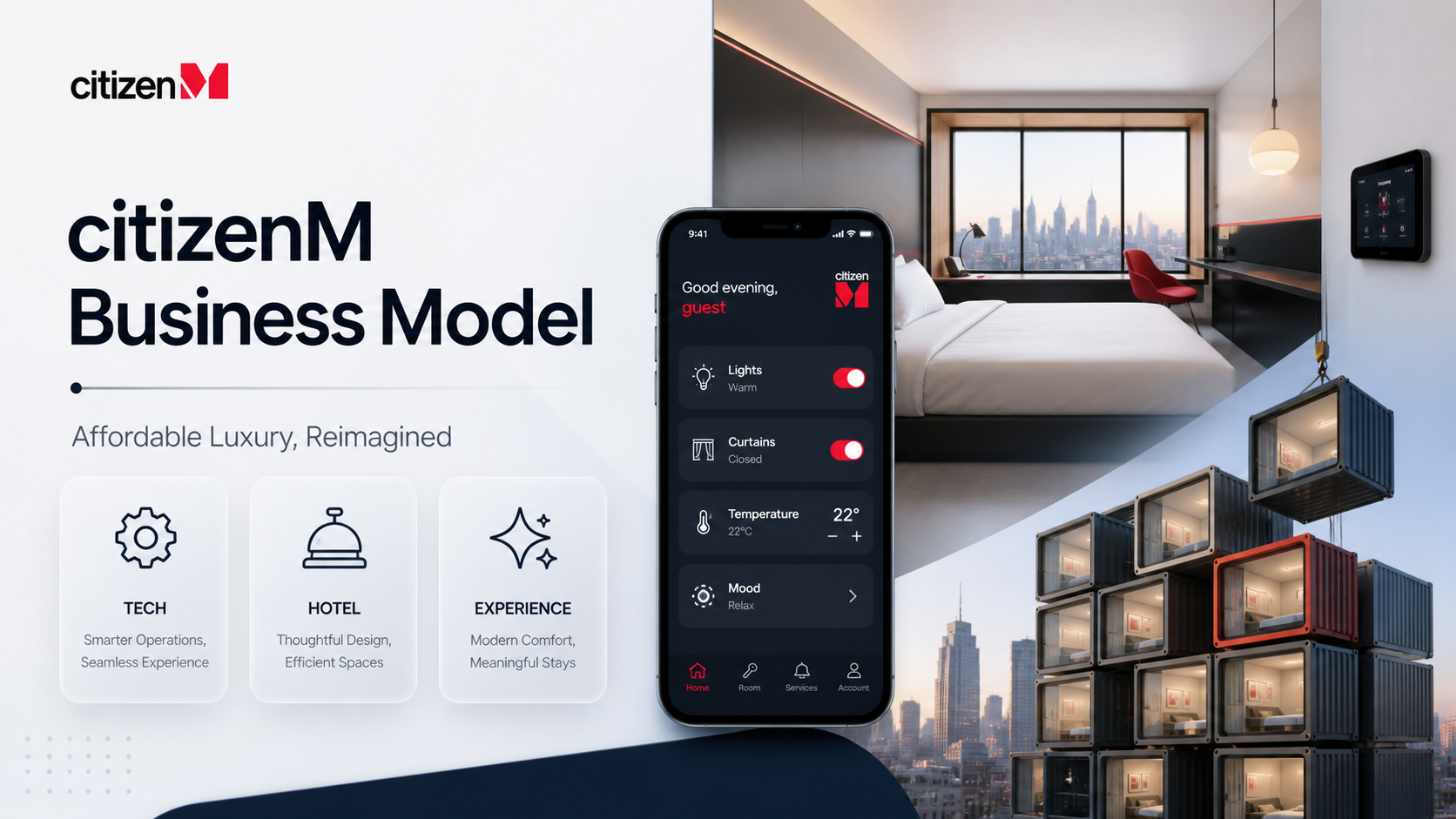
citizenM builds hotel rooms in factories. Actual prefabricated modules, assembled off-site, then transported and stacked on location like Lego blocks.
This approach delivers three major advantages.
Speed. Traditional hotel construction takes years. Modular builds move significantly faster because manufacturing happens in parallel with site preparation.
Cost. Factory production is more efficient than on-site construction. Less waste, fewer delays, more controlled quality.
Consistency. Every room is built to the same spec. Whether you are in New York, Amsterdam, or Singapore, the room looks and feels identical. That consistency is a core part of the brand promise.
For a brand trying to scale across major global cities, this construction model is a serious competitive moat. It is hard to replicate quickly, and it compounds over time as they build expertise and supplier relationships.
Tech-First Operations
Walk into a citizenM hotel and you will not see a traditional front desk. You check in at a kiosk. You control your room temperature, lighting, and TV from an app on your phone. The entire experience is designed to require minimal human interaction without feeling cold or impersonal.
This is not tech for tech’s sake. It is a direct cost reduction strategy.
Traditional hotels employ front desk staff around the clock. Bellhops. Concierge teams. People handling check-in paperwork and handing out physical keys. All of that costs money, and that cost gets passed to the guest.
citizenM replaced most of that with software and hardware. The result is a leaner staff operation without sacrificing the experience. In fact, many guests prefer it because it is faster and gives them more control.
The tech infrastructure also allows centralized management across properties. One team can monitor and support multiple hotels simultaneously. That is scalability built into the operating model.
The Living Room Lobby Concept
Here is where citizenM gets genuinely interesting from a brand perspective.
The room is small. The lobby is not.
citizenM invests heavily in large, beautifully designed communal spaces at the ground level. These are not your typical hotel lobbies with a few chairs and a sad coffee station. They are designed like high-end co-working spaces meets boutique hotel bar meets contemporary art gallery.
Guests work there. They hang out. They meet other travelers. They grab food and drinks from the 24/7 canteen setup.
This is a smart move for several reasons.
It solves the small room problem. Guests who feel slightly cramped in their room have a premium space to escape to without leaving the property.
It creates a reason to spend more money. The lobby generates food and beverage revenue in a low-cost, high-volume format.
It builds brand identity. The lobby IS the citizenM experience in many ways. It is photographable, shareable, and memorable in ways that a standard hotel corridor never will be.
The citizenM Business Model Canvas
Customer Segments
citizenM is not trying to be everything to everyone. Their target customer is specific.
Primary segments:
- Business travelers who want a productive, comfortable stay without corporate hotel prices
- Digital nomads who treat cities as temporary home bases
- Solo urban travelers visiting for tourism or work
- Millennials and Gen Z who value design, tech, and experience over traditional hotel markers of status
Who they are NOT targeting:
- Families who need multiple connecting rooms
- Traditional luxury travelers who want full concierge service
- Budget backpackers who just need a bed
This focus is deliberate. Trying to serve everyone usually means serving no one particularly well.
Value Proposition
citizenM delivers on four core promises.
Consistent global experience. You know exactly what you are getting, no matter which city you book in.
Prime locations. Near airports, city centers, and business districts. Convenience is part of what you are paying for.
Tech-enabled convenience. Fast check-in, app-controlled rooms, reliable WiFi. The basics that modern travelers actually need.
Affordable premium feel. You leave feeling like you stayed somewhere special without wincing at the bill.
The emotional value proposition is sharp: feel premium without paying premium prices.
Revenue Channels
Direct booking is the priority. citizenM pushes hard to get guests to book through their website and app rather than through OTAs like Expedia or Booking.com.
This matters because OTAs take a commission, typically 15 to 25 percent, on every booking. Direct bookings keep that margin inside the business. citizenM invests in making their own booking experience seamless to reduce OTA dependency.
They also appear on OTAs for discovery and reach, but the goal is to convert those guests into direct bookers over time through their loyalty program and branded experience.
Revenue Streams
Room bookings drive the majority of revenue. The pricing model is straightforward and transparent, which is a contrast to traditional hotels that layer on resort fees, parking charges, and other add-ons that frustrate guests.
Food and beverage through the 24/7 canteen concept generates meaningful secondary revenue. The format is grab-and-go, self-service style, which keeps labor costs down while still capturing spending from guests who want food without leaving the property.
Co-working subscriptions represent a newer revenue stream as citizenM has leaned into the remote work and hybrid work trend. Non-guests can pay for access to the lobby and workspace, which generates revenue from the square footage during hours when hotel guests might be out.
Key Resources
Brand identity is a genuine asset. citizenM has built strong recognition among their target demographic.
Proprietary technology systems are a competitive advantage. They have built or deeply customized the software that runs their operations, which is not something a competitor can easily copy overnight.
Hotel properties represent significant capital assets, particularly because citizenM operates a hybrid model where they own many of their locations rather than just franchising.
Design and architecture expertise has become a core capability. Their ability to design beautiful, functional spaces efficiently is embedded in how they build.
Key Partners
citizenM works with tech partners including major consumer electronics companies to integrate hardware into rooms. They rely on specialized construction and manufacturing partners for the modular build process. Real estate investors and partners help fund property acquisition in expensive urban markets. Design firms collaborate on maintaining and evolving the aesthetic.
Cost Structure
Real estate acquisition in prime urban locations is the largest cost driver. Modular construction significantly reduces build costs compared to traditional methods. Technology infrastructure is an ongoing investment but enables lower operational headcount. Staff costs are meaningfully lower than comparable traditional hotels. Marketing investment supports direct booking goals.
What Actually Makes the citizenM Model Profitable
Most analysis stops at “they have small rooms and tech.” The real profitability story is more interesting.
Revenue Per Square Foot Is the Key Metric
Hotels, like retail, are fundamentally a real estate business. The question is always: how much revenue can you extract from a given amount of space?
citizenM’s compact room strategy means they pack significantly more rooms into a building footprint than a traditional hotel would. If a conventional hotel puts 150 rooms in a building, citizenM might fit 220 rooms in the same space.
Those extra 70 rooms, at even $150 a night and 80 percent occupancy, represent millions in additional annual revenue from the same real estate investment.
This is the same logic that airlines use when debating seat configurations, or that cloud companies use when maximizing server utilization. More units per fixed cost asset equals better economics.
Low Operational Complexity Protects Margins
Complexity is expensive. Every additional service, room type, or operational process adds cost and management overhead.
citizenM runs a deliberately simple operation. One room type. Self-service check-in. Centralized systems. Limited service options. This is not laziness. It is margin protection.
When operations are simple, there are fewer things that can go wrong, fewer staff you need to hire and train, and fewer systems you need to manage. That simplicity compounds into significantly better margins over time.
Occupancy Strategy Over Price Gouging
citizenM’s pricing philosophy is to stay competitive and drive high occupancy rather than maximize revenue per booking on low-occupancy nights.
High occupancy with moderate pricing beats low occupancy with premium pricing in most hotel economics. A full hotel generates revenue across rooms, food and beverage, and other touchpoints. An empty room generates nothing, no matter how high the rack rate is.
By staying competitively priced and choosing high-demand locations, citizenM keeps occupancy rates strong. That consistency is more valuable to the overall business than occasional premium pricing spikes.
Owning vs. Franchising: The Hybrid Asset Model
Many hotel chains grow by franchising. They license the brand and take a royalty while property owners bear the capital cost and operational risk.
citizenM takes a different approach. They own many of their properties while also operating them. This means they bear more capital risk, but they also capture more of the upside. They control the full customer experience. They keep margins that would otherwise go to a franchisee or property owner.
This model requires more capital to execute but results in better unit economics and stronger brand control at scale.
citizenM vs. Traditional Hotels: A Direct Comparison
| Factor | Traditional Hotel | citizenM |
|---|---|---|
| Room size | Large to very large | Compact and optimized |
| Pricing structure | Complex, variable, add-on heavy | Flat, transparent, simple |
| Primary experience | Service-heavy, staff-driven | Design and tech-driven |
| Staffing model | High headcount | Lean, tech-augmented |
| Construction approach | Traditional, slow, expensive | Modular, fast, cost-efficient |
| Location strategy | Mixed | Prime urban only |
| Room variety | Multiple types and tiers | Single standardized room |
| Lobby experience | Functional | Premium social space |
How citizenM Scales Globally
Scaling a hotel brand is hard. Every city has different real estate costs, regulations, labor markets, and consumer preferences. Most hotel brands either franchise aggressively and lose quality control, or grow slowly and lose market share.
citizenM’s scaling strategy is built on three pillars.
Standardization. Because every room is the same and the tech stack is the same across properties, there is no reinvention required at each new location. Open a new hotel in Tokyo, and the operational playbook is identical to the one in London.
Modular construction. The factory-built room approach allows new properties to come online faster than competitors building through traditional methods. Speed to market in high-demand locations is a real advantage.
Target market focus. citizenM only enters major cities, airport zones, and high-traffic urban corridors. They do not try to go everywhere. That discipline keeps the brand relevant to its target customer and keeps occupancy rates strong across the portfolio.
The acquisition interest from larger hospitality groups, including the reported Marriott connection, reflects how seriously the industry takes citizenM’s model as a scalable alternative to traditional hotel structures.
The Real Risks in the citizenM Model
Any honest business model breakdown has to acknowledge the weaknesses. citizenM has real ones.
Room size limits the audience. A compact room works for a solo business traveler or a couple on a city trip. It does not work for families with kids, travelers with lots of luggage, or guests who want to spread out and work from their room for extended periods.
Over-standardization reduces flexibility. When everything is the same, you cannot easily customize for local markets or respond to unique guest needs. A guest in Bangkok might want something different from a guest in Boston, and the model does not accommodate that well.
Urban travel dependency. citizenM’s entire model is built on dense urban demand. A global pandemic, a shift to remote work reducing business travel, or an economic downturn that cuts city tourism hits the model hard. They have limited ability to pivot to suburban or resort markets given how the brand is positioned.
Experience consistency is hard at scale. The modular rooms are identical, but the staff culture, lobby vibe, and service quality can vary across geographies. Maintaining a consistent experience in 30 cities across 15 countries is operationally challenging.
What Founders and Operators Can Learn From citizenM
citizenM is not just a hotel case study. It is a product strategy and business model lesson that applies across industries.
Remove features nobody actually uses. Most products and services are bloated with features that feel important but generate minimal value for the customer. citizenM audited the hotel experience and cut aggressively. What can you cut from your product without your best customers noticing or caring?
Standardization enables scaling. Customization feels customer-friendly but it destroys operational efficiency. The more you can standardize your core product while still delivering genuine quality, the faster you can grow.
Design is a competitive moat. citizenM spends real money on design and architecture. That investment creates an experience that is genuinely hard to replicate. Design is not decoration. It is differentiation.
Technology should reduce cost AND improve experience simultaneously. Most tech investment does one or the other. When you find tech that does both, it compounds into a structural advantage. Self-check-in kiosks cut staffing costs while giving guests faster, more autonomous check-in. That is a win in both directions.
Sell the experience, not the specs. citizenM does not market “250 square foot room in midtown Manhattan.” They market the feeling. The design. The social lobby. The tech. Guests buy experiences, not features.
Unit economics matter more than total revenue. citizenM is obsessed with revenue per square foot, per room, per property. Getting your unit economics right at small scale is what allows you to grow profitably rather than just grow.
Future Outlook for citizenM
Several macro trends play directly into citizenM’s model.
Remote and hybrid work has expanded the definition of the business traveler. More people are taking extended work trips, blending travel with work in ways that were less common pre-2020. citizenM’s work-friendly lobbies and co-working offerings are well-positioned for this shift.
The subscription economy has room to grow in hospitality. citizenM has experimented with subscription models that give frequent travelers predictable pricing and guaranteed access. As more travelers become location-flexible, subscription hotel access becomes genuinely useful rather than just a marketing gimmick.
Sustainability pressure will hit hospitality hard. Compact rooms use less energy. Centralized systems are more efficient. Modular construction generates less waste. citizenM’s model has inherent sustainability advantages that will become more competitively relevant as ESG expectations rise from both guests and investors.
Asia-Pacific expansion is a significant growth runway. Major Asian cities with high urban density, tech-savvy populations, and strong business travel markets are a natural fit for the citizenM model. Their presence in that region is still relatively limited compared to Europe and North America.
FAQs
citizenM makes money by offering a premium hotel experience in a compact, tech-driven, standardized format. They spend money on things guests care about (location, design, bed quality, tech) and cut costs on things guests do not notice (room size, large staff teams, complex services). The result is strong margins and high occupancy.
Primary revenue comes from room bookings. Secondary revenue comes from food and beverage sales through their 24/7 canteen format and co-working space subscriptions. They prioritize direct bookings over OTA bookings to protect margins.
Smaller rooms are a deliberate strategic choice. They allow more rooms per building on the same real estate footprint, which directly increases revenue per square foot. citizenM compensates with high-quality beds, smart design that maximizes usable space, and premium communal lobbies where guests can spread out.
citizenM is positioned as “affordable luxury.” The rooms are compact and the service is self-directed, but the design, location, tech, and bed quality are premium. They sit between traditional budget hotels and full-service luxury properties.
Key cost reduction levers include modular prefabricated construction (faster and cheaper to build), technology-driven self-service operations (lower staffing needs), one standardized room type (simpler operations), and centralized management systems across properties.
citizenM operates a hybrid model where they own and operate many of their properties directly rather than franchising. They work with real estate partners and investors on some locations. Larger hospitality groups including Marriott have shown acquisition interest in the brand.
citizenM is ideal for solo business travelers, digital nomads, couples on city trips, and design-conscious urban travelers. It is not the best fit for families needing multiple rooms, guests who want full concierge service, or travelers who need extended workspace inside their room.
Discover more from Business Model Hub
Subscribe to get the latest posts sent to your email.