Midjourney Business Model And How It Makes Money, Grows, and Dominates AI Image Generation

Midjourney is one of the few AI companies that turned a research experiment into a highly profitable business without taking outside venture funding. Founders and AI entrepreneurs study it because it proves that a subscription-only model, with no ads and no free tier, can scale to hundreds of millions in revenue.
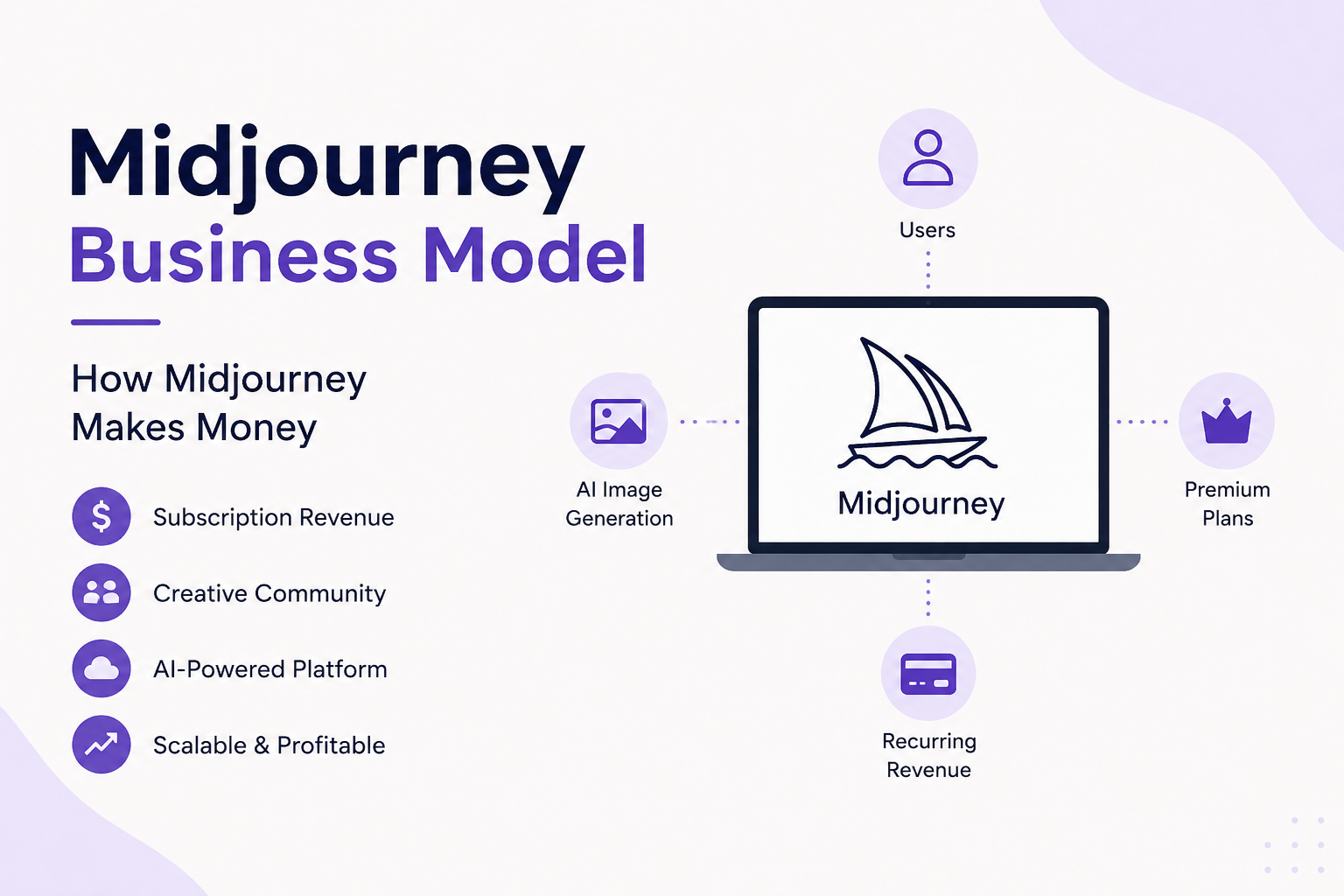
Midjourney makes money through recurring monthly and annual subscription plans that give users access to GPU compute time for AI image and video generation. It has no advertising, no free tier, and no public API. Revenue comes almost entirely from four subscription tiers, priced from $10 to $120 a month, plus commercial licensing terms for larger companies.
In this guide you will learn what Midjourney is, how its business model works, how it makes and structures its revenue, why users keep paying, and what founders can learn from its growth.
What Is Midjourney?
Company overview
Midjourney is an independent research lab that builds an AI system capable of turning text prompts into images and, more recently, video. It operates as a subscription product accessible through Discord and its own web app.
Founding story
Midjourney was founded in 2022 by David Holz, who serves as CEO. Before Midjourney, Holz co-founded Leap Motion, a hardware and software company focused on gesture recognition, which was later acquired. Holz left Leap Motion in August 2021 and recruited a small team of engineers to begin training diffusion models, and Midjourney’s first private demo launched in September 2021. The tool was released publicly as a Discord bot in February 2022.
Mission
Holz has repeatedly described Midjourney not as a chatbot but as a tool to expand human imagination rather than to build imaginative machines on their own.
Core product
Midjourney generates artistic images from text prompts, with video generation added in 2025. It is known for a distinctive, painterly aesthetic rather than photorealism.
Target users
Graphic designers, illustrators, marketers, game studios, publishers, and everyday creators who want high-quality visuals without traditional design skills.
Evolution from Discord-only to web platform
Midjourney ran exclusively through Discord for its first two years. In August 2024, Midjourney launched its own website, giving users a way to generate images outside of Discord for the first time.
Midjourney at a Glance
| Factor | Details |
|---|---|
| Founded | 2022 (private demo in 2021) |
| Founder | David Holz |
| Headquarters | San Francisco, California |
| Industry | Generative AI, creative software |
| Business Type | Subscription SaaS, self-funded |
| Revenue Model | Recurring subscriptions, no ads |
| Target Customers | Creators, designers, agencies, businesses |
| Pricing | $10 to $120 per month across four tiers |
| Availability | Web app and Discord |
What Is the Midjourney Business Model?
Midjourney runs a pure subscription business. Every user, from a hobbyist to an enterprise client, pays a recurring fee for access to GPU compute that powers image and video generation. There is no free tier, no advertising, and no marketplace layer. Revenue scales with subscriber count and with how much GPU time each subscriber needs.
Business Model Explained
AI-as-a-Service. Users rent access to a trained AI model instead of buying software outright.
Subscription business. All revenue is recurring, billed monthly or annually.
Community-driven platform. Public galleries and Discord discovery reduce the need for paid marketing.
Cloud-based generation. All processing happens on Midjourney’s GPU infrastructure, not on the user’s device.
Self-service SaaS model. Users sign up, pay, and start generating without sales calls or onboarding calls.
How Midjourney Works
- User creates an account on the website or Discord
- User subscribes to a paid plan
- User enters a text prompt describing the desired image
- The AI model generates image variations
- User upscales, edits, or refines a chosen image
- User downloads the final result
- User shares the creation publicly or keeps it private with Stealth mode
- User continues generating using their monthly GPU hour allocation
Midjourney Business Model Canvas
Customer Segments
Graphic designers, illustrators, freelancers, marketing agencies, content creators, game studios, publishers, startups, businesses, and AI enthusiasts.
Value Propositions
High-quality AI artwork, fast generation, simple prompting, distinctive artistic styles, commercial usage rights, an active community, and frequent model upgrades.
Channels
The Midjourney website, Discord, social media, community showcases, word of mouth, creator referrals, and YouTube tutorials.
Customer Relationships
Subscription plans, community engagement through Discord and public galleries, a self-service platform, documentation, and regular feature updates.
Revenue Streams
Monthly subscriptions, annual subscriptions, higher-tier plans, commercial licensing for large companies, and additional paid GPU hours.
Key Resources
Proprietary AI models, GPU infrastructure, its engineering and research team, brand reputation, and its large creator community.
Key Activities
AI model training, infrastructure management, product development, community management, and research.
Key Partners
Cloud infrastructure and GPU providers, payment processors, and Discord as a distribution platform.
Cost Structure
GPU computing, cloud hosting, AI research, salaries, infrastructure, customer support, and legal costs tied to copyright litigation.
How Midjourney Makes Money
Subscription Plans
Midjourney runs on a subscription model with four tiers: Basic at $10 per month, Standard at $30, Pro at $60, and Mega at $120. This recurring fee is the backbone of the business. Instead of buying a fixed number of images, subscribers buy monthly access to GPU-generation time. FluxNote
Premium Plans
Higher tiers unlock more Fast GPU hours plus features casual users do not need. Each plan includes a set monthly allotment of Fast GPU hours: 3.3 hours on Basic, 15 on Standard, 30 on Pro, and 60 on Mega. Standard and above also include unlimited Relax mode, which generates images at lower priority with no monthly cap.
Commercial Licenses
Every paid plan allows commercial use of generated images, but companies with more than one million dollars in annual revenue are required to purchase a corporate-tier license. This requirement is stated directly in Midjourney’s own terms of service. Fueler
Enterprise Opportunities
Midjourney has not launched a dedicated enterprise product or public API, which leaves room for a future enterprise tier, licensing deals, or API access as a growth lever.
Midjourney Revenue Streams Breakdown
| Revenue Stream | Description | Recurring |
|---|---|---|
| Monthly Plans | Basic, Standard, Pro, Mega billed monthly | Yes |
| Annual Plans | Same tiers billed yearly at a discount | Yes |
| Premium Plans | Pro and Mega for stealth mode and volume | Yes |
| Business Usage | Mandatory upgrade for companies over $1M revenue | Yes |
| Extra GPU Hours | Pay-as-you-go top-ups outside plan limits | No |
Midjourney Pricing Strategy
No more free tier
Midjourney has not offered a free trial since March 2023, when it suspended the option following viral deepfake abuse. Every user must pay from day one.
Paid-only approach
This removes the cost of supporting non-paying users and keeps the funnel simple. Anyone who wants to try Midjourney has to commit to at least the Basic plan.
Tiered pricing by GPU allocation
Rather than charging for features, Midjourney charges based on how much Fast GPU time a subscriber consumes. The four-tier structure of $10, $30, $60, and $120 has stayed unchanged since Midjourney’s July 2022 launch, which is unusually stable for an AI company.
Usage limits and GPU allocation
Once Fast GPU hours run out, users either switch to slower Relax mode or purchase additional hours. Extra Fast GPU hours can be purchased directly at four dollars per hour.
Value-based pricing
David Holz has said publicly that improving generation speed is more likely to raise prices than lower them, reflecting a model built around compute cost rather than customer acquisition discounts.
Why Users Pay for Midjourney
- Consistently high image quality compared to competitors
- Fast turnaround with Fast GPU mode
- Creative freedom through a distinctive artistic style
- Reliable uptime and performance
- Commercial usage rights on every paid plan
- Frequent model upgrades that keep output competitive
Midjourney Growth Strategy
Product-led growth. The product itself, not a sales team, drives adoption.
Community-led growth. Midjourney’s Discord server had grown to roughly 21 million members by 2025, making it the platform’s largest community.
Viral AI art sharing. Public galleries turn every generated image into a piece of organic marketing.
Continuous model improvements. Regular version releases keep existing subscribers engaged and attract new ones through visible quality jumps.
Creator economy fit. Freelancers and agencies use Midjourney as a paid tool inside their own client work, extending its reach indirectly.
Midjourney Marketing Strategy
Midjourney has never run a traditional paid marketing campaign. Its growth has instead come from organic social sharing, user-generated content, influencer adoption, and its Discord community, where new releases are announced directly rather than through press releases.
Midjourney Competitive Advantages
- Exceptional and instantly recognizable image quality
- Strong brand recognition among creators
- A large, loyal community that self-sustains growth
- Pure subscription revenue with no reliance on ad income
- Fast iteration on new model versions
- A simple prompt-based user experience
Midjourney vs Competitors
| Feature | Midjourney | DALL·E | Stable Diffusion | Adobe Firefly |
|---|---|---|---|---|
| Business Model | Subscription only | Bundled with ChatGPT Plus | Open source, self-hosted or paid API | Credit-based, bundled with Adobe apps |
| Pricing | $10 to $120/month | $20/month via ChatGPT Plus | Free to run, paid hosted options vary | Credits included with Creative Cloud plans |
| Open Source | No | No | Yes | No |
| Commercial Use | Included on paid plans, revenue cap applies | Included, no revenue cap | Depends on license | Included with subscription |
| Best For | Distinctive, painterly artistic output | Casual users already on ChatGPT | Developers wanting full control | Designers inside Adobe workflows |
SWOT Analysis of Midjourney
Strengths: Profitable without outside funding, strong brand, large community, distinctive output quality.
Weaknesses: No public API limits automation use cases, Discord-first design still confuses some new users, no free tier to lower the entry barrier.
Opportunities: Enterprise licensing, vertical tools for industries like gaming and ecommerce, expanding hardware and video products.
Threats: Disney and Universal sued Midjourney in 2025, alleging that generated images and videos infringed on their copyrighted characters, and Midjourney has denied wrongdoing on fair use grounds. Rising competition from well-funded labs is another ongoing pressure.
Challenges Facing Midjourney
- Rising GPU and compute costs as usage grows
- Intensifying competition from OpenAI, Google, and Adobe
- Active copyright litigation from major studios
- Uncertain AI regulation across different countries
- Scaling infrastructure without external capital
- Building credible enterprise-grade offerings
Future of Midjourney
Video generation, launched in 2025, is an early signal of where the company is headed next. Reports of an in-house hardware effort, along with growing enterprise demand for licensed commercial use, point toward possible expansion into 3D generation, dedicated design tools, and deeper workflow integrations, even without a public API today.
Lessons Entrepreneurs Can Learn from Midjourney
Community before advertising. Midjourney built a multi-million member community with zero paid marketing spend.
Recurring revenue wins. A subscription model created predictable, compounding revenue instead of one-off sales.
Product quality is the moat. Distinctive output quality, not marketing, is what keeps subscribers paying.
Simplicity attracts users. A single prompt box removed friction that complex tools carry.
Scarcity and premium perception matter. Removing the free tier repositioned Midjourney as a premium tool rather than a free experiment.
Continuous innovation drives retention. Frequent model upgrades give existing subscribers a reason to keep their subscription active.
Wrapping Up
Midjourney shows that a generative AI company does not need free users, ads, or venture funding to scale into a nine-figure business. Its subscription-first strategy works because pricing is tied directly to compute cost, the community handles distribution for free, and product quality does the retention work that a sales team usually does elsewhere.
For founders and SaaS builders, the core takeaway is that recurring revenue paired with a genuinely differentiated product can outperform flashier growth tactics, and that staying disciplined on pricing and cost structure matters as much as the product itself.
FAQs
Midjourney is a subscription-only SaaS business that charges recurring monthly or annual fees for AI image and video generation, with no advertising or free tier.
Nearly all revenue comes from four subscription tiers priced between $10 and $120 a month, plus mandatory upgrades for companies earning over $1 million in annual revenue.
Yes. Midjourney became profitable within a year of its 2021 founding and has operated without outside investors.
Its main competitors are OpenAI’s DALL·E, Stability AI’s Stable Diffusion, and Adobe Firefly.
No. Midjourney removed its free trial in late 2024, and the cheapest way to use it is the ten dollar a month Basic plan.
Its painterly, artistic aesthetic and its large self-sustaining Discord community set it apart from more photorealistic competitors.
Yes, it operates as a self-service, cloud-based subscription SaaS product.
Yes, every paid plan includes commercial usage rights, though companies earning over one million dollars a year must use the Pro or Mega plan.
Discover more from Business Model Hub
Subscribe to get the latest posts sent to your email.