Lieferando Business Model And How Europe’s Food Delivery Giant Actually Makes Money

Ever wondered how food reaches your door in 30 minutes and the platform still makes money? That question sits at the heart of one of Europe’s most successful tech-enabled businesses.
Lieferando is not a restaurant. It does not cook anything. It does not own a single kitchen. Yet it processes millions of food orders every year and generates significant revenue doing it. That is the magic of a marketplace business model done right.
This blog breaks down exactly how Lieferando works, how it makes money, why restaurants keep signing up, and why customers keep coming back. If you want to understand one of Europe’s dominant food delivery platforms from a business perspective, this is the complete breakdown.
What is Lieferando
Lieferando is an online food delivery marketplace that connects customers with local restaurants through a mobile app and website. It was originally founded in Germany and later became part of Just Eat Takeaway.com, one of the largest food delivery companies in the world.
The platform operates primarily across Germany and the Netherlands, where it holds a strong market position. It functions as a middleman, or more accurately, a three-sided connector between customers who want food, restaurants that make food, and delivery riders who move food from point A to point B.
Here is the key distinction that matters for understanding the business model. Lieferando does not produce anything. It builds and maintains the infrastructure that allows transactions to happen. That infrastructure is digital, data-driven, and highly scalable.
This puts Lieferando in the category of a food delivery marketplace, not a traditional food business. Its competitors include Uber Eats, Deliveroo, and various regional players. Its parent company also owns similar platforms across other European markets.
How the Lieferando Business Model Works
The core system is straightforward. Understanding it helps you see where money enters and how it flows.
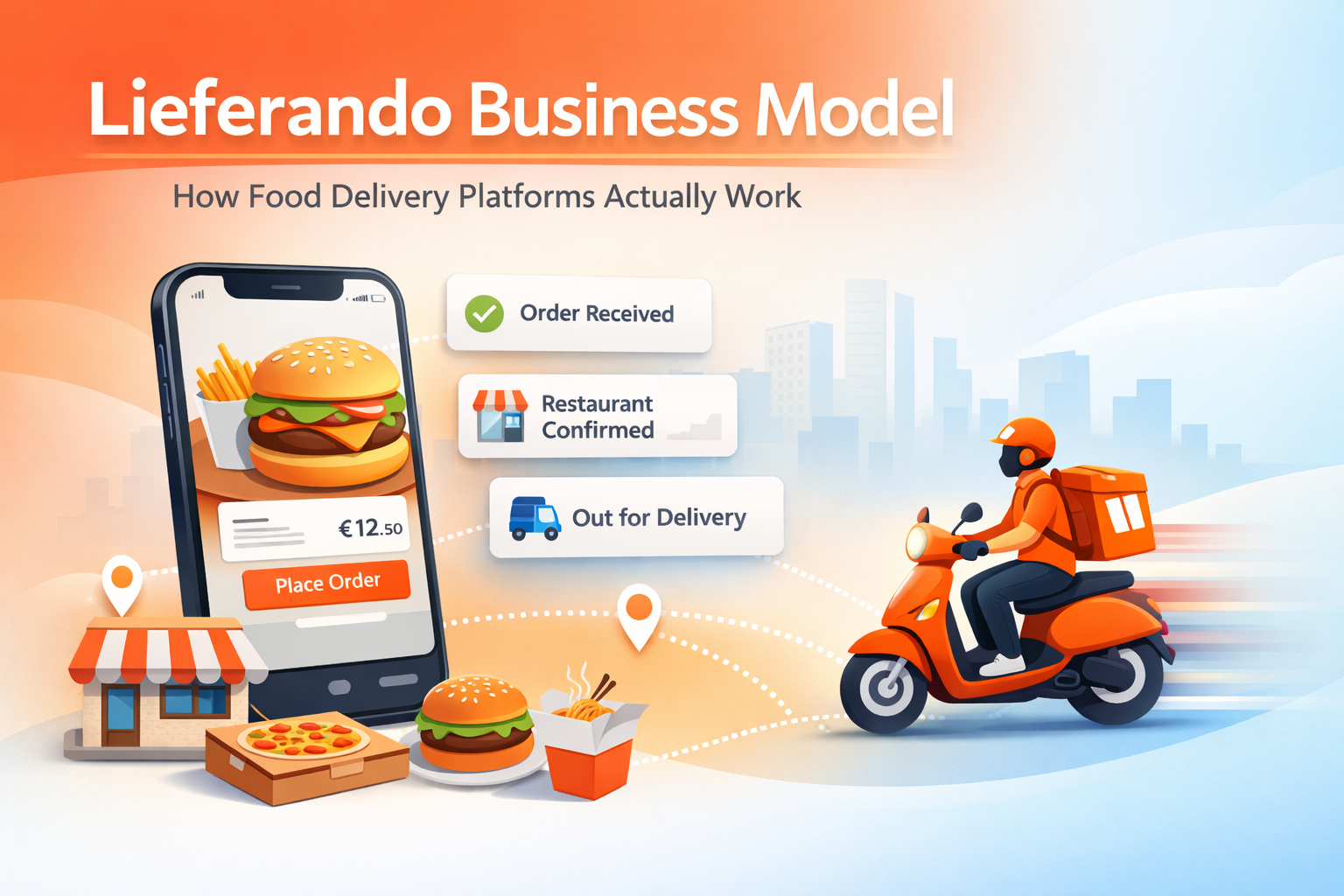
Step one: A customer opens the Lieferando app or visits the website. They enter their address and browse restaurants available in their area.
Step two: The customer selects items, places an order, and pays through the app. Payment is processed digitally through integrated payment gateways.
Step three: The restaurant receives the order notification through Lieferando’s restaurant dashboard or a connected device. They begin preparing the food.
Step four: Delivery is handled in one of two ways. Either the restaurant uses its own delivery staff, or Lieferando riders pick up and deliver the order. This depends on the restaurant’s setup and the city.
Step five: The customer tracks the order in real time through the app. They receive the food, can rate the experience, and the cycle is complete.
Throughout this entire process, Lieferando earns money by sitting at the center. It connects all three sides efficiently, and each side pays for that connection in different ways.
Revenue Model of Lieferando
This is the most important section. Here is exactly how Lieferando generates revenue.
Commission from Restaurants
The biggest and most consistent revenue stream is commission. Every time a customer places an order through Lieferando, the restaurant pays a percentage of that order value to the platform.
Commission rates are not publicly fixed. They vary based on the size of the restaurant, the volume of orders, the contract terms, and the level of services the restaurant uses. Typically, food delivery platforms charge commissions in the range of 15 to 30 percent per order, though the exact figures for Lieferando depend on individual agreements.
For restaurants, this is the cost of accessing Lieferando’s customer base. A small local restaurant that cannot afford to run its own delivery operation or digital marketing benefits from being listed on a platform with millions of active users. The commission is essentially a customer acquisition cost paid per transaction.
The commission model works because it aligns incentives. Lieferando only earns when restaurants earn. More orders mean more revenue for both sides.
Delivery Fees Charged to Customers
In many regions and situations, Lieferando charges customers a delivery fee on top of the food cost. This fee varies based on several factors including distance between the restaurant and the delivery address, time of day and demand levels, and whether the restaurant uses Lieferando riders or handles delivery independently.
During peak hours or in high-demand periods, delivery fees can increase. This is similar to surge pricing used by ride-sharing platforms. It helps balance supply and demand and ensures enough riders are available when demand spikes.
Delivery fees are a direct revenue source that also helps offset the cost of operating a delivery fleet in cities where Lieferando provides its own riders.
Service Fees and Platform Fees
Beyond delivery, Lieferando applies service fees or platform fees on orders. These are often small fixed amounts or percentages added to each transaction. Customers may see this as a checkout fee or processing fee.
This revenue stream might seem minor per transaction, but across millions of orders it adds up to a meaningful revenue contribution. It also helps cover the cost of payment processing, customer support infrastructure, and platform maintenance.
Advertising and Promotional Revenue
Restaurants do not just pay to be listed. They also pay to be seen. Lieferando offers restaurants the ability to pay for better visibility within the platform.
This includes sponsored placements where a restaurant appears at the top of search results or category lists, featured listings that highlight a restaurant with visual prominence, and promotional placements tied to discount campaigns or seasonal events.
For restaurants competing in dense urban markets where dozens of similar options exist, visibility is critical. Paying for a featured spot can directly translate into more orders. Lieferando monetizes this competitive pressure by charging restaurants for premium exposure.
This advertising model is similar to how Amazon charges sellers for sponsored product listings. The platform becomes not just a transaction channel but also an advertising channel.
Subscription and Membership Programs
Lieferando has explored subscription-based options that give customers benefits such as reduced delivery fees, exclusive discounts, or free delivery on qualifying orders above a minimum cart value.
Subscription models benefit the business in multiple ways. They create predictable recurring revenue, they increase customer loyalty and order frequency, and they reduce customer price sensitivity since subscribers feel they are already getting value.
The depth of subscription offerings varies by region and continues to evolve as the platform refines its monetization strategy.
Delivery Model: Asset-Light vs Hybrid Strategy
One of the defining characteristics of Lieferando’s business model is how it handles the physical delivery challenge.
The Asset-Light Approach
In the traditional marketplace model, Lieferando does not handle delivery at all. Restaurants use their own drivers and staff. Lieferando simply provides the ordering platform and takes a commission.
This is the asset-light model. It requires minimal operational investment from Lieferando because the logistics burden sits with the restaurant. It scales easily because adding more restaurants does not require adding more riders.
The downside is quality control. When restaurants manage their own delivery, Lieferando has less control over delivery speed, packaging quality, and customer experience consistency.
The Hybrid Delivery Model
To address quality and coverage gaps, Lieferando operates a hybrid model in many cities. It maintains a network of its own delivery riders who pick up orders from restaurants and deliver them to customers.
This hybrid approach is more expensive to operate but gives Lieferando two key advantages. First, it can onboard restaurants that have great food but no delivery infrastructure. Second, it can ensure faster and more reliable delivery in high-density areas where order volume justifies the operational investment.
The hybrid model also creates a competitive moat. Restaurants that rely on Lieferando riders become more deeply integrated with the platform, increasing switching costs.
Why Hybrid Works Strategically
By combining both approaches, Lieferando can serve a broader range of restaurant partners, optimize costs based on city-level economics, maintain service quality standards in key markets, and compete with logistics-heavy rivals like Deliveroo.
The cost balancing act is constant. Where rider-managed delivery is too expensive relative to order volume, the platform leans on restaurant delivery. Where customer experience and speed matter most, its own riders fill the gap.
Business Model Canvas: Lieferando
Breaking down Lieferando using the Business Model Canvas gives a clear structural view of how the entire business fits together.
Customer Segments
Lieferando serves two distinct groups simultaneously, which is what makes it a two-sided marketplace.
On the demand side: individual customers looking for food delivery, busy professionals who prioritize convenience over cooking, students and young urban residents who eat out frequently and prefer digital ordering.
On the supply side: restaurants of all sizes that want access to a larger customer base without building their own delivery infrastructure.
The platform creates value for both sides and earns from the interaction between them.
Value Propositions
For customers, Lieferando offers fast food delivery from a wide range of restaurants, real-time order tracking, a simple and intuitive digital ordering experience, and consistent access to deals and discounts.
For restaurants, the platform provides instant access to a large pool of potential customers, no need to build or maintain their own delivery system, digital marketing exposure, and incremental revenue especially during off-peak hours.
The core value proposition that ties it all together is this: food from anywhere, delivered quickly to your doorstep.
Channels
The primary customer touchpoint is the mobile app, which is where the majority of orders are placed. The website serves as a secondary channel, particularly for desktop users.
Lieferando also reaches customers through push notifications that promote offers and re-engage inactive users, email marketing campaigns, and search engine optimization that puts the platform in front of users searching for food delivery options in their city.
Restaurant acquisition happens through a dedicated sales and onboarding team that brings new partners onto the platform and helps them set up their menus and delivery settings.
Customer Relationships
Lieferando maintains customer relationships primarily through automated systems. The ordering process is self-service. Customers browse, select, pay, and track without needing to interact with a human.
Trust is built through the ratings and review system that lets customers evaluate restaurants and delivery experiences. Personalized recommendations driven by order history help customers discover new options while increasing average order frequency.
Customer support is available for issue resolution through chat, email, and helpline channels. Promotions and time-limited discounts are used to re-engage customers who have not ordered recently.
Revenue Streams
As covered in the revenue model section, the primary streams are restaurant commissions, delivery fees, service and platform fees, advertising and sponsored placements, and subscription memberships.
These streams layer on top of each other across every transaction, making the revenue model more diversified than it first appears.
Key Resources
The most critical resource is the technology platform itself, including the app, website, and backend order management systems. Without a reliable, fast, and easy-to-use platform, the entire business collapses.
The delivery network is the second critical resource. This includes the physical infrastructure of riders, dispatch systems, and logistics coordination that moves food from kitchen to customer.
The restaurant database is also a core asset. A larger and more diverse selection of restaurant partners means more value for customers and more transaction volume for the platform.
Brand reputation in European markets, particularly Germany, and proprietary user data that enables personalization and demand prediction round out the key resources.
Key Activities
The operational core of Lieferando involves managing the end-to-end food ordering and delivery flow without disruption, continuously onboarding new restaurant partners, maintaining and upgrading the technology infrastructure, running marketing campaigns to acquire and retain customers, and optimizing delivery routes and logistics to reduce cost and improve speed.
Data operations are also a key activity. Analyzing order patterns, customer behavior, and restaurant performance feeds back into platform improvements and demand forecasting.
Key Partners
Lieferando cannot operate without its network of restaurant partners, who supply the product that customers actually want. Delivery riders and third-party logistics partners physically move that product to customers.
Payment gateway providers enable the digital transactions that make the entire system work without cash. Mapping and GPS service providers power real-time tracking and route optimization. Marketing and advertising partners help drive customer acquisition at scale.
Parent company Just Eat Takeaway.com provides strategic resources, shared infrastructure, and access to broader European market learnings.
Cost Structure
Operating this business requires significant and ongoing expenditure. Rider pay and delivery operations represent the largest operational cost, especially in cities where Lieferando manages its own fleet.
Technology development and maintenance is a continuous cost because the platform must be fast, reliable, and constantly improving. Marketing and customer acquisition costs are high in competitive urban markets where multiple platforms are fighting for the same users.
Customer support operations, discount campaigns and promotional subsidies used to attract new customers or drive order volume, and administrative costs related to expansion and compliance round out the cost picture.
The economics of food delivery are challenging precisely because these costs are high while per-transaction margins are thin. Scale and volume are what make the model viable.
Technology Behind Lieferando
Technology is not a supporting function for Lieferando. It is the product.
The mobile app and web platform are the primary interfaces for both customers and restaurants. They must be fast, intuitive, and reliable. Any friction in the ordering process directly reduces conversion and order volume.
Real-time order tracking is a major trust-building feature. Customers can see exactly where their order is at every stage from confirmation through preparation to delivery. This reduces anxiety, reduces inbound customer support contacts, and improves satisfaction.
AI-based restaurant suggestions use a customer’s order history, location, time of day, and browsing behavior to surface relevant options. This increases order frequency and average cart value by making discovery easier.
Route optimization algorithms calculate the most efficient paths for delivery riders, reducing delivery time and operational cost simultaneously. In dense urban areas where riders may be handling multiple orders, smart routing is essential to performance.
Demand prediction models help Lieferando anticipate order surges before they happen, allowing the platform to deploy more riders in specific areas and ensure restaurants are not overwhelmed without warning.
The entire technology stack is what allows Lieferando to operate at scale without proportionally scaling its human workforce.
Why Restaurants Use Lieferando
Restaurants join Lieferando because the business case is straightforward.
Building and operating a proprietary delivery system is expensive and complex. It requires hiring riders, managing scheduling, handling logistics, and building or licensing a customer-facing digital platform. For most restaurants, especially independent ones, this is not economically viable.
Lieferando offers instant access to a ready-made delivery infrastructure and a customer base of millions of active users. A new restaurant can go from zero online presence to receiving digital orders within days of onboarding.
The platform also provides marketing exposure. Being listed on a platform that customers already use regularly is itself a form of advertising. Restaurants appear in front of users who are actively looking for food in their area, which is high-intent traffic that is difficult and expensive to generate independently.
During peak hours, particularly lunch and dinner rushes, Lieferando can drive incremental order volume that fills capacity gaps a restaurant might otherwise struggle to fill. For restaurants with high fixed costs like rent and labor, maximizing order volume during peak periods has a direct impact on profitability.
For restaurants that do not have strong brand recognition, being listed alongside well-known competitors on a trusted platform levels the playing field to some extent and gives smaller operators a fighting chance.
Customer Experience Strategy
Lieferando competes heavily on customer experience because in a market with multiple delivery options, convenience and reliability are the main differentiators.
The fast delivery promise is central to the value proposition. Customers have come to expect sub-45-minute delivery windows, and platforms that consistently miss this benchmark lose users.
The app user experience is designed to minimize steps between opening the app and placing an order. Saved addresses, saved payment methods, reorder functionality for past orders, and clear restaurant information all reduce friction.
Discounts and promotional offers are used strategically to attract new customers, reward loyal ones, and drive orders during typically slow periods. New user promotions are particularly common as a customer acquisition tool.
The ratings and reviews system creates a quality feedback loop. Customers rate restaurants and delivery experiences. High-rated restaurants get more visibility. Poor performers face consequences through reduced placement and potential removal. This keeps quality standards honest across the platform.
Customer support handles the inevitable issues that arise in a high-volume delivery operation. Refunds for missing items, reorders after failed deliveries, and complaint resolution all feed into customer retention. A customer who has a bad experience but gets it resolved quickly is often more loyal than one who never had a problem.
Competitive Advantage
Lieferando’s dominance in its core markets is not accidental. It is the result of structural advantages that compound over time.
The network effect is the most powerful force in its favor. As more customers use the platform, more restaurants want to be listed. As more restaurants join, the platform becomes more valuable to customers. This self-reinforcing cycle is extremely difficult for new entrants to break without massive capital investment.
Brand trust in Germany is a tangible asset built over years of operation. Customers default to the platforms they know and trust, and Lieferando has been embedded in German digital consumer behavior for long enough to benefit from this inertia.
The delivery infrastructure in cities where Lieferando operates its own rider network represents a barrier to entry. It takes time, investment, and operational expertise to build a reliable delivery fleet, and Lieferando has already done that work in key markets.
Data advantage compounds every day. With millions of orders processed, Lieferando has deep insight into customer preferences, restaurant performance, demand patterns by location and time, and delivery logistics efficiency. This data makes the platform smarter and harder to replicate.
Challenges in the Business Model
The model is strong but not without pressure points.
Delivery costs are the biggest structural challenge. Whether Lieferando uses its own riders or restaurants use theirs, physical delivery is expensive. Fuel, rider compensation, insurance, and logistics management all add up. Reducing these costs without sacrificing speed or reliability is an ongoing operational challenge.
Thin profit margins are a defining feature of the food delivery industry. High commission rates can drive restaurant dissatisfaction and push some partners toward building their own channels. Low commission rates protect restaurant relationships but compress platform margins. Finding the right balance is a constant tension.
Competition from Uber Eats and regional players keeps customer acquisition costs high. In markets where two or three platforms are competing aggressively, discounts and promotions are used as weapons, which benefits customers in the short term but hurts platform economics.
Dependency on restaurants and riders creates operational vulnerability. A large restaurant chain pulling off the platform, a rider shortage during peak periods, or regulatory changes affecting gig economy worker classification can all disrupt revenue and delivery capacity.
Restaurant economics are also under pressure. If restaurants find that commissions eat too deeply into their margins, they may push back, negotiate lower rates, or redirect their marketing budgets toward their own apps and direct order channels.
Future of Lieferando
The platform’s evolution will be driven by technology, market pressure, and changing consumer expectations.
Automation in delivery is moving from experimental to practical. Drone delivery and autonomous ground robots are being tested by various players in the food delivery space. These technologies could dramatically reduce last-mile delivery costs if regulatory and technical hurdles are cleared. Lieferando’s parent company has the resources to invest in or partner with these technologies as they mature.
Quick commerce is a natural adjacent opportunity. Expanding beyond restaurant food into grocery and convenience delivery allows the platform to drive more orders per customer per week. Several food delivery platforms have already moved into this space aggressively. Lieferando can leverage its existing rider network and customer base to compete here.
AI-driven personalization will continue to improve. Better recommendation engines, smarter promotional targeting, and more accurate demand forecasting all increase order frequency and reduce waste. As the platform accumulates more data, these systems get better.
Subscription revenue expansion is likely. Platforms across the industry are pushing toward recurring revenue models because they improve predictability and reduce churn. Deeper subscription tiers with more meaningful benefits could increase customer lifetime value significantly.
Final Conclusion
Lieferando’s business model is a marketplace and logistics hybrid that sits between restaurants and customers and earns from both sides of that relationship.
It makes money through restaurant commissions on every order, delivery fees charged to customers, service fees layered onto transactions, advertising revenue from restaurants competing for visibility, and subscription programs that lock in loyal customers.
It delivers value through technology, network effects, delivery infrastructure, and data-driven operations. Its competitive moat deepens with every new restaurant added and every new customer acquired.
The model is not without challenges. Margins are thin, competition is fierce, and delivery costs are structurally high. But the network effect and brand position in core European markets give Lieferando durable advantages that take years and significant capital for competitors to replicate.
The ultimate insight from studying this business is simple. Lieferando succeeds not because it sells food, but because it controls convenience. In a world where time is the scarcest resource, controlling the fastest, easiest path between a hungry customer and a quality meal is a very valuable position to hold.
Discover more from Business Model Hub
Subscribe to get the latest posts sent to your email.