How Does Uber Eats Make Money? Full Business Model Breakdown for Founders

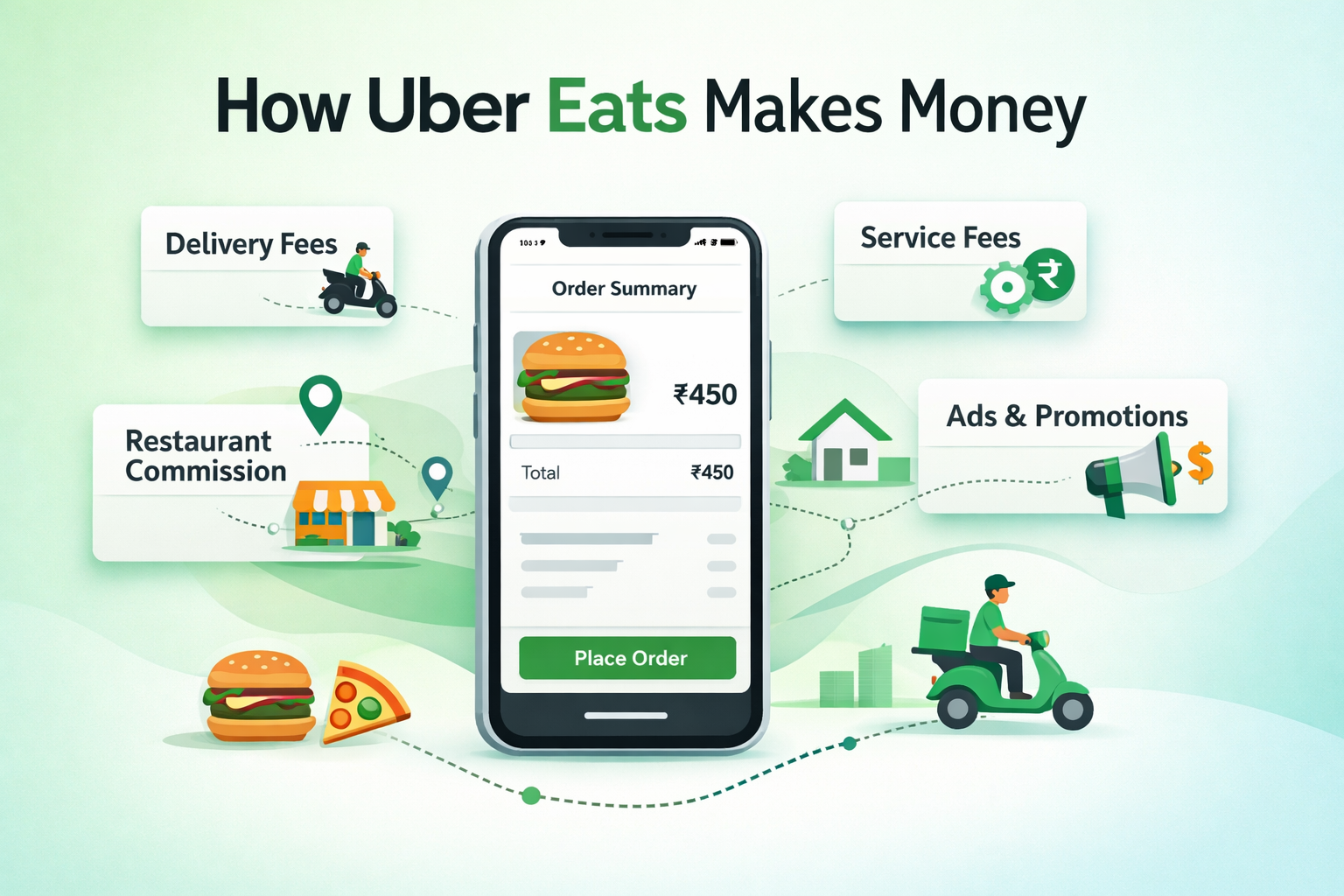
The short answer: Uber Eats makes money through delivery fees, service fees, restaurant commissions, advertising, and subscriptions like Uber One. But the full picture is way more interesting than that.
If you’ve ever looked at your Uber Eats receipt and wondered where all that extra money goes, you’re not alone. And if you’re a founder trying to understand how a marketplace like this actually works under the hood, this breakdown is for you.
What Uber Eats Actually Is
Most people think of Uber Eats as a food delivery app. That framing is wrong, and it matters.
Uber Eats is a logistics company, a demand aggregation platform, and a pricing engine all rolled into one. They don’t cook food. They don’t own restaurants. They don’t employ drivers in most markets.
What they do own is demand. And when you control demand at scale, you can charge both sides of the marketplace to access it.
Uber Technologies launched Uber Eats as a natural extension of its existing logistics network. The cars were already on the road. The routing algorithms already existed. The payment infrastructure was already built. Food delivery was a logical next layer on top of that.
Today, Uber Eats operates in dozens of countries and continues to grow, even though turning a consistent profit remains one of its biggest ongoing challenges.
The Three-Sided Marketplace Explained
Uber Eats runs on three players, and understanding each one is key to understanding the money.
Customers are the demand side. They place orders, pay fees, and generate the transaction volume that makes everything else work.
Restaurants are the supply side. They prepare the food and pay commissions to access Uber Eats’ customer base.
Delivery partners are the fulfillment layer. They physically move the food and get paid per delivery.
Here is what makes this model powerful for Uber Eats specifically: they get paid by both customers and restaurants. Customers pay delivery fees and service fees. Restaurants pay commissions. Uber Eats sits in the middle collecting from both sides while paying drivers to handle the physical work.
This double monetization setup is the core reason the model is so compelling, and also why it is so hard to balance. Keep drivers happy, keep restaurants happy, keep customers happy, and do it all while the margins stay razor thin.
What Actually Happens When You Place an Order
This matters because every step in the process is a point where Uber Eats controls pricing, margins, and experience.
You open the app and place an order. Uber’s algorithm immediately runs in the background, assigning both a restaurant and a driver based on location, availability, and predicted delivery time. The restaurant gets the order, prepares the food, and the driver picks it up and delivers it to your door. Payments are split in real time.
That entire sequence happens in minutes. But underneath it, Uber Eats is making pricing decisions, routing decisions, and margin decisions at every single step. That is not a food delivery process. That is a logistics optimization engine with food attached to it.
How Uber Eats Makes Money: Every Revenue Stream Broken Down
Delivery Fees
This is the most visible fee for customers. Every time you place an order, you pay a delivery fee based on distance, driver availability, and current demand.
The key mechanism here is dynamic pricing. Just like surge pricing works for Uber rides, delivery fees go up when demand is high and driver availability is low. During lunch rush, dinner time, or bad weather, delivery fees spike automatically.
This is not arbitrary. It is a real-time pricing optimization system. Uber Eats is not raising prices to be unfair. It is balancing supply and demand automatically, and capturing more revenue per transaction when conditions allow.
For founders, the lesson here is significant. Dynamic pricing lets you optimize revenue without touching your base price. You are not raising prices broadly. You are capturing more value at peak moments when customers have already decided to order.
Service Fees
Service fees are the hidden margin layer that most customers scroll past without thinking about. These are typically calculated as a percentage of the total order value, and they show up as a separate line item at checkout.
The fee covers platform usage, technology infrastructure, and the general cost of connecting you with a restaurant and a driver through the app.
Most users accept this without question. It feels like a normal cost of using the platform. But for Uber Eats, service fees are a meaningful and reliable revenue stream on every single transaction, regardless of distance or driver availability.
Because these fees scale with order value, a bigger order means a bigger fee. That naturally aligns with Uber Eats’ incentive to drive higher cart sizes across the platform.
Restaurant Commissions
This is the primary revenue engine. Restaurants pay Uber Eats a commission on every order placed through the platform, typically ranging from 15% to 30% depending on the plan they are on.
Uber Eats offers tiered commission structures. A basic listing gets you on the platform. Higher tiers unlock priority delivery assignment, better placement in search results, and increased visibility to customers. The more a restaurant pays, the more exposure they get.
So why do restaurants agree to these commission rates? Because Uber Eats controls the demand. A restaurant that is not on Uber Eats is invisible to a massive pool of customers who only order through delivery apps. The commission is essentially the price of accessing those customers.
This is one of the most important dynamics any marketplace founder needs to internalize. When you own the demand, suppliers will pay to access it. The commission rate is a function of how much leverage you have over where customers decide to spend their money.
Uber One Subscription Revenue
Uber One is a monthly or annual subscription that gives customers free delivery, reduced service fees, and priority service across both Uber rides and Uber Eats.
The subscription model creates two major advantages.
First, it generates predictable recurring revenue. Instead of relying entirely on transaction volume, Uber Eats knows exactly how many subscribers it has and what they are paying each month. That predictability is valuable for financial planning and investor confidence.
Second, it dramatically improves customer retention. A customer who has paid for an annual subscription has a strong incentive to keep ordering through Uber Eats rather than switching to a competitor. They have already paid for the benefit, so they want to use it. That behavioral lock-in is worth more than any individual delivery fee.
The subscription model also increases order frequency. Research consistently shows that subscription customers order more often than non-subscribers. They have removed the friction of paying a delivery fee on every order, so they order more impulsively and more often.
Advertising Revenue
This revenue stream is underrated, underappreciated, and growing fast.
Restaurants can pay for sponsored listings within the Uber Eats app. That means paying to appear at the top of search results, to show up on the homepage in featured sections, and to be promoted to relevant customers based on their past ordering behavior.
This is the Amazon advertising model applied to food delivery. Once you have a large enough user base, your platform becomes a valuable advertising channel for the suppliers who depend on access to that user base. The ads become nearly pure profit because the traffic infrastructure already exists.
For Uber Eats, advertising revenue is attractive precisely because it has very low incremental cost. They have already built the app, maintained the user relationships, and generated the traffic. Charging restaurants to access better placement within that traffic costs almost nothing on the margin.
As the platform matures, advertising is likely to become an increasingly significant portion of overall revenue.
Surge Pricing and Peak Fees
Beyond the base dynamic pricing on delivery fees, Uber Eats applies additional peak fees during high-demand periods. Bad weather, major sporting events, holiday evenings, and lunch or dinner rush hours all trigger elevated pricing.
These fees are applied automatically and increase per-order margins without requiring any additional infrastructure or operational change. It is pure pricing optimization.
The psychological reality is that customers who are ordering during a snowstorm or on Super Bowl Sunday are highly committed to the order. Demand is inelastic in those moments. Uber Eats captures more value precisely when customers are least likely to abandon their cart due to fees.
Small Order Fees
If a customer places an order below a certain dollar threshold, Uber Eats charges a small order fee. This is a deliberate unit economics mechanism.
Small orders are disproportionately expensive to fulfill. A driver makes the same trip whether the order is worth eight dollars or forty dollars, but the commission, delivery fee, and service fee are all much smaller on a low-value order. The small order fee either discourages small orders or compensates for them when they do happen.
Either outcome benefits Uber Eats. Customers are nudged toward adding more items to their cart, which increases order value and commission revenue. Or they pay a fee that makes the low-value order economically viable. Both outcomes improve unit economics.
Cancellation and Miscellaneous Fees
Late cancellations, failed deliveries, and certain edge case scenarios trigger additional fees. These are not a major revenue driver on their own, but they serve an important function.
They protect Uber Eats and its restaurant partners from the real operational cost of orders that fall through. A restaurant that has already started preparing food suffers a direct loss if an order is cancelled without any recovery mechanism. Cancellation fees partially offset that harm and incentivize customers to be more deliberate about completing orders.
The Advanced Monetization Layers Most People Miss
Data Monetization
Every order on Uber Eats generates data. What customers in a given neighborhood order most often. When demand peaks. Which cuisine categories are growing. How price sensitivity varies across different customer segments.
This data has direct value in two ways. Internally, it helps Uber Eats optimize pricing, improve routing efficiency, and make better decisions about which restaurants to recruit. Externally, or at least indirectly, it improves the advertising product because better targeting makes ads more valuable to restaurant partners.
Uber Eats does not sell raw customer data. But the insights derived from that data inform nearly every revenue-generating decision across the platform.
Cross-Selling Within the Uber Ecosystem
Uber and Uber Eats share a user base. Someone who uses Uber for rides is already in the ecosystem, already has a payment method saved, and already trusts the brand. Converting that person to an Uber Eats customer requires minimal effort.
Uber One amplifies this by bundling ride and delivery benefits into a single subscription. A customer who subscribes for the ride perks ends up using Uber Eats more because the delivery benefits are already included. A customer who subscribes for food delivery ends up taking more Uber rides for the same reason.
The cross-platform ecosystem creates retention and engagement advantages that neither product could achieve on its own.
Cloud Kitchens and Virtual Brands
Uber Eats has invested in and promoted delivery-only restaurants, also called cloud kitchens or ghost kitchens. These are commercial cooking facilities with no dine-in component, built exclusively to fulfill delivery orders.
This gives Uber Eats more control over the supply side of the marketplace. Cloud kitchen operators tend to rely almost entirely on delivery platform traffic, which gives Uber Eats more leverage in commission negotiations. They also allow Uber Eats to introduce its own virtual restaurant brands in some markets, capturing additional margin without competing directly with existing restaurant partners.
Financial Services as a Future Opportunity
Uber Eats sits on top of ongoing financial relationships with both restaurants and drivers. That positioning creates future opportunities in financial services.
Lending to restaurants based on their transaction history on the platform. Offering driver financing or pay advances. Embedded payment products that keep more of the transaction value within the Uber ecosystem.
None of these are fully developed revenue streams today, but they represent a logical expansion path as the platform matures and regulatory environments become more favorable.
The Cost Structure: Why Profitability Is So Hard
Understanding how Uber Eats makes money is only half the picture. The other half is understanding where all that revenue goes.
Driver Payouts
This is the biggest line item on the cost side. Drivers receive base pay per delivery plus incentives and bonuses designed to maintain supply in areas and time periods where demand is high.
Driver costs are also difficult to reduce. Cutting driver pay reduces driver supply, which slows down delivery times, which makes the product worse for customers. It is a constraint that cannot be easily engineered away.
Discounts and Promotions
Uber Eats spends aggressively on discounts and promotional offers to acquire new customers and compete with rivals like DoorDash, Grubhub, and international competitors like Swiggy and Zomato.
Customer acquisition through promotions is expensive. A first-time customer who gets their first three orders for free costs real money upfront, with the expectation of recouping that cost through future full-price orders. This works well when retention is high and breaks down badly when customers churn after the promotions end.
Technology and Infrastructure
Routing algorithms, app development, server infrastructure, payment processing, fraud detection, these are ongoing and significant costs. The technology is what makes the whole operation work, but it requires constant investment.
Customer Support and Operations
Every failed delivery, wrong order, or billing dispute requires resolution. At Uber Eats’ volume, even a tiny percentage of problematic orders generates an enormous support burden. Refunds, redeliveries, and service credits all come at a direct cost.
Marketing and Growth Costs
Paid advertising, influencer campaigns, referral programs, and partnership marketing are all ongoing expenses. In competitive markets, Uber Eats cannot afford to go dark on marketing without losing market share quickly.
Unit Economics: How Profitability Actually Works Per Order
Here is the simplified version of what happens financially on a single order.
Revenue on that order comes from three sources: the delivery fee from the customer, the service fee from the customer, and the commission from the restaurant.
Costs on that order include the driver payout, any discount or promotional credit applied to the order, and a proportional share of customer support and tech infrastructure costs.
Whether that specific order is profitable depends on several factors. How far did the driver have to travel? Was there a promo applied? Did the customer need any support? Was the order placed during a surge period or at a standard rate?
Profitability at scale depends on order density, delivery efficiency, and repeat customer behavior. A dense urban market where one driver can complete multiple orders per hour is dramatically more profitable than a sprawling suburban market where each delivery requires a long round trip.
This is why Uber Eats focuses so heavily on retention and subscription. A repeat customer who orders three or four times per month at full price, with no promotional discount, is vastly more valuable than a new customer who redeems a promo and then disappears.
How Uber Eats Grows into New Markets
The growth playbook is fairly consistent across markets.
Uber Eats enters a new city by recruiting large restaurant chains first. Major brands create immediate credibility and give customers a reason to try the platform. Once anchor restaurants are signed, smaller local restaurants follow because they want access to the same customers.
The platform then offers aggressive introductory discounts to drive initial order volume. High volume attracts more drivers. More drivers means faster delivery times. Faster delivery times means better customer experience. Better customer experience drives more orders and better retention.
This is the network effect flywheel. More customers attract more restaurants. More restaurants give customers better selection. Better selection attracts more customers. The loop reinforces itself over time, and once a platform achieves sufficient density in a market, it becomes very hard for competitors to displace.
Uber Eats vs. The Competition
Uber Eats competes primarily with DoorDash in the US, with Grubhub in certain urban markets, and with regional players internationally including Zomato and Swiggy in India, Deliveroo in Europe, and others.
The competitive dynamics are brutal. Commission rates are under constant pressure as restaurants push back. Customer acquisition costs are high because every competitor is fighting for the same customers with similar promotional strategies. Driver relationships are strained across the industry because pay has been squeezed in many markets.
Uber Eats’ biggest structural advantage over pure-play competitors is the Uber ecosystem. Cross-platform retention through Uber One, shared infrastructure between rides and delivery, and a broader brand relationship with customers give Uber Eats advantages that DoorDash or Grubhub cannot easily replicate.
Key Lessons for Founders Building Marketplace Businesses
If you are building any kind of marketplace or platform business, the Uber Eats model has a lot to teach you.
Own the demand, not the product. Uber Eats does not cook food and does not need to. They own the customer relationship and the distribution channel. That is where the leverage lives. If you are building a marketplace, focus relentlessly on the demand side first.
Monetize both sides. Single-sided monetization leaves money on the table. If you are connecting two parties who each receive value from the connection, both parties should be paying for access. The challenge is structuring it so neither side feels unfairly squeezed.
Build network effects early and intentionally. Network effects are the real moat in marketplace businesses. More participants on one side make the platform more valuable to the other side. Your job in the early stages is to reach the threshold where that flywheel starts spinning on its own.
Logistics is harder than technology. The app is not the hard part. The hard part is coordinating physical movement of goods at scale with reliable quality and speed. Any marketplace that involves real-world fulfillment will hit this wall eventually. Plan for it early.
Retention beats acquisition every time. Customer acquisition is expensive and competitive. Customer retention is where the actual economics of a marketplace business start to work. Build your product, your subscription offering, and your operational quality around keeping existing customers rather than endlessly chasing new ones.
The Future of Uber Eats
The next phase of the Uber Eats business model is already taking shape.
AI-driven delivery optimization will reduce driver costs by improving routing efficiency, predicting demand patterns, and reducing empty miles between deliveries. Even small improvements in routing efficiency at Uber Eats’ volume translate to significant cost reductions.
Drone and autonomous vehicle delivery remain on the horizon. Regulatory hurdles are real, but the economics of removing human labor from the delivery step are compelling enough that every major platform is investing in it.
Dark stores and quick commerce represent a major expansion of the model beyond restaurant food. These are small fulfillment warehouses stocked with grocery and household items designed for fast delivery. Uber Eats has been expanding into this category and it has the potential to meaningfully increase order volume and revenue per customer.
Deeper advertising monetization is likely as the platform continues to grow. As more restaurants compete for visibility within the app, the advertising product becomes more valuable and more sophisticated. This could eventually become a material revenue stream comparable to what Amazon has built with its advertising business.
Wrapping Up
Uber Eats is not a food delivery app. It is a pricing engine, a logistics network, and a demand aggregation platform that happens to deliver food. The real business is controlling the connection between customers, restaurants, and drivers while capturing value at every point in that chain. That is the model worth studying if you are building anything in the marketplace or platform space.
FAQs
Typically between 15% and 30%, depending on the tier and market. Restaurants on higher-tier plans pay more but get better visibility and priority delivery assignment.
The profitability picture has been improving, but it remains challenging in many markets. High driver costs, aggressive promotional spending, and intense competition keep margins thin. Uber Eats has reached profitability on an adjusted basis in certain segments, but it is not consistently profitable across all markets.
Uber One is Uber’s subscription membership that includes free delivery on Uber Eats orders, reduced service fees, and benefits across Uber rides as well. It is available as a monthly or annual plan.
They make money in different ways. Restaurants make revenue on the food itself. Uber Eats earns through commissions, fees, and advertising. Margins for both depend heavily on scale, efficiency, and market conditions. Many restaurants report that Uber Eats commissions significantly reduce their margin on delivery orders, but they accept it because the alternative is losing access to a large pool of delivery customers entirely.
Each fee serves a specific economic purpose. Delivery fees cover driver costs. Service fees cover platform infrastructure. Small order fees improve unit economics on low-value transactions. Surge fees optimize supply and demand during peak periods. Together, they create a fee structure that allows Uber Eats to remain economically viable across a wide range of order types and market conditions.
Discover more from Business Model Hub
Subscribe to get the latest posts sent to your email.