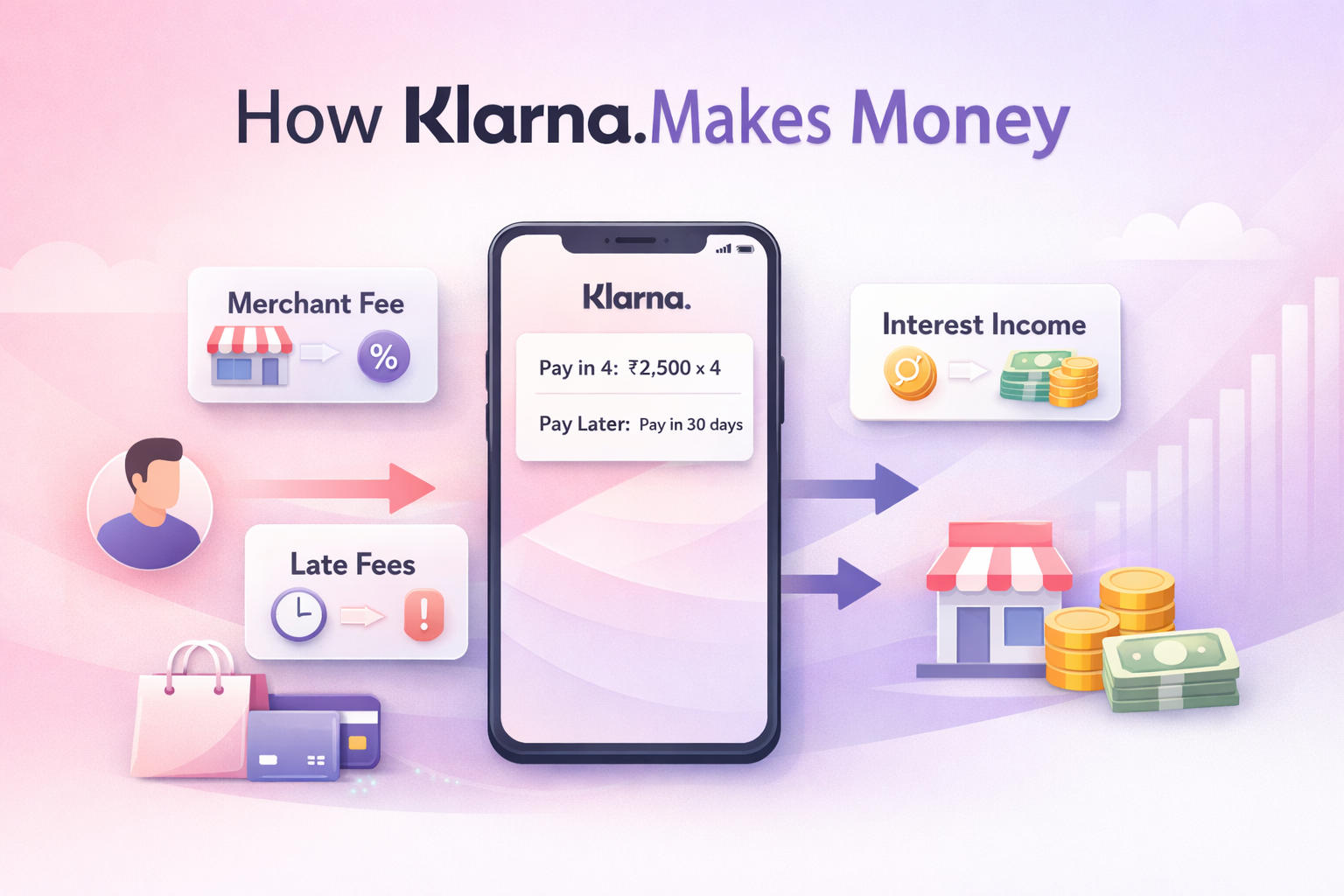

Klarna lets you split a $200 purchase into four easy payments. No interest. No fees. Sounds too good to be true.
So who’s actually paying?
The answer reveals one of the smartest business models in fintech. Klarna doesn’t make money from you. It makes money because of you.
Here’s the full breakdown.
What Is Klarna?
Klarna is a Swedish fintech company founded in 2005. It started as a simple “pay later” tool for online shoppers and has since grown into one of the most valuable private fintech companies in the world.
Today, Klarna operates across three core areas:
Buy Now, Pay Later (BNPL). The product most people know. Split purchases into installments, often with zero interest.
Banking and financial services. Klarna holds a banking license in Sweden and offers savings accounts and other financial products.
Shopping platform. The Klarna app has evolved into a full shopping discovery engine with deals, price tracking, and sponsored product listings.
The simplest way to understand Klarna is this: it’s a checkout layer, a lending engine, and a shopping platform rolled into one.
How Klarna Actually Works
The basic flow is straightforward.
You shop at a retailer that offers Klarna at checkout. You select a payment option, such as Pay in 4 or Pay in 30 Days. Klarna instantly pays the merchant the full purchase amount. You repay Klarna over time according to your chosen schedule.
That’s the user experience. Clean, fast, frictionless.
But what’s happening underneath is more interesting. Klarna steps in as a financial intermediary. It takes on the credit risk, handles collections, and manages the relationship with the shopper after the sale. The merchant gets paid immediately and walks away from the transaction entirely.
This setup gives Klarna significant control. It owns the post-purchase relationship with the customer. It knows what people are buying, when they buy, and how they repay. That data is enormously valuable.
The Core Business Logic
Before diving into individual revenue streams, it helps to understand the foundational logic behind Klarna’s model.
Klarna’s core thesis is simple: remove friction at checkout, increase sales, charge merchants for the lift.
Klarna doesn’t sell payments. It sells conversion rate improvement. When a shopper sees a $300 item broken into four $75 payments, they’re far more likely to complete the purchase. That incremental sale would not have happened without Klarna.
Merchants understand this. They’re not paying Klarna for payment processing. They’re paying for customers who would have otherwise bounced at checkout.
This reframe is everything. Klarna monetizes the purchase decision, not just the transaction.
How Does Klarna Makes Money
Merchant Fees
This is Klarna’s primary revenue source.
Every time a shopper uses Klarna at checkout, the merchant pays a fee. That fee typically ranges from 2.5% to 6% of the transaction value, depending on the product, market, and merchant agreement.
For context, standard credit card processing fees run around 1.5% to 3%. Klarna charges more. And merchants still pay it.
Why? Because the math works in their favor.
If a merchant sells a $500 item and Klarna charges a 5% fee, the merchant nets $475. But without Klarna, that shopper might not have bought at all. A $475 margin beats a $0 sale every time.
Klarna has consistently shown merchants that it increases:
Average order value. Shoppers spend more when payments are split.
Conversion rates. Fewer abandoned carts because the upfront cost feels lower.
Customer acquisition. Especially among younger shoppers who prefer BNPL over credit cards.
Merchant fees scale with volume. The more transactions Klarna processes, the more it earns. This is why merchant acquisition is one of Klarna’s most critical growth activities.
Interest Income
Not all of Klarna’s products are interest-free.
The Pay in 4 and Pay in 30 Days products typically carry no interest for shoppers who pay on time. But Klarna also offers longer-term financing options, sometimes stretching 6 to 36 months, and those come with interest charges.
On these longer installment plans, Klarna functions like a lender. It extends credit, collects repayments over time, and earns interest on the outstanding balance. The interest rates vary by market and creditworthiness, but this segment operates similarly to a consumer lending business.
As Klarna pushes into more markets and higher average order values, interest income becomes an increasingly meaningful revenue line.
Late Fees
When shoppers miss a payment, Klarna charges a late fee.
This is not Klarna’s primary business driver. The company has been vocal about the fact that it does not want users to miss payments. Late fees hurt users and increase credit risk for Klarna.
But late fees do contribute to revenue. The structure varies by country and product type. In the US, Klarna charges a flat late fee capped by regulation. In other markets, fees are structured differently.
Worth noting: regulators across the US, UK, and EU have scrutinized BNPL late fees closely. This is a revenue stream with meaningful regulatory risk attached.
Interchange Fees from the Klarna Card
Klarna offers a physical and virtual card that works anywhere Visa is accepted.
When users make purchases with the Klarna Card, Klarna earns interchange fees, the small percentage that card networks collect from merchants on every swipe. Klarna gets a share of that revenue.
This product is strategically important beyond just interchange income. The Klarna Card extends Klarna’s reach beyond its integrated merchant network. Users can shop anywhere and still route purchases through Klarna’s ecosystem, enabling the same BNPL features even at retailers that don’t have a formal Klarna partnership.
Advertising and Sponsored Listings
This is the revenue stream most people overlook.
The Klarna app has evolved into a shopping discovery platform. Millions of users open the app not just to manage payments but to browse deals, discover products, and find retailers.
Klarna monetizes this traffic by charging brands and retailers for sponsored product placements and featured listings inside the app.
This is the same model Google and Amazon use. Retailers pay for visibility at the moment of shopper intent. Klarna has built a captive audience of high-intent buyers, and it charges for access to that audience.
This segment is still a relatively small portion of total revenue, but it’s growing. And it has very attractive margins compared to the lending business because there’s no credit risk attached.
As Klarna scales its user base, advertising becomes a more powerful monetization layer.
Financial Services
Klarna holds a banking license, and it’s using it.
In select markets, Klarna offers savings accounts with competitive interest rates. This gives Klarna access to a lower-cost source of funding compared to traditional capital markets.
Longer term, Klarna has signaled ambitions to expand further into personal finance, budgeting tools, and other banking products. This positions Klarna as a financial super app rather than just a checkout tool.
Financial services revenue is still a minor contributor to the overall business, but the strategic value is significant. The more deeply embedded Klarna becomes in a user’s financial life, the stickier the product becomes.
The Klarna Business Model Canvas
Breaking Klarna’s business down into its core building blocks makes the structure easier to understand.
Customer Segments
Klarna serves two primary groups simultaneously.
Shoppers. Primarily millennials and Gen Z consumers who are comfortable with digital payments, skeptical of traditional credit cards, and drawn to flexible payment options. These users often have limited credit history or simply prefer not to carry revolving credit card balances.
Merchants. eCommerce brands, direct-to-consumer retailers, and physical stores that want to increase conversion rates and average order values. These range from massive retailers like H&M and Sephora to small online shops.
Klarna also serves financial service users who use its banking and savings products, but this segment is smaller today.
Value Propositions
For shoppers:
Split purchases into manageable payments. Access short-term financing with zero or low interest. Manage all purchases in one app. Get personalized shopping recommendations and deals.
For merchants:
Higher conversion rates at checkout. Larger average order values. Access to Klarna’s shopper base as a new customer acquisition channel. Risk-free settlement since Klarna absorbs credit risk.
Channels
Klarna reaches users through checkout integrations on merchant websites and apps. The Klarna mobile app serves as a standalone shopping and account management tool. Browser extensions let users access Klarna even on sites without direct integration. Retail partnerships and physical card presence extend reach further.
Customer Relationships
Klarna maintains relationships with shoppers primarily through its app. Push notifications, payment reminders, personalized deals, and price drop alerts keep users engaged between purchases. The goal is to make Klarna the first place users open when they want to shop.
For merchants, Klarna operates more like a B2B software partner. It provides dashboards, performance data, and integration support.
Revenue Streams
Merchant fees are the core. Interest income, late fees, interchange fees, advertising, and financial services round out the revenue mix. The model is intentionally diversified to reduce dependence on any single source.
Key Resources
Capital. Klarna needs funding to pay merchants upfront before shoppers repay. This requires access to debt markets or deposits from its banking operations.
Risk algorithms. Klarna makes real-time credit decisions on millions of transactions. Its underwriting models determine who gets approved, at what limit, and with what repayment terms. This is a core competitive asset.
Merchant network. The value of Klarna’s platform grows as more merchants integrate it. A larger merchant network means more shopper touchpoints.
Brand trust. Klarna has invested heavily in brand building, particularly among younger consumers.
Key Activities
Credit underwriting at scale. Payment processing and settlement. Merchant acquisition and onboarding. Fraud and risk management. App development and user engagement.
Key Partners
Retail and eCommerce brands are Klarna’s most critical partners. Without merchant integrations, there’s no product. Funding partners and banks provide the capital Klarna needs to operate its lending business. Payment networks like Visa enable the Klarna Card. Regulators, while not traditional partners, shape the boundaries within which Klarna can operate.
Cost Structure
Credit losses. When shoppers default, Klarna absorbs the loss. This is the largest risk in the business model.
Cost of capital. Borrowing money to fund merchant payouts has a cost. As interest rates rise, this cost increases.
Technology infrastructure. Running a real-time payment and credit platform at scale requires significant engineering investment.
Marketing and merchant acquisition. Growth requires spending to acquire both shoppers and merchant partners.
Compliance and regulation. Operating across dozens of markets with different financial regulations is expensive.
Unit Economics: What One Transaction Actually Looks Like
Take a $1,000 purchase at a fashion retailer.
The shopper selects Pay in 4. They’ll pay four installments of $250 each.
Klarna pays the merchant $950 immediately, keeping $50 as its fee (roughly 5%).
Over the next six weeks, the shopper repays $1,000 in four installments. If they pay on time, Klarna nets the $50 merchant fee minus its operational costs.
Klarna’s costs on this transaction include the cost of the capital it advanced, fraud screening, payment processing, and a share of default risk across its portfolio.
The simplified equation: Profit = Merchant Fees + Interest + Other Revenue, minus Defaults, Funding Costs, and Operations.
At scale, small margins per transaction add up to large aggregate revenue. But this model is also sensitive to default rates. A spike in missed payments eats directly into margins.
The Risks in Klarna’s Model
Credit Default Risk
The entire model depends on shoppers repaying what they owe. In economic downturns, default rates rise. Klarna absorbs those losses.
This is not a theoretical risk. During periods of economic stress, BNPL companies across the industry have reported rising default rates. Klarna’s underwriting models are designed to minimize this, but the risk never disappears.
Rising Interest Rates
Klarna borrows money to fund merchant payouts. When central bank rates rise, Klarna’s cost of capital rises too. That compresses margins, particularly on the interest-free BNPL products where Klarna can’t pass costs to the shopper.
Regulatory Pressure
BNPL is under increasing scrutiny globally. Regulators in the US, UK, Australia, and EU have introduced or are developing rules requiring credit checks, clearer disclosures, and caps on fees. New regulation could restrict who Klarna can lend to, how much it can charge, and how it structures its products.
Merchant Concentration Risk
If Klarna loses major retail partners, volume drops fast. Large merchants also have negotiating leverage to push fees down. Klarna needs to maintain a diversified merchant base to avoid overdependence on any single partner.
Klarna vs. Credit Cards
Most people assume Klarna and credit cards are competing for the same thing. The reality is more nuanced.
| Factor | Klarna | Credit Cards |
|---|---|---|
| Primary Revenue Source | Merchants | Consumers |
| Interest Charges | Low or none (short-term) | High (revolving) |
| Credit Check | Soft check, real-time | Hard credit pull |
| User Experience | Integrated at checkout | Separate step |
| Rewards | Limited | Extensive |
The key structural difference is who pays.
Credit card companies charge consumers through interest, annual fees, and late fees. They subsidize perks like cashback and airline miles from those charges.
Klarna flips that model. Merchants pay. Shoppers get a frictionless, often free payment option. The merchant absorbs the cost because the incremental sales value justifies it.
This is why Klarna has resonated so strongly with younger shoppers who grew up skeptical of credit card debt. There’s no revolving balance, no compound interest trap, no annual fee.
Klarna’s Growth Strategy
Embedded Finance
Klarna’s long-term play is to own the checkout layer across as much of eCommerce as possible. The more deeply embedded Klarna is in the purchase flow, the harder it is for merchants to remove and the more data Klarna accumulates.
Browser extensions and the Klarna Card extend this reach to merchants who haven’t formally integrated Klarna. This is a direct push to make Klarna universally accessible.
Global Expansion
Klarna operates in over 45 countries. Each new market brings new merchant partnerships, new shopper relationships, and new regulatory challenges. The US market has become one of Klarna’s most important growth areas.
The Shopping App
Klarna is investing heavily in turning its app into a primary shopping destination. Features like price tracking, deal alerts, personalized recommendations, and a cashback program are designed to make Klarna sticky independent of any single merchant.
If Klarna succeeds here, it shifts from being a payment option at someone else’s checkout to being the starting point for the shopping journey.
Banking and Super App
The banking license is a long game. Access to deposits provides cheaper funding. Savings accounts and financial products create deeper user relationships. Over time, Klarna wants to be where users manage money broadly, not just installment payments.
Financial Snapshot
Klarna reached profitability in 2023 after years of heavy losses during its rapid expansion phase. The company processed hundreds of billions of dollars in gross merchandise volume annually and serves over 150 million active users globally.
Revenue is primarily merchant-driven, which means it scales with transaction volume rather than depending on consumer borrowing behavior. This is both a strength and a constraint. Strong retail spending environments boost Klarna’s revenue. Consumer pullbacks hit it directly.
Klarna has been publicly discussing a US IPO, which would give public markets full visibility into its financials for the first time.
The Future of Klarna
AI Shopping Assistant
Klarna has launched AI-powered features that function as a shopping assistant. Users can describe what they’re looking for and get personalized product recommendations, price comparisons, and deal alerts. This directly competes with Google Shopping and Amazon’s discovery features.
If Klarna captures even a portion of product search behavior, its advertising revenue potential expands significantly.
Competing at the Platform Level
The long-term competitive picture puts Klarna alongside PayPal, Apple Pay, and Affirm rather than just other BNPL providers. Each of these players is trying to own the checkout moment and the broader financial relationship with consumers.
Klarna’s differentiation is its merchant network depth, its brand affinity with younger consumers, and its evolution toward a full shopping platform.
Key Takeaways for Founders and Business Thinkers
Klarna’s model has several lessons worth examining.
Charge businesses, not users. Klarna built a massive consumer product that users love in part because they don’t pay for it directly. The cost sits with merchants who benefit from the volume.
Own the moment of decision. The checkout moment is where purchase decisions are made or abandoned. Klarna planted itself there and built an entire business around that single touchpoint.
Friction reduction is a product. Klarna’s core feature is making buying easier. That ease translates directly to revenue for merchants and justifies Klarna’s fees.
Ecosystem beats feature. Klarna started with one product and built outward into cards, banking, advertising, and a shopping app. The goal is always to become harder to remove and more valuable over time.
Data compounds. Every transaction gives Klarna better insight into shopper behavior, creditworthiness, and merchant performance. That data improves underwriting, feeds the shopping app, and makes the advertising product more valuable.
Conclusion
Klarna’s business model is built on a simple but powerful insight: the moment someone decides to buy something is the most valuable moment in commerce.
By making that moment easier, Klarna increases the number of purchases that actually happen. Merchants pay for that increase. Shoppers get a frictionless experience. Klarna captures the spread.
It’s not a payments company in the traditional sense. It’s a conversion tool that happens to process payments, bundled with a lending business, wrapped in a shopping platform.
The complexity is in the balance. Klarna has to manage credit risk, fund merchant payouts, comply with global regulation, and keep both merchants and shoppers happy simultaneously. Getting any one of those wrong creates problems across the whole system.
But when it works, it works well. Klarna has built one of the most structurally interesting business models in modern fintech by turning the checkout moment into a multi-sided revenue engine.
The shopper pays nothing. The merchant pays for growth. And Klarna earns on both sides of the transaction.
FAQs
For Pay in 4 and Pay in 30 Days, Klarna typically charges shoppers nothing if they pay on time. Late fees apply on missed payments. Longer financing plans carry interest. The short-term products are genuinely free for on-time payers.
Merchants pay the largest share of Klarna’s revenue through transaction fees. Shoppers contribute through late fees and interest on financing plans. Advertisers pay for placement in the Klarna app.
Yes. Klarna returned to profitability in 2023 after scaling back its aggressive expansion spending. The company has worked to improve credit quality and operational efficiency.
Klarna holds a banking license in Sweden and operates regulated financial services in several markets. In the US, it operates as a licensed lender but not a full bank. Its banking ambitions are real and growing.
Because the revenue lift outweighs the cost. Merchants consistently report higher conversion rates and larger order values when Klarna is available at checkout. The math works in the merchant’s favor even with higher per-transaction fees.
Discover more from Business Model Hub
Subscribe to get the latest posts sent to your email.