
Most startups do not fail because of bad execution. They fail because nobody validated whether the problem was worth solving in the first place.
Founders often jump straight into building. They spend months writing code, designing interfaces, and polishing features before a single customer confirms the idea is worth paying for. By the time they launch, the market has already told them no, they just were not listening.
Validation flips this process. Instead of assuming people want your solution, you test that assumption early, cheaply, and honestly. This guide walks through a complete process for validating a startup idea before you write a single line of code.
What Does Startup Idea Validation Mean?
Startup idea validation is the process of confirming that real people have a real problem, and that they are willing to pay for a solution to it, before you build anything.
Is validation the same as assumption?
No. An assumption is something you believe to be true based on your own experience or opinion. Validation replaces that belief with evidence collected from actual potential customers.
Why don’t opinions from friends and family count?
Friends and family want to support you. Their feedback is shaped by loyalty, not by whether they would actually pull out a credit card and pay for your product. Validation requires input from people who have no personal stake in your success.
What is the difference between idea validation and product validation?
Idea validation confirms that a problem exists and that people care enough to solve it. Product validation happens later, once you have a working product, and measures whether your specific solution satisfies that need. Idea validation always comes first.
Why You Should Never Build First
Building before validating is one of the most expensive mistakes a founder can make.
How much does building unnecessary features cost?
Development time is not cheap. Every feature built on an unvalidated assumption represents hours, and often thousands of dollars, spent on something customers may never use.
How much time gets lost building without validation?
Founders who skip validation often spend six months to a year building a full product, only to discover during launch that nobody wants it. That time could have been spent testing five or ten different ideas instead.
How many startups fail due to lack of market need?
Lack of market need is consistently cited as one of the top reasons startups fail. It ranks above running out of cash, above having the wrong team, and above poor marketing.
What is the opportunity cost of skipping validation?
Every month spent building the wrong product is a month not spent finding the right one. Opportunity cost is often invisible until it is too late to recover.
A founder who spends two weeks validating an idea and finds it does not work has lost two weeks. A founder who spends a year building the same failed idea has lost a year, savings, and often motivation to try again.
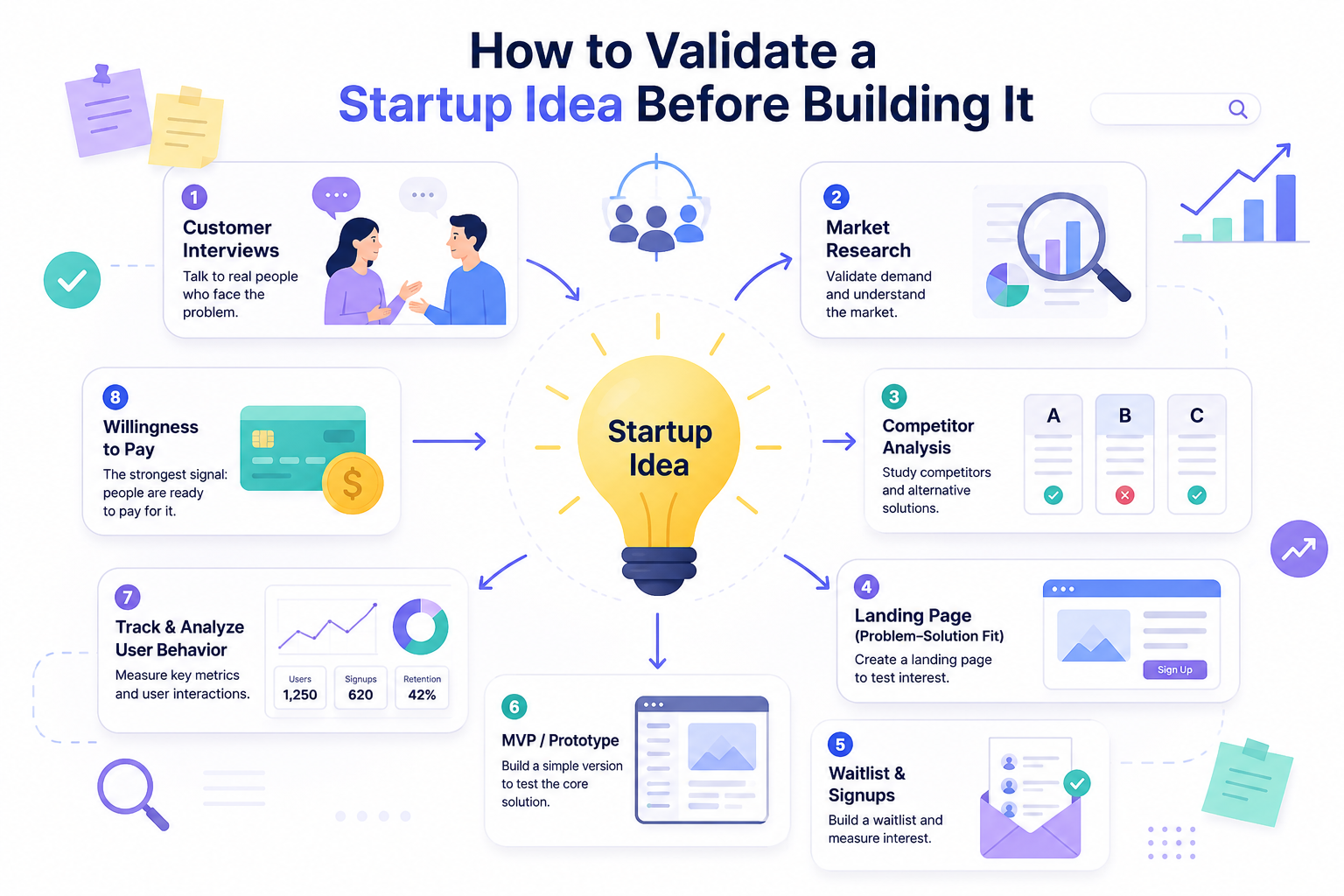
Startup Idea Validation Steps
Step 1: Define the Exact Problem
Every strong startup begins with a clearly defined problem, not a vague idea.
What problem exists?
Write the problem in one sentence. If you cannot describe it clearly, you do not understand it well enough yet.
Who experiences this problem?
Identify the specific group of people affected. “Everyone” is not an answer. Be specific about industry, role, or situation.
How often does this problem occur?
A problem that happens once a year is very different from one that happens every day. Frequency affects how much people are willing to pay for a fix.
How painful is the problem?
Rate the pain on a practical scale. Does it cost people money, time, or stress? The more painful the problem, the stronger your validation signal will be.
How are people solving this today?
If people have found workarounds, even bad ones, that means the problem is real. If nobody is doing anything about it, that could mean the problem is not painful enough to solve.
Problem definition template
Use this simple format to document your findings.
Problem: [one sentence]
Who feels it: [specific group]
Frequency: [daily, weekly, monthly, rarely]
Pain level: [low, medium, high]
Current workaround: [what people do today]
Step 2: Identify Your Ideal Customer
You cannot validate an idea without knowing exactly who you are validating it for.
What is an ideal customer profile?
An ideal customer profile, or ICP, describes the specific type of person or business most likely to buy your solution and get the most value from it.
What demographics should you define?
Age range, location, job title, and company size if you are targeting businesses.
What industry should you target first?
Pick one industry to start. Trying to serve every industry at once dilutes your message and makes validation harder to measure.
What budget does your ideal customer have?
Know whether your target customer has the financial ability to pay for your solution. A great idea aimed at someone with no budget will not convert into revenue.
What behavior signals a strong customer fit?
Look for people who are already searching for solutions, already spending money on alternatives, or actively complaining about the problem online.
Who has buying authority?
In business settings, the person who feels the pain is not always the person who approves the purchase. Identify who actually signs off on spending.
Example customer persona
Name: Sarah
Role: Operations manager at a 50 person logistics company
Problem: Spends 6 hours a week manually tracking delivery schedules in spreadsheets
Budget: Has authority to approve tools under 500 dollars a month
Current solution: Google Sheets and email reminders
Step 3: Research Existing Competitors
Competitors are not a threat during validation. They are proof that a market exists.
What are direct competitors?
Companies offering a very similar solution to the same problem you are addressing.
What are indirect competitors?
Companies solving the same underlying problem in a different way.
What counts as an alternative solution?
This includes manual processes, spreadsheets, or simply doing nothing. Many people “compete” with startups by not solving the problem at all.
Which tools help you research competitors?
Google Search shows who ranks for your target problem.
Reddit reveals unfiltered opinions and complaints.
Product Hunt shows recently launched competitors and audience reactions.
G2 and Capterra show software reviews and pricing comparisons.
LinkedIn shows how competitors position themselves professionally.
YouTube reviews reveal real user experiences and objections.
What should you analyze in competitor research?
Look at pricing, customer complaints in reviews, feature gaps, and the language customers use to describe their frustrations. This language becomes valuable for your own marketing later.
Step 4: Validate Search Demand
If people are not searching for a solution to their problem, that is important information.
How do you check if people are actively searching for this problem?
Search demand tools show whether your target audience is looking for answers online right now.
What tools help measure search demand?
Google Autocomplete shows real queries people type.
Google Trends shows whether interest is rising, falling, or stable.
Ahrefs and Semrush show estimated search volume and keyword difficulty.
Keywords Everywhere gives quick volume data directly in your browser.
Does low search volume always mean low demand?
No. Some of the best startup ideas solve problems people do not yet know how to search for. In these cases, forums, communities, and direct customer interviews matter more than keyword tools.
Step 5: Talk to Real Potential Customers
Customer interviews are the single most valuable validation method available to early stage founders.
What questions should you ask in customer interviews?
How do you currently solve this problem?
What is the most frustrating part of your current process?
How much does the current solution cost you, in time or money?
What happens if this problem goes unsolved?
Would you pay for a better solution, and how much?
What mistakes should you avoid in interviews?
Do not describe your solution before asking about their problem. Do not ask leading questions that push people toward the answer you want. Do not treat polite interest as a commitment to buy.
Step 6: Create a Landing Page Before Building
A landing page lets you test demand before writing a single line of product code.
What should a validation landing page include?
A clear statement of the problem.
A clear statement of your proposed solution.
A short list of benefits, not features.
A strong call to action.
An email signup form.
Early pricing information, even if approximate.
What metrics should you track on the landing page?
Conversion rate shows what percentage of visitors take action.
Signups show how many people want to stay informed.
Bounce rate shows whether your messaging is resonating or falling flat.
A landing page with steady traffic and a low conversion rate usually means your messaging needs work. A landing page with almost no traffic means you need to test different channels before drawing conclusions.
Step 7: Pre-Sell Your Product
Nothing validates demand faster than someone paying before the product exists.
Why are pre-orders one of the strongest validation signals?
Money changes everything. Anyone can say they like an idea. Very few people will pay for something that does not exist yet unless they genuinely need it.
What pre-sell strategies work well?
Lifetime deals reward early customers with permanent discounts.
Early access programs create urgency and exclusivity.
Waitlists build anticipation and give you a warm audience for launch.
Beta programs let a small group test the product in exchange for feedback.
Deposits require partial payment upfront to confirm serious intent.
Step 8: Build a Simple MVP
Once you have validated demand, it is time to build the smallest possible version of your product.
What is the difference between an MVP and a full product?
An MVP includes only the core features needed to solve the main problem. A full product includes the complete feature set built over time based on real usage data.
What are examples of a simple MVP?
A no-code MVP built with tools like Bubble or Webflow.
A clickable prototype in Figma that simulates the experience without real functionality.
A manual service delivered by a human behind the scenes, while customers believe they are using software.
Many successful companies started by manually doing the work their software now automates. This approach lets you validate the full customer experience without investing in engineering too early.
Step 9: Measure User Behavior
Once real users interact with your MVP, data replaces assumptions completely.
What metrics should you track?
Activation shows whether new users experience the core value quickly.
Retention shows whether users come back after their first visit.
Churn shows how many users stop using the product over time.
Usage frequency shows how often users engage with the product.
Feature adoption shows which parts of the product actually get used.
Conversion shows how many free users become paying customers.
What tools help track user behavior?
GA4 tracks website and app traffic patterns.
Mixpanel tracks detailed user actions and funnels.
PostHog offers open source product analytics with session recordings.
Hotjar shows heatmaps and recordings of real user sessions.
Step 10: Iterate Based on Feedback
Validation does not stop once you launch. It becomes a continuous cycle.
What does the build, measure, learn cycle mean?
You build a small piece of the product, measure how real users respond, and use those learnings to decide what to build next.
Why does continuous improvement matter?
Markets change, customer expectations shift, and competitors evolve. Startups that stop listening to users after launch often lose the product market fit they worked hard to find.
Startup Idea Validation Checklist
Use this checklist to track your progress through the validation process.
| Validation Step | Completed |
|---|---|
| Problem validated | ☐ |
| Customer interviews | ☐ |
| Competitor research | ☐ |
| Search demand checked | ☐ |
| Landing page created | ☐ |
| Waitlist collected | ☐ |
| MVP tested | ☐ |
| Feedback collected | ☐ |
| First customer acquired | ☐ |
Best Tools for Startup Validation
| Tool | Purpose |
|---|---|
| Google Trends | Demand tracking |
| Semrush | Keyword research |
| Ahrefs | SEO and competitor analysis |
| Product Hunt | Competitor research |
| Community research | |
| Typeform | Surveys |
| Google Forms | Feedback collection |
| Figma | Prototyping |
| Bubble | No-code MVP |
| Carrd | Landing pages |
| Mixpanel | User analytics |
| PostHog | Product analytics |
Common Startup Validation Mistakes
Why is asking leading questions a problem?
Leading questions push interviewees toward the answer you want to hear, which corrupts your data before you even collect it.
Why is talking only to friends a mistake?
Friends are biased toward encouragement. Their feedback rarely reflects how a real, unbiased customer would react.
Why is ignoring competitors risky?
Skipping competitor research means missing pricing benchmarks, feature gaps, and proof that a market already exists.
Why is building too many features a mistake?
Extra features early on waste development time on things customers have not asked for and may never use.
Why does assuming instead of measuring cause failure?
Assumptions feel true until they are tested. Measurement replaces belief with fact.
Why do compliments get confused with buying intent?
People are polite. A compliment costs nothing. A purchase requires real commitment.
Why is waiting for a perfect product a mistake?
Perfection delays feedback. Feedback is what makes the product better in the first place.
Startup Idea Validation Examples
How did a SaaS company validate demand before writing code?
A SaaS founder built a simple landing page describing the product and collected email signups through a waitlist. Only after seeing consistent signups did the team begin development.
How did an ecommerce brand test demand?
An ecommerce founder ran small social media ad campaigns pointing to a pre-order page. Real purchases confirmed demand before any inventory was ordered.
How did a marketplace startup validate its model?
A marketplace founder manually matched buyers and sellers through spreadsheets and direct messages before building any platform. Once manual matching proved valuable and repeatable, the team invested in software.
When Should You Stop Validating and Start Building?
What signs indicate it is time to build?
Customers clearly and consistently describe the problem in their own words.
People continue joining your waitlist without heavy promotion.
Some users are willing to pay before the product exists.
Your solution receives repeated positive feedback across multiple interviews.
Early MVP users keep coming back without being reminded.
When these signals appear together, you have enough evidence to move forward with confidence.
Key Takeaways
Validate the problem before building the solution.
Speak with real customers instead of relying on assumptions.
Research competitors and confirm demand through search trends and interviews.
Use landing pages, waitlists, and pre-sales to measure genuine interest.
Launch a simple MVP, analyze user behavior, and iterate based on feedback.
The strongest validation signal is when people are willing to pay, not just praise the idea.
Frequently Asked Questions
How do you validate a startup idea without building a product?
Talk to potential customers, research competitors, check search demand, and create a landing page to measure interest before writing any code.
What is the fastest way to validate a business idea?
Customer interviews combined with a simple landing page usually deliver the fastest, clearest signal.
How many customer interviews are enough?
Most founders start seeing clear patterns after 15 to 20 conversations with people who match their ideal customer profile.
What is the difference between validation and product market fit?
Validation confirms a problem is worth solving. Product market fit confirms your specific product solves it well enough that customers keep using and paying for it.
Can a startup succeed without validation?
It is possible, but rare. Most successful founders validate demand in some form, even informally, before committing significant time and money.
How much should validation cost?
Validation can often be done for under 100 dollars using free interview scheduling tools, a simple landing page builder, and organic outreach.
What if competitors already exist?
Existing competitors are a positive signal. They prove the market is real. Focus on what you can do differently or better.
Should I build an MVP before validating?
No. Validate the problem first. Building an MVP without validation risks wasting time on a product nobody wants.
How long does startup validation take?
Most founders can complete a solid validation process in two to six weeks, depending on how quickly they can reach potential customers.
What metrics prove a startup idea is worth building?
Consistent landing page conversions, growing waitlist signups, completed pre-orders, and repeated positive feedback from customer interviews all point toward a validated idea.
Discover more from Business Model Hub
Subscribe to get the latest posts sent to your email.