
An MVP (Minimum Viable Product) business model is a lean startup approach where you build a bare-bones version of your product with just enough features to solve a core problem for early customers. You launch it quickly, gather feedback, and improve incrementally based on real user data. The goal isn’t perfection it’s learning what customers actually want before investing heavily in a full product launch.
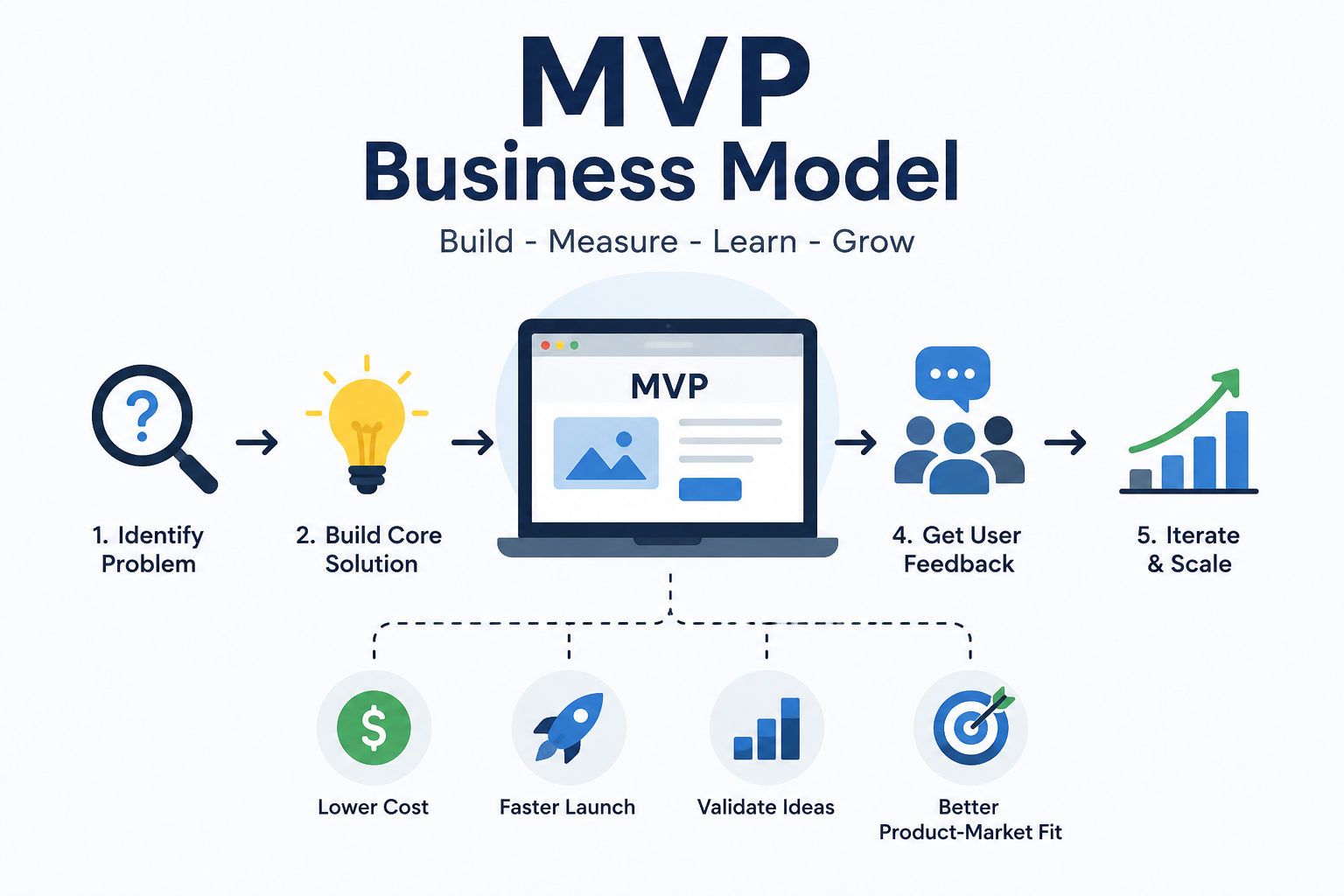
You identify a real customer problem, build only the essential solution, launch it to early adopters, collect feedback, then iterate or pivot based on what you learn. Only after validating demand do you scale up.
Building a full product before testing the market is risky and expensive. Most startups fail because they build something nobody wants. An MVP helps you test your assumptions quickly and cheaply, so you don’t waste time and money on features customers don’t care about.
Introduction
You’ve got this amazing idea for a product. You can already picture it all the features, the sleek design, the happy customers. But here’s the thing: your customers might not want what you’re building.
I’ve seen it happen way too many times. Founders spend months (or even years) developing a full-featured product, only to launch it and hear… crickets. It’s heartbreaking and expensive.
That’s exactly why the MVP business model exists. It’s your safety net. Your reality check. The smart way to test whether your idea actually solves a real problem before you bet the farm on it.
Let me walk you through everything you need to know about MVPs. No fluff. Just practical insights that’ll help you validate your idea and build something people actually want.
What Is an MVP Business Model?
Definition
An MVP business model is a strategy that focuses on building the simplest possible version of your product—just enough to test your core assumptions with real customers. Think of it as your product’s “first draft.” It’s not supposed to be perfect. It’s supposed to teach you something.
Core Concept
The MVP approach is built on one simple truth: you don’t know what customers actually want until they try it. You can do all the market research in the world, but nothing beats real-world feedback from real users. An MVP lets you get that feedback fast and cheap .
Why It’s Different from a Beta Product
Here’s a common mix-up: an MVP is NOT a beta product .
A beta is usually a nearly-finished product that just needs bug fixes and polish. An MVP, on the other hand, is deliberately incomplete. It’s an experiment designed to test whether your solution actually solves a real problem.
When Dropbox launched their MVP, it was just a video explaining what the product would do. Not a working product. Not a beta. Just a video . Thousands of people signed up overnight, validating that there was real demand.
What Does MVP Stand For?
Minimum
“Minimum” means you only build what’s absolutely necessary. No extras. No “nice-to-have” features. Just the core functionality that solves the primary problem .
Example: When Uber started, they didn’t build a complex ride-hailing platform with driver recruitment features. They just created a simple app that connected users with a handful of limos they had pre-arranged in San Francisco .
Viable
“Viable” means the product actually works and delivers value to customers. It’s not just a mockup or a concept—it’s functional enough that someone would actually want to use it .
Example: Airbnb’s first MVP was just renting out air mattresses in their apartment during a conference. It was minimal (literally just air mattresses) but viable—people actually paid to stay there, proving there was demand for the concept.
Product
“Product” means it’s something your customers can actually use. It’s not just an idea or a pitch deck. It’s real, it exists, and people can interact with it.
The key insight here: the product doesn’t have to be perfect or even complete. It just needs to be real enough to test your hypotheses.
How the MVP Business Model Works
Step 1: Identify a Real Customer Problem
Before you build anything, you need to understand what problem you’re solving. Talk to potential customers. Learn about their pain points. What’s frustrating them? What are they currently doing to solve this problem?
Step 2: Build Only the Core Solution
Here’s where you need discipline. Ask yourself: “What’s the absolute minimum I need to build to solve this problem?” Cut everything else.
Zappos founder Nick Swinmurn didn’t build an e-commerce platform with inventory management and fulfillment systems. He just took photos of shoes in stores and posted them online. When someone ordered, he went to the store and bought the shoes .
Step 3: Launch Quickly
Remember Reid Hoffman’s famous quote: “If you are not embarrassed by the first version of your product, you’ve launched too late” . Get it out there. Waiting for perfection is just delaying the learning.
Step 4: Collect User Feedback
Once your MVP is live, watch how people use it. What do they love? What frustrates them? What features do they actually use versus ignore?
Step 5: Improve Continuously
Use what you learn to make your product better. This is the “Build-Measure-Learn” loop in action . Each iteration gets you closer to product-market fit.
Step 6: Scale After Validation
Only when you’ve proven that people want your product and are willing to pay for it should you invest in scaling up. This might mean adding more features, expanding to new markets, or ramping up marketing.
MVP Business Model Canvas
The Business Model Canvas helps you map out your entire business model on one page . Here’s what it includes:
- Customer Segments: Who are you building for? Get specific.
- Value Proposition: What problem do you solve? Why should customers care?
- Channels: How do you reach your customers? (Social media, ads, partnerships, etc.)
- Customer Relationships: How do you interact with customers? (Self-service, personal support, etc.)
- Revenue Streams: How does your business make money? (Subscriptions, transactions, etc.)
- Key Activities: What do you need to do to deliver value?
- Key Resources: What do you need to make this work? (Technology, team, capital, etc.)
- Key Partners: Who can help you succeed? (Suppliers, distributors, etc.)
- Cost Structure: What are your biggest costs?
Key Components of an MVP Business Model
Problem Validation
Before you build anything, confirm that the problem actually exists. Talk to at least 20 potential customers. If they’re not complaining about this problem, it might not be worth solving .
Customer Validation
Test whether your target customers actually want your solution. Would they pay for it? Are they excited about it? Don’t trust what they say—look at what they do .
Rapid Development
Speed matters. Your goal should be to get an MVP out in weeks, not months. Every day you delay is a day you’re not learning .
Continuous Learning
Treat everything as an experiment. You’re testing assumptions, not building the final product. Be ready to pivot based on what you learn .
Product Iteration
Each version of your product should be better than the last. Use customer feedback to guide your improvements.
Lean Operations
Keep costs low until you’ve validated demand. No fancy offices. No huge teams. No expensive marketing campaigns. Save your resources for what matters.
How an MVP Business Model Makes Money
Your MVP doesn’t just validate your product—it can also generate revenue. Here are common monetization models:
Early Revenue
Don’t wait to charge money. If people aren’t willing to pay for your MVP, that’s valuable feedback. It might mean your solution isn’t solving a painful enough problem .
Subscription Model
Charge customers a recurring fee. This works well for SaaS products, content platforms, and services with ongoing value.
Freemium Model
Offer a basic version for free and charge for premium features. This builds a user base while monetizing power users.
Transaction Fees
Take a cut of every transaction on your platform. Marketplaces, payment processors, and gig economy platforms use this model.
Enterprise Sales
Sell to businesses instead of individuals. This often means higher revenue per customer and longer contracts.
Licensing
Charge other companies to use your technology or intellectual property.
Advertising (Where Applicable)
If your product attracts a large audience, you can monetize through ads. This works best for content platforms and social products.
Types of MVPs
Landing Page MVP
This is as simple as it gets—a single page describing your product with a call-to-action. Buffer tested their idea with just a landing page before building anything .
Concierge MVP
You manually deliver the service to understand what customers truly need. The travel startup example: giving people real maps with circled locations to test itinerary preferences .
Wizard of Oz MVP
You make it seem like you have a complex system, but you’re actually doing everything manually behind the scenes. This lets you test the concept without building the technology .
Prototype MVP
A basic, clickable model of your product. It might not have full functionality, but it lets users experience the flow and provide feedback.
Single Feature MVP
Build just one feature and do it well. This focuses your learning on what matters most.
Crowdfunding MVP
Platforms like Kickstarter let you test demand before building. If people pre-order, you know you’re onto something.
No-Code MVP
Use platforms like Webflow or Bubble to build your MVP without coding. This is perfect for non-technical founders who want to test an idea fast .
Explainer Video MVP
Dropbox’s famous video is the classic example. They explained their product and measured interest through signups .
Piecemeal MVP
Combine existing tools and services to simulate your product. For example, using Typeform, Zapier, and Airtable to create a workflow that looks like a custom app.
Benefits of an MVP Business Model
Lower Development Costs
You’re only building what’s essential. This saves money and lets you test ideas without breaking the bank.
Faster Market Entry
Launching a product in weeks instead of months gives you a huge advantage. You learn faster, adapt quicker, and beat competitors to market.
Reduced Business Risk
By testing assumptions early, you avoid the devastating cost of building something nobody wants. Most startups fail because they skip this step .
Better Product-Market Fit
When you build based on real feedback, you’re far more likely to create something customers genuinely love.
Faster Customer Feedback
Every interaction with your MVP teaches you something. This accelerates your learning and helps you make better decisions.
Easier Fundraising
Investors love evidence. An MVP with real users and real revenue is far more compelling than a polished pitch deck .
Efficient Resource Allocation
You’re not wasting time and money on features that don’t matter. Every dollar goes toward validated needs.
Continuous Innovation
With an iterative approach, you’re always improving. This keeps you competitive and responsive to market changes.
Challenges of an MVP Business Model
Limited Features
Some customers might be disappointed by what’s missing. Be transparent about what your MVP is—and isn’t.
User Expectations
People might assume your MVP is the final product. Manage expectations clearly to avoid negative reviews.
Difficulty Defining the Minimum Feature Set
It’s harder than it sounds to figure out what’s truly “minimum.” You need to deeply understand what problem you’re solving and what’s essential .
Negative First Impressions
You only get one chance to make a first impression. If your MVP is too buggy or clunky, you might lose customers forever.
Competitor Replication
Once you validate demand, competitors might copy your idea. This is why speed matters—don’t spend months perfecting your MVP.
Technical Debt
Moving fast often means cutting corners. That’s okay for an MVP, but you’ll eventually need to address the technical debt.
Slow Monetization
Some MVPs take time to generate revenue. That’s fine if you’ve planned for it, but you need enough runway to survive the validation phase.
MVP Business Model Examples
Dropbox: The Explainer Video
Dropbox didn’t build the product first. They created a 3-minute video explaining how it would work. Thousands of people signed up for the waitlist overnight. That validated demand before they wrote a single line of code .
Airbnb: Testing Demand
Airbnb started with air mattresses. Literally. They rented out floor space during a design conference. When they saw people were willing to pay, they knew they were onto something.
Uber: Launching in One City
Uber didn’t try to conquer the world on day one. They launched in San Francisco with a handful of limos. By testing in a small market, they could learn what worked before going global .
Buffer: Landing Page Strategy
Buffer’s MVP was just a landing page. They described the product and asked people to sign up. The response was strong enough to justify building the actual product .
Zappos: Manual Fulfillment
Zappos founder Nick Swinmurn didn’t build an e-commerce platform with automated fulfillment. He took photos of shoes in shoe stores and manually fulfilled orders. This proved people would buy shoes online .
Spotify: Starting Small
Spotify launched with a simple desktop streaming experience. No mobile app. No social features. Just music streaming. They expanded as they learned what users wanted.
MVP Business Model vs Traditional Business Model
| Feature | MVP Business Model | Traditional Business Model |
|---|---|---|
| Initial Investment | Low | High |
| Time to Launch | Fast | Slow |
| Risk | Lower | Higher |
| Customer Feedback | Immediate | Often delayed |
| Product Development | Iterative | Complete before launch |
| Scalability | After validation | Planned upfront |
When Should You Use an MVP Business Model?
MVPs work great for:
- SaaS startups
- Mobile apps
- AI products
- Marketplaces
- E-commerce startups
- FinTech
- EdTech
- HealthTech
- B2B software
- Consumer products
When an MVP Is Not the Right Choice
Some industries require fully developed, tested, and certified products from day one:
- Medical devices requiring certification: You can’t release an unproven device. Patient safety is at stake.
- Aerospace products: Planes and spacecraft can’t be “minimally viable.” Lives depend on reliability.
- Critical industrial control systems: Manufacturing and energy systems need to work perfectly.
- Banking infrastructure: Core banking systems can’t be launched with bugs. Financial risk is too high.
- Government compliance-heavy products: Regulated industries often require full compliance before launch.
Best Practices for Building a Successful MVP
Solve One Important Problem
Don’t try to solve everything. Pick the most painful problem your customers have and solve that. Nothing else matters.
Build Only Essential Features
Write down every feature you can think of. Then cross out everything that isn’t absolutely necessary. What’s left? That’s your MVP .
Launch Quickly
Set a deadline and stick to it. Your MVP doesn’t need to be perfect. It needs to be real enough to test.
Measure User Behavior
Don’t just ask if people like it. Watch what they actually do. Are they coming back? Are they sharing it with others?
Listen to Customer Feedback
Every complaint is a gift. It tells you what to fix. Every suggestion is a clue. It tells you what to build next.
Iterate Continuously
Never stop improving. Each version of your product should be better than the last.
Validate Before Scaling
Don’t invest in growth until you’ve proven demand. A $10,000 marketing campaign won’t fix a product that nobody wants.
Track Meaningful KPIs
Focus on metrics that matter. Activation rate, retention, and user engagement tell you more than signups .
Avoid Feature Creep
Every time you add a feature, you’re delaying launch. Be ruthless about cutting.
Common Mistakes Startups Make
Building Too Many Features
The more features you add, the longer it takes to launch. Cut ruthlessly .
Ignoring Customer Interviews
Don’t build in isolation. Talk to customers constantly. Their feedback should drive your product decisions.
Measuring Vanity Metrics
Signups don’t equal traction. Retention and revenue are what matter .
Pivoting Too Frequently
Changing direction is fine—but give each experiment enough time to learn something meaningful.
Delaying Launch
Waiting for perfection is a trap. Launch when you’ve got the bare minimum. Learn from there.
Copying Competitors
Your competitors might be wrong. Validate your own assumptions based on your customers’ needs.
Ignoring Monetization
If people aren’t willing to pay for your product, you don’t have a business. Test willingness to pay early .
Scaling Too Early
Don’t throw money at growth until you’ve validated demand. Burn too fast, and you’ll crash before you learn.
Is the MVP Business Model Profitable?
Short-Term Profitability
Your MVP might not be profitable immediately. That’s fine—profitability isn’t the point of an MVP. Validation is. But if you can generate revenue early, that’s a great sign .
Long-Term Scalability
Once you’ve validated product-market fit, scaling becomes much safer. You know people want your product. Now you just need to get it to more of them.
Investment Attractiveness
Investors love MVPs that demonstrate traction. Real users and real revenue are far more compelling than a fancy pitch deck .
Customer Acquisition Economics
Your MVP helps you understand your unit economics. How much does it cost to acquire a customer? How much revenue do they generate? This data is invaluable for planning your growth strategy .
Future of the MVP Business Model
AI-Assisted MVP Development
AI tools like V0.dev let founders build prototypes in hours instead of weeks. Non-technical founders can now experiment, visualize, and refine ideas without writing code .
No-Code Platforms
Platforms like Webflow and Bubble democratize MVP development. You don’t need to be a developer to test your idea.
Faster Product Experimentation
With lower barriers to building, founders can run more experiments in less time. This speeds up validation and increases your chances of finding product-market fit.
Low-Cost Validation
Modern tools make it cheap to test ideas. A landing page might cost a few dollars. An MVP might cost a few thousand. That’s a small price for validation.
Continuous Deployment
Automated deployment makes it easy to push updates. You can iterate faster than ever before.
Data-Driven Product Evolution
Better analytics tools give you deeper insights into user behavior. This means smarter decisions and faster learning.
Wrapping Up
Building a product is exciting. But it’s also risky. The MVP business model is your safety net.
It helps you validate demand before you invest heavily. It forces you to focus on what matters most solving a real problem for real customers. And it gives you the feedback loop you need to build something people actually want.
Remember: Your first version doesn’t need to be perfect. It doesn’t need to have all the features. It just needs to solve one problem well for a specific group of people.
Start small. Learn fast. Iterate constantly. And scale only when you’ve proven there’s demand.
That’s how you build products that actually succeed.
Frequently Asked Questions (FAQ)
What is an MVP business model?
An MVP business model is a lean approach where you build the simplest possible version of your product to test your core assumptions with real customers. You launch quickly, gather feedback, and improve based on what you learn.
Why is an MVP important for startups?
It reduces risk, saves money, and helps you find product-market fit faster. Most startups fail because they build something nobody wants an MVP helps you avoid that fate.
What is the difference between an MVP and a prototype?
A prototype is usually internal it tests functionality and design. An MVP is external it tests whether people want what you’re building. An MVP is something customers can actually use .
How long does it take to build an MVP?
Ideally, 4–8 weeks. The longer you take, the more you’re spending and the longer you’re delaying learning .
How much does an MVP cost?
It depends, but it should be significantly cheaper than building a full product. No-code tools can lower costs dramatically.
Can an MVP generate revenue?
Absolutely. In fact, if you can charge for your MVP, that’s one of the best forms of validation. People vote with their wallets .
What industries benefit most from MVPs?
SaaS, mobile apps, marketplaces, e-commerce, and consumer tech. Really, any digital product benefits from an MVP approach.
What are the biggest risks of an MVP?
Negative first impressions, limited features disappointing users, and competitors copying your validated idea. Manage these risks by being transparent and moving fast.
Can an MVP become a full product?
Yes that’s the goal. Your MVP is the foundation. As you learn and improve, it evolves into a full-featured product.
What is the difference between MVP and a beta product?
An MVP is an experiment to test demand. A beta is a nearly-finished product ready for bug testing. MVPs can be incomplete and even “embarrassing” betas should be polished .
Discover more from Business Model Hub
Subscribe to get the latest posts sent to your email.