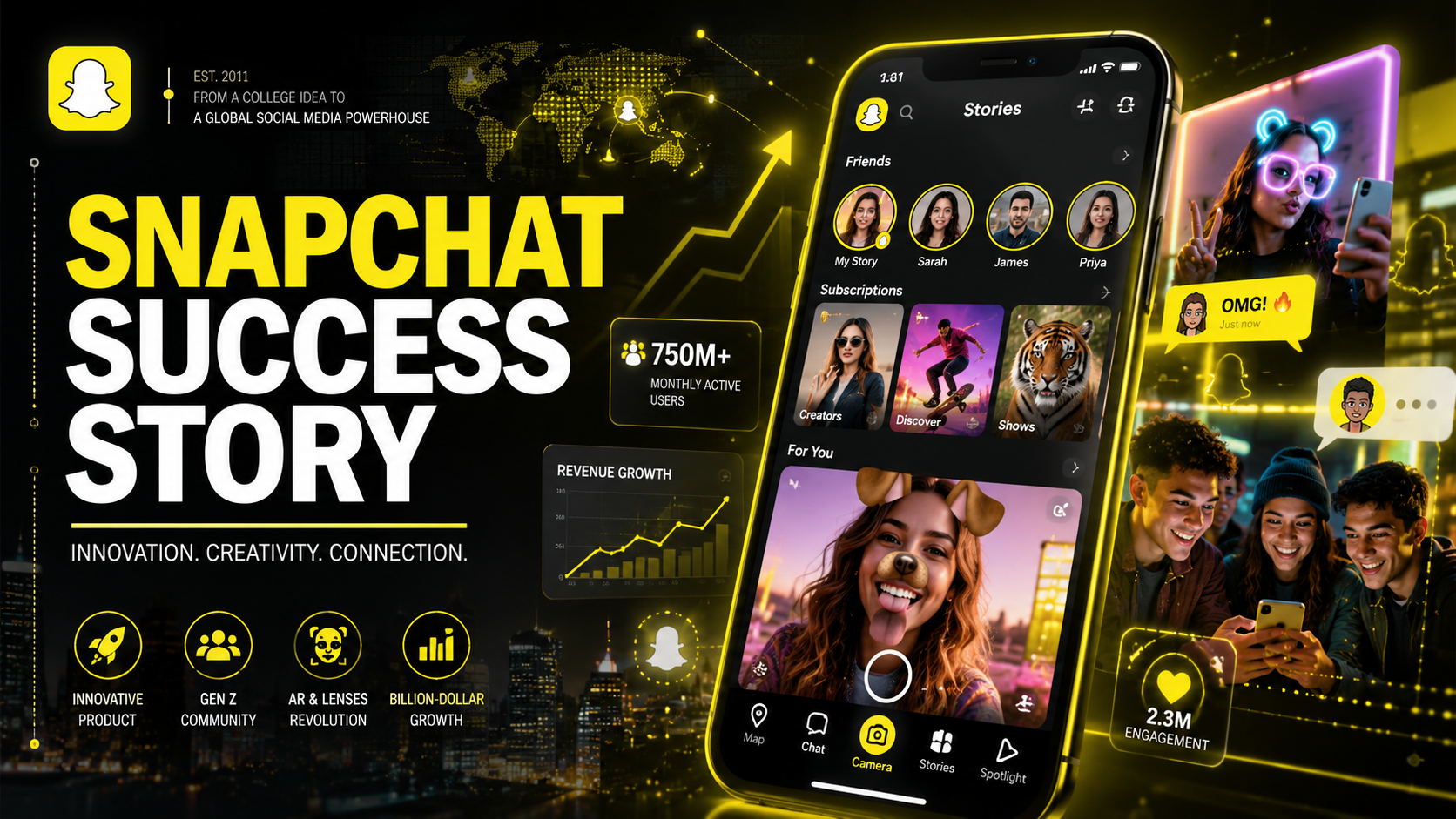
Snapchat Success Story And How a Disappearing Photo App Built a Social Media Empire

Quick Answer: Snapchat became a billion-dollar company by solving a simple problem permanent social media stress. Founded in 2011 by Evan Spiegel and Bobby Murphy, it introduced disappearing messages, Stories, and AR filters that changed how we communicate online.
Introduction
I still remember when Snapchat first started popping up on college campuses.
Everyone thought it was weird. Why would anyone want photos that disappear?
But here’s the thing Snapchat understood something that Facebook and Instagram didn’t. People were tired of creating perfect online personas. They wanted to share real moments without them living on the internet forever.
Today, Snapchat has over 400 million daily active users. It pioneered features that every social media platform now copies. And it turned down a $3 billion acquisition offer from Facebook.
This is the story of how a college project became a social media empire.
What Is Snapchat?
The Basic Concept
Snapchat is a camera-first messaging app where content disappears after viewing.
You send photos or videos (called Snaps) to friends. They view them once, and they’re gone. No permanent record. No anxiety about what you posted last year haunting you.
It sounds simple now. But in 2011, it was revolutionary.
Core features include:
- Disappearing Snaps and messages
- Stories (24-hour content)
- AR filters and lenses
- Snap Map (location sharing)
- Spotlight (short-form videos)
- Discover (media content)
Why Snapchat Was Different
Before Snapchat, social media was permanent.
Every photo you posted on Facebook stayed there. Instagram was building a culture of perfect, filtered photos. Twitter kept every tweet in your timeline forever.
People started feeling pressure. What if I don’t look good enough? What if people judge this photo?
Snapchat removed that pressure. Your content disappeared. You could be real, silly, and casual without worrying about your digital footprint.
This wasn’t just a feature—it was a psychology shift.
The Founders Behind Snapchat
Evan Spiegel’s Vision
Evan Spiegel was a Stanford student studying product design.
He wasn’t a typical tech bro. He understood design, user experience, and human behavior. He came from a business background and thought about products differently.
In 2011, he had a simple observation: people wanted to share moments without the permanence.
That idea became Snapchat.
Bobby Murphy and Reggie Brown
Bobby Murphy was Spiegel’s fraternity brother and a coding genius.
While Spiegel handled product and design, Murphy built the actual technology. He’s still Snapchat’s CTO today and co-owns the company with Spiegel.
Reggie Brown was the third founder. He actually came up with the initial idea of disappearing photos during a conversation about sexting and regretted texts.
But Brown left early. There was a messy legal battle, and he eventually settled for $157.5 million in 2014.
The Original Name: Picaboo
Snapchat wasn’t always called Snapchat.
The first version launched as “Picaboo” in July 2011. The app barely had any users. People didn’t get it.
They rebranded to Snapchat in September 2011. The new name was catchier and better explained what the app did.
Still, growth was slow at first.
The Early Days of Snapchat
Launching the App
Snapchat launched during summer break when students weren’t on campus.
Big mistake. User growth was almost zero for months.
Spiegel’s mom even tried to get her friends to download it. That’s how desperate things were early on.
But when students returned to Stanford and nearby high schools in fall 2011, something clicked.
Why Teenagers Loved It
Teenagers got Snapchat immediately.
They understood the appeal of temporary sharing. They didn’t want their parents, teachers, or future employers seeing everything they posted.
Snapchat gave them privacy and freedom that Facebook couldn’t offer.
Plus, it was fun. The interface was simple. You could draw on photos. Send silly faces to friends without overthinking it.
Viral Growth Through Schools
Snapchat spread like wildfire through high schools.
One student would download it. They’d send a Snap to a friend. That friend had to download the app to view it. Perfect viral loop.
By December 2012, Snapchat users were sharing over 1 billion photos daily.
The app hadn’t spent a dollar on marketing.
The Turning Point That Changed Everything
Introduction of Snapchat Stories
In October 2013, Snapchat launched Stories.
This was the feature that changed social media forever.
Stories let users post photos and videos that lasted 24 hours. Everyone could view them, not just individual recipients. It created a narrative of your day.
Engagement exploded. Users loved sharing casual moments without permanent commitment.
Instagram copied this feature in 2016. Facebook copied it. YouTube, LinkedIn, Twitter—everyone copied Stories.
But Snapchat did it first.
Filters and AR Lenses
Snapchat’s filters started as simple overlays—location tags, timestamps, temperature.
Then they introduced face lenses in September 2015.
The dog filter went viral. Suddenly, everyone was using Snapchat to turn themselves into puppies, rainbow-vomiting characters, or face-swapping with friends.
This was augmented reality going mainstream. Snapchat made AR fun and accessible before anyone else.
Brands started creating sponsored lenses. Taco Bell made a taco head filter. Gatorade created a “dunk” filter. These campaigns reached millions of users.
Celebrity Adoption
When celebrities started joining Snapchat, it legitimized the platform.
DJ Khaled became famous for his Snapchat Stories. Kylie Jenner used it constantly. Comedians like Kevin Hart built huge followings.
Gen Z culture was forming on Snapchat. It wasn’t their parents’ social media. It was theirs.
Snapchat’s Business Model
How Snapchat Makes Money
Snapchat doesn’t charge users to download or use the basic app.
So how do they make billions? Three main revenue streams.
1. Advertising Revenue
Snap Ads appear between Stories or in Discover content. These are full-screen vertical video ads—perfect for mobile.
Brands pay for Story Ads that appear in the Discover section. Video advertising dominates their revenue model.
The ads are native and feel part of the experience, not intrusive pop-ups.
2. Sponsored Filters and Lenses
Brands create custom AR filters for campaigns.
A movie premiere might sponsor a filter. A makeup brand creates a virtual try-on lens. McDonald’s might add a branded game.
These sponsored lenses can cost $450,000 to $700,000 for a single day during major events.
The ROI is huge because users actively engage with branded content instead of passively viewing ads.
3. Snapchat+ Subscription
Launched in 2022, Snapchat+ costs $3.99/month.
Subscribers get exclusive features: custom app icons, story rewatch count, pinned conversations, special badges.
Within the first year, Snapchat+ had over 5 million paying subscribers. That’s $20+ million in monthly recurring revenue.
Why This Model Works
Snapchat built a mobile-first advertising platform when Facebook was still desktop-focused.
Their younger audience has high engagement. Users open Snapchat 30+ times per day on average.
Visual-first content means ads blend naturally into the experience.
Snapchat’s Growth Strategy
Focusing on Gen Z
Snapchat made a strategic choice early: own the teenage demographic.
While Facebook courted everyone, Snapchat built specifically for 13-24 year-olds.
They understood youth behavior—the desire for privacy, authentic communication, and creative expression.
This created platform loyalty. When you’re 14 and all your friends use Snapchat, you’ll probably still use it at 24.
Innovation Over Competition
Snapchat has a culture of rapid experimentation.
They don’t wait for perfect features. They launch, test, and iterate quickly.
Camera-first experiences became their north star. Every feature starts with opening the camera, not a feed.
This differentiation kept them unique even when competitors copied specific features.
Fear of Missing Out (FOMO)
Snapchat engineered FOMO into the product.
Streaks count consecutive days you’ve Snapped with a friend. Break the streak, and you lose your number.
Sounds silly? Teenagers take streaks incredibly seriously. Some maintain hundreds of consecutive days.
This creates daily habits. You open Snapchat every single day to maintain streaks.
Temporary Stories create urgency too. You have to check now or miss content forever.
Snapchat vs Facebook: The Competition Battle
Facebook’s Acquisition Offer
In 2013, Mark Zuckerberg offered to buy Snapchat for $3 billion in cash.
Evan Spiegel was 23 years old. He said no.
Everyone thought he was crazy. Three billion dollars for a disappearing photo app with no revenue?
But Spiegel believed Snapchat could be worth much more. He saw the long-term vision.
That rejection became legendary in Silicon Valley. It showed confidence and belief in the product.
Instagram Copying Features
When Facebook couldn’t buy Snapchat, they tried to destroy it.
First, Facebook launched Poke—a Snapchat clone. It failed miserably.
Then in 2016, Instagram launched Stories. It was almost identical to Snapchat Stories.
Instagram had a larger user base and Facebook’s resources. Stories on Instagram exploded. Within a year, Instagram Stories had more users than all of Snapchat.
This was Snapchat’s biggest threat.
Did Snapchat Survive?
Yes, but it hurt.
Snapchat’s user growth slowed dramatically after Instagram Stories launched. The stock price dropped. Investors panicked.
But Snapchat didn’t die. They doubled down on what made them unique—AR innovation, camera-first design, and Gen Z loyalty.
Today, Snapchat has a stable user base that’s highly engaged. They survived by being different, not by being bigger.
Snapchat’s Biggest Challenges
User Growth Slowdown
Snapchat struggled to expand beyond teenagers.
Older demographics found the interface confusing. International growth was slow. Instagram and TikTok captured broader audiences.
By 2018, user growth had nearly flatlined.
App Redesign Backlash
In 2018, Snapchat released a controversial redesign.
They separated social content from media content. The interface changed dramatically.
Users hated it. Kylie Jenner tweeted “sooo does anyone else not open Snapchat anymore?” The stock dropped 6% in one day.
Over 1 million people signed a petition to reverse the redesign.
Snapchat eventually made adjustments, but the damage was done.
Financial Struggles
After going public in 2017, Snapchat faced intense pressure to become profitable.
They were losing hundreds of millions per quarter. Ad revenue wasn’t growing fast enough. Competition was fierce.
It took until Q4 2021 for Snapchat to post its first profitable quarter as a public company.
Snapchat IPO and Financial Journey
Going Public
Snapchat’s parent company, Snap Inc., went public in March 2017.
The IPO was one of the biggest tech offerings in years. The company was valued at $24 billion.
Initial investor excitement was massive. The stock jumped 44% on the first day.
Stock Market Struggles
Then reality hit.
The stock price crashed from $27 to under $5 by 2018. Investors lost confidence. User growth stalled. Instagram was winning.
Snap became the poster child for overhyped tech IPOs.
But the company fought back. They improved monetization, launched new features, and focused on profitability.
Current Position
Today, Snapchat is stabilized.
They have over 400 million daily active users. Annual revenue exceeds $4.5 billion. The stock has recovered significantly.
They’re not Instagram or TikTok in size. But they’re profitable, innovative, and deeply embedded with Gen Z.
Snapchat’s Innovation Strategy
Augmented Reality Leadership
Snapchat doesn’t see itself as a social media company.
Evan Spiegel calls Snap “a camera company.”
They’ve invested billions in AR technology. Their AR lenses are the most advanced in consumer tech.
They’re building the infrastructure for how we’ll interact with the world through cameras and AR glasses.
Snap Spectacles
Snapchat launched Spectacles—camera-enabled sunglasses—in 2016.
The idea was cool: record videos from your perspective, instantly share to Snapchat.
The execution was messy. The first version sold through vending machines and created hype but limited distribution.
Later versions added AR capabilities. The latest Spectacles have full AR displays.
They haven’t become mainstream yet. But they show Snapchat’s long-term vision beyond smartphones.
AI Integration
Snapchat recently launched My AI, powered by ChatGPT.
It’s a conversational AI assistant built into the app. You can chat with it, ask questions, get recommendations.
Over 150 million users have engaged with My AI.
Snapchat is integrating AI into lenses, content recommendations, and personalization.
Marketing Strategies That Helped Snapchat Grow
Word-of-Mouth Marketing
Snapchat spent almost nothing on traditional advertising early on.
They relied entirely on viral, user-to-user growth.
The app’s core mechanic—you have to download it to view a Snap—created a built-in viral loop.
Exclusivity helped too. It felt like a secret platform for young people.
Influencer Marketing
Snapchat partnered with creators and celebrities before “influencer marketing” was a buzzword.
They gave early access to features. They highlighted interesting accounts.
When celebrities like DJ Khaled went viral on Snapchat, millions of fans downloaded the app.
Product-Led Growth
The product itself was the marketing.
Features like Stories, filters, and lenses were so unique that users naturally wanted to share them.
User experience drove retention better than any ad campaign could.
Emotional Marketing
Snapchat positioned itself around authenticity.
Their message: be real, not perfect. Share moments, not highlights.
This resonated emotionally with a generation tired of Instagram’s curated perfection.
Why Snapchat Became So Popular
Psychological Reasons
Instant gratification: Snaps are immediate and temporary. You get quick dopamine hits.
Reduced judgment: Disappearing content means less fear of embarrassment.
Authentic communication: You can be casual without maintaining a perfect profile.
These psychological triggers made Snapchat addictive.
Solution to Social Media Fatigue
By 2013, people were getting tired of Facebook.
Everything felt performative. Your aunt commented on photos. Old posts resurfaced. Your profile was a permanent record.
Snapchat offered an escape. It was low-pressure, high-fun communication.
Camera-First Strategy
Snapchat reimagined the smartphone as a communication camera.
Instead of text-first or feed-first, they made the camera the main interface.
This felt fresh and modern. It aligned with how people actually used phones—taking photos constantly.
Key Lessons From Snapchat’s Success Story
Innovation Beats Size
Snapchat competed against Facebook, Instagram, and Google.
They won by being different, not bigger. They created new categories instead of fighting in existing ones.
Understand User Psychology
Snapchat succeeded because they understood human behavior.
The need for privacy. The pressure of permanence. The desire for authentic connection.
They built for emotions, not just features.
Focus on One Audience First
Snapchat dominated teenagers before expanding.
This laser focus created a loyal base. They became the platform for Gen Z.
Only after owning that demographic did they try to expand.
Product Experience Is Everything
Snapchat’s UX is simple and addictive.
Opening the camera immediately. Easy gesture controls. Fun, discoverable features.
The product experience drove growth more than marketing ever could.
Taking Risks Creates Opportunities
Rejecting Facebook’s $3 billion offer was risky.
Betting on AR when it wasn’t mainstream was risky.
But calculated risks built a billion-dollar company. Playing it safe wouldn’t have.
Criticism and Controversies
Privacy Concerns
Snapchat markets itself as private, but nothing digital is truly temporary.
Screenshots exist. Third-party apps can save Snaps. Data breaches happen.
Critics argue Snapchat creates false security, especially for teenagers.
Mental Health Issues
Streaks create pressure and anxiety.
Kids feel obligated to open the app daily. FOMO intensifies. Comparison culture still exists.
Studies link heavy Snapchat use to increased anxiety and depression in teens.
Content Moderation Problems
Discover features media content that isn’t always appropriate.
Snapchat has faced criticism for promoting sensationalized, clickbait content.
Drug dealers have also used Snapchat to sell illegal substances because of its perceived privacy.
Snapchat’s Future
Competing With TikTok
TikTok dominates short-form video.
Snapchat launched Spotlight in 2020 to compete. They paid creators over $250 million in the first year.
Spotlight hasn’t overtaken TikTok, but it’s become a meaningful part of the app.
AR and Wearables Vision
Snapchat is betting big on AR glasses.
They believe the future isn’t scrolling feeds on phones—it’s experiencing digital content overlaid on the real world.
If AR glasses become mainstream, Snapchat could be the platform that powers them.
Long-Term Transformation
Evan Spiegel’s vision is becoming a camera company, not just a social media company.
They’re building technology for how humans will communicate in 10-20 years.
Whether that vision succeeds remains to be seen.
Snapchat Success Story Timeline
2011: Snapchat launches as Picaboo. Rebrands to Snapchat in September.
2012: Reaches 1 billion Snaps shared daily.
2013: Stories feature launches. Facebook offers $3 billion acquisition—rejected.
2015: Discover launches. Face lenses introduced.
2016: Spectacles launch. Name changes to Snap Inc.
2017: Goes public at $24 billion valuation.
2018: Stock crashes. Controversial redesign backlash.
2020: Spotlight launches to compete with TikTok.
2021: First profitable quarter.
2022: Snapchat+ subscription launches.
2023: My AI chatbot integration.
What Entrepreneurs Can Learn
Start Simple
Snapchat began with one feature—disappearing photos.
They didn’t build everything at once. They solved one problem really well.
Solve Emotional Problems
Snapchat didn’t just solve a technical problem.
They solved social anxiety, permanence pressure, and authenticity needs.
Emotional solutions create loyal users.
Build for Behavior, Not Trends
Snapchat built for how people naturally wanted to communicate.
They observed behavior and designed around it, rather than following what was trendy.
Viral Loops Matter
The best marketing is built into the product.
Snapchat’s viral loop—download to view Snaps—drove massive growth without ad spend.
Retention Over Downloads
Snapchat focused on daily active users, not just total downloads.
Features like Streaks kept people coming back. Engagement mattered more than vanity metrics.
Conclusion
Snapchat’s story is proof that innovation can beat size.
A college project that everyone thought was silly became a company worth billions. It changed how we communicate. It pioneered features that every platform now copies.
Snapchat showed that understanding human psychology matters more than having the most users.
They took risks. They rejected massive acquisition offers. They focused on one audience first. They built for authenticity when everyone else chased perfection.
Today, Snapchat isn’t the biggest social media platform. But it’s one of the most influential.
And the story isn’t over. With AR innovation and AI integration, Snapchat is building the future of communication.
FAQs
Snapchat was founded by Evan Spiegel, Bobby Murphy, and Reggie Brown in 2011 at Stanford University. Spiegel is CEO, Murphy is CTO. Brown left early after a legal dispute and received a $157.5 million settlement.
Snapchat became popular because it solved social media anxiety. Disappearing messages reduced pressure. Stories created casual sharing. AR filters made it fun. Gen Z adopted it as their platform because it felt authentic, not performative.
Yes. In 2013, Facebook offered $3 billion in cash to acquire Snapchat. Evan Spiegel, who was 23 at the time, rejected the offer. He believed Snapchat could be worth much more long-term. That decision proved correct.
Snapchat makes money through: (1) Advertising—Snap Ads, Story Ads, and video ads, (2) Sponsored filters and AR lenses from brands, (3) Snapchat+ subscription at $3.99/month with premium features. Advertising is the biggest revenue source.
Snapchat focused on temporary content and camera-first communication. Instagram was about permanent, curated photos. Snapchat emphasized real moments over perfect aesthetics. It opened to a camera, not a feed. This psychology difference created a unique platform.
Snapchat has over 400 million daily active users and continues growing, though slower than before. They’re profitable and innovating in AR. While TikTok and Instagram are bigger, Snapchat maintains strong Gen Z loyalty and engagement.
Discover more from Business Model Hub
Subscribe to get the latest posts sent to your email.