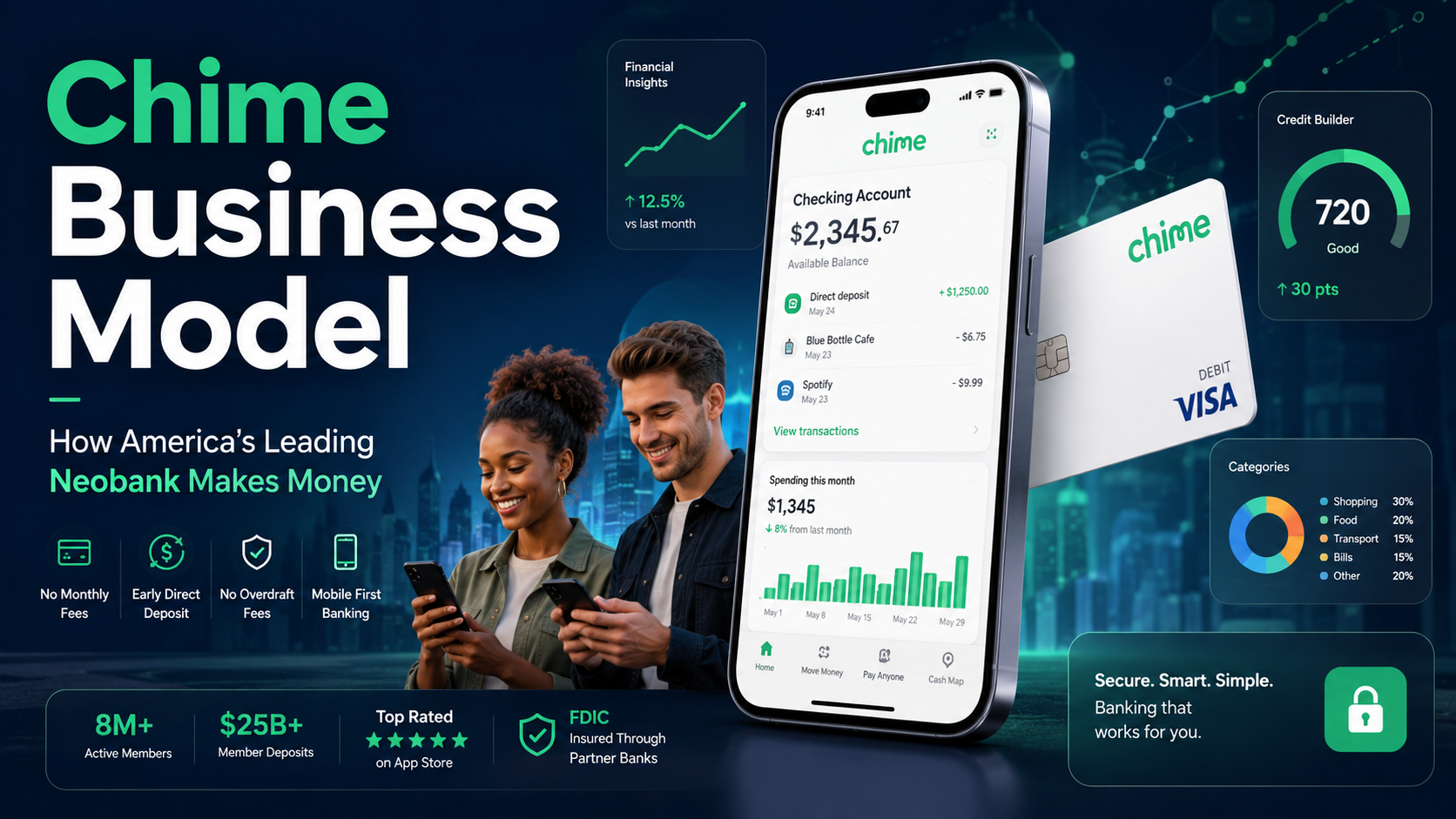

Quick Answer: Chime makes money primarily through interchange fees—small fees merchants pay every time you swipe your Chime debit card. They also earn from out-of-network ATM fees, interest on deposits held at partner banks, and premium services like Chime Credit Builder. Unlike traditional banks, Chime doesn’t charge monthly fees or overdraft penalties.
Introduction
Here’s something that confused me when I first heard about Chime: they offer completely free banking. No monthly fees. No overdraft charges. No minimum balance requirements.
So how does a company like this make billions of dollars?
I decided to dig deep into Chime’s business model. And honestly, it’s pretty clever. They’ve basically flipped traditional banking on its head.
Chime became one of America’s biggest neobanks by doing something simple. They removed the fees that people hate most. Then they built a mobile-first experience that actually works.
Today, Chime has over 13 million users. The company’s valued at around $25 billion. And they’re growing faster than most traditional banks.
But here’s the interesting part: Chime makes money without charging you directly. They’ve found ways to earn revenue that don’t involve annoying monthly fees or surprise charges.
Let me walk you through exactly how they do it.
What is Chime?
Chime isn’t actually a bank. I know that sounds weird, but it’s true.
Chime is a financial technology company a fintech platform. They provide banking services through a mobile app. But the actual banking happens through their partner banks (The Bancorp Bank and Stride Bank).
The company was founded in 2013 by Chris Britt and Ryan King. Their headquarters is in San Francisco, California.
Think of Chime as the front-end experience. They built the app, the website, the customer service. The partner banks handle the boring backend stuff like holding your money and FDIC insurance.
This is what we call a “neobank” model. No physical branches. No paper statements. Everything happens on your phone.
Why Younger Users Love Chime
Traditional banks were built for a different generation. They have branches on every corner. They charge fees for everything. Their apps feel like they were designed in 2005.
Chime said: “What if we just… didn’t do any of that?”
They targeted millennials and Gen Z users who basically live on their phones. These users don’t want to visit a bank branch. They don’t want to pay $12 a month just to have a checking account.
They want banking that works like every other app they use: simple, fast, and free.
And that’s exactly what Chime built.
Chime Business Model Overview
Let me break down how Chime’s business model actually works.
Chime operates as a technology platform that partners with licensed banks. They don’t take deposits directly. They don’t lend money themselves. They’re basically the middleman who makes everything easier.
Here’s the simple version:
- You download the Chime app
- You open an account (takes about 2 minutes)
- Chime partners with a real bank to hold your money
- You get a Chime Visa debit card
- You use their app for all your banking needs
The genius part? Chime makes money from your transactions, not from charging you fees.
Traditional banks make money by charging you monthly fees, overdraft fees, ATM fees, and interest on loans. Chime flipped this model. They make money when you use your card, not when you hold an account.
This is why they can offer “free” banking. They’re not really giving it away for free. They’re just getting paid differently.
How Does Chime Make Money?
Okay, here’s the main event. Let me show you every way Chime generates revenue.
1. Interchange Fees (Primary Revenue Source)
This is where Chime makes most of their money. And most people have no idea this even exists.
Every time you swipe your Chime debit card at a store, Chime earns a small fee. This is called an interchange fee.
Here’s how it works:
Let’s say you buy a $50 pair of shoes at Target. You pay with your Chime card. The merchant (Target) pays around 1.5% to 2% of that transaction to the payment network (Visa). A portion of that fee goes to Chime.
So on your $50 purchase, Chime might earn around $0.50 to $1.00. You don’t pay this fee. The merchant does. It’s already built into their payment processing costs.
Now imagine millions of Chime users making multiple transactions every day. Those small fees add up fast.
This is why Chime wants you to use your card. Every swipe makes them money. They’re not sitting around hoping you overdraft your account. They want you to successfully buy stuff.
This changes the incentive structure completely. Traditional banks profit when you mess up. Chime profits when you use their service successfully.
Pretty smart, right?
2. Out-of-Network ATM Fees
Chime gives you access to over 60,000 fee-free ATMs through networks like MoneyPass and Allpoint.
But if you use an ATM outside this network, you might pay a fee. Sometimes Chime earns a small cut from these out-of-network transactions.
This isn’t a huge revenue driver for them. But it’s still money in their pocket.
3. Chime Credit Builder
This is one of Chime’s newer products, and it’s pretty clever.
Chime Credit Builder is a secured credit card that helps you build credit. Here’s how it works: You load money onto the card. Then you spend that money. Chime reports your payments to credit bureaus.
You can’t go into debt with this card. You can only spend what you’ve loaded.
How does Chime make money from this? Interchange fees again. When you use the Credit Builder card, merchants pay fees just like with a regular debit card. Chime gets a cut.
Plus, it keeps users in their ecosystem. Once you’re building credit with Chime, you’re less likely to leave.
4. Interest Income on Deposits
Here’s something most people don’t think about: when you deposit money into your Chime account, that money doesn’t just sit there.
It goes to Chime’s partner banks. Those banks can lend that money out or invest it. They earn interest on your deposits.
Chime gets a portion of this interest income through their partnership agreements.
Now, they pay you some interest too (Chime offers a savings account with competitive rates). But they keep a slice for themselves.
The more money users deposit, the more interest income Chime can generate. This is why they incentivize early direct deposits and encourage savings.
5. Premium Financial Services (Future Revenue)
Chime hasn’t fully built this out yet, but it’s clearly part of their long-term strategy.
Eventually, Chime will likely offer premium services you can pay for. This could include:
- Investment accounts
- Advanced credit products
- Financial planning tools
- Business banking features
- International transfers
Right now, they’re focused on growth. But once they have tens of millions of users, they can start offering paid upgrades to people who want more features.
This is the classic fintech playbook: grow fast with free services, then monetize with premium options.
Chime’s Value Proposition
Let me tell you why people actually choose Chime over traditional banks.
Chime’s main selling point is simple: no bullshit fees.
Here’s what you DON’T pay with Chime:
- No monthly maintenance fees
- No minimum balance fees
- No overdraft fees (with SpotMe feature)
- No foreign transaction fees
- No transfer fees
Compare that to a typical bank account. Bank of America charges $12/month if you don’t maintain a minimum balance. Wells Fargo hits you with $35 overdraft fees.
Chime looked at all these fees and said: “What if we just… didn’t?”
Plus, they added features people actually want:
- Get paid up to 2 days early with direct deposit
- Automatic savings tools
- Instant transaction notifications
- Easy mobile check deposits
- Budgeting tools built into the app
The app experience is genuinely better than most banks. I’m not just saying that. Traditional bank apps feel like they were designed by people who hate technology.
Chime’s app is clean, fast, and actually makes sense.
Target Audience of Chime
Chime isn’t trying to serve everyone. They have a specific audience in mind.
Millennials and Gen Z
These generations grew up with smartphones. They expect apps to work smoothly. They don’t want to visit bank branches or talk to tellers.
Chime built an experience that matches how younger people already live their lives.
Gig Workers and Freelancers
If you drive for Uber or freelance on the side, traditional banks aren’t great. Your income is irregular. You might not maintain high balances.
Chime doesn’t care about any of that. No minimum balance. No fees for small accounts. Perfect for people with variable income.
Underbanked Americans
Around 7 million US households don’t have a bank account. Another 19 million are “underbanked” (they have an account but still use alternative financial services).
Why? Because traditional banks have barriers. Minimum deposits. Credit checks. Monthly fees. Overdraft penalties.
Chime removed most of these barriers. You can open an account in minutes. No credit check. No minimum deposit. No monthly fees.
This opens banking to people who couldn’t access it before.
People Frustrated with Bank Fees
I’ve talked to so many people who switched to Chime for one simple reason: they were sick of bank fees.
One $35 overdraft fee can ruin your week when you’re living paycheck to paycheck. Chime’s SpotMe feature lets you overdraft up to $200 without fees (if you qualify).
That alone is worth switching for many people.
Chime’s Growth Strategy
Chime grew faster than almost any bank in US history. Here’s how they did it.
Referral Marketing
Chime’s referral program is brilliant. They give you $100 when you refer a friend who sets up direct deposit. Your friend gets $100 too.
This created a viral growth loop. People tell their friends. Friends tell their friends. Everyone gets money.
It’s way cheaper than traditional advertising. And it works because people trust recommendations from friends more than ads.
Mobile-First Experience
Chime didn’t try to build a bank and then add a mobile app. They built a mobile app first. Everything else came second.
This matters because the experience is genuinely better. Opening an account takes 2 minutes. Depositing checks happens instantly. Sending money to friends is easy.
Traditional banks bolted mobile apps onto their existing infrastructure. Chime built the infrastructure around the mobile experience.
Big difference.
Financial Inclusion Positioning
Chime marketed themselves as the anti-bank. They positioned traditional banks as the enemy charging unfair fees.
This resonated with people who felt screwed over by banks. And let’s be honest—a lot of people feel that way.
Chime’s messaging was simple: “Banking that has your back.”
Brand Building and Trust
Chime invested heavily in friendly, approachable branding. Their green logo. Simple messaging. Transparent communication.
They didn’t try to look like a serious financial institution. They looked like a tech company that happens to do banking.
This attracted younger users who didn’t trust traditional banks anyway.
Chime’s Marketing Strategy
Let me show you how Chime actually acquired millions of customers.
Performance Marketing
Chime spent heavily on Facebook, Instagram, and Google ads. But they focused on performance—only paying for actual sign-ups, not just impressions.
This kept their customer acquisition costs reasonable. They could track exactly what they were spending per customer.
Influencer Partnerships
Chime partnered with YouTube creators, TikTok influencers, and Instagram personalities. These influencers explained how Chime worked and shared their referral codes.
This worked because it didn’t feel like traditional advertising. It felt like a friend recommending a product.
Social Media Advertising
Chime’s ads are everywhere on social media. And they’re good ads. They focus on specific pain points:
- “Tired of overdraft fees?”
- “Get paid 2 days early”
- “Banking with no hidden fees”
Simple messages that solve real problems. No complex financial jargon.
App Store Optimization
Chime optimized their app listing to show up when people search for “banking app” or “no fee bank” in app stores.
This drives tons of organic downloads. People searching for these terms are already interested. They just need to find the right option.
Financial Education Content
Chime publishes blog posts, videos, and guides about personal finance. This helps with SEO and positions them as helpful experts.
It’s not just about selling. They’re genuinely trying to educate people about money.
Chime vs Traditional Banks
Let me show you the key differences in a simple comparison:
| Feature | Chime | Traditional Banks |
|---|---|---|
| Physical branches | No | Yes, hundreds |
| Monthly fees | $0 | $5-$15/month |
| Overdraft fees | $0 (with SpotMe) | $25-$35 per overdraft |
| Minimum balance | None | Often $500-$1,500 |
| Account opening | 2 minutes (app) | 30-60 minutes (in-person) |
| Mobile experience | Excellent | Mixed (often clunky) |
| Early direct deposit | Yes (2 days early) | No |
| ATM network | 60,000+ fee-free | Varies widely |
| Customer service | App chat, email | Phone, in-person |
| FDIC insurance | Yes (through partners) | Yes |
The differences are pretty stark. Chime optimized for convenience and low costs. Traditional banks optimized for… well, I’m not sure what they optimized for.
Why Chime Became So Popular
Let me tell you the real reasons Chime exploded in growth.
Perfect Timing
Chime launched in 2013, right when mobile banking was becoming mainstream. Smartphones were everywhere. People were comfortable doing everything on apps.
They caught the wave at exactly the right moment.
Anti-Bank Sentiment
After the 2008 financial crisis, a lot of people didn’t trust big banks. They were looking for alternatives.
Chime positioned themselves as the good guys. They weren’t a greedy bank. They were a tech company trying to help people.
This narrative worked.
Genuinely Better User Experience
I’m not exaggerating when I say Chime’s app is better than most bank apps. It’s faster. Cleaner. More intuitive.
People switched because the experience was actually better. Not just cheaper—better.
Word of Mouth Growth
Happy customers told their friends. The referral program accelerated this. But even without referrals, people were recommending Chime.
That’s the best kind of marketing. You can’t buy that kind of authentic advocacy.
Solving Real Pain Points
Chime focused on the fees people hated most. Overdraft fees. Monthly maintenance fees. Minimum balance requirements.
They removed these pain points completely. That’s not a gimmick. That’s solving real problems.
Challenges in Chime’s Business Model
Chime isn’t perfect. They face some serious challenges.
Profitability Pressure
Chime isn’t profitable yet. They’re growing fast, but they’re also spending heavily on customer acquisition.
Eventually, investors will want to see profits. That might mean adding fees or cutting costs. Both could hurt growth.
Dependence on Interchange Fees
Almost all of Chime’s revenue comes from interchange fees. If regulations change (and they might), Chime’s entire business model could be at risk.
The Durbin Amendment already capped debit card interchange fees for big banks. If Chime gets big enough, they might face similar restrictions.
Regulatory Uncertainty
Chime operates in a gray area. They’re not technically a bank, but they offer banking services.
Regulators are still figuring out how to handle neobanks. New rules could force Chime to change how they operate.
Customer Trust Issues
When something goes wrong (fraud, account lockouts, payment delays), Chime users sometimes struggle to get help quickly.
Not having physical branches is usually an advantage. But when you need urgent support, it can be frustrating.
Fraud Prevention
Digital-only banks are targets for fraud. Chime has had issues with scammers opening accounts using stolen identities.
They’ve had to invest heavily in fraud detection. This cuts into their margins and slows down account opening for legitimate users.
Intense Competition
Every fintech company wants to be the next Chime. Competition is fierce and growing.
Chime’s early-mover advantage won’t last forever. They need to keep innovating to stay ahead.
Competitors of Chime
Chime isn’t alone in this space. Here are their main competitors:
Varo Bank
Varo became the first US neobank to get a national bank charter. This gives them more flexibility than Chime.
They offer similar features: no fees, early direct deposit, savings tools. But they’re smaller than Chime.
Current
Current targets a younger demographic with features like faster direct deposits and earnings opportunities.
They’re growing fast among Gen Z users. Their app has a more modern feel than Chime.
SoFi
SoFi started with student loans but expanded into full banking. They offer checking, savings, investing, and loans.
SoFi targets higher-income users. They’re more about wealth-building than basic banking.
Revolut
Revolut is huge internationally but smaller in the US. They offer banking plus cryptocurrency and international transfers.
They’re more feature-rich than Chime. But also more complex.
PayPal and Venmo
PayPal now offers banking features through their app. Venmo has a debit card and direct deposit options.
They have huge existing user bases. That’s a big advantage over Chime.
Traditional Banks’ Digital Offerings
Banks like Chase and Capital One have improved their mobile apps significantly.
Some now offer fee-free accounts with good mobile experiences. They’re fighting back against neobanks.
Future of Chime
Where is Chime headed? Let me share some predictions.
Expansion into Credit Products
Chime will likely offer more lending products. Personal loans, auto loans, mortgages. They have data on millions of users’ spending habits. That’s valuable for underwriting.
Credit Builder is just the beginning.
Investment Features
I’d bet Chime adds investment accounts soon. Let users buy stocks and ETFs directly in the app.
This keeps users in their ecosystem. Why switch to Robinhood when you can invest through Chime?
Small Business Banking
Millions of freelancers and small business owners could benefit from Chime-style business accounts.
This is a huge market. And Chime already understands gig workers and freelancers.
International Expansion
Chime is currently US-only. But the neobank model works globally.
International growth could multiply their user base. Though regulations vary widely by country.
AI and Personalization
Future banking will use AI to give personalized financial advice. Chime could analyze your spending and automatically save money or suggest budgets.
This is where fintech is heading.
Embedded Finance Partnerships
Chime could partner with other apps to offer banking services. Imagine getting a Chime account when you sign up for DoorDash or Uber.
This is called “embedded finance.” It’s growing fast.
Key Lessons Entrepreneurs Can Learn from Chime
If you’re building a startup, here’s what Chime can teach you.
Solve Real Frustrations
Chime didn’t invent banking. They just removed the parts people hated.
Sometimes innovation is about subtraction, not addition. What can you remove from your industry that customers hate?
User Experience Wins
Chime’s app isn’t magical. It’s just… good. But in banking, “good” is revolutionary.
Never underestimate the power of a great user experience. It’s often more important than features.
Free Can Scale
Chime proved you don’t need to charge customers directly to build a huge business.
Find alternative revenue models. If your product is good enough, money will follow from somewhere.
Distribution Over Infrastructure
Chime doesn’t have bank branches. They don’t have ATMs. They don’t have most infrastructure traditional banks have.
But they have distribution: a great app, easy sign-up, viral referrals. In the digital age, distribution beats infrastructure.
Build for Mobile First
Chime didn’t add mobile as an afterthought. They built mobile as the main experience.
This gave them a structural advantage over banks trying to retrofit mobile onto old systems.
Trust Through Transparency
Chime built trust by being transparent about fees (or lack thereof). They clearly explained how everything worked.
Transparency is a competitive advantage. Especially in industries people don’t trust.
Conclusion
So there you have it: how Chime makes money while offering “free” banking.
The short version? Interchange fees. Every time you swipe your Chime card, merchants pay a small fee. Chime gets a cut. Those small fees add up to billions when you have millions of active users.
They also make money from out-of-network ATM fees, interest on deposits, and future premium services. But interchange fees are the main driver.
Chime’s business model shows how fintech is changing banking forever. You don’t need branches. You don’t need to charge monthly fees. You don’t need to profit from customer mistakes.
You just need to build something people want to use. A lot.
The future of banking is mobile-first, fee-free, and customer-friendly. Chime proved this model works. Now everyone’s trying to copy it.
Will Chime maintain their lead? That depends on whether they can keep innovating faster than competitors. And whether they can eventually become profitable while staying true to their fee-free promise.
One thing’s certain: banking will never look the same again.
FAQs
No, Chime is not technically a bank. It’s a financial technology company. Your money is held by their partner banks (The Bancorp Bank or Stride Bank, N.A.). These are real FDIC-insured banks. So your deposits are protected up to $250,000, just like a traditional bank.
Chime makes money primarily from interchange fees—small fees merchants pay when you use your Chime debit card. They also earn from out-of-network ATM fees, interest on deposits, and their Credit Builder card. They just don’t charge you directly.
Chime is a private company owned by its founders (Chris Britt and Ryan King) and investors. Major investors include SoftBank, Tiger Global, Coatue, and others. As of 2021, the company was valued at about $25 billion.
Not yet. Chime is focused on growth rather than profitability. They’re spending heavily to acquire new customers. Like many tech startups, they’re prioritizing market share over immediate profits.
Chime removed the fees Americans hate most (overdraft fees, monthly fees, minimum balances). They built a genuinely good mobile app. They launched at the perfect time when people were ready for digital banking. And they marketed effectively to younger users frustrated with traditional banks.
Chime partners with The Bancorp Bank, N.A. and Stride Bank, N.A. These FDIC-insured banks actually hold your deposits. Chime provides the technology, app, and customer experience. This partnership model lets Chime offer banking without being a licensed bank themselves.
Discover more from Business Model Hub
Subscribe to get the latest posts sent to your email.