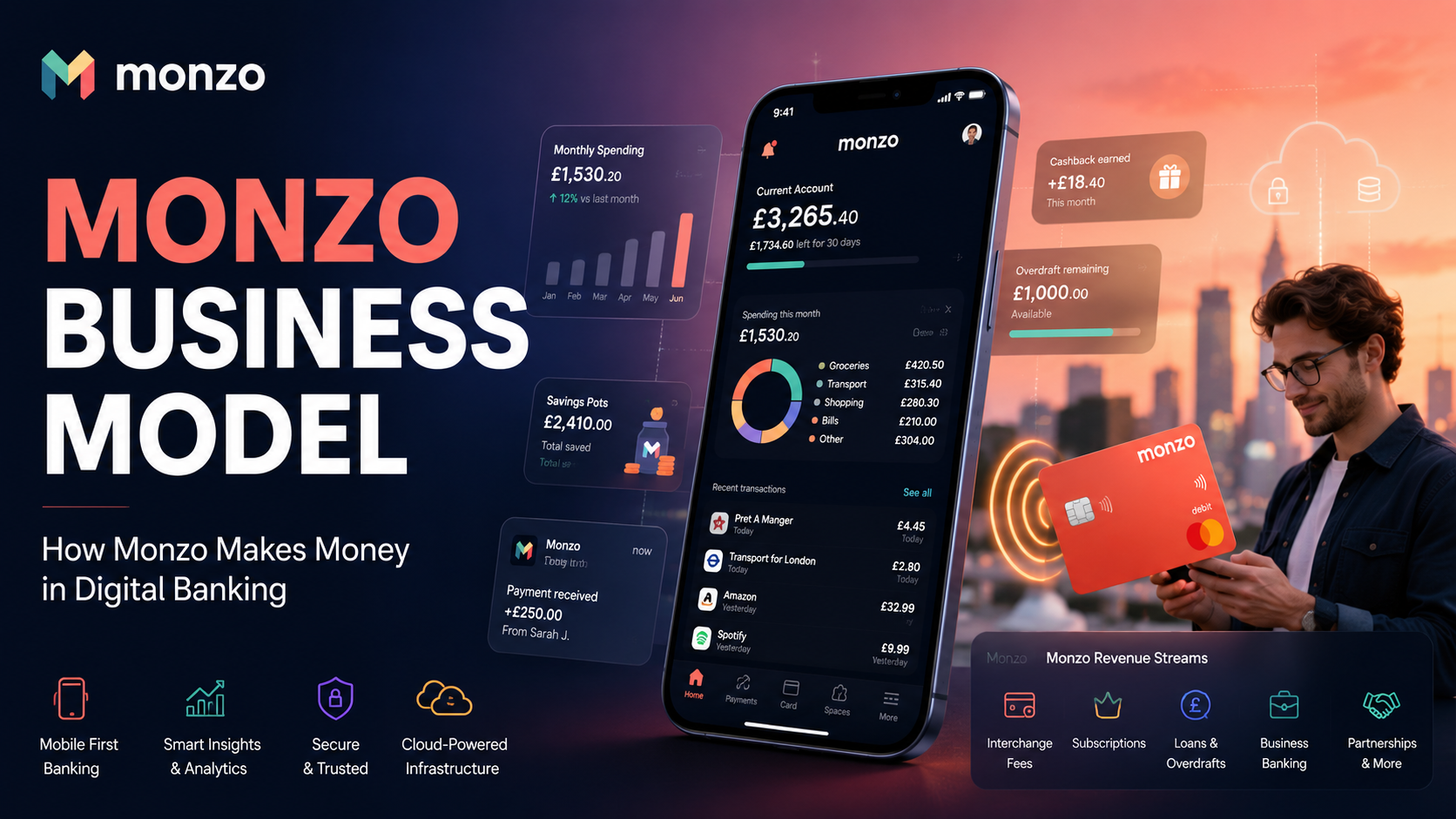
Monzo Business Model And How This Digital Bank Makes Money Without Traditional Branches

The banking industry is experiencing a digital revolution, and Monzo sits at the forefront of this transformation. This UK-based challenger bank has disrupted traditional banking by offering a completely mobile-first experience without a single physical branch.
Monzo has become one of the biggest fintech success stories in the UK, attracting millions of users who prefer managing their money through an intuitive app rather than visiting a brick-and-mortar bank. The company represents a new era of banking where convenience, transparency, and user experience matter more than marble lobbies and long teller lines.
Digital-first banking isn’t just a trend. It’s becoming the new standard, especially among younger generations who expect financial services to be as seamless as ordering food or booking a ride.
Quick answer: Monzo makes money through premium subscriptions, interchange fees, loans, overdrafts, business banking, and partnerships while operating as a fully digital bank.
What Is Monzo and Why Did It Become Popular?
Monzo started as a challenger bank in the United Kingdom with a simple mission: make banking better. The company launched with a distinctive coral-colored debit card that became instantly recognizable and a mobile app that redefined what banking could feel like.
Unlike traditional banks, Monzo operates entirely without physical branches. Everything happens through your smartphone. You can open an account in minutes, receive real-time spending notifications, and access powerful budgeting tools that help you understand where your money goes.
This approach resonated strongly with millennials and freelancers who felt underserved by traditional banks. These users wanted banking that fit their digital lifestyle, not one that required them to adapt to outdated systems and inconvenient branch hours.
The Monzo Story
Monzo was founded in 2015 by Tom Blomfield, Jonas Huckestein, Jason Bates, Paul Rippon, and Gary Dolman. The company initially operated under the name Mondo before rebranding to Monzo due to trademark issues.
The bank started with a prepaid card offering while working to secure a full banking license. In 2017, Monzo received its UK banking license, allowing it to offer current accounts with deposit protection.
Growth accelerated rapidly after that milestone. Monzo reached one million customers in 2018, two million in 2019, and continued expanding its user base year after year. The company became one of the most valuable fintech startups in Europe.
The banking license evolution was crucial to Monzo’s business model. Operating as a regulated bank allowed the company to offer a full range of financial products, including savings accounts, loans, and overdrafts. This regulatory approval also built trust with customers who might have been hesitant about keeping their money with an unregulated fintech startup.
Understanding Monzo’s Business Model
Monzo operates as a neobank, which is a type of fintech company that provides banking services entirely through digital channels. The business model combines modern technology with customer-centric design to deliver banking experiences that traditional institutions struggle to match.
The core of Monzo’s approach is building an app-based financial ecosystem. Everything you need for everyday banking lives in one place: checking your balance, making payments, splitting bills, tracking spending, saving money, and getting financial insights.
This digital infrastructure comes with a significant advantage. Monzo’s operational costs are dramatically lower than traditional banks. No physical branches means no rent, no branch staff, no maintenance costs, and no geographic limitations. The company can serve customers across the entire UK with a relatively lean team.
How Monzo Differs From Traditional Banks
The differences between Monzo and traditional banks go far beyond just having an app.
Traditional banks built their infrastructure decades ago, often running on legacy systems that are expensive to maintain and difficult to update. Monzo started fresh with modern technology, allowing the company to move faster and innovate more easily.
Physical banks require you to visit a branch for many services. Opening an account might take days or weeks. Getting a replacement card could mean waiting in line. Monzo flips this model entirely.
Here’s how they compare:
Traditional Banks:
- Physical branches in specific locations
- High operating costs for real estate and staff
- Slow onboarding processes with paperwork
- Complex fee structures with hidden charges
- Limited hours based on branch schedules
Monzo:
- Fully digital with no physical branches
- Lean operations focused on technology
- Instant onboarding through the app
- Transparent pricing with clear explanations
- Available 24/7 through your smartphone
The user experience difference is substantial. With Monzo, you can freeze your card instantly if you lose it, get spending notifications within seconds of making a purchase, and categorize transactions automatically to see where your money goes.
Speed of innovation is another major differentiator. Traditional banks need months or years to roll out new features. Monzo can test, iterate, and release updates continuously through app updates.
Revenue Streams of Monzo
Understanding how Monzo makes money requires looking at multiple revenue streams. Unlike traditional banks that rely heavily on overdraft fees and hidden charges, Monzo has built a more diversified approach to generating income.
Interchange Fees
Every time you use your Monzo card to make a purchase, the bank earns a small interchange fee. This is one of the primary revenue sources for the company.
Here’s how interchange fees work. When you swipe your card at a store, the merchant pays a processing fee to accept card payments. A portion of that fee goes to the card network (like Mastercard), another portion goes to the payment processor, and a small percentage goes to the card-issuing bank, which in this case is Monzo.
The fee is typically a small percentage of the transaction amount, usually around 0.2% to 0.3% for debit cards in the UK due to regulatory caps. While that sounds tiny, it adds up across millions of transactions.
Practical example: You spend $50 at a supermarket using your Monzo card. The merchant pays a processing fee of around $0.15. Monzo receives a portion of that fee, perhaps $0.10. Multiply that by millions of daily transactions across the entire customer base, and it becomes a meaningful revenue stream.
The beauty of this model is that it aligns Monzo’s interests with customer behavior. The more customers use their Monzo cards for everyday spending, the more the bank earns. This creates an incentive to build the best possible spending experience rather than trying to trap customers with fees.
Premium Subscription Plans
Monzo Plus and Monzo Premium represent the company’s subscription-based revenue model. These paid tiers offer additional banking features and benefits in exchange for a monthly fee.
Monzo Plus costs around £5 per month and includes features like virtual cards for online shopping, advanced budgeting tools, interest on balances, and custom spending categories. Monzo Premium, priced higher at around £15 per month, adds insurance benefits, priority customer support, and additional financial tools.
This subscription model provides recurring revenue, which is incredibly valuable for a fintech company. It creates predictability in cash flow and reduces dependence on transaction-based income that can fluctuate with economic conditions.
The approach mirrors SaaS business models that have proven successful in other industries. Rather than charging unpredictable fees when customers make mistakes, Monzo offers optional premium features for users who want enhanced banking capabilities.
Not every customer subscribes to these paid tiers. The base Monzo account remains free. But for the percentage who do upgrade, they contribute stable monthly revenue that helps the company move toward profitability.
Overdraft Fees
When customers spend more money than they have in their account, they can use an overdraft facility, which is essentially short-term borrowing from the bank. Monzo charges interest on these overdrafts, creating an income stream from lending.
The key difference with Monzo is transparency. The bank clearly shows how much an overdraft will cost before you use it. There are no hidden fees or surprise charges. If you go into your overdraft, you pay interest at a stated annual rate on the amount you’ve borrowed.
Monzo has positioned itself as offering a more responsible lending approach compared to traditional banks that historically made significant profits from punitive overdraft fees. The company caps overdraft costs and provides warnings when you’re about to enter your overdraft.
This revenue stream is significant but also sensitive. Regulators have increasingly scrutinized overdraft practices, and Monzo has had to adapt its pricing and policies accordingly. The company tries to balance earning revenue from overdrafts while maintaining its reputation for customer-friendly banking.
Personal Loans
Monzo offers personal loans to qualified customers, creating interest income through lending products. These loans allow customers to borrow larger amounts over longer periods compared to overdrafts.
The loan application process happens entirely within the app. Customers can check eligibility, see their rate, and receive funds quickly if approved. This embedded finance approach makes borrowing convenient while generating interest revenue for Monzo.
Credit risk management is crucial here. Monzo uses data and technology to assess creditworthiness and make lending decisions. The bank needs to balance approving enough loans to generate revenue while avoiding excessive defaults that could lead to losses.
Personal loans represent an opportunity for Monzo to deepen customer relationships. Users who have multiple products with the bank tend to be stickier and more valuable over time.
Business Banking Services
Monzo Business provides banking services specifically designed for freelancers, sole traders, and small businesses. This segment has become an increasingly important part of the revenue strategy.
Business accounts typically come with monthly subscription fees that are higher than personal account subscriptions. Monzo Business customers pay for features like invoice creation, tax calculation, receipt storage, and integration with accounting software.
The small and medium enterprise market represents a significant opportunity for fintech companies. Traditional banks often underserve this segment with complicated processes and generic products. Monzo saw a gap and built business banking tools that actually fit how modern freelancers and entrepreneurs work.
Revenue from business banking comes from both subscription fees and transaction-based income as these accounts often have higher spending volumes than personal accounts.
Marketplace and Partner Commissions
Monzo has built a marketplace within its app where customers can access third-party financial products. When users sign up for these partner services through the Monzo app, the bank earns referral commissions.
This includes insurance products, savings accounts from other providers, and various financial tools. The marketplace strategy allows Monzo to offer a wider range of services without building everything in-house.
Partner commissions create an additional revenue stream that requires minimal operational overhead. Monzo essentially acts as a distribution channel, connecting its large user base with partner companies that pay for customer acquisition.
This embedded finance approach turns the banking app into a financial hub. Rather than going to multiple websites to manage different aspects of their financial life, users can access everything through Monzo and the bank earns a commission for facilitating those connections.
Where Monzo Spends Money
Running a digital bank isn’t free, even without physical branches. Monzo faces significant costs across several categories.
Technology infrastructure is the foundation of everything. The company needs servers, databases, security systems, and development tools to keep the app running smoothly for millions of users. Cloud infrastructure costs can be substantial at scale.
Regulatory compliance represents another major expense. As a licensed bank, Monzo must meet strict requirements around capital reserves, reporting, auditing, and operational standards. The company needs compliance officers, legal experts, and systems to ensure it meets all regulatory obligations.
Security and fraud prevention are critical investments. Monzo must protect customer data and money from increasingly sophisticated cyber threats. This requires ongoing investment in security technology, monitoring systems, and fraud detection algorithms.
Customer support is important even for a digital bank. While automation handles many inquiries, Monzo still needs support teams to help customers with complex issues. The company has invested in building a responsive support function that maintains the quality experience customers expect.
Marketing and growth spending drives customer acquisition. While Monzo benefits from word-of-mouth and organic growth, the company still invests in marketing campaigns, partnerships, and referral programs to continue expanding its user base.
Why Digital Banks Still Burn Cash
Many neobanks, including Monzo at various points, have operated at a loss despite growing revenue. Understanding why helps explain the business model challenges.
Customer acquisition costs can be high in the competitive fintech market. Even with viral growth, acquiring each new customer requires investment in marketing, onboarding infrastructure, and often promotional offers.
The fintech space has become increasingly crowded with well-funded competitors. Revolut, Starling Bank, and other challengers are fighting for the same customers, which drives up acquisition costs and puts pressure on pricing.
Expansion into new products and markets requires upfront investment before generating returns. Building business banking, launching lending products, or entering new countries all require significant spending before they contribute meaningful revenue.
The path to profitability for digital banks involves reaching scale where revenue from millions of customers outweighs the fixed costs of running the operation. Some neobanks have achieved this, while others continue to prioritize growth over profits.
How Monzo Scaled So Fast
Monzo’s growth story is remarkable. The company went from zero to millions of customers in just a few years. This didn’t happen by accident.
Referral-led growth was central to the strategy. Early on, Monzo created a waitlist and gave existing users the ability to bump up friends who wanted accounts. This created viral loops where satisfied customers became advocates who actively recruited new users.
The customer experience itself drove growth. When people found banking that actually worked the way they wanted, they told their friends. Real-time notifications, instant spending categorization, and beautiful design created moments worth sharing.
Community-driven branding made customers feel like they were part of something special. Monzo engaged users through social media, community forums, and events. The company listened to feedback and actually implemented suggestions, making customers feel heard and valued.
Transparent communication set Monzo apart. The company shared financial results, explained challenges openly, and communicated in plain language rather than corporate speak. This transparency built trust and loyalty.
Social media marketing worked because Monzo had something worth talking about. The coral card became Instagram-worthy. The app experience generated positive word-of-mouth. The company didn’t need to rely solely on paid advertising because customers were already spreading the word.
Product-led growth meant the product itself was the best marketing tool. Every time someone used their Monzo card and received an instant notification, it demonstrated value. When friends split a bill using the app’s built-in feature, it showcased functionality that traditional banks couldn’t match.
The Power of UX in Fintech
User experience became Monzo’s competitive moat. The company proved that in banking, how you deliver services matters as much as what services you offer.
The interface is remarkably simple. You can understand your finances at a glance without decoding complex banking terminology. Transactions are categorized automatically. Your spending is visualized in ways that actually make sense.
Real-time banking notifications changed customer expectations. Knowing exactly when money leaves your account, where it went, and how much you have left creates a sense of control that traditional banking never provided.
Financial insights help users understand their behavior. Monzo shows spending trends, compares months, and highlights patterns. This turns banking from a passive necessity into an active tool for financial management.
The experience feels almost gamified in how it encourages positive behaviors. Saving money, staying within budgets, and tracking goals all feel more achievable when the interface makes it easy and even enjoyable.
Why Users Prefer Monzo
Monzo’s competitive advantages go beyond just being digital. Several factors explain why users choose and stick with the bank.
Fast onboarding means you can go from downloading the app to having a working bank account in minutes. No appointments, no paperwork, no waiting. This removes friction that traditionally made switching banks painful.
Transparent fees mean no surprises. Monzo clearly explains what costs money and what doesn’t. When fees apply, you see them upfront. This contrasts sharply with traditional banks that have complex fee schedules designed to generate revenue from customer confusion.
Smart budgeting tools are built directly into the app. You don’t need separate personal finance apps when Monzo provides spending tracking, savings pots, and financial insights natively.
The mobile app experience consistently ranks among the best in the industry. Monzo invests heavily in design and functionality, continuously improving based on user feedback.
Customer trust has been earned through consistent delivery and transparent communication. When things go wrong, Monzo acknowledges it and explains how they’re fixing it. This honesty resonates with customers tired of corporate doublespeak.
Modern branding appeals to younger demographics who want their bank to reflect contemporary values and aesthetics. The coral card, friendly tone, and approachable design all contribute to a brand that feels current rather than outdated.
The Competitive Landscape
Monzo doesn’t operate in a vacuum. Several competitors offer similar digital banking experiences.
Revolut positions itself as a global financial super app with cryptocurrency trading, stock investing, and multi-currency accounts alongside traditional banking features. The company has attracted millions of users with its international focus.
Starling Bank is another UK challenger bank with a strong reputation for customer service and a full banking license. Starling has achieved profitability, demonstrating that the neobank model can work.
N26 serves European markets with a sleek digital banking experience. The company has focused on international expansion and building a range of premium account tiers.
Each competitor has strengths, but Monzo has maintained a strong position through its focus on user experience, community engagement, and continuous product improvement.
Biggest Challenges Facing Monzo
Despite its success, Monzo faces significant challenges that could impact its long-term viability.
Profitability pressure comes from investors, regulators, and market expectations. While growth is valuable, the company needs to demonstrate it can operate sustainably without continuously raising capital.
Regulatory scrutiny has increased across the fintech industry. Banking regulations exist for good reasons, and Monzo must comply while maintaining the agility that makes it competitive. Changes in regulations around overdrafts, lending, or capital requirements can significantly impact the business model.
Rising competition makes customer acquisition harder and more expensive. As more players enter the market, differentiation becomes crucial. Monzo can’t rely on being novel anymore; it needs to be demonstrably better.
Fraud risks are an ongoing concern. Digital banks face sophisticated fraud attempts, and any security breach could damage customer trust and result in financial losses.
Economic downturns affect lending businesses. If unemployment rises or the economy contracts, loan defaults could increase while customers reduce spending that generates interchange fees.
Customer retention becomes critical as the market matures. Acquiring customers is expensive. Keeping them engaged and preventing them from switching to competitors requires continuous product improvement and value delivery.
Can Digital Banks Become Fully Profitable?
The neobank profitability debate continues across the industry. Some digital banks have achieved profitability while others continue to operate at losses.
High valuations during growth periods don’t always translate to sustainable profits. Investors may fund growth at any cost during boom times, but eventually, companies need to demonstrate they can generate more revenue than they spend.
The economics improve with scale. Fixed costs get spread across more customers. Revenue per user can increase as customers adopt more products. But reaching the necessary scale requires sustained investment and execution.
Some analysts question whether the fintech banking model can work without eventually charging fees similar to traditional banks or finding new revenue sources that might compromise the customer-first approach.
Others point to successful examples showing that digital banks can achieve profitability while maintaining competitive advantages. The debate likely won’t be settled until more neobanks have operated at scale for longer periods.
Monzo Business Model Canvas Breakdown
Breaking down Monzo’s business model into a canvas format helps visualize how all the pieces fit together.
Key Partners include payment networks like Mastercard that process transactions, banking partners that provide services Monzo doesn’t offer directly, technology providers for cloud infrastructure, and regulatory bodies that license and oversee operations.
Key Activities focus on app development and continuous product improvement, customer support and community engagement, regulatory compliance and risk management, marketing and user acquisition, and fraud prevention and security.
Value Propositions center on easy digital banking accessible anywhere, smart budgeting tools that help manage money, transparent fees without hidden charges, instant notifications and real-time insights, and a modern banking experience designed for how people actually live.
Customer Segments primarily target millennials who grew up with smartphones, freelancers and gig workers who need flexible banking, tech-savvy users who prefer digital services, people underserved by traditional banks, and small business owners seeking better business banking tools.
Customer Relationships are maintained through app-based self-service for most interactions, responsive customer support when needed, community engagement through forums and social media, transparent communication about changes and challenges, and personalized financial insights based on spending patterns.
Channels consist mainly of the mobile app as the primary banking interface, the website for information and acquisition, social media for marketing and community building, app stores for distribution, and word-of-mouth referrals from satisfied customers.
Revenue Streams include interchange fees from card transactions, premium subscription plans, overdraft interest, personal loan interest, business banking subscriptions, and marketplace partner commissions.
Cost Structure involves technology infrastructure and development, regulatory compliance and legal, security and fraud prevention, customer support operations, marketing and customer acquisition, and salaries for staff.
This canvas shows how Monzo has built an integrated system where each element supports the others in delivering value to customers while generating revenue.
Business Lessons Entrepreneurs Can Learn From Monzo
Monzo’s journey offers valuable insights for anyone building a business, especially in fintech or consumer technology.
Solve one pain point exceptionally well. Monzo didn’t try to revolutionize every aspect of banking immediately. The company focused on making everyday banking better: instant notifications, easy spending tracking, and a great mobile experience. Master one thing before expanding.
UX can become a competitive advantage. In industries where products are commoditized, user experience creates differentiation. Monzo proved that how you deliver banking services matters more than what services you offer. Great design isn’t a nice-to-have; it’s a strategic asset.
Transparency builds trust. Being open about fees, challenges, and decisions creates stronger customer relationships than marketing spin. Customers appreciate honesty and reward it with loyalty.
Community creates loyalty. Treating customers as partners rather than transactions builds emotional connections that transcend product features. Monzo’s community engagement turned users into advocates who actively promoted the brand.
Subscription models improve predictability. Recurring revenue from subscriptions provides stability that transaction-based models lack. While not every customer will upgrade, those who do contribute consistent cash flow.
Simplicity wins in fintech. Banking is complex behind the scenes, but customer-facing experiences should be simple. Removing jargon, streamlining processes, and making things intuitive reduces friction and improves adoption.
Timing matters. Monzo launched when smartphone adoption was widespread, millennials were entering prime banking years, and trust in traditional banks was declining. The company rode multiple tailwinds simultaneously.
Regulation is a feature, not a bug. Getting a banking license was challenging but ultimately became a competitive advantage. It provided credibility and allowed Monzo to offer a full range of products. Don’t avoid regulated industries; embrace the moat regulation creates once you’re licensed.
What’s Next for Monzo
The future of Monzo involves several potential directions as the company matures and the fintech landscape evolves.
AI-driven banking could transform how Monzo serves customers. Machine learning can power better fraud detection, personalized financial advice, automated savings, and predictive insights about spending patterns. As AI technology improves, banking apps could become proactive financial assistants.
International expansion represents growth opportunities beyond the UK. While Monzo has focused primarily on its home market, expanding to other countries could multiply the addressable market. However, international expansion requires navigating different regulatory environments and competitive landscapes.
Embedded finance could allow Monzo to offer banking services through other platforms. Rather than requiring customers to use the Monzo app exclusively, the company could power financial features within e-commerce platforms, gig economy apps, or other services.
Cryptocurrency integration remains a possibility as digital assets become more mainstream. Some neobanks have added crypto trading and holdings. Monzo could follow if customer demand justifies the regulatory complexity.
Business banking growth offers significant opportunity. Small businesses and freelancers represent an underserved market where Monzo has already gained traction. Expanding business banking features could drive revenue growth and increase customer lifetime value.
The financial super app vision would transform Monzo from a bank into a comprehensive financial platform. Imagine managing not just checking and savings, but also investments, insurance, mortgages, pensions, and more all through one app. This integration could increase engagement and revenue per user.
Product innovation will continue as customer needs evolve. Features like instant international payments, better savings rates, investment products, or financial planning tools could all become part of the Monzo ecosystem.
The path forward requires balancing growth with profitability, maintaining the customer-first approach while building a sustainable business, and staying innovative as the market matures.
Wrapping Up on Monzo’s Business Model
Monzo has demonstrated that digital banking can challenge established institutions by focusing relentlessly on customer experience. The company generates revenue through a diverse mix of interchange fees, subscriptions, lending, and partnerships while keeping costs low through digital operations.
The business model works because it aligns Monzo’s success with customer satisfaction. When users spend more on their Monzo cards, the bank earns more interchange fees. When customers find value in premium features, they pay for subscriptions. When borrowers need loans, Monzo provides them at transparent rates.
Digital banking is fundamentally reshaping finance. Customers increasingly expect banking to work like other digital services: instant, mobile, transparent, and user-friendly. Traditional banks are adapting, but challenger banks like Monzo set the pace of innovation.
The long-term sustainability of the fintech banking model remains to be proven at scale. Monzo and its competitors need to demonstrate they can achieve lasting profitability while maintaining the customer-friendly approach that attracted users in the first place.
What’s clear is that Monzo changed expectations for what banking should feel like. The company proved that banking experience matters as much as banking itself. A great app, transparent fees, and genuine customer focus can compete with centuries-old institutions that have vastly more resources.
For entrepreneurs, Monzo’s story illustrates the power of reimagining established industries through the lens of modern technology and customer expectations. Sometimes the biggest opportunities exist in making existing services work better rather than inventing entirely new categories.
Discover more from Business Model Hub
Subscribe to get the latest posts sent to your email.