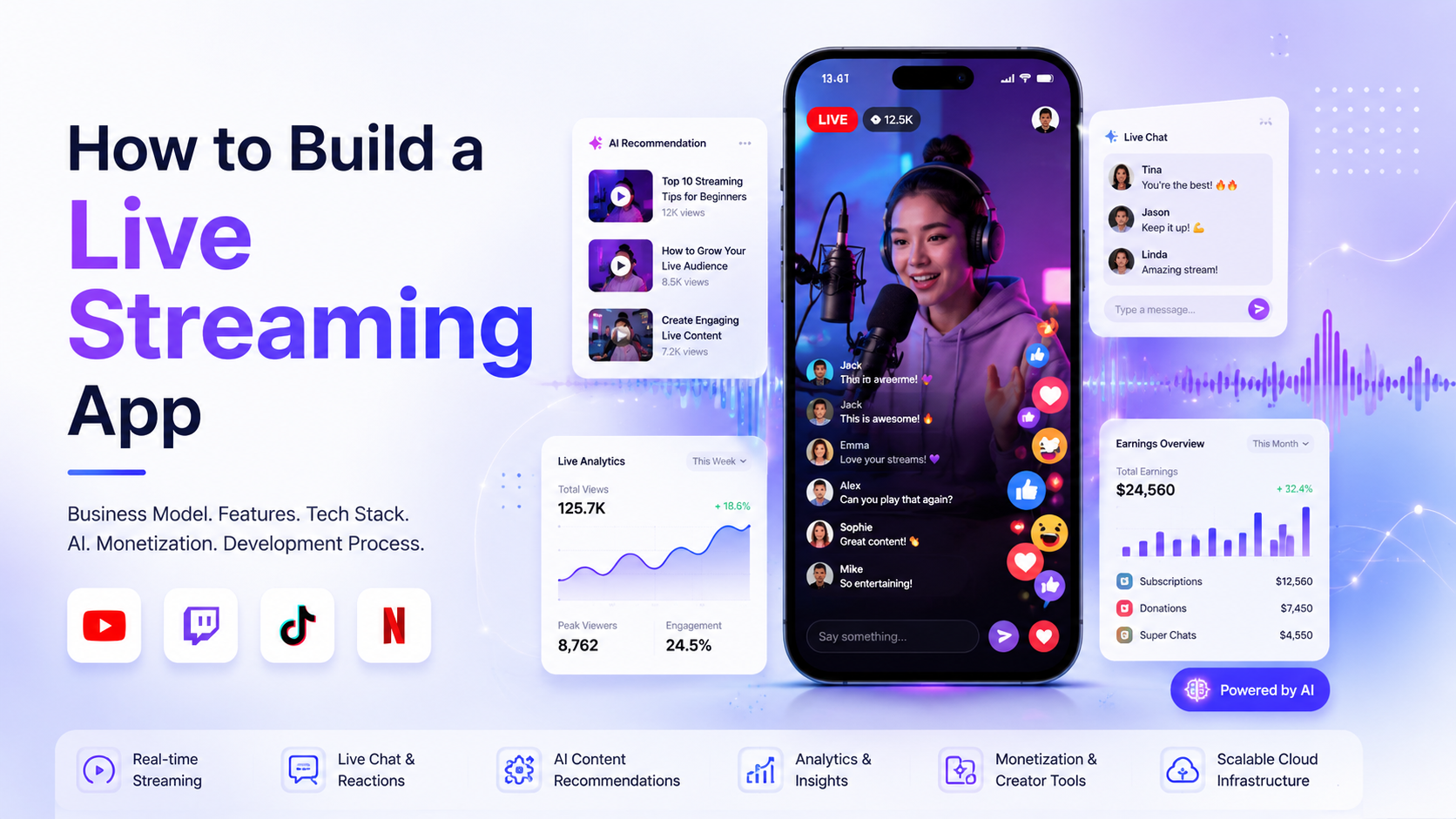

Live streaming is no longer just entertainment. It is a full business ecosystem generating billions of dollars across gaming, education, sports, social media, and enterprise communication.
The global live streaming market is projected to exceed $250 billion by 2028. Platforms like Twitch, YouTube Live, TikTok Live, and Kick have proven that real-time video content drives massive engagement, loyal communities, and serious revenue.
If you are a founder, startup, or business exploring how to build a live streaming app, this guide covers everything from business models and must-have features to tech stack, development costs, and AI integrations.
What Is a Live Streaming App?
A live streaming app is a platform that allows users to broadcast real-time video content to an audience over the internet. Viewers can watch, interact through chat, send reactions, and engage with creators or hosts in real time.
Modern streaming apps go beyond just video delivery. They include creator monetization tools, AI-powered recommendations, analytics dashboards, and community features.
Entertainment Streaming Apps
Platforms like Netflix and Disney+ deliver on-demand and live event content to subscribers globally. They focus on high-quality production, exclusive content libraries, and subscription revenue.
Gaming Streaming Apps
Twitch and Kick are built specifically for gamers. Viewers watch live gameplay, interact with streamers through chat, and support creators through subscriptions and donations.
Social Live Streaming Apps
TikTok Live and Instagram Live allow everyday creators to go live directly from their phones. These platforms focus on short-form interaction, gifting, and algorithmic discovery.
Educational Streaming Apps
Online coaching platforms, webinar tools, and e-learning apps use live streaming to deliver real-time classes, tutoring, and professional training to students worldwide.
Enterprise Streaming Platforms
Companies use private streaming platforms for virtual events, internal town halls, product launches, and large-scale corporate communication. Security and reliability are the top priorities here.
Why Businesses Are Investing in Live Streaming Apps
The business case for live streaming is stronger than ever in 2026.
Engagement is unmatched. Live content generates significantly higher engagement than pre-recorded video. Viewers spend more time watching, commenting, and interacting during live streams compared to any other content format.
The creator economy is booming. Independent creators are building audiences worth millions. Platforms that give creators tools to earn money directly from their audience are winning market share fast.
Subscription and ad revenue scale well. Once a streaming platform hits critical mass, revenue from subscriptions, ads, and in-app purchases scales without proportional cost increases.
Investors see long-term value. Creator-focused platforms attract venture capital because they combine community, content, and commerce into one product.
AI is accelerating growth. Personalized feeds, AI-generated highlights, and smart recommendations are increasing watch time and retention across every major streaming platform.
Types of Live Streaming Business Models
Choosing the right business model before you build is one of the most important decisions you will make.
Subscription Model
Users pay a recurring monthly or annual fee for access. Netflix, Spotify, and Disney Plus use this model. It provides predictable revenue and encourages long-term platform investment.
Best for: OTT platforms, premium content, ad-free experiences.
Ad-Supported Streaming Model
Content is free to watch, but revenue comes from advertisers. YouTube is the dominant example. This model works well at scale when your platform has large viewer numbers.
Best for: Broad audiences, news streaming, general entertainment.
Freemium Streaming Model
Basic features are free. Premium features require a paid upgrade. This lowers the barrier to entry while creating a clear path to monetization as users get more value from the platform.
Best for: Social streaming apps, creator tools, gaming platforms.
Pay-Per-View Model
Users pay to access specific events. Sports broadcasting, live concerts, and exclusive matches use this approach. Revenue is event-driven and can be very high per transaction.
Best for: Sports, concerts, live events, premium webinars.
Creator Monetization Model
The platform takes a cut of revenue generated by creators through gifts, donations, super chats, memberships, and tips. Twitch and TikTok operate heavily on this model.
Best for: Gaming streams, social live content, creator-first communities.
Hybrid Streaming Business Model
Most successful platforms use multiple revenue streams simultaneously. A platform might combine subscriptions, creator revenue sharing, sponsorships, and advertising to maximize income from different user segments.
Best for: Growth-stage platforms targeting long-term sustainability.
Must-Have Features in a Live Streaming App
Features define the experience. Here is what a competitive streaming app needs in 2026.
User Features
- User registration and social login (Google, Apple, Facebook)
- Live streaming with low-latency playback
- Real-time chat and comment system
- Reactions, emojis, and live polls
- Video filters and beauty modes
- Push notifications and activity alerts
- Searchable user profiles and creator pages
- Multi-device support across iOS, Android, and web
- VOD (video on demand) replay for past streams
Creator Features
- Live broadcast dashboard with stream health indicators
- Audience analytics and engagement metrics
- Monetization panel for managing revenue
- Stream scheduling and advance promotion tools
- Viewer management and ban controls
- Clip creation and highlight reels
- Collaboration tools for co-streaming
Admin Features
- Content moderation and flagging system
- User management and account controls
- Revenue dashboard and payout management
- Platform-wide analytics and reporting
- AI-assisted moderation tools for scaling oversight
AI Features for Modern Streaming Apps
AI is no longer optional. It is the competitive edge that separates good streaming apps from great ones.
- AI content recommendations: Personalized feeds based on watch history and behavior
- AI moderation: Automatic detection of harmful content, spam, and policy violations
- Auto-generated subtitles and captions: Real-time transcription for accessibility
- AI clipping and highlights: Automatic detection of key moments for short-form clips
- AI chat summarization: Quick summaries of high-volume live chat conversations
- Personalized feed algorithms: Similar to TikTok’s For You page mechanics
- AI thumbnail generation: Automatic creation of optimized stream thumbnails
These features directly improve retention, watch time, and monetization performance.
Live Streaming App Development Process
Step One: Market Research and Niche Selection
Before writing a single line of code, define your niche clearly.
Are you building a gaming stream platform like Twitch? An OTT service for original content? A social live app for creators? An enterprise webinar tool?
Each niche has different technical requirements, audience expectations, and monetization logic. Getting this wrong early costs you months of development time and significant money.
Research your competitors. Identify gaps. Find the audience segment that is underserved.
Step Two: Define Your Business Model
Map out exactly how your platform will make money before you start building.
Subscription tiers, ad inventory, creator revenue splits, pay-per-view events. Each model requires different backend infrastructure, pricing pages, and payment integrations.
A clear business model also helps your development team prioritize features correctly from day one.
Step Three: UI/UX Design
Great streaming apps are built around the viewer and creator experience.
Mobile-first design is essential. Most live streaming consumption happens on smartphones. Your UI needs to work flawlessly on small screens with one-handed navigation.
Focus on:
- Minimal friction from app open to live stream start
- Clear creator dashboard layout
- Engagement-focused viewer interface
- Fast-loading thumbnails and stream previews
Step Four: Choose the Right Tech Stack
Frontend Development
- React Native (cross-platform mobile)
- Flutter (high-performance cross-platform)
- Swift (iOS native)
- Kotlin (Android native)
Backend Development
- Node.js (real-time event handling)
- Python (AI and data processing)
- Go (high-performance microservices)
Streaming Technologies
- WebRTC (ultra-low latency, under one second)
- RTMP (Real-Time Messaging Protocol, standard for broadcasting)
- HLS (HTTP Live Streaming, adaptive bitrate for viewers)
- FFmpeg (video transcoding and processing)
Cloud Infrastructure
- AWS (Amazon Web Services, most widely used)
- Google Cloud Platform
- Microsoft Azure
CDN Providers
- Cloudflare Stream
- Akamai
- AWS CloudFront
Step Five: Backend Architecture Development
The backend is where live streaming apps succeed or fail.
Your architecture needs to handle:
Real-time communication: Chat, reactions, and notifications must update instantly across thousands of concurrent viewers.
Low latency video delivery: Streaming latency must be minimized. WebRTC delivers sub-second latency. HLS with optimized settings delivers three to ten seconds. Choose based on your use case.
Video transcoding: Incoming video streams must be transcoded into multiple quality levels (1080p, 720p, 480p, 360p) to support different internet speeds and devices.
Scalable storage: Recorded streams, VOD content, and user-generated clips require cost-efficient cloud storage with fast retrieval.
Streaming pipeline: The flow from broadcaster to viewer goes through capture, encoding, ingest servers, transcoding, CDN distribution, and playback. Each layer must be optimized.
Step Six: App Testing
Testing a live streaming app requires more than standard QA.
- Latency testing: Measure delay between broadcast and viewer playback
- Load testing: Simulate thousands of concurrent viewers to find infrastructure limits
- Performance testing: Check CPU and memory usage during extended streams
- Security testing: Protect against DDoS attacks, unauthorized stream access, and content theft
Step Seven: Launch and Scaling
Launch on both the Apple App Store and Google Play simultaneously. Submit early, as review processes can take time.
Post-launch priorities:
- Monitor server performance during peak usage
- Optimize CDN routing for different geographic regions
- Enable auto-scaling to handle traffic spikes during popular streams
- Collect user feedback and iterate on UX quickly
Live Streaming App Tech Architecture Explained
A professional streaming app is built in layers. Each layer has a specific function.
Video Capture Layer
This is where the stream originates. A broadcaster uses a phone camera, desktop software like OBS, or professional broadcasting equipment to capture and send video to your ingest server.
Encoding Layer
Raw video is encoded into a compressed format (H.264, H.265) that can be transmitted efficiently. Encoding happens on the broadcaster’s device or your media server.
Media Server Layer
Your media server receives the incoming stream, processes it, and prepares it for distribution. This layer handles the core streaming logic, including transcoding into multiple quality levels.
CDN Layer
The Content Delivery Network distributes your stream to edge servers located close to viewers worldwide. This reduces latency and prevents buffering by serving video from nearby locations.
Playback Layer
The viewer’s device receives the video stream and plays it back using the streaming protocol (HLS, DASH, WebRTC). Adaptive bitrate streaming automatically adjusts quality based on connection speed.
Analytics Layer
This layer tracks viewer counts, engagement metrics, stream health, drop-off rates, and creator performance data in real time.
AI Recommendation Layer
Machine learning models analyze viewing behavior and serve personalized content recommendations to each user. This layer is what keeps viewers watching longer.
Best Tech Stack Comparison for Live Streaming Development
Flutter vs React Native
| Factor | Flutter | React Native |
|---|---|---|
| Performance | High (compiled to native) | Good (JavaScript bridge) |
| Development Speed | Fast | Fast |
| Community | Growing | Large |
| Best For | Performance-heavy streaming apps | Rapid cross-platform development |
WebRTC vs RTMP
| Factor | WebRTC | RTMP |
|---|---|---|
| Latency | Under one second | Two to five seconds |
| Use Case | Interactive streams | Broadcast streaming |
| Complexity | Higher | Lower |
| Browser Support | Native | Requires Flash (deprecated) or conversion |
AWS vs Firebase
| Factor | AWS | Firebase |
|---|---|---|
| Scalability | Enterprise-grade | Good for early stage |
| Streaming Support | Full (IVS, CloudFront, S3) | Limited |
| Cost | Pay-as-you-go | Predictable tiers |
| Best For | Production streaming platforms | MVPs and prototypes |
How Much Does It Cost to Build a Live Streaming App?
Cost depends heavily on features, team location, and infrastructure requirements.
MVP Development Cost
A minimum viable product with core streaming, user accounts, chat, and basic monetization typically costs between $30,000 and $80,000.
This covers essential features only. No advanced AI, no complex recommendation systems, no enterprise-grade infrastructure.
Mid-Level Streaming Platform Cost
A competitive platform with AI features, multi-monetization models, creator dashboards, analytics, and solid backend architecture ranges from $80,000 to $200,000.
Enterprise Streaming App Cost
A full-scale OTT or enterprise streaming platform with custom AI, multi-region infrastructure, advanced moderation, and deep analytics can exceed $300,000 to $500,000 or more.
Key Cost Factors
- Number of features and complexity
- Streaming quality requirements (4K vs 1080p vs 720p)
- AI integrations and machine learning models
- CDN and cloud infrastructure costs (ongoing)
- Development team size and location
- Ongoing maintenance and scaling costs
Biggest Challenges in Live Streaming App Development
Building a streaming app is technically complex. Here are the challenges you need to plan for.
Latency: Keeping stream delay low while maintaining quality is an ongoing engineering challenge. WebRTC helps but adds architectural complexity.
Server scaling: A popular stream can spike from 100 to 100,000 viewers in minutes. Your infrastructure must handle this without crashing.
Video buffering: Buffering destroys user experience. CDN optimization and adaptive bitrate streaming are essential solutions.
Real-time synchronization: Chat, reactions, and viewer counts must all sync across thousands of clients simultaneously.
Content moderation: As your platform grows, manually reviewing content becomes impossible. AI moderation tools are critical but not perfect.
Infrastructure costs: High-quality live streaming is expensive to serve at scale. CDN costs, transcoding compute, and storage add up quickly.
Content piracy: Unauthorized copying and restreaming of your platform’s content is a real threat. DRM and watermarking technologies help protect against this.
How AI Is Changing Live Streaming Apps in 2026
AI is fundamentally reshaping how streaming platforms operate and how viewers consume content.
AI-generated clips: Platforms automatically detect highlights and create short shareable clips without any creator input. This extends content reach far beyond the live stream itself.
AI stream recommendations: Instead of showing popular content, AI serves each viewer exactly what they are most likely to watch next based on their behavior patterns.
AI moderation at scale: Machine learning models detect hate speech, nudity, violence, and spam in real time across thousands of simultaneous streams. This allows small teams to moderate massive platforms.
AI stream summaries: Long streams are automatically summarized into text or short video recaps, making content more accessible and discoverable.
AI personalization: TikTok’s algorithm is the gold standard here. Every streaming platform now needs a personalized feed system that improves with every user interaction.
AI engagement systems: Smart notification timing, optimal stream scheduling suggestions, and predictive analytics help creators grow their audiences faster.
YouTube, TikTok, and Netflix all invest heavily in AI-driven personalization, and it is the primary driver of their watch time metrics.
Live Streaming App Monetization Strategies
Subscriptions
Offer monthly or annual plans with ad-free viewing, exclusive content, or premium features. This creates predictable recurring revenue.
Advertising
Serve pre-roll, mid-roll, and banner ads to free users. This works at scale with strong viewer numbers and CPM rates.
Sponsorships
Partner with brands to sponsor streams, events, or creator channels. Sponsorships can generate significant revenue without taking anything from viewers directly.
Donations and Tips
Let viewers send money directly to creators during live streams. TikTok coins, Twitch Bits, and YouTube Super Chats are proven implementations of this model.
In-App Purchases
Sell virtual goods, custom emotes, exclusive stickers, and profile upgrades. These purchases feel low-cost to buyers but generate strong aggregate revenue.
Affiliate Commerce
Let creators promote products during streams with affiliate links. The platform takes a percentage of sales driven through the app.
Creator Marketplace
Build a marketplace where brands can find and hire creators for sponsored content directly through your platform. Take a transaction fee on every deal.
How to Scale a Streaming Platform Successfully
Scaling is not just about adding more servers. It requires architectural planning from day one.
Multi-region servers: Deploy infrastructure in multiple geographic regions to reduce latency for viewers worldwide.
CDN optimization: Configure your CDN with smart routing rules, caching strategies, and edge node selection to minimize buffering.
Cloud auto-scaling: Use AWS Auto Scaling or similar tools to automatically increase compute capacity during traffic spikes and reduce it during quiet periods.
Microservices architecture: Break your backend into independent services for streaming, chat, notifications, payments, and analytics. Each can scale independently based on demand.
Edge computing: Process video and data closer to the viewer using edge computing nodes to reduce round-trip latency.
Best Examples of Live Streaming Apps
Twitch
Twitch built its empire on gaming streams and community culture. Its business model combines subscriptions, Bits (virtual currency), ad revenue, and brand sponsorships. The creator-first approach and strong community features are core to its success.
YouTube Live
YouTube Live benefits from the world’s largest video platform infrastructure. Its monetization includes Super Chats, memberships, and ad revenue. The AI-powered recommendation system drives massive discovery for live content.
TikTok Live
TikTok Live is built around gifting. Viewers buy virtual coins and send gifts to creators. The For You page algorithm drives live content discovery to exactly the right audience at exactly the right time.
Netflix
Netflix uses live streaming for sports, comedy specials, and reality TV events. Its strength is production quality and a massive subscriber base willing to pay for premium content.
Kick
Kick launched as a Twitch alternative with a more creator-friendly revenue split. It shows that there is appetite for new entrants in the streaming market if they offer better terms to creators.
Why Startups Should Build Streaming Apps in 2026
The timing is genuinely strong for new streaming platforms.
Creator economy growth: Millions of independent creators are looking for platforms that give them better tools, better revenue splits, and better community features.
AI content tools are democratized: Startups can access the same AI models and APIs that large companies use, leveling the playing field for building smart streaming features.
Digital communities are valuable: Platforms that build tight-knit communities around content create high switching costs and strong retention.
Monetization is diverse: Unlike e-commerce or SaaS, streaming platforms have multiple revenue streams available simultaneously from launch.
Interactive media is the future: The line between passive content consumption and interactive participation is blurring. The next generation of streaming apps will be far more interactive than what exists today.
Why Choosing the Right Live Streaming App Development Company Matters
Building a live streaming app is not the same as building a standard mobile app. It requires specialized expertise.
Technical scalability expertise: Your development partner needs to understand distributed systems, CDN integration, and real-time video infrastructure at scale.
Security knowledge: Streaming platforms face DDoS attacks, content theft, and unauthorized access attempts. Security must be built in from the start.
AI integration capability: Modern streaming apps require machine learning models for recommendations, moderation, and personalization. Your dev team needs this skill set.
Architecture planning: Poor architecture decisions made early are extremely expensive to fix later. Choose a team that plans for scale before building.
Post-launch support: Streaming infrastructure requires ongoing maintenance, optimization, and rapid response to outages. Your partner needs to be available after launch day.
Wrapping Up
Live streaming apps in 2026 are digital ecosystems, not just video players.
The most successful platforms combine strong infrastructure, creator-friendly monetization, AI-powered personalization, and community features that keep users coming back daily.
Before investing in development, get clear on your niche, your business model, and your monetization strategy. These decisions shape every technical choice that follows.
AI is no longer a nice-to-have feature. It is the engine driving watch time, creator growth, and platform revenue across every major streaming platform on the market.
Infrastructure matters more than flashy UI. A beautiful app that buffers loses to a simple app that streams flawlessly every single time.
The opportunity to build the next breakout streaming platform is real. The creator economy is still growing. Underserved niches still exist. Founders who combine solid business model thinking with the right technical team have a genuine shot at building something that scales.
Business Model Hub helps startups and businesses understand streaming business models, monetization strategies, platform scalability, creator economy opportunities, and app development planning. Whether you want to launch the next creator platform, OTT app, gaming stream app, or AI-powered live streaming platform, understanding the business side is just as important as the development itself.
Discover more from Business Model Hub
Subscribe to get the latest posts sent to your email.

[…] cost to develop a live streaming app typically ranges from $15,000 to $300,000+ depending on features, platform, scalability, and […]