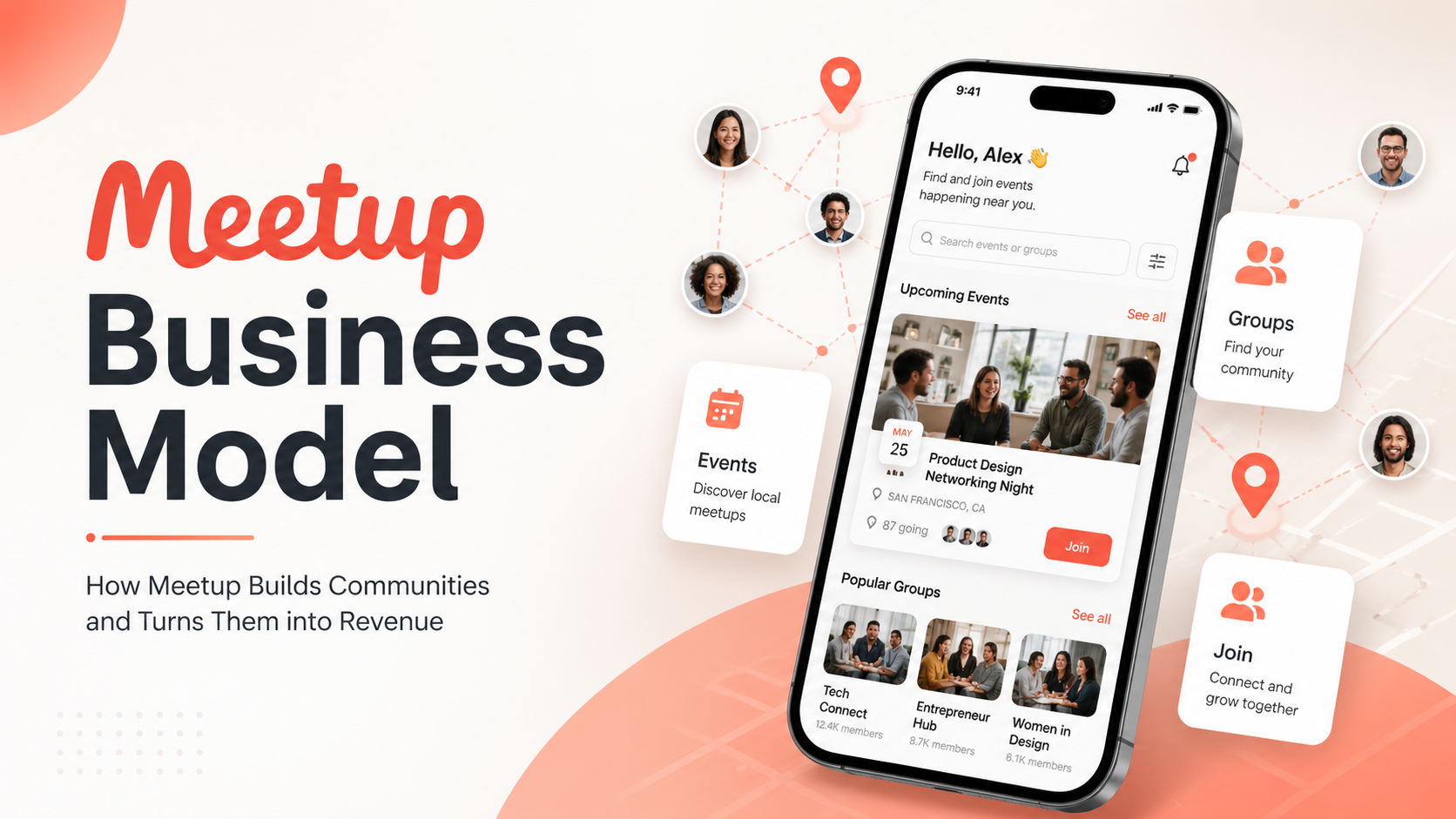
Meetup Business Model And How Meetup Turns Communities into Recurring Revenue

Meetup uses a community-led subscription model. It charges organizers to create and manage groups while letting members join and attend events for free. The platform monetizes the supply side (organizers) rather than the demand side (users), which is a deliberate and scalable approach to marketplace revenue.
Intro
Most social platforms sell your attention to advertisers. Meetup does something different. It sells access to community building.
While Facebook and Instagram monetize eyeballs, Meetup monetizes belonging. It connects people with shared interests in the real world, and it charges the people who make those connections happen.
That single insight shapes everything about how Meetup operates, grows, and generates revenue.
What is Meetup?
Meetup is an online platform designed to facilitate offline gatherings. It allows people to find and join local groups organized around shared interests, from tech talks and hiking clubs to book circles and entrepreneurship forums.
Founded: 2002, by Scott Heiferman in New York City, following the social solidarity he witnessed after 9/11.
Ownership history: Meetup was acquired by WeWork in 2017 for a reported $156 million. After WeWork’s financial collapse, Meetup was sold to AlleyCorp in 2020 and has operated independently since.
Mission: To bring people together in real life, forming meaningful communities around shared passions.
Meetup currently hosts millions of groups across hundreds of countries, covering virtually every interest category imaginable.
The Problem Meetup Solves
Urban Loneliness
Despite being more digitally connected than ever, people in cities report increasing levels of loneliness and social isolation. Digital friendships lack depth. Meetup addresses the gap between online connection and real-world belonging.
Difficulty Finding Niche Communities
If you are into urban beekeeping, competitive chess, or Python programming, finding your people locally is hard. Meetup aggregates niche communities and makes them searchable and accessible.
Lack of Real-World Interaction
Remote work, digital entertainment, and busy schedules have reduced spontaneous in-person interaction. Meetup creates structured opportunities for people to show up and engage with others face to face.
Event Discovery Problem
Local events are scattered across flyers, Facebook posts, and neighborhood apps. Meetup centralizes event discovery in one place, filtered by interest and location.
How Meetup Works
For Members
The experience for a regular Meetup user is simple and free.
Discover: Users search for groups by interest or location. The platform surfaces relevant communities based on profile preferences.
Join: Joining a group is free. Members can browse upcoming events, see who else is attending, and read group discussions.
Attend: Members RSVP for events. Some events are free, some have a small fee set by the organizer. The member shows up, meets people, and builds community.
The friction is intentionally low for members. There is no paywall to discover or join groups.
For Organizers
Organizers are the backbone of the platform, and they operate under a paid model.
Create a group: Organizers set up a group with a name, description, topic tags, and location.
Pay a subscription: To keep the group active and visible, organizers pay a recurring fee. This is the core of Meetup’s revenue model.
Host events: Organizers schedule events, manage RSVPs, communicate with members, and build their community over time.
Grow the community: As the group gains traction, organizers can charge for premium events, partner with sponsors, or use Meetup as a customer acquisition tool for their business.
Meetup’s Business Model Explained
Meetup operates as a platform business, but it does not follow the typical two-sided monetization playbook. Most marketplaces charge both sides. Meetup charges only one.
The platform monetizes organizers, the people who create and host communities. Members use the platform for free.
This works because members are not just consumers. They are the value proposition for organizers. Without a large, engaged member base, organizers would have no reason to pay. So Meetup keeps the demand side frictionless to maximize supply-side willingness to pay.
Core insight: Meetup charges the people who build value hubs, not the people who consume them. Organizers are essentially paying for distribution access to a qualified, interest-matched audience.
This is closer to the SaaS model than the advertising model. Revenue is predictable, recurring, and tied directly to the organizer’s continued use of the platform.
How Meetup Makes Money
Organizer Subscription Fees
This is Meetup’s primary and most consistent revenue stream.
Organizers pay a subscription to maintain their group on the platform. Pricing has varied over the years, but Meetup typically offers:
Monthly plans: Charged on a per-month basis, giving organizers flexibility.
Bi-annual or annual plans: Offered at a discount to encourage longer commitment and improve Meetup’s revenue predictability.
The subscription unlocks full group management tools including unlimited events, member communication, RSVP management, and group analytics.
An organizer running a thriving community has every reason to keep paying because the platform is actively delivering value in the form of engaged members and event attendance.
Event Monetization Layer
Beyond subscriptions, Meetup supports a secondary layer of monetization through events.
Paid events: Organizers can charge members a ticket fee to attend events. Meetup facilitates this payment and takes a processing cut.
Ticket integrations: Larger events can integrate with ticketing infrastructure, allowing organizers to manage capacity, collect payments, and track attendance all within the platform.
This layer benefits both organizers and Meetup. Organizers unlock a revenue stream from their community. Meetup earns a percentage without increasing its own overhead.
Partnerships and Corporate Communities
Meetup has increasingly moved into the enterprise space.
Brands and corporations can use Meetup to build and manage communities around their products or services. A software company might run a developer meetup series. A fitness brand might sponsor local running clubs.
These partnerships generate revenue through:
Sponsored community programs: Brands pay to host or co-brand community groups.
Corporate community plans: Enterprise pricing for companies that want to run multiple groups or events at scale.
This revenue stream is less commoditized and harder to replicate, making it a strategic priority for Meetup’s growth.
Pricing Strategy
Meetup’s pricing philosophy is built around a clear freemium structure.
For members: Completely free to join, browse, and attend most events. This drives volume and ensures organizers always have an audience to build for.
For organizers: A paid subscription that unlocks the ability to create and manage groups. The price point is kept accessible enough that individual community builders can afford it, not just businesses.
Low barrier, scalable model: Because the product is digital and the cost to serve an additional organizer is minimal, Meetup can scale revenue without scaling costs proportionally. Each new paying organizer adds margin.
The freemium approach also creates a natural upgrade path. Members who develop a passion for community building often become organizers themselves, converting from free users to paying customers without any sales effort.
Value Proposition
For Members
Real-world connections: Unlike social media, Meetup results in actual face-to-face interaction, which research consistently links to better mental health, stronger relationships, and greater life satisfaction.
Interest-matched networking: Every group is organized around a specific topic, so the people you meet at a Meetup already share at least one thing in common with you.
Learning and skill development: Many Meetup groups are structured around professional development, coding, languages, or entrepreneurship, making them informal but valuable learning environments.
Zero cost entry: Members get all of this without paying a cent, which removes every barrier to participation.
For Organizers
Built-in audience: Organizers do not have to build their audience from scratch. Meetup’s member base is already there, searching for communities.
Community monetization tools: Paid events, sponsorships, and merchandise are all facilitated through or alongside the platform.
Event management infrastructure: RSVPs, reminders, communication, and attendance tracking are all handled by Meetup, so organizers focus on running their community rather than managing logistics.
Brand and thought leadership: Running a successful Meetup group positions an organizer as a community leader, which has professional and reputational value beyond the platform itself.
Business Model Canvas of Meetup
Customer Segments
Individual members: People looking for social connection, learning opportunities, or niche communities in their city.
Community organizers: Passionate individuals who want to build and lead communities around shared interests. They range from hobbyists to professional community managers.
Businesses and brands: Companies that use Meetup as a community-building or customer engagement channel, often at a larger scale with enterprise needs.
Value Propositions
For members: Easy discovery of local, interest-based communities and events. Free access. Real-world connection.
For organizers: Turnkey community infrastructure. Access to a large, searchable user base. Tools to run events, communicate with members, and grow an audience.
For businesses: A trusted platform for branded community building, with built-in credibility and an existing user base to tap into.
Channels
Website: The primary discovery and management interface, optimized for both search-driven acquisition and direct navigation.
Mobile app: Critical for on-the-go event browsing, RSVP management, and last-minute event discovery.
Email notifications: High-intent engagement channel. Meetup sends event reminders, new group suggestions, and activity updates that consistently drive return visits.
Search engine visibility: Many Meetup group pages and event pages rank in Google for interest-plus-location queries, making organic search a major acquisition channel.
Customer Relationships
Self-service platform: Most users and organizers manage everything independently. The product is designed to be intuitive without requiring support.
Community-driven engagement: Members engage with each other, not just the platform. This creates organic retention that does not require Meetup to actively maintain every relationship.
Notifications and recommendations: Algorithmic nudges keep users connected to relevant events and groups, reducing churn without human intervention.
Revenue Streams
Organizer subscriptions: The primary recurring revenue source. Predictable, scalable, and tied directly to platform usage.
Event-related fees: Transaction fees on paid event tickets. Variable revenue that scales with event volume.
Enterprise and partnership revenue: Custom pricing for brands and businesses running communities at scale.
Key Resources
Platform technology: The core product, including the website, mobile app, search infrastructure, and event management tools.
User base: Millions of members who represent the value that organizers are paying to access.
Organizer network: The community leaders who create and sustain the content and activity on the platform.
Brand trust: Meetup has been around since 2002. That longevity creates trust that new entrants cannot easily replicate.
Key Activities
Platform development and maintenance: Keeping the product fast, reliable, and feature-competitive.
Community moderation tools: Building tools that help organizers manage group health and enforce community standards.
Organizer support: Helping new organizers succeed, which directly protects subscriber retention.
Marketing and growth: Driving awareness among potential organizers and members, particularly in new cities or interest categories.
Key Partnerships
Payment gateways: Stripe, PayPal, and similar processors handle ticket transactions and subscription billing.
Event venues: Partnerships or integrations with co-working spaces, bars, community centers, and other venues that host Meetup events.
Corporate and brand partners: Companies that sponsor or co-create community groups, providing Meetup with revenue and organizers with resources.
Cost Structure
Technology infrastructure: Servers, development, and maintenance of a platform serving millions of users globally.
Marketing and user acquisition: Paid and organic marketing to grow both the member and organizer base.
Customer support: Handling organizer issues, billing problems, and community disputes.
Platform development: Ongoing product investment to stay competitive and improve organizer and member experience.
Mini Insight: Meetup’s canvas reveals a lean model. Users generate the content and community value. Organizers fund the platform. Meetup provides the infrastructure and distribution. It is a capital-efficient model where community creation is outsourced to passionate individuals who are happy to pay for the privilege.
Network Effects in Meetup
Meetup benefits from a classic multi-sided network effect, and it compounds over time.
More organizers create more groups. As more community leaders join, the variety of groups expands, covering more interests, more neighborhoods, and more demographics.
More groups attract more members. A richer event calendar draws more users to the platform. People who could not find their niche before suddenly can.
More members make organizers more successful. Higher attendance validates the organizer’s effort and increases the return on their subscription. It also attracts more organizers who see that communities can thrive here.
This loop is self-reinforcing. Once a city reaches a critical mass of groups and members, Meetup becomes the default destination for community discovery in that market. Competitors face an increasingly high bar to displace it.
The key vulnerability is that network effects can also work in reverse. If a major cohort of organizers leaves due to pricing changes or a competing platform, member activity drops, which discourages new organizers from joining. This is why organizer retention is the single most important operational metric for Meetup.
Growth Strategy
Organic and Word-of-Mouth Growth
Most Meetup discovery happens through personal recommendation. Someone attends their first event, loves it, tells a friend. That friend joins, attends, and eventually starts their own group. The cycle repeats without any paid marketing.
This organic loop is powerful because it is interest-specific. People recommend Meetup groups to people who are precisely the right fit, so conversion and retention are naturally high.
Community-Led Growth
Meetup’s most reliable growth mechanism is the member-to-organizer pipeline.
A member attends events for months or years. They build relationships within the community. When the organizer steps back or a new interest emerges, that engaged member starts their own group. They go from free user to paying subscriber without any sales funnel.
This is a textbook example of product-led growth, where the best customers come from within the existing user base.
SEO and Event-Based Discoverability
Meetup has a significant organic search advantage. Every group page and event page is a potential search landing page. Queries like “Python meetup in Austin” or “book club New York” often surface Meetup results at or near the top of Google.
This creates a flywheel. More events generate more indexed pages. More indexed pages drive more organic traffic. More traffic means more members and organizers, which generates more events and more pages.
It is a content and SEO advantage that compounds quietly in the background, reducing Meetup’s dependence on paid acquisition.
Competitive Analysis
Eventbrite
Eventbrite focuses on one-off events and ticket sales rather than recurring community building. It monetizes differently, primarily through ticketing fees charged to organizers per transaction. Meetup is subscription-based and community-focused. They serve overlapping but distinct use cases.
Eventbrite is better for large, one-time events. Meetup is better for building an ongoing community that meets repeatedly.
Facebook Groups
Facebook Groups is Meetup’s most direct competitive threat. Groups are free, ubiquitous, and deeply integrated into a platform where most people already spend time.
But Facebook Groups lacks Meetup’s offline-first design, interest-based discovery, and event management tools built specifically for recurring gatherings. Facebook is optimized for content consumption. Meetup is optimized for showing up in person.
Bumble BFF
Bumble’s BFF feature addresses social loneliness through one-on-one friend matching. It is a different mechanic. Meetup is group-based and interest-organized rather than individual matchmaking.
They serve similar emotional needs but through very different product experiences.
Where Meetup wins: Its offline-first positioning, niche community depth, and organizer tooling are purpose-built for recurring real-world gatherings. No competitor has fully replicated that combination.
Strengths
Recurring subscription revenue: Unlike transaction-based models, subscriptions provide predictable cash flow that compounds as the organizer base grows.
High community engagement: People who attend Meetup events regularly build genuine relationships. That social investment creates platform stickiness that purely digital products struggle to match.
Community stickiness: When an organizer builds a thriving group over years, leaving the platform means abandoning their community infrastructure, member history, and event archive. The switching cost is real.
Long brand history: Two decades of operation creates credibility and organic SEO authority that newer entrants cannot buy.
Weaknesses
Organizer dependency: The entire model depends on organizers continuing to pay. If a key segment of organizers churns, due to pricing, competing platforms, or life changes, revenue and community quality both suffer quickly.
Free alternatives exist: Facebook Groups, Discord servers, and WhatsApp communities offer organizer tools at no cost. Meetup must constantly justify its subscription price through superior discoverability and tooling.
Event inconsistency: Meetup cannot control event quality. A poorly run group reflects on the platform even though Meetup did not create the problem. Inconsistent event experiences can turn members away.
Geographic concentration: Meetup is strongest in major metros. In smaller cities, the group density may be too low to provide a valuable discovery experience for new users.
Real-World Example: How the Model Plays Out
Here is a concrete example of Meetup’s model in action.
A software engineer in Chicago wants to connect with other developers. She searches Meetup for Python groups in Chicago. She finds three active groups, joins all three for free, and RSVPs to an upcoming event.
Meanwhile, the organizer of one of those groups, a developer advocate at a tech company, pays a monthly subscription to keep the group active and visible. He schedules a monthly meetup at a local co-working space. He charges a small $5 ticket fee to cover the cost of pizza and drinks.
Meetup earns from the organizer’s subscription. Meetup earns a small processing fee on each ticket sold.
The engineer attends, loves the community, and eighteen months later, when the organizer moves to another city, she takes over the group. She becomes a paying subscriber. The model regenerates itself.
This cycle, member becomes organizer, happens thousands of times across Meetup’s platform every year.
The Future of Meetup
Hybrid Events
The pandemic permanently expanded what a “meetup” means. Hybrid events, with some attendees in person and others joining via video, are now a core expectation. Meetup’s infrastructure needs to support both modes seamlessly.
AI-Powered Recommendations
Meetup is positioned to use AI to dramatically improve event and group recommendations. A member’s attendance history, interests, and social graph within the platform could power hyper-personalized suggestions that increase engagement and retention without human curation.
Corporate and Community Partnerships
The enterprise angle is Meetup’s most underexploited growth vector. More companies are investing in developer relations, customer communities, and brand advocacy programs. Meetup is a natural partner for those initiatives, and corporate contracts carry significantly higher revenue per account than individual organizer subscriptions.
Creator Economy Integration
As the creator economy matures, community leaders are increasingly looking for ways to monetize their audiences. Meetup could position itself as a platform that helps organizers not just manage communities but earn from them, through paid events, exclusive memberships, or sponsor marketplaces.
Key Takeaways
Meetup monetizes the supply side. Organizers pay. Members do not. This keeps demand high and supply funded.
It is a subscription business at its core. Recurring revenue from organizer subscriptions is predictable and scalable in ways that transaction-based or ad-based models are not.
Network effects protect the moat. More groups attract more members, which attract more organizers. Once this loop is spinning, it is hard to disrupt.
The freemium structure is intentional and strategic. Free member access is not a cost center. It is the value proposition that makes organizers willing to pay.
Community stickiness drives retention. Organizers do not leave because their community is on the platform. That social capital is the real switching cost.
Wrapping Up
Meetup’s business model works because it charges the right people.
Community organizers are not just users. They are builders. They invest time, energy, and reputation into creating something valuable for others. They have a vested interest in the platform succeeding because their community’s success depends on it.
Charging organizers while keeping the platform free for members creates alignment across the entire system. Members show up because it costs them nothing. Organizers pay because the audience is already there. Meetup earns because it provides the infrastructure that makes both sides possible.
The deeper lesson for founders is this: identify who creates the value hub in your market, and charge them. Not the people who consume value. The people who create it and who have the highest stake in the platform’s continued operation.
Meetup figured this out in 2002. Two decades later, the model still holds.
That is the kind of structural clarity that builds durable businesses.
Discover more from Business Model Hub
Subscribe to get the latest posts sent to your email.