Strive Health Business Model And How This Startup Is Reinventing Kidney Care in the US

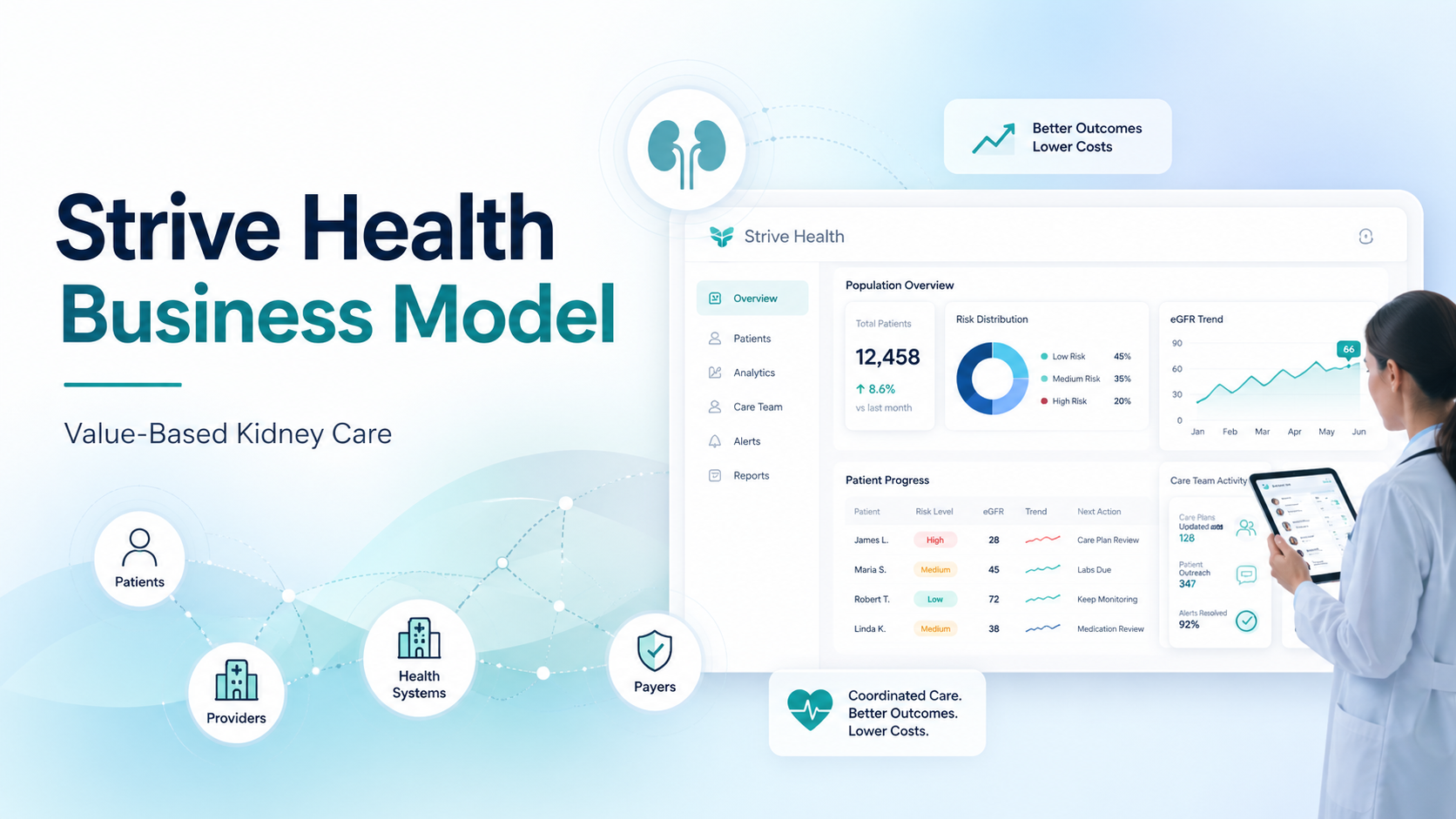
Strive Health uses a value-based healthcare model where it partners with providers and insurers to improve kidney care outcomes while reducing costs. It earns revenue through shared savings, care management fees, and risk-based contracts. The company does not own dialysis clinics. It sits between patients, doctors, and payers as a care coordination and technology layer that gets paid when outcomes improve.
That is the short version. Here is everything else you need to understand how this business actually works.
What Is Strive Health
Strive Health was founded in 2018 and is headquartered in Denver, Colorado. The company focuses exclusively on chronic kidney disease (CKD) and end-stage renal disease (ESRD). Its model is built around intercepting patients earlier in the disease progression before they reach dialysis and coordinating their care across the entire treatment journey.
It is not a hospital. It is not a dialysis company. It is a specialized care management organization that plugs into existing healthcare infrastructure and improves how that infrastructure performs.
What Makes Strive Health Different
Most kidney care in the US is reactive. Patients show up already in crisis, get placed on dialysis, and stay on dialysis for the rest of their lives. Strive Health is built around a different idea: catch the disease early, slow its progression, and when dialysis is necessary, guide patients toward home-based options that cost less and produce better quality of life.
That focus on prevention and care coordination is what separates Strive from legacy players like DaVita and Fresenius, which primarily operate dialysis clinics and earn more when more patients use their facilities.
The Problem Strive Health Is Built to Solve
Kidney Disease Is Extremely Expensive
Kidney disease is one of the most expensive chronic conditions in the American healthcare system. The Centers for Medicare and Medicaid Services (CMS) spends more on ESRD patients than on almost any other patient population. A single patient on in-center dialysis can cost the system over $90,000 per year. There are approximately 800,000 Americans living with ESRD and over 37 million living with some stage of CKD.
The financial burden is enormous and growing.
Most Patients Are Diagnosed Too Late
A significant portion of CKD patients do not know they have the disease until it has already progressed to an advanced stage. The condition is largely asymptomatic in its early phases. By the time symptoms appear, the window for meaningful intervention has often closed. This late-stage detection drives up costs and worsens outcomes.
The System Is Fragmented
Kidney patients typically see multiple specialists, primary care physicians, and care facilities, none of which talk to each other in a coordinated way. There is no single entity responsible for the whole patient. Strive Health positions itself as that entity. It wraps care coordination around the patient and ensures every part of the system is working together.
Over-Dependence on In-Center Dialysis
In-center dialysis is the default treatment for most ESRD patients in the US, even though home dialysis options like peritoneal dialysis and home hemodialysis produce comparable or better outcomes for many patients at significantly lower cost. The dominance of in-center dialysis is partly a result of the economic incentives built into the existing system. Strive Health’s model is aligned around steering appropriate patients toward home modalities, which fits both better outcomes and lower costs.
Strive Health Business Model Overview
Strive Health operates on a value-based care (VBC) model. That term gets used loosely in healthcare, so here is what it means in practice for Strive.
Traditional healthcare pays providers for volume. More visits, more procedures, more dialysis sessions mean more revenue. Value-based care flips that logic. Providers and care managers get paid based on outcomes. If patients stay healthier, avoid hospitalizations, and use fewer expensive interventions, the system saves money, and a portion of those savings flows to the organization that made it happen.
Strive Health is paid to produce better outcomes, not to generate more healthcare activity. That alignment of financial incentives with patient outcomes is the core of the entire model.
How the Model Works at a High Level
Strive partners with health insurers (payers) and health systems. It embeds its care teams and technology platform into those partnerships. It takes on financial responsibility, either partial or full, for the cost of care for a defined patient population. When it keeps those patients healthier and reduces total cost of care, it earns a return. When it fails to do so, it absorbs some of the loss.
This is a high-stakes, high-reward model. It requires clinical excellence, strong data infrastructure, and deep relationships with both payers and providers.
How Strive Health Makes Money
Value-Based Contracts
The foundation of Strive’s revenue is value-based contracts with Medicare Advantage plans, commercial insurers, and government programs. These contracts define a target cost for managing a population of CKD or ESRD patients. Strive is responsible for coordinating care for those patients and is financially accountable for how their total cost of care compares to that target.
This is not fee-for-service. Strive does not bill per appointment or per service. It takes on population-level financial accountability.
Shared Savings
Under shared savings arrangements, Strive and its payer partners split the savings generated when patient care costs come in below the benchmark. If the target cost for managing a population is set at $80,000 per patient per year and Strive gets that cost down to $68,000, a portion of the $12,000 difference is shared with Strive.
The split percentage varies by contract. Some contracts allow Strive to capture 30 to 50 percent of savings. This creates a direct financial incentive to invest in early intervention and preventive care.
Care Management Fees
Some contracts include a monthly per-member fee paid by payers to Strive for providing care management services. These fees are often structured as Per Member Per Month (PMPM) payments. They provide a baseline of predictable revenue that covers the cost of embedding care teams and maintaining the technology platform.
PMPM fees are common in value-based care arrangements and help stabilize cash flow between performance settlement periods.
Risk-Based Payments
In more advanced contracts, Strive takes on full or partial capitation. Under capitation, Strive receives a fixed payment per patient per month and is responsible for covering all or a portion of that patient’s care costs from that budget. If a patient’s care costs more than the capitated amount, Strive absorbs the difference. If it costs less, Strive keeps the margin.
Full capitation is the highest-risk, highest-reward structure in value-based care. It requires significant financial reserves and actuarial sophistication. Strive’s participation in Medicare programs like Kidney Care Choices (KCC) and the Comprehensive Kidney Care Contracting (CKCC) model exposes it to this type of risk.
Participation in CMS Innovation Programs
Strive has been an active participant in CMS innovation models specifically designed to transform kidney care. These programs allow organizations like Strive to take on risk for Medicare beneficiaries with CKD or ESRD, with the potential to earn substantial shared savings if they outperform cost benchmarks.
These government programs have been a major driver of Strive’s growth and credibility in the market.
Business Model Canvas of Strive Health
Customer Segments
Health insurance companies (payers) are Strive’s primary commercial partners. Medicare Advantage plans and commercial insurers pay Strive to manage the cost and quality of care for their kidney disease populations. The payer bears financial risk for its members and shares that risk with Strive under value-based contracts.
Health systems and hospitals partner with Strive to improve outcomes for their kidney patients and reduce readmissions and emergency department visits, both of which are costly to health systems under value-based arrangements.
Nephrologists and nephrology practices are clinical partners. Strive embeds its care coordinators and tools into nephrology practice workflows, supporting physicians without replacing them. Nephrologists benefit from better-supported patients and reduced administrative burden.
CKD and ESRD patients are the end beneficiaries. They receive more coordinated, proactive care. They are not Strive’s paying customers, but they are central to the value proposition.
Value Propositions
For payers, the value is reduced total cost of care and improved quality metrics. Strive takes a high-cost, high-complexity patient population and makes it more manageable.
For health systems, the value is better patient outcomes, fewer readmissions, and support for their own value-based care goals.
For nephrologists, the value is care team support, data tools, and help managing complex patients between appointments.
For patients, the value is more personalized, coordinated care, better education about their options, and support navigating a complicated disease.
The core value proposition across all segments is simple: better outcomes at lower cost. Strive sells that promise and gets paid when it delivers.
Channels
Strive does not acquire patients directly through consumer marketing. Its channels are entirely B2B.
Direct partnerships with payers are the primary channel. Strive approaches insurance companies with its model, negotiates contracts, and gains access to the insurer’s kidney disease patient population.
Provider network relationships represent a secondary channel. Nephrologists and health systems refer patients to Strive’s care programs and integrate Strive’s tools into their workflows.
Government healthcare programs, specifically CMS innovation models, represent a third channel that has given Strive access to Medicare patients at scale.
Customer Relationships
Strive’s relationships are long-term and high-touch by design.
Contracts with payers typically span multiple years. Shared savings models require time to show results, so short-term contracts do not work well for either party.
Patient relationships are managed through dedicated care teams that include registered nurses, social workers, dietitians, and care coordinators. These teams communicate with patients regularly, not just when they are sick. The high-touch model is expensive but essential to producing the outcomes that justify Strive’s contracts.
Data-driven engagement means Strive uses its analytics platform to identify which patients are at highest risk and ensure care teams are proactively reaching out before crises occur.
Revenue Streams
Strive earns through three primary mechanisms:
Shared savings from payer contracts when total cost of care falls below benchmarks.
Monthly care management fees paid on a per-member basis by payers.
Risk-based payments under capitated or partial-capitation arrangements, primarily through Medicare innovation programs.
These streams are interconnected. PMPM fees provide operating cash flow. Shared savings represent the upside. Risk contracts represent the performance-based model at its most advanced.
Key Resources
Clinical care teams are the most important resource. Strive’s model is delivered by humans, nurses, coordinators, social workers, and pharmacists who work directly with patients and providers. Without excellent clinical staff, the model does not function.
Data and analytics platform is the second critical resource. Strive’s technology identifies high-risk patients, tracks outcomes, surfaces gaps in care, and enables care teams to prioritize their work. The platform turns patient data into actionable clinical intelligence.
Payer and provider partnerships are relationship assets that took years to build and are difficult for competitors to replicate quickly.
Patient health data accumulated over time becomes a compounding advantage. Better data produces better risk models, which produce better interventions, which produce better outcomes.
Key Activities
Patient monitoring and outreach: Identifying who is at risk and making sure they receive timely intervention before their condition deteriorates.
Care coordination: Ensuring that every provider involved in a patient’s care is working from the same plan and communicating effectively.
Data analysis and predictive modeling: Using patient data to anticipate problems and allocate care team resources efficiently.
Provider collaboration: Working alongside nephrologists and health systems to integrate Strive’s model into existing clinical workflows without disrupting care.
Contract management and performance reporting: Demonstrating outcomes to payer partners and managing the financial settlement processes associated with value-based contracts.
Key Partners
Insurance companies provide the contracts and the patient populations that make the model possible. Without payer partnerships, Strive has no revenue.
Hospitals and health systems are both referral sources and clinical collaborators. They benefit when Strive keeps their patients healthier and out of the hospital.
Nephrologists are the trusted clinical relationships for kidney patients. Strive works with nephrologists rather than around them. Physicians who trust Strive’s model refer their patients and integrate Strive’s support tools into their practice.
Dialysis providers, including both large chains and independent centers, are practical partners. Strive works with dialysis facilities to coordinate care for patients who do require in-center treatment, even while promoting home modality transitions for appropriate patients.
Technology and data partners support the analytics infrastructure that powers Strive’s care management capabilities.
Cost Structure
Clinical staff salaries represent the largest cost category. Care teams are people-intensive and that is not going to change. Nurses, coordinators, and social workers cost money, and that cost scales with patient volume.
Technology and data infrastructure includes the cost of building, maintaining, and improving the analytics platform and care management software that supports clinical operations.
Operational and administrative costs cover everything from compliance and regulatory affairs to billing operations and contract management.
Partnership development and management involves the ongoing cost of building and sustaining relationships with payers, health systems, and nephrologists. This is a relationship-heavy business, and relationships require investment.
Strive is not a SaaS company. Its cost structure reflects a services and technology hybrid model. That means margins are harder to expand than in pure software, but the business is far more defensible once relationships and data advantages are established.
How the Product Works
The Patient Journey
The experience begins with identification. Strive’s analytics platform, working with data from payer partners, identifies patients with CKD who are at elevated risk of progression to ESRD or hospitalization. These patients are flagged for outreach.
A Strive care coordinator contacts the patient, usually by phone. The coordinator explains the program, answers questions, and conducts an initial assessment of the patient’s health status, social situation, and care needs.
If the patient enrolls, a care plan is developed. The plan identifies clinical goals (stabilizing kidney function, controlling blood pressure, managing comorbidities like diabetes), behavioral goals (dietary changes, medication adherence), and social needs (transportation to appointments, food access, mental health support).
The care team checks in with the patient regularly. Frequency depends on the patient’s risk level. High-risk patients might receive weekly outreach. Stable patients might be contacted monthly.
Strive’s platform monitors incoming data, lab results, claims data, and self-reported symptoms, and alerts care coordinators when a patient shows signs of deterioration. The coordinator can intervene, contact the patient’s physician, or help the patient navigate to the right level of care before a crisis occurs.
For patients approaching ESRD, Strive provides kidney replacement therapy (KRT) education. This helps patients understand their options and make informed decisions about dialysis modality and transplant eligibility, in advance rather than in a hospital emergency.
Throughout all of this, Strive is communicating with the patient’s nephrologist and primary care physician to ensure everyone is working from the same plan.
Why Strive Health Is Growing Fast
The Value-Based Care Trend Is Accelerating
CMS has been aggressively pushing the US healthcare system toward value-based models for over a decade. The ESRD Treatment Choices (ETC) model and Kidney Care Choices programs have created a regulatory environment that rewards exactly what Strive does. As mandatory participation in value-based kidney care models expands, the market for Strive’s services grows with it.
Chronic Disease Is Rising
CKD prevalence is increasing due to rising rates of diabetes and hypertension, the two leading causes of kidney disease in the US. More patients with CKD means a larger addressable population for Strive’s model.
Cost Pressure Is Intensifying
Medicare spends a disproportionate share of its budget on kidney disease. Payers are increasingly motivated to try new approaches to controlling those costs. Strive’s value proposition, reduce cost while improving outcomes, addresses a genuine and growing financial pain point for insurers and government programs.
Competitive Advantage and Moat
Deep Specialization
Strive operates only in kidney care. That focus means its clinical protocols, technology, care team training, and regulatory relationships are all optimized for one disease area. Generalist care management companies cannot replicate that depth of specialization quickly.
Data Advantage
Every patient Strive manages adds to its dataset. Over time, Strive accumulates richer data on CKD and ESRD patient populations than any competitor without comparable patient volume. Better data produces better predictive models, which produce better clinical interventions, which produce better outcomes and better contract performance. This is a compounding advantage.
Strong Partnerships
Long-term contracts with payers and deep integrations with nephrology practices create switching costs. A payer that has built a multi-year relationship with Strive and is seeing strong results is unlikely to switch vendors. A nephrologist whose practice is embedded in Strive’s care coordination workflow is unlikely to partner with a competitor.
These relationships are genuinely hard to replicate and represent a durable competitive moat.
Competitors and Alternatives
DaVita
DaVita is the largest dialysis provider in the US and has its own value-based care arm, DaVita Integrated Kidney Care. DaVita brings massive scale and existing patient relationships. However, its core business is in-center dialysis, which creates an inherent conflict with the goal of transitioning patients to home modalities or preventing ESRD altogether. Strive does not have that conflict.
Fresenius Medical Care
Fresenius is DaVita’s closest competitor in dialysis and has similar scale and similar structural conflicts around its core dialysis business. Its value-based care capabilities are growing but are anchored to a volume-based legacy model.
Interwell Health
Interwell Health is a nephrology-centered value-based care company that emerged from Fresenius’s physician practice assets. It operates in a similar space to Strive and represents one of the more direct competitive comparisons.
Monogram Health
Monogram Health focuses on in-home care for patients with kidney disease and end-stage renal disease, with an emphasis on palliative care and chronic condition management. Its model overlaps partially with Strive’s, particularly in the home care and care coordination components.
Cricket Health (acquired by InterWell)
Cricket Health built a patient education and kidney care platform focused on home dialysis and transplant navigation. Its acquisition by InterWell signals ongoing consolidation in the kidney care space.
Challenges in the Business Model
Regulatory Complexity
Value-based care models in kidney disease operate within a dense regulatory environment. CMS program rules change, contract terms are renegotiated, and compliance requirements are demanding. Staying current and compliant requires significant legal and regulatory resources.
Risk-Heavy Model
Taking on financial risk for patient populations is not easy. If a patient population turns out to be sicker than the actuarial models predicted, Strive can take losses on risk-based contracts. Managing that risk requires sophisticated financial modeling and sufficient capital reserves. Startups in this space need either strong investor backing or very careful contract structuring to avoid catastrophic downside scenarios.
Long Sales Cycles
Selling to health insurance companies and hospital systems takes time. Contracts are large, complex, and require extensive due diligence on both sides. A single payer contract can take 12 to 18 months from initial conversation to signed agreement. This makes revenue growth slower and less predictable than in consumer or SaaS businesses.
Clinical Workforce Constraints
Strive’s model is people-intensive. Recruiting, training, and retaining skilled care coordinators, nurses, and social workers is expensive and competitive. As the company scales, maintaining clinical quality while managing workforce costs is a real operational challenge.
Future of Strive Health
Geographic Expansion
Strive will continue expanding into new markets and new payer relationships. Each new geography requires building provider relationships and local clinical infrastructure, so expansion is sequential rather than instant. But the playbook is repeatable.
AI-Driven Care
The integration of AI into Strive’s analytics platform will accelerate over time. Better predictive models, more sophisticated risk stratification, and AI-assisted care coordination workflows will allow Strive’s clinical teams to manage larger patient panels without proportional increases in headcount. This is where margin improvement becomes possible.
More Advanced Risk Contracts
As Strive’s data assets and clinical capabilities mature, it will be able to take on more full-risk contracts with confidence. Moving up the risk spectrum means higher potential returns when performance is strong.
Potential for Broader Chronic Disease Application
The care coordination model Strive has built for kidney disease is theoretically applicable to other high-cost chronic conditions. Whether Strive expands beyond nephrology or stays focused is a strategic question, but the infrastructure could support broader application over time.
Key Lessons for Founders
Solve Expensive Problems
Kidney disease costs the US healthcare system billions of dollars annually. When you solve a problem at that scale, even capturing a small fraction of the value created produces a substantial business. Pick markets where the status quo is genuinely broken and the cost of the problem is enormous.
Align Financial Incentives With Outcomes
Strive’s model works because it makes money when patients get better, not when they consume more healthcare. Fee-for-service healthcare creates perverse incentives. Value-based care corrects them. When your revenue is tied to the outcome your customer actually wants, sales conversations become much easier and customer relationships become stickier.
Go Niche and Go Deep
Strive could have built a generalist chronic disease management company. It chose to focus exclusively on kidney disease. That focus enabled it to develop deeper clinical protocols, better technology, and stronger provider relationships than any generalist could match. In healthcare, depth of specialization is a genuine moat.
Relationships Are the Product
In B2B healthcare, trust is the product. Payers do not sign multi-year risk contracts with companies they do not deeply trust. Nephrologists do not integrate unfamiliar tools into their practices overnight. Strive’s growth has been built on relationship capital as much as clinical or technical capability. Founders building in healthcare need to be patient investors in relationships.
Defensibility Comes From Complexity
Strive’s model is hard to replicate because it requires clinical expertise, data infrastructure, regulatory knowledge, payer relationships, and provider relationships all at once. Any one of those is achievable. All of them together takes years. Building a business that requires multiple compounding advantages to replicate means your moat deepens over time.
Conclusion
Strive Health is not the most visible healthcare startup in the US. It does not sell directly to consumers, does not have a flashy app, and does not generate the kind of media coverage that consumer health companies attract. But it is solving one of the most expensive and most neglected problems in American medicine.
The business model is fundamentally sound. It aligns financial incentives with patient outcomes, operates in a market with massive and growing need, and has built compounding advantages in data and relationships that are genuinely difficult to replicate.
The challenges are real. The sales cycles are long, the regulatory environment is complex, and taking on risk for sick patient populations requires both clinical excellence and financial discipline. This is not an easy business to build.
But for founders, investors, and healthcare professionals trying to understand where value-based care is actually working, Strive Health is one of the clearest examples available. It is a company that is getting paid to do the right thing for patients, and building a durable business in the process.
That combination, doing good and doing well, is rare in healthcare. Strive Health is proof that it is possible.
Discover more from Business Model Hub
Subscribe to get the latest posts sent to your email.