Octopus Energy Business Model And How a Utility Startup Disrupted the Energy Industry

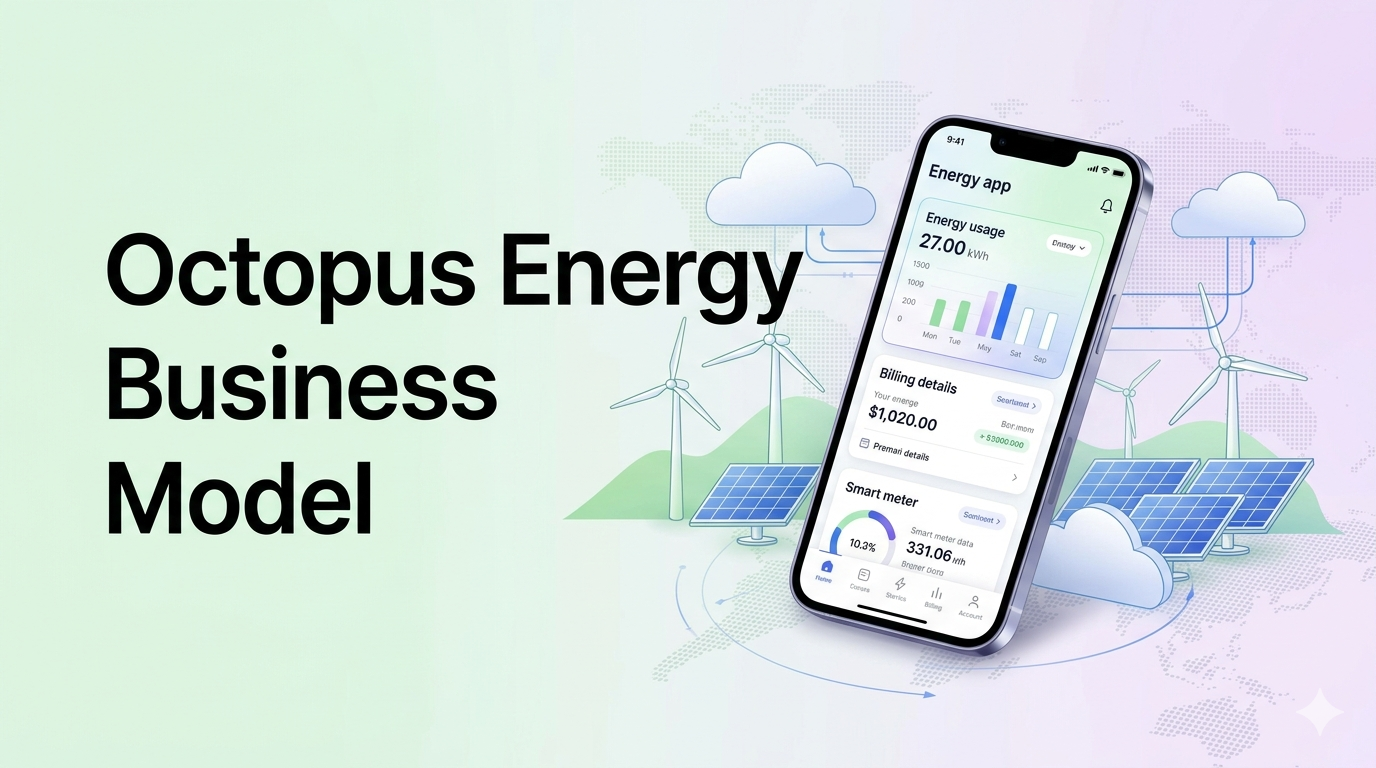
Octopus Energy is not your typical power company. While most utilities focus on delivering electricity and sending invoices, Octopus built something entirely different. It combined renewable energy with a proprietary tech platform to create a business that looks more like a SaaS company than a traditional utility.
The result? A global energy brand that has quietly become one of the most talked-about startups in the cleantech space.
This breakdown covers exactly how Octopus Energy works, how it makes money, and why its model is worth paying attention to.
What Is Octopus Energy
Octopus Energy was founded in 2015 in the UK. At its core, it supplies renewable electricity and gas to homes and businesses. But that surface-level description misses what makes it genuinely interesting.
The company operates more like a technology business that happens to sell energy. Its core infrastructure is software-based. Its highest-value asset is a platform, not a power plant. And its fastest-growing revenue stream comes from licensing that platform to other utilities worldwide.
That is a fundamentally different business than what most people picture when they hear the word “utility.”
The Core Insight That Drives Everything
Most energy companies are built around infrastructure. Wires, pipes, meters, plants. Octopus is built around software first and energy second.
The company identified early that the biggest inefficiencies in the energy sector were not in generation or distribution. They were in billing systems, customer data management, grid coordination, and pricing logic. All of that is software. And software scales.
That insight is what separates Octopus from every other green energy startup that came before it.
How Octopus Energy Business Model Actually Works
To understand Octopus Energy, you need to understand that it runs two parallel businesses simultaneously. One sells energy. The other sells the technology that runs energy companies. Both feed each other.
Energy Supply at the Consumer Level
The first business is straightforward. Octopus buys renewable electricity from generators, sells it to customers at a margin, and manages the billing relationship. It operates like a retailer in a deregulated energy market.
What makes this different from a standard energy retailer is the pricing model. Octopus pioneered smart tariffs that change price based on time of use. Customers with smart meters can shift usage to off-peak hours and pay significantly less. This is not just a marketing feature. It is a grid management tool that reduces costs for Octopus and creates genuine value for customers.
The subscription-style billing model also means predictable revenue. Customers pay monthly for ongoing energy access. This creates a recurring revenue structure that investors and operators both appreciate.
The Kraken Platform: The Real Business
The second business is where Octopus earns its highest margins.
Kraken is Octopus Energy’s proprietary cloud-based energy management platform. It handles billing, customer accounts, smart meter data, grid optimization, and regulatory compliance. It was built entirely in-house and designed to replace the outdated legacy systems that most utilities still run on.
Once Kraken proved itself inside Octopus, the company started licensing it to other energy providers globally. That turned a cost center into a revenue stream. Other utilities now pay to use the system that Octopus built for itself.
This is the SaaS layer of the business. High margins, recurring contracts, scalable without proportional cost increases. It is the part of the model that traditional energy analysts tend to underestimate.
What the Dual Model Creates
Running both businesses simultaneously creates a compounding effect. More energy customers generate more usage data. More data improves Kraken’s algorithms. Better algorithms make Kraken more valuable to licensees. More licensees fund further tech development.
Each side of the business strengthens the other. That feedback loop is the structural advantage that makes Octopus harder to replicate than it might appear.
Octopus Energy Revenue Streams
Octopus Energy generates revenue from several distinct sources. Understanding each one explains why the business is structured the way it is.
Direct Energy Sales
The largest revenue line comes from selling electricity and gas to residential and commercial customers. Octopus procures renewable energy and charges customers a rate that covers procurement costs, operational overhead, and margin.
This is high volume but relatively thin margin at the per-customer level. The economics improve significantly at scale, which is why customer acquisition and retention are both priorities for the business.
Kraken Platform Licensing Fees
Utilities that license Kraken pay ongoing fees to use the platform. This is enterprise SaaS revenue, and it carries substantially better margins than energy supply. The customer base here includes major utilities across the UK, Europe, Australia, the United States, and Japan.
The licensing model is particularly powerful because switching costs are high. Once a utility migrates its billing and customer data to Kraken, moving away is a major operational undertaking. That creates sticky, long-term contracts.
Renewable Energy Generation Assets
Octopus has made direct investments in renewable energy generation, including solar and wind assets. Revenue from these investments provides a different economic profile than either the supply business or the platform business. It adds asset-backed income that is less dependent on customer volume or licensing deals.
This also serves a strategic purpose. Owning generation assets gives Octopus more control over procurement costs and tighter alignment with its renewable positioning.
Flexibility and Grid Services
This is one of the most forward-looking parts of the model.
As more renewable energy enters the grid, grid stability becomes a growing challenge. Renewable sources like wind and solar generate energy when conditions allow, not necessarily when demand peaks. That mismatch creates a need for demand flexibility services.
Octopus addresses this through smart tariffs that incentivize customers to use electricity during low-demand periods. Customers save money. The grid gets more balanced. And Octopus earns revenue from grid operators for providing that balancing service.
This revenue stream is still growing but has significant long-term potential as grid complexity increases globally.
Electric Vehicle Ecosystem
The EV market is a meaningful expansion opportunity for Octopus. As more households adopt electric vehicles, home charging patterns create new energy demand. Octopus has developed EV-specific tariffs that offer dramatically lower rates for overnight charging, when grid demand is lowest.
This serves customers who want to minimize charging costs, helps manage grid load, and adds a new category of usage that benefits Octopus’ demand flexibility business.
The EV ecosystem also includes charging solutions and partnerships with automakers, which deepens the customer relationship beyond the standard energy billing interaction.
Kraken in Depth: Why It Matters So Much
Kraken deserves its own section because most business breakdowns of Octopus undervalue it.
What Legacy Utility Systems Look Like
To appreciate Kraken, you need to understand what it replaced.
Most traditional utilities run on billing and customer management systems that are decades old. These systems were built before smart meters existed, before real-time pricing was technically feasible, and before cloud infrastructure made dynamic data processing affordable. They are slow, expensive to maintain, and fundamentally unable to support the kind of flexible pricing and grid services that the modern energy transition requires.
Updating them is not a software patch. It is a multi-year, multi-hundred-million-dollar infrastructure project. Most utilities have been avoiding it.
What Kraken Does Differently
Kraken was built cloud-native from scratch. It was designed to handle millions of smart meter reads per day, support dynamic pricing logic, automate billing, manage regulatory reporting, and integrate with grid operators in real time.
For Octopus internally, this means dramatically lower operational costs per customer compared to incumbents. It processes customer accounts with a fraction of the staff that a traditional utility would require at equivalent scale.
For external licensees, it means access to modern infrastructure without the cost or risk of building it themselves.
The Moat It Creates
Enterprise software moats are well understood in tech but less discussed in energy. Kraken creates one of the strongest moats in the sector because it addresses a genuinely hard problem, it works at scale, and migration away from it is operationally painful.
Utilities that license Kraken are not just buying software. They are migrating their entire customer relationship and billing infrastructure to a new platform. Once that migration is complete, the probability of switching to a competitor system within a standard contract period is very low.
That is recurring, high-margin, low-churn revenue. It is the kind of revenue profile that commands premium valuation multiples in public markets.
Customer Experience as a Strategic Asset
Energy is a low-trust industry. Most customers feel locked in, confused by pricing, and frustrated by poor customer service. Octopus identified that gap and built its customer experience strategy around closing it.
Transparent Pricing as a Differentiator
Octopus publishes its rates clearly. It does not use introductory pricing that spikes after a promotional period. It does not bury fees in fine print. This sounds basic, but in the context of the energy industry, it is genuinely unusual.
Transparent pricing reduces customer anxiety. It also reduces the volume of billing disputes and customer service contacts, which lowers operational costs. Being honest is, in this case, also economically efficient.
No Long-Term Contracts
Octopus does not lock residential customers into multi-year contracts. This removes a significant barrier to switching and builds trust. Customers who choose to stay do so because they want to, not because leaving is expensive.
Counterintuitively, this increases retention. When customers feel free to leave, many of them choose not to.
Customer Support That Actually Works
Octopus has consistently ranked at the top of customer satisfaction surveys in the UK energy market. Its support model emphasizes giving frontline agents more authority to resolve issues quickly, rather than escalating through layers of management.
The operational implication is that fewer contacts per customer per year, combined with faster resolution, reduces the cost per support interaction. Good service is not just a marketing advantage here. It directly affects the cost structure.
Cost Structure and Where the Money Goes
Understanding the cost structure reveals what kind of company Octopus actually is.
Energy Procurement
The largest cost is buying the renewable electricity and gas that Octopus sells to customers. This is subject to market price volatility, which represents the most significant financial risk in the business. Octopus manages this through long-term procurement contracts and its own generation assets, but it cannot eliminate it entirely.
Technology Development
Unlike traditional utilities, where technology is a support function, Octopus treats tech investment as a core business cost. The Kraken platform requires continuous development to maintain its competitive position, support new market entrants, add functionality for licensees, and handle increasing data volumes from smart meters.
This investment is what allows Kraken to be sold externally. It is simultaneously an operating cost and the foundation of a high-margin revenue stream.
Customer Support and Operations
Octopus invests more in customer support quality than a typical low-cost energy retailer would. This is a deliberate strategic choice. The payoff is lower churn and stronger word-of-mouth growth, which reduces customer acquisition costs over time.
Regulatory Compliance
Operating in multiple countries means navigating multiple regulatory environments. Compliance costs are meaningful, and they increase with each new market entry. Kraken helps here because it was designed with regulatory reporting built in, which reduces the marginal compliance cost per market.
Marketing and Expansion
Customer acquisition and market expansion require ongoing marketing investment. Octopus relies more on organic referrals and reputation than heavy paid advertising, which keeps this line item lower than competitors at similar scale.
Global Expansion Strategy
Octopus has grown from a UK-focused startup to a genuinely global energy business. The expansion strategy follows a consistent playbook.
Enter With Kraken First
When Octopus enters a new market, it typically leads with Kraken. Licensing the platform to a local utility creates a foothold, a revenue stream, and market intelligence before Octopus has to acquire a single retail customer. It is lower risk than building a customer base from scratch in an unfamiliar regulatory environment.
Partner Before Building
Rather than trying to build local infrastructure from the ground up, Octopus partners with established local players. This accelerates market entry and reduces capital requirements. Partnerships also provide regulatory relationships and local market knowledge that are expensive to develop independently.
Acquire Strategically
In some markets, Octopus has accelerated growth through acquisitions of smaller energy retailers. These acquisitions bring customer books, local operating knowledge, and sometimes local infrastructure. Combined with the Kraken platform, acquired businesses can be integrated and optimized quickly.
Key Markets
The UK remains the largest market and the operational foundation. Europe is a significant and growing presence. The United States is a priority expansion market, where Octopus has been establishing partnerships and launching retail operations. Asia-Pacific, particularly Australia and Japan, have been active markets for Kraken licensing.
Competitive Advantages That Are Hard to Copy
Octopus has several advantages that are structural rather than circumstantial. They compound over time.
The Technology Gap
Most traditional utilities have underinvested in technology for decades. The gap between their systems and Kraken is not a matter of incremental updates. It is a multi-year, capital-intensive rebuild. While incumbents weigh that investment, Octopus continues developing Kraken further.
Technology leads in software markets tend to widen, not narrow, because the leader uses revenue from the platform to fund the next generation of development.
Recurring Revenue With Two Models
Most energy companies have one recurring revenue stream: energy supply. Octopus has two: energy supply and SaaS licensing. This diversification improves financial stability and gives the business a higher revenue ceiling than a pure energy retailer at equivalent customer count.
Renewable-First Positioning
The global energy transition is not a trend. It is a multi-decade structural shift driven by economics, policy, and infrastructure investment. Octopus built its entire supply model around renewables from day one.
This is not just a marketing benefit. It means Octopus’ procurement relationships, product designs, and customer expectations are all aligned with where the market is going. Incumbents have to manage the transition. Octopus is already positioned on the far side of it.
Data as Infrastructure
Smart meters generate continuous usage data. Octopus collects and processes this data at scale across millions of customers and licensee accounts. That data improves pricing algorithms, grid management tools, and demand flexibility offerings over time.
Data advantages compound. More data leads to better models, which leads to better products, which attracts more customers, which generates more data. Traditional utilities do not have the software infrastructure to extract comparable value from equivalent data volumes.
Challenges and Real Risks
The model is strong but not without vulnerabilities.
Energy Price Volatility
The UK energy crisis of 2021 to 2022 demonstrated how exposed retail energy suppliers can be to sudden price spikes. Several UK energy retailers collapsed during that period. Octopus survived partly due to its scale and partly due to better hedging practices, but the episode highlighted the fundamental commodity risk embedded in the supply business.
No amount of software sophistication eliminates wholesale energy price risk entirely.
Regulatory Complexity at Scale
Operating in multiple regulatory environments simultaneously creates compliance overhead. Energy markets are heavily regulated. Changes in one market can affect operational models in ways that are difficult to predict. Managing this risk requires sustained investment in legal and regulatory capacity.
Infrastructure Dependency
Octopus does not own the grid. It is dependent on the same transmission and distribution infrastructure as every other retailer. When infrastructure fails, Octopus customers experience outages regardless of how good the software is. This dependency is an inherent feature of the retail energy model.
Competition From Incumbents
Traditional utilities are not standing still. Several major European energy companies have launched their own technology initiatives or acquired tech companies to modernize their platforms. While the gap between incumbents and Kraken remains large, incumbents have capital advantages that could accelerate catch-up efforts.
What Makes This Model Worth Studying
Octopus Energy is not uniquely interesting because it sells renewable energy. Many companies do that. It is interesting because of how it built durable competitive advantages in one of the most capital-intensive and heavily regulated industries in the world.
Software Inside a Hard Industry
Energy is not a software industry. It involves physical infrastructure, regulatory oversight, commodity markets, and geopolitical risk. Building a software platform that creates real competitive advantage inside that environment is significantly harder than building software in a pure-play tech market.
Octopus managed it because its founders understood both sides. They built something technically sophisticated enough to work and operationally practical enough to be adopted by utilities that had no interest in becoming technology companies.
Turning a Cost Into a Product
Kraken began as an internal tool. Octopus needed better software to run its own operations, so it built it. Once it worked, the company recognized that every other utility needed the same thing. What started as a cost center became the company’s highest-margin revenue line.
This pattern, building internal tools to the standard of external products, is one of the most underutilized growth strategies in business. It works especially well in industries where existing tooling is poor, which describes most of the energy sector.
Trust as a Moat in a Low-Trust Industry
Energy customers have very low baseline trust in their suppliers. Most assume they are being overcharged and that switching will be complicated. Octopus inverted that expectation with transparent pricing, no lock-in contracts, and genuine customer service investment.
Trust is hard to quantify but very real in its effects. It lowers churn, increases referral rates, and allows a company to charge fair prices without losing customers to competitors promising (but not delivering) something better.
Key Takeaways From the Octopus Energy Model
For operators, investors, and founders paying attention, several things stand out.
The platform model inside a traditional industry creates higher valuations than either a pure utility or a pure SaaS business would on its own. Two revenue streams, both recurring, one with software margins, is a structurally superior financial model.
Customer experience investment in low-trust industries compounds. The short-term cost is real but the long-term retention and referral economics justify it.
Building proprietary infrastructure is only worth it if the proprietary infrastructure becomes a product. Kraken is valuable not because Octopus built it, but because Octopus commercialized it.
Global expansion through software licensing before retail entry is a lower-risk sequencing than most companies use. It generates revenue from day one in a new market, builds relationships, and reduces the capital required to establish market presence.
Final Assessment
Octopus Energy built a real business with real competitive advantages in an industry that most technology investors and founders tend to ignore. It did not invent new energy technology. It did not discover a new power source. It rebuilt the operational systems that everyone in the industry needed but no one was willing to build.
That is a more defensible position than it might appear. Incumbents are hampered by legacy systems, organizational inertia, and shareholders who prefer dividends to technology investment. New entrants face the regulatory and capital hurdles of the energy market. Octopus positioned itself in the gap between those two groups and built a platform that both sides now depend on.
The business is not without risk. Commodity exposure, regulatory complexity, and infrastructure dependency are permanent features of the energy retail model. But the combination of recurring SaaS revenue, renewable positioning, and data advantage creates a profile that is meaningfully more resilient than a traditional utility and more defensible than a pure energy startup.
Understanding the Octopus model matters because it demonstrates a generalizable principle. The most durable competitive advantages in legacy industries are often built not by changing what the industry does, but by rebuilding how it does it.
Octopus did not reinvent energy. It rebuilt the backend. That turned out to be enough.
Discover more from Business Model Hub
Subscribe to get the latest posts sent to your email.