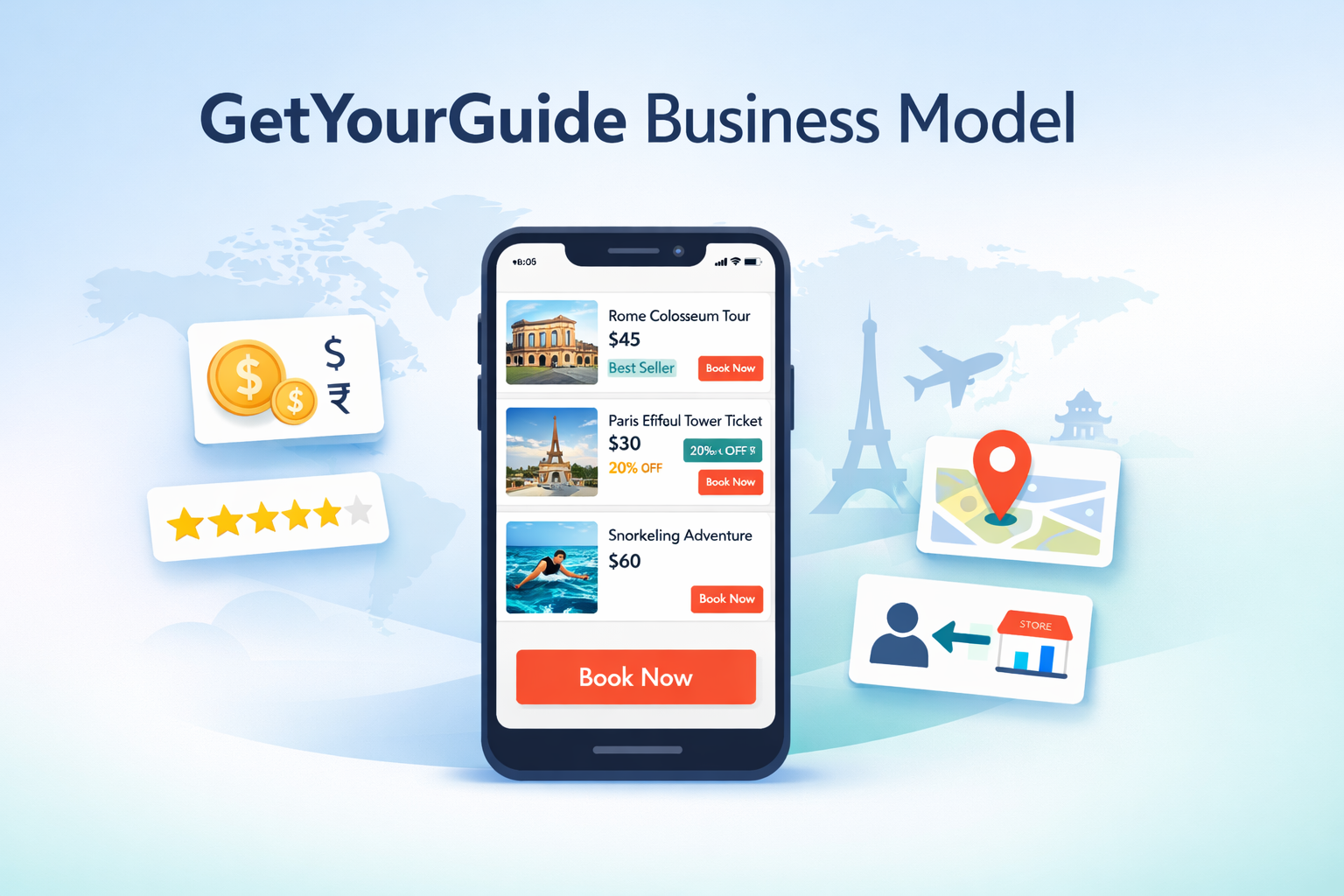
GetYourGuide Business Model: How It Works and How It Makes Money

The GetYourGuide business model is a two-sided marketplace that connects travelers with local tour and activity providers. It earns revenue primarily through commissions on bookings, along with featured listings, advertising, and strategic partnerships.
Intro
Most travelers have figured out how to book flights and hotels in minutes. But booking a food tour in Naples or skip-the-line tickets for the Colosseum? That used to be chaotic.
GetYourGuide stepped into that gap. It built a platform where travelers can discover, compare, and instantly book experiences anywhere in the world, and where local operators can reach a global audience without building their own tech stack.
This is the experience economy in action. People are spending more on doing things than on owning things. Experiences are now a core part of travel, not an afterthought.
GetYourGuide sits at the center of that shift. And its business model is designed to scale with it.
What is GetYourGuide?
GetYourGuide was founded in 2009 and is headquartered in Berlin, Germany. It started as a small tours aggregator and has grown into one of the largest online marketplaces for travel experiences in the world.
What it offers:
The platform lists tours, local activities, attraction tickets, cooking classes, day trips, skip-the-line passes, and thousands of other bookable experiences across hundreds of destinations.
Who it serves:
On one side, it serves travelers looking for things to do during a trip. On the other side, it serves tour operators, local guides, and activity providers who want to reach more customers.
That two-sided structure is the foundation of everything GetYourGuide does.
The Core Idea: The Experience Marketplace
What is the experience economy?
The experience economy is a shift in consumer behavior where people prioritize spending on experiences over physical goods. Travel experiences, in particular, have seen massive growth over the last decade.
Why experiences are harder to book than flights or hotels:
Flights and hotels are standardized. Seat 14A on a Delta flight is the same everywhere. A “Rome food tour” is not. Every operator is different. Quality varies. Trust is hard to establish. Discovery is scattered.
GetYourGuide solves three specific problems:
Discovery problem: Travelers do not know what experiences exist in a destination. GetYourGuide surfaces options through search, recommendations, and curated collections.
Trust problem: Booking an unknown local operator is risky. GetYourGuide adds reviews, verified listings, and a standardized booking process that makes the transaction feel safe.
Booking friction: Before platforms like GetYourGuide, booking a local experience often required emailing operators, waiting for confirmation, or paying in cash on arrival. GetYourGuide made it instant.
How GetYourGuide Works
For Travelers:
The user journey is simple. A traveler lands on the site or app, searches by destination, browses available experiences, reads reviews, compares prices, and books instantly. Confirmation is immediate. No waiting, no back-and-forth with operators.
For Suppliers:
Tour operators and activity providers create a listing on the platform. They set pricing, manage availability, and update their inventory through a supplier portal. When a booking comes in, they get notified and fulfill the experience. GetYourGuide handles the marketing, payment processing, and customer service layer.
The platform does the heavy lifting on demand generation. Suppliers focus on delivering the experience.
Value Proposition
For Travelers:
Convenience is the top draw. Everything is in one place. Reviews from real customers add credibility. Instant booking confirmation removes uncertainty. Refund policies and customer support provide safety net assurance.
For Suppliers:
GetYourGuide gives small and mid-sized operators access to a global customer base they could never reach on their own. A local guide in Kyoto does not need to run Google Ads or build a multilingual website. GetYourGuide does that work. Suppliers also get booking management tools, analytics, and demand forecasting support.
GetYourGuide Business Model Breakdown
Marketplace Model
GetYourGuide operates as a two-sided marketplace. Supply comes from tour operators and experience providers. Demand comes from travelers. The platform earns a fee for every successful match between the two.
Network effects drive the value. More suppliers attract more travelers. More travelers attract more suppliers. As the platform grows, both sides benefit more from being on it.
Aggregator Model
GetYourGuide does not own any experiences. It aggregates supply from third-party providers. This is asset-light by design. The company does not run tours, hire guides, or manage physical assets. It manages the marketplace layer.
This is a critical distinction. It means GetYourGuide can scale without proportional increases in operational costs.
Platform Model
At its core, GetYourGuide acts as infrastructure. It provides the tech stack, payment processing, trust and safety systems, and marketing channels that connect both sides of the market. Operators and travelers both plug into this infrastructure.
How GetYourGuide Makes Money
This is the most important section for understanding the business.
Commission-Based Revenue
This is the primary revenue stream. GetYourGuide takes a percentage cut from every booking made through the platform. The commission rate varies but typically falls in the range of 20 to 30 percent of the booking value.
When a traveler books a $100 walking tour, GetYourGuide keeps roughly $20 to $30. The operator receives the rest. This model aligns GetYourGuide’s incentives with volume. More bookings equal more revenue.
Because this is purely transactional, there are no upfront fees for suppliers to list. This lowers the barrier to entry and encourages more operators to join the platform.
Featured Listings and Promotions
Suppliers can pay to improve their visibility on the platform. Featured placements appear at the top of search results or in curated sections on destination pages. This is similar to how Amazon sellers pay for sponsored listings.
For high-competition destinations like Paris or New York, visibility is valuable. Operators with strong reviews but limited organic ranking can pay to get in front of more travelers.
This is a secondary but meaningful revenue stream that also improves monetization per supplier.
Advertising Revenue
GetYourGuide generates traffic through SEO and paid media at massive scale. That traffic has advertising value. The company partners with travel brands, credit card companies, hotels, and airlines to place relevant promotions in front of its audience.
This revenue stream is not the primary focus but adds a layer of monetization on top of the core booking business.
Dynamic Pricing Margins
In some cases, GetYourGuide applies a markup on top of the supplier’s base price rather than taking a visible commission. This is common in travel distribution. The platform controls the retail price and earns the spread between what the traveler pays and what the supplier receives.
This approach gives GetYourGuide more control over pricing strategy and margin management in competitive markets.
Partnerships and Bundles
GetYourGuide has partnerships with airlines, hotel chains, credit card platforms, and OTAs (online travel agencies) like Booking.com. These integrations place GetYourGuide inventory in front of travelers who are already planning or booking other parts of their trip.
Revenue from these partnerships can be structured as referral fees, white-label commissions, or rev-share agreements depending on the deal.
Business Model Canvas
Key Partners: Tour operators and local guides form the supply base. Payment gateways like Stripe or Adyen handle transactions. OTAs and airlines serve as distribution partners. Marketing platforms like Google and Meta drive demand.
Key Activities: Platform development and maintenance, supplier onboarding and quality control, performance marketing, customer support, and content creation for SEO.
Key Resources: The technology platform itself is the most critical asset. Brand trust, user-generated reviews, proprietary data on traveler behavior, and supplier relationships are equally important.
Value Propositions: For travelers: trusted discovery, instant booking, verified reviews, and customer support. For suppliers: global distribution, demand generation, and booking technology.
Customer Relationships: Reviews and ratings build trust at scale. Personalization through AI recommendations increases repeat usage. Customer support handles disputes and refunds.
Channels: The website and mobile app are primary channels. Organic search drives a significant share of traffic. Paid search and social ads supplement that. Email marketing and push notifications handle retention.
Customer Segments: International tourists and weekend travelers on the demand side. Local tour operators, museums, attraction owners, and experience businesses on the supply side.
Cost Structure: Marketing and customer acquisition are the largest costs. Technology development and infrastructure are ongoing investments. Operations, customer support, and supplier management add to the cost base.
Revenue Streams: Commissions on bookings are primary. Featured listings, advertising, and partnerships are secondary.
Unit Economics
Customer Acquisition Cost (CAC): GetYourGuide competes in a high-cost paid search environment. Travel keywords are expensive. The company invests heavily in SEO to reduce CAC over time. Organic traffic from destination-based content is a core strategy for keeping acquisition costs manageable.
Lifetime Value (LTV): Travelers who use GetYourGuide once and have a good experience are likely to return for future trips. LTV improves with repeat usage. The challenge is that travel is episodic. People do not book experiences every week. This makes LTV harder to build compared to subscription businesses.
Commission Margins: The 20 to 30 percent commission rate is competitive in the travel industry. Margins depend on category, destination, and negotiation with suppliers. Premium experiences with limited supply can command higher margins.
Refund and Cancellation Impact: GetYourGuide’s refund policies, including free cancellation on many listings, add operational complexity. Refunds directly reduce revenue. Managing cancellation rates is an ongoing challenge, especially in destinations with weather-dependent activities.
Growth Strategy
SEO and Content Marketing
GetYourGuide has built an enormous library of destination content. Pages targeting keywords like “things to do in Barcelona” or “best tours in Tokyo” drive organic traffic at scale. This content machine is one of the most important growth levers the company has.
Every piece of destination content has a commercial intent. It pulls in travelers who are actively planning trips and converts them into bookers.
Mobile-First Strategy
A significant and growing share of GetYourGuide bookings happen on mobile. The company has invested heavily in its app experience, push notification systems, and last-minute booking features that are particularly valuable for on-the-go travelers.
Mobile also opens up in-destination discovery. A traveler already in Rome who wants a tour tomorrow is a high-intent user. The app captures that demand.
Localization Strategy
GetYourGuide operates in dozens of languages and currencies. Localizing the platform for different markets reduces friction for both travelers and suppliers. A supplier in Japan can list in Japanese. A French traveler can book in euros with French language support.
Localization is a competitive moat. It takes time and investment to replicate, and it expands the addressable market significantly.
Supply Expansion
More experiences mean more reasons to choose GetYourGuide over a competitor. The company continuously onboards new operators across new destinations and experience categories. Niche categories like food tours, photography walks, and wellness experiences have seen strong growth.
Strategic Partnerships
Rather than building its own hotel or flight booking system, GetYourGuide partners with companies in those categories. This lets it appear at key moments in the travel planning journey without building adjacent products from scratch.
Marketing Strategy
Performance Marketing: GetYourGuide runs large-scale campaigns on Google Search, Google Display, and Meta platforms. These campaigns target high-intent travelers searching for destination-specific activities.
Organic Search: Destination pages, experience guides, and travel content rank for millions of keywords globally. This organic traffic base reduces dependence on paid channels over time.
Influencer and Creator Marketing: Travel creators on YouTube, Instagram, and TikTok feature GetYourGuide experiences. This content builds brand awareness among new audiences and drives direct traffic.
Retargeting: Users who browse the platform but do not book are retargeted across the web and social media. Given that travel planning often happens over several weeks, retargeting is a key part of the conversion funnel.
Email and Push Notifications: For existing users, email campaigns highlighting destination deals, new experiences, and personalized recommendations drive repeat bookings.
Competitive Analysis
Viator (TripAdvisor): Viator is the most direct competitor. It operates a similar marketplace model and has the backing of TripAdvisor’s massive review network. TripAdvisor’s SEO dominance gives Viator strong organic visibility. GetYourGuide competes on product quality, UX, and mobile experience.
Klook: Klook is strong in Asia Pacific markets. It started with a focus on attraction tickets and has expanded into tours and activities. GetYourGuide has stronger positioning in European destinations.
Airbnb Experiences: Airbnb added experiences to its platform to leverage its traveler audience. However, it has not prioritized this category as heavily as its core accommodation business. The inventory depth and UX for experiences is not yet at the level of dedicated platforms like GetYourGuide.
Tripadvisor: Tripadvisor is a discovery and review platform first. Its booking capability for experiences is secondary to its review function. GetYourGuide benefits from travelers who research on Tripadvisor and then book elsewhere.
Comparison Summary:
| Factor | GetYourGuide | Viator | Klook | Airbnb Experiences |
|---|---|---|---|---|
| Inventory Depth | Very High | Very High | High (Asia focus) | Moderate |
| UX Quality | Strong | Moderate | Strong | Moderate |
| Geographic Focus | Global (Europe strength) | Global | Asia Pacific | Global |
| Trust Signals | Strong reviews | TripAdvisor integration | Strong reviews | Host profiles |
| Mobile Experience | Strong | Moderate | Strong | Strong |
SWOT Analysis
Strengths: GetYourGuide has a large, globally distributed inventory. Its brand is well recognized in European travel markets. The platform’s SEO presence is a significant organic traffic driver. Its mobile app has strong ratings and functionality.
Weaknesses: Quality control across hundreds of thousands of listings is difficult. The platform is highly dependent on third-party suppliers, which means it has limited control over the customer experience post-booking. Supplier concentration in popular destinations creates vulnerability if key operators leave.
Opportunities: Travel demand continues to recover and grow post-pandemic. Emerging markets in Southeast Asia, Latin America, and the Middle East represent underpenetrated supply and demand. AI-powered personalization could significantly increase conversion rates and LTV.
Threats: Viator and Klook are well-funded competitors. Google’s travel products could reduce organic search visibility over time. Regulatory changes in popular destinations (like limits on tour group sizes in fragile heritage sites) could constrain supply. Seasonal demand patterns create revenue volatility.
Challenges in the Business Model
Quality Control: GetYourGuide cannot be present at every experience to ensure quality. It relies on reviews, supplier ratings, and customer feedback to police standards. Bad experiences hurt the platform’s brand even when the operator is at fault.
Refund and Cancellation Management: Free cancellation is now table stakes in the experience booking market. Managing refund requests, disputes, and cancellation policies across diverse supplier agreements is operationally complex and directly impacts margin.
Supplier Dependency: The most popular experiences on the platform are controlled by third-party operators. If a key supplier in a major destination decides to list exclusively elsewhere or goes out of business, it creates a supply gap.
Seasonality: Travel is seasonal. GetYourGuide’s revenue peaks in summer and holidays and drops in off-peak months. This creates cash flow planning challenges and makes it harder to maintain a consistent growth trajectory throughout the year.
Technology Behind GetYourGuide
AI-Based Recommendations: The platform uses machine learning to personalize experience recommendations based on search history, booking patterns, and similar user behavior. This increases relevance and improves conversion.
Search Algorithms: GetYourGuide’s internal search ranks experiences based on multiple factors including reviews, pricing, availability, booking velocity, and supplier responsiveness. This algorithm shapes what travelers see first.
Booking Engine: Real-time inventory management, instant confirmation, and multi-currency payment processing are core components. The booking engine must handle high traffic volumes, especially during peak travel seasons.
Fraud Detection: Fake reviews, chargebacks, and fraudulent bookings are risks on any marketplace. GetYourGuide uses automated systems to flag suspicious activity and protect both travelers and suppliers.
Why This Business Model Works
Asset-Light Operations: GetYourGuide does not own buses, boats, or any physical experience infrastructure. This means it can scale revenue without proportional increases in capital expenditure or operational headcount.
High Scalability: Adding a new destination or experience category requires onboarding suppliers and creating content. It does not require physical expansion. This makes geographic growth significantly cheaper than it would be for an asset-heavy business.
Global Reach with Local Depth: The platform serves travelers across hundreds of destinations while offering hyper-local supply. This combination of scale and specificity is hard to replicate without years of supplier relationship building.
Network Effects: As noted earlier, more supply attracts more demand and vice versa. This creates a compounding advantage over time. New entrants face a significant barrier when trying to match the depth of inventory and reviews that GetYourGuide has accumulated.
Case Study: Rome Colosseum Booking
Here is a simple example of how GetYourGuide earns money on a single transaction.
A traveler searches “Colosseum skip the line tickets” on GetYourGuide. They find a guided tour listed at $65 per person. They book for two people, paying $130 total.
The tour operator has agreed to a 25 percent commission arrangement with GetYourGuide. GetYourGuide earns $32.50 from that booking. The operator receives $97.50.
GetYourGuide also incurs payment processing fees (roughly 2 to 3 percent), customer support costs, and a share of the marketing spend that drove the booking. After those costs, the net margin on this transaction might be 10 to 15 percent.
Multiply this across millions of bookings annually, and the revenue potential becomes clear.
Future of GetYourGuide
AI Personalization: The next frontier is using AI to predict what a traveler wants before they search for it. Destination-aware recommendations, dynamic itinerary building, and real-time availability matching are all areas where AI can improve conversion and user experience.
Experience Bundling: GetYourGuide could move toward packaging experiences together, a walking tour plus a cooking class plus a wine tasting as a single bookable itinerary. This increases average order value and deepens engagement.
Subscription Models: A travel experience subscription (similar to Amazon Prime for travel) could improve LTV and reduce CAC by creating loyal, high-frequency users. This is speculative but aligns with broader trends in the subscription economy.
Deeper OTA Integrations: Partnering more deeply with Booking.com, Expedia, and airlines to surface experiences at the point of flight or hotel booking would unlock significant distribution advantages.
Key Takeaways
GetYourGuide built its business on a marketplace model that benefits from network effects and asset-light scalability. Its primary revenue comes from commissions, supported by promotions, advertising, and partnerships. The company has invested heavily in SEO, mobile, and technology to drive demand and improve user experience. Challenges around quality control, supplier dependency, and seasonality are real but manageable within a well-run marketplace model.
Conclusion
GetYourGuide built something that looks simple from the outside but is genuinely hard to replicate: a trusted, global marketplace for travel experiences with deep supply, strong brand recognition, and a scalable technology platform.
The business model works because it is asset-light, network-driven, and aligned with a growing consumer trend toward experience spending. The commission model means GetYourGuide only earns when its suppliers earn, which creates a natural incentive to deliver value on both sides.
For founders and business strategists, the key lesson is this: marketplace models win when they solve a real friction problem, build trust at scale, and grow the value of the network faster than any single participant could alone. GetYourGuide did exactly that in a category that was historically fragmented and underserved.
The company is not without challenges. Quality control, competitive pressure, and seasonality are ongoing headwinds. But the structural advantages of its model, network effects, global reach, and asset-light scalability, give it a durable foundation to keep growing.
FAQs
GetYourGuide has not publicly confirmed sustained profitability as a private company. It has raised over $1.2 billion in funding and has indicated it is focused on growth. Profitability at the unit level (per booking) is achievable given commission margins, but overall profitability depends on marketing spend and operational costs.
GetYourGuide typically charges suppliers between 20 and 30 percent of the booking value as commission. The exact rate varies based on the supplier, destination, and negotiated terms.
Yes. GetYourGuide uses secure payment processing, offers free cancellation on many bookings, and has a customer support team to handle disputes. Reviews from verified bookers add an additional trust layer.
Tripadvisor is primarily a review and discovery platform. Booking is a secondary feature. GetYourGuide is a booking-first platform. Its inventory depth, booking experience, and supplier tools are purpose-built for the experience category.
No. GetYourGuide is a marketplace. It aggregates tours and experiences from third-party operators. It does not employ guides or operate tours directly.
Discover more from Business Model Hub
Subscribe to get the latest posts sent to your email.