Indiegogo Business Model And How It Makes Money (Complete Breakdown)

Indiegogo is a crowdfunding platform that connects creators with backers. It makes money through platform fees, payment processing fees, and premium services like marketing support and campaign promotion.
This breakdown covers everything: how the platform works, where the revenue comes from, and why the model holds up in a competitive market.
What Is Indiegogo?
Indiegogo launched in 2008, making it one of the earliest crowdfunding platforms in the world. It was built on a straightforward idea: creators should not have to go through banks or venture capitalists to fund their ideas. Instead, they can go directly to their audience.
The platform supports three main categories:
- Tech and hardware products
- Creative projects like films, music, and art
- Social causes and community initiatives
Creators post a campaign. Backers contribute money. In return, backers usually get early access to the product or a reward. Simple, scalable, and global.
The Core Business Model
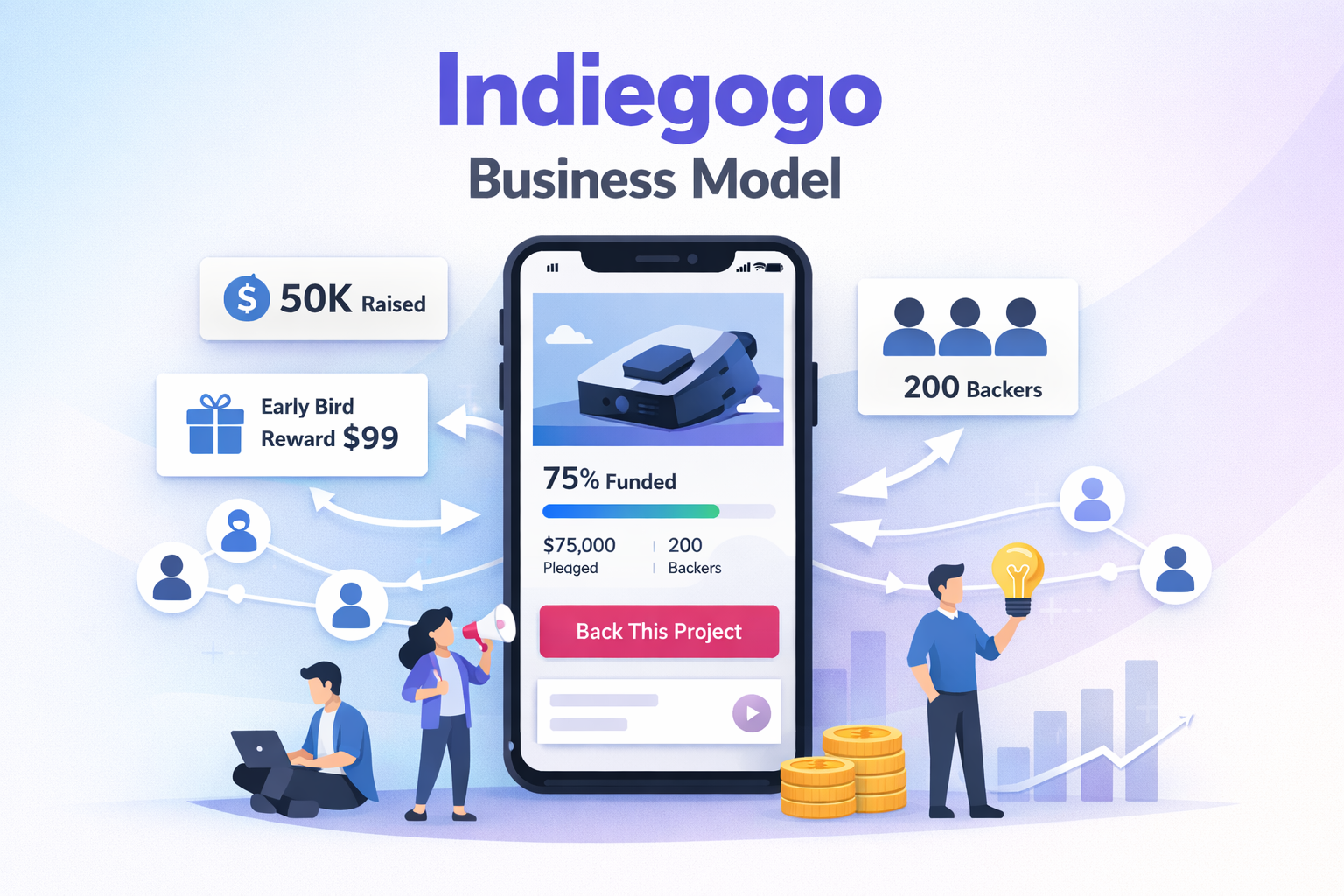
Indiegogo operates as a two-sided marketplace. On one side, you have creators who need funding. On the other side, you have backers who want early access to innovative products or want to support ideas they believe in.
Indiegogo sits in the middle and earns a commission on successful funding. The more money raised on the platform, the more Indiegogo makes. That alignment of incentives is what makes the model work.
How Indiegogo Works
Understanding the business model starts with understanding how campaigns actually run.
Campaign Creation
A creator signs up, sets a funding goal, defines a timeline, and outlines the rewards backers will receive. Rewards can range from a thank-you note to a discounted early version of the product.
Campaign Promotion
Once live, creators promote their campaign through social media, email lists, and paid ads. Indiegogo also promotes selected campaigns through its own channels, which is a service some creators pay for.
Backers Fund Projects
Visitors browse the platform and contribute to campaigns they find interesting. They are not investing in equity. They are pre-ordering or supporting in exchange for a perk.
Funds Distribution
How funds are released depends on the campaign type. Fixed funding campaigns release money only if the goal is met. Flexible funding campaigns release money regardless of whether the goal is hit.
Product Delivery
After the campaign closes, creators fulfill their promises. This is where trust either builds or breaks. Indiegogo does not guarantee delivery, which is one of the platform’s known risk areas.
Types of Crowdfunding on Indiegogo
Indiegogo offers two distinct funding models, and the choice matters for both creators and backers.
Fixed Funding
The creator sets a goal. If the campaign does not reach that goal by the deadline, all backers are refunded. No money changes hands. This model lowers risk for backers because they only pay if the project is fully funded.
Fixed funding works best when a creator needs a specific minimum budget to actually build the product. Raising half the goal would mean they cannot deliver anything, so all-or-nothing makes sense.
Flexible Funding
With flexible funding, the creator keeps whatever money is raised, even if the goal is not met. There are no refunds tied to the goal amount.
This gives creators more flexibility but increases risk for backers. If a campaign raises only 20% of its goal, backers may still be charged, and the creator may not have enough to actually ship the product.
Flexible funding is popular with campaigns where partial funding is still useful, like events, creative projects, or campaigns with scalable production costs.
How Indiegogo Makes Money
This is the core of the business model. Indiegogo has multiple revenue streams, and each one is built around the activity happening on the platform.
Platform Fees
The primary revenue source is a flat percentage fee on all funds raised. Indiegogo charges around 5% of the total amount raised on a campaign.
This fee applies after the campaign ends and funds are distributed. If a campaign raises $100,000, Indiegogo takes approximately $5,000. Scale that across thousands of campaigns and the revenue adds up fast.
This fee structure means Indiegogo only makes money when creators succeed. That creates a natural incentive for the platform to support campaigns and help them reach their goals.
Payment Processing Fees
On top of the platform fee, Indiegogo charges a payment processing fee. This is approximately 3% plus a small per-transaction charge.
This fee covers the cost of processing credit cards, debit cards, and other payment methods. Most of this goes to third-party payment processors like Stripe, but Indiegogo builds it into their pricing structure.
For a campaign raising $100,000, total fees including both platform and processing could easily exceed $8,000. That is the real cost of using the platform.
The InDemand Program
InDemand is one of Indiegogo’s smartest revenue plays. After a campaign officially closes, creators can continue accepting orders through InDemand. This turns a one-time campaign into an ongoing pre-order store.
This matters because successful campaigns often generate momentum. Media coverage, word of mouth, and social sharing keep driving traffic even after the campaign deadline. InDemand captures that traffic and converts it into additional revenue.
Indiegogo takes a fee on InDemand sales, making this a recurring revenue stream on top of the initial campaign fee. Many hardware startups use InDemand as their primary sales channel while they ramp up manufacturing.
Marketing and Promotion Services
Indiegogo offers paid promotional services to campaign creators. These include:
Featured listings place campaigns prominently on the homepage or in category pages, increasing visibility and backer conversions.
Email promotions let creators reach Indiegogo’s subscriber base directly. For a platform with millions of users, email access is a valuable paid service.
Campaign consulting connects creators with Indiegogo’s team for strategic advice on pricing, reward tiers, and launch timing. This is typically offered as a premium service for larger campaigns.
These marketing services are an important revenue diversifier. They generate income from creators who are willing to pay upfront for better visibility, separate from the percentage-based fees.
Enterprise Solutions and Brand Partnerships
Indiegogo works with established brands, not just individual creators. Large companies use the platform to test market demand for new products before committing to full production runs.
This is market validation at scale. A company can launch a product on Indiegogo, see how many people back it, and use that data to make manufacturing and distribution decisions.
Enterprise partnerships typically involve custom agreements beyond the standard fee structure. Indiegogo provides dedicated support, co-marketing, and platform features tailored to larger clients.
The Business Model Canvas
Breaking down the Indiegogo model using a business model canvas makes the structure easier to visualize.
Key Partners
Indiegogo relies on payment processors to handle transactions, marketing agencies to support campaign promotion, and logistics partners who help creators with fulfillment. These relationships are essential to the platform’s core operations.
Key Activities
The platform’s main activities include building and maintaining the technology, curating and reviewing campaigns for quality, processing payments, and providing creator support. Campaign curation is particularly important because the quality of campaigns directly affects backer trust.
Value Propositions
For creators, Indiegogo offers a direct path to funding without traditional gatekeepers. No investors, no bank loans, no equity dilution. Just a public campaign and a potential customer base.
For backers, the value is early access to innovative products, often at a lower price than retail. Backers also get the satisfaction of supporting something they believe in before it hits the mainstream market.
Customer Segments
Indiegogo serves four main groups. Startups and entrepreneurs use it for product funding. Individual creators use it for artistic and social projects. Early adopters and tech enthusiasts back campaigns for access to new products. And increasingly, established brands use it for market validation.
Channels
The primary channel is the Indiegogo website itself. Secondary channels include email marketing to its subscriber base, social media, and creator-driven promotion. Creator networks do a significant portion of the marketing work because it is in their interest to drive traffic to their own campaigns.
Customer Relationships
Indiegogo operates primarily as a self-service platform. Creators build their own campaigns using provided tools. However, the platform also builds community engagement through comments, updates, and backer communication features built into each campaign page.
Revenue Streams
Platform fees, payment processing fees, InDemand program fees, marketing services, and enterprise partnerships. These five streams work together to create a diversified revenue model.
Cost Structure
Major costs include technology infrastructure to keep the platform running, marketing to attract creators and backers, customer support for dispute resolution, and compliance and legal costs associated with handling money in multiple countries.
Why the Indiegogo Model Works
Several structural advantages make this business model durable.
No Upfront Cost for Creators
Creators do not pay to launch a campaign. They only pay a fee if they raise money. That zero-risk entry point removes friction and attracts a wide range of campaigns to the platform.
Global Reach
Indiegogo operates in over 235 countries and territories. A creator in one country can access backers from anywhere in the world. That global reach is a significant competitive advantage over local funding alternatives.
Market Validation Before Production
This is one of the most underrated benefits. A successful campaign proves there is real demand for a product before the creator spends money on manufacturing. If the campaign fails, the creator learns that lesson cheaply. If it succeeds, they have funding and proof of concept simultaneously.
Community-Driven Promotion
Backers share campaigns with their networks. Creators promote their own campaigns aggressively. This creates a viral marketing loop that benefits Indiegogo without requiring equivalent advertising spend from the platform itself.
Scalable Infrastructure
Adding more campaigns does not require proportionally more costs. The platform scales well because the technology infrastructure serves thousands of campaigns with relatively fixed overhead.
Growth Strategy
Indiegogo has made deliberate strategic choices to grow its platform and revenue.
Focus on Hardware and Tech
Indiegogo has positioned itself as the go-to platform for hardware startups and tech products. Categories like consumer electronics, smart home devices, and wearables consistently perform well on the platform and attract media attention that drives additional traffic.
InDemand Expansion
By pushing InDemand as a post-campaign revenue tool, Indiegogo extends the lifetime value of each successful campaign. Instead of a one-time transaction, it becomes an ongoing relationship with recurring fee income.
Trust Building Initiatives
One of Indiegogo’s ongoing challenges is backer trust. Some campaigns have failed to deliver on their promises. Indiegogo has invested in better campaign vetting, creator accountability tools, and clearer communication standards to reduce the frequency of failed deliveries.
Startup Ecosystem Integration
Indiegogo has built relationships with accelerators, incubators, and investor networks. This positions the platform as part of a larger startup pipeline rather than a standalone funding tool. Creators who succeed on Indiegogo often attract follow-on investment from traditional venture capital.
Competitors
Indiegogo operates in a competitive crowdfunding market. Understanding its competitors clarifies where Indiegogo’s model is differentiated.
Kickstarter
Kickstarter is Indiegogo’s closest competitor and in many ways its primary rival. The key difference is funding model: Kickstarter uses fixed funding almost exclusively, while Indiegogo offers flexible funding as an option. Kickstarter also operates as a public benefit corporation and focuses more heavily on creative projects. Indiegogo leans more toward tech products and startups.
GoFundMe
GoFundMe focuses on personal fundraising, charity, and social causes rather than product campaigns. The overlap with Indiegogo is minimal. GoFundMe does not offer a rewards-based crowdfunding structure, so it attracts a completely different creator base.
Patreon
Patreon is a subscription-based platform for ongoing creator support rather than one-time product campaigns. It is relevant as a competitor for creators in the media and entertainment space, but it does not compete directly on the hardware or startup side where Indiegogo is strongest.
Advantages of the Business Model
Low Barrier to Entry
Any creator with an idea and a campaign page can launch on Indiegogo. There is no application process, no gatekeepers, and no minimum funding requirement. That openness creates volume, and volume is what drives marketplace revenue.
Multiple Revenue Streams
Indiegogo does not rely on a single income source. Platform fees, processing fees, InDemand, marketing services, and enterprise partnerships create a diversified revenue structure that is more resilient than a single-fee model.
Scalable Marketplace
The two-sided marketplace model scales efficiently. As more creators join, more backers follow. As more backers join, the platform becomes more attractive to creators. That network effect is self-reinforcing.
Global Audience
Operating in over 200 countries gives Indiegogo access to a massive and diverse backer base. Creators benefit from global reach, and Indiegogo benefits from the transaction volume that comes with it.
Challenges and Risks
No business model is without its vulnerabilities. Indiegogo faces real structural challenges.
Campaign Failures and Delayed Deliveries
Some campaigns raise significant money and then fail to deliver the product. This damages backer trust and creates reputational risk for the platform. Indiegogo has limited ability to enforce delivery because it is not the product manufacturer.
Trust Deficit
High-profile campaign failures have made some potential backers cautious. Rebuilding trust requires ongoing investment in campaign vetting and accountability tools, which adds operational cost without directly generating revenue.
High Competition
The crowdfunding space is crowded. Kickstarter, GoFundMe, and dozens of niche platforms compete for creator attention. Indiegogo must continuously differentiate its offering to retain its creator base.
Dependence on Creator Success
Indiegogo’s revenue is directly tied to how much money creators raise. If campaigns underperform or the quality of campaigns declines, platform revenue drops. There is no fixed subscription income to buffer against downturns.
Regulatory Complexity
Handling money across 235 countries means navigating different financial regulations, tax laws, and consumer protection requirements. Compliance costs are significant and ongoing.
Real-World Examples of Indiegogo Success
Indiegogo has hosted thousands of successful campaigns across multiple categories.
Smart home devices have consistently performed well on the platform. Products like smart lighting systems, home security gadgets, and connected appliances have raised millions through Indiegogo campaigns and used that funding to go to retail.
Wearable technology is another strong category. Smartwatches, fitness trackers, and health monitoring devices have found early audiences on Indiegogo before moving into mainstream distribution.
Creative projects including independent films, music albums, and graphic novels have also used Indiegogo to fund production and build audiences simultaneously.
These examples illustrate that the platform’s model works across diverse categories, not just a single niche.
The Future of Indiegogo
Several trends will shape how Indiegogo evolves its business model in the coming years.
Hardware Innovation
The rise of consumer hardware startups continues to drive activity on the platform. As manufacturing becomes more accessible and prototyping costs drop, more hardware startups will use crowdfunding as their initial go-to-market strategy.
AI-Driven Campaign Tools
Machine learning can improve campaign recommendations for backers, optimize reward pricing for creators, and predict campaign success rates. Indiegogo has the data from thousands of campaigns to train useful models. Integrating AI into the platform experience is a logical growth area.
Startup Ecosystem Expansion
Indiegogo is increasingly positioned as the first step in a startup’s funding journey rather than the only step. Connecting successful campaigns with angel investors, accelerators, and venture funds would deepen the platform’s value and increase creator retention.
Post-Campaign Commerce
The InDemand program is an early version of what could become a full post-campaign commerce layer. As creators build audiences through crowdfunding, there is an opportunity for Indiegogo to support ongoing product sales, not just initial fundraising.
Key Takeaways
Indiegogo is a commission-based marketplace that makes money by connecting creators with backers and taking a percentage of funds raised.
Its primary revenue streams are platform fees at around 5%, payment processing fees at around 3%, the InDemand post-campaign program, paid marketing services, and enterprise partnerships with established brands.
The model works because it aligns Indiegogo’s financial incentives with creator success. When campaigns do well, the platform earns more. That alignment drives the platform to invest in tools and features that improve campaign performance.
The core competitive advantage is flexible funding combined with global reach. No other major platform offers the same combination of flexible and fixed funding options across such a large international backer base.
The biggest risks are backer trust issues from failed deliveries and competitive pressure from Kickstarter and other alternatives. Addressing trust is the most important long-term challenge for the platform.
FAQs
Launching a campaign on Indiegogo is free. There are no upfront costs. However, if a campaign raises money, Indiegogo charges approximately 5% as a platform fee plus around 3% for payment processing. Creators only pay when they raise funds.
The biggest difference is funding flexibility. Indiegogo offers both fixed and flexible funding options. Kickstarter uses all-or-nothing fixed funding almost exclusively. Indiegogo also tends to attract more tech and hardware campaigns, while Kickstarter has a stronger presence in creative categories like games, design, and art. Both platforms charge similar percentage-based fees.
Yes, and many do. Indiegogo is widely used for product validation, pre-orders, and early customer acquisition. A successful campaign proves market demand, generates initial revenue, and creates a customer base before the product goes into full production. Many startups have used Indiegogo as their first funding round before pursuing traditional investment.
InDemand allows creators to continue accepting orders after their campaign officially ends. It functions as an ongoing pre-order store. Indiegogo takes a fee on InDemand sales. It is particularly useful for campaigns that generated media attention and ongoing traffic after the campaign deadline passed.
No. Indiegogo is a funding platform, not a product guarantor. If a creator fails to deliver, Indiegogo has limited ability to enforce fulfillment. Backers take on the risk that a creator may not deliver as promised. This is one of the known risks of reward-based crowdfunding on any platform.
Discover more from Business Model Hub
Subscribe to get the latest posts sent to your email.