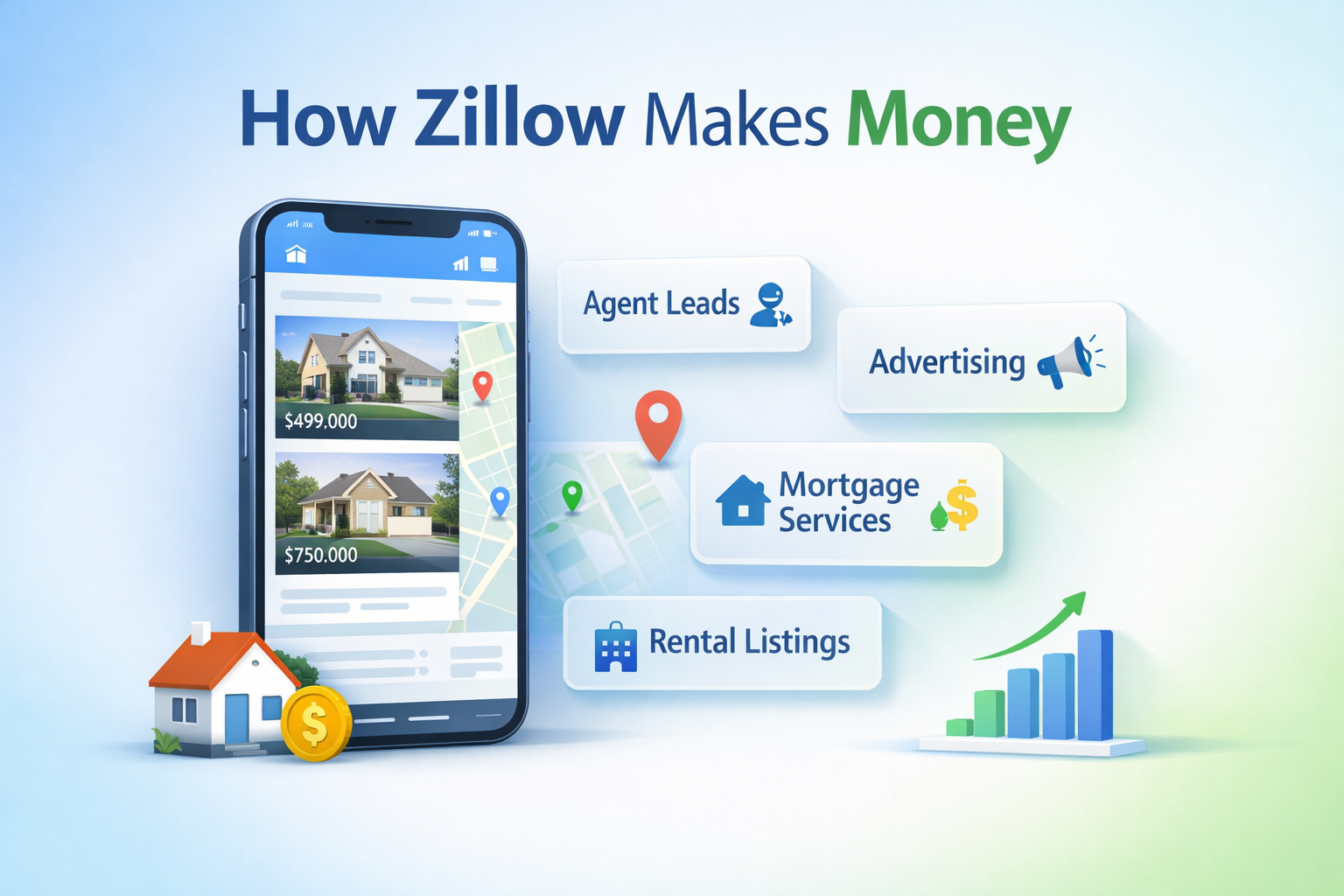

Zillow makes money primarily through its Premier Agent program, where real estate agents pay for leads generated from buyers and sellers on the platform. Additional revenue comes from advertising, mortgage services through Zillow Home Loans, rental marketplace fees, and closing services. Zillow Offers, its home-flipping experiment, was shut down in 2021 after major losses.
Ever Wondered How Zillow Lets You Browse Millions of Homes for Free?
You open Zillow, search your dream neighborhood, scroll through hundreds of listings, check the Zestimate on your current home, and close the app. You paid nothing. Zillow spent nothing on you directly.
So how does a company that gives away so much for free manage to generate billions of dollars in revenue?
That question is worth answering clearly, because the answer reveals a lot about how modern tech platforms actually work.
Zillow is not a real estate company in the traditional sense. It does not sell you a house. It does not take a commission when you buy one. What it does is far more profitable and far less obvious to the average user.
In this article, we break down exactly how Zillow makes money, where most of that revenue actually comes from, why the business model works, and what lessons it holds for anyone building a marketplace or platform business.
What Is Zillow
Zillow is an online real estate marketplace that lets users search for homes to buy, rent, or sell across the United States. It was founded in 2006 by Rich Barton and Lloyd Frink, both former Microsoft executives who also co-founded Expedia.
The platform gives users access to:
Property listings across millions of homes for sale and rent in the US.
The Zestimate which is Zillow’s proprietary home valuation tool that uses machine learning and public data to estimate what any given home is worth. It has become one of the most recognized features in residential real estate.
A full ecosystem for home transactions covering buying, selling, renting, and financing all in one place.
Zillow operates several brands under its umbrella including Trulia, StreetEasy (focused on New York City), and HotPads. Each targets a slightly different segment of the real estate market but feeds into the same core business model.
The key thing to understand about Zillow is that it built its brand by becoming the go-to destination for home search. Hundreds of millions of visits every month flow through its platform. That traffic is the asset. Monetizing that traffic is the business.
Zillow’s Business Model at a Glance
Zillow operates as a two-sided marketplace. On one side, you have consumers looking to buy, sell, or rent homes. On the other side, you have real estate professionals including agents, brokers, lenders, and landlords who want to reach those consumers.
Zillow’s job is to sit in the middle and facilitate that connection.
The consumers get a free, high-quality search experience. The professionals pay to reach those consumers. That is the entire model in its simplest form.
One line explains it well: Zillow does not sell houses. It sells attention and leads.
When millions of people search for homes on Zillow every day, that search behavior creates something extremely valuable. Every person clicking on a listing is a potential buyer or seller. Real estate agents need those people. Lenders need those people. Landlords need those people.
Zillow charges them for the access.
How Does Zillow Makes Money
The Premier Agent Program
This is Zillow’s biggest revenue driver by a wide margin. To understand it, you need to understand what happens when a buyer or seller interacts with a listing on Zillow.
When you browse a home listing and click “Contact Agent,” you are often not contacting the listing agent directly. Instead, you are submitting a lead that Zillow has sold or allocated to a Premier Agent, a real estate agent who has paid for advertising on the platform.
Premier Agents pay Zillow for prominent placement on listings in specific zip codes. The more they pay, the more impressions and leads they receive. They essentially buy a share of voice in a given market.
This program generates the majority of Zillow’s total revenue. In recent years, Zillow has reported that its residential segment, which is built almost entirely on Premier Agent revenue, accounts for well over half of total company income.
The model is built around a simple insight. Real estate agents earn commissions that average around two to three percent of a home’s sale price. On a $500,000 home, that is $10,000 to $15,000 per transaction. If Zillow can consistently deliver qualified leads that convert into closed deals, agents will gladly pay hundreds or even thousands of dollars per month for access.
Zillow has also experimented with different pricing structures for Premier Agent over the years. It has moved between impression-based pricing and a “Flex” model where agents only pay when they close a deal from a Zillow lead. Both approaches are designed to make the program more attractive and sticky for agents.
Advertising Revenue
Beyond Premier Agent, Zillow generates revenue from display advertising and featured placements across its platform.
Property managers and rental companies pay for banner ad placements and featured listings. Real estate brokerages pay for brand visibility. Financial services companies and mortgage lenders purchase ad inventory targeted at users who are actively searching for homes.
This advertising revenue is not Zillow’s primary income source, but it adds meaningful dollars on top of the Premier Agent program. Because Zillow’s audience is highly intent-driven, meaning users are actively researching real estate decisions, the ad inventory commands premium pricing compared to general display advertising.
Think about the context. Someone searching for a three-bedroom home in Austin, Texas, with a $450,000 budget is an extremely high-value target for mortgage lenders, home insurance companies, moving services, and renovation contractors. Zillow’s ability to target ads against that specific search behavior makes its platform attractive to a wide range of advertisers beyond just real estate agents.
Zillow Home Loans
Zillow entered the mortgage business directly through Zillow Home Loans, its in-house lending operation.
Instead of simply referring users to third-party lenders and collecting a referral fee, Zillow decided to become the lender itself. Zillow Home Loans offers purchase mortgages and refinancing directly to consumers.
Revenue from this segment comes from two main places.
Loan origination fees are charged when a borrower takes out a mortgage. This is a standard fee in the lending industry, typically representing a percentage of the loan amount.
Interest income and loan sales come from the spread between the interest rate charged to borrowers and Zillow’s cost of capital, as well as fees earned when loans are packaged and sold on the secondary market.
The strategic logic behind this move is clear. If Zillow already has millions of home shoppers on its platform, converting even a small percentage of them into mortgage customers is enormously lucrative. The average mortgage generates thousands of dollars in revenue. Capturing that transaction in-house means Zillow keeps more of the value chain instead of passing it to a third-party lender.
The mortgage segment is still smaller than the Premier Agent business, but it represents a major growth area as Zillow tries to build a more integrated transaction experience.
Rental Marketplace Revenue
Zillow operates a large rental marketplace where landlords and property managers can list available units for rent.
Revenue in this segment comes from two main sources.
Listing fees are paid by landlords and property managers who want their rental units featured on the platform. Pricing typically scales based on the number of units and the level of visibility desired.
Application fees are collected when prospective tenants submit rental applications through Zillow’s platform. Zillow offers a streamlined application process including background checks and credit reports, and it charges either the landlord or the tenant for these services depending on the market.
The rental segment has grown significantly as Zillow has invested in building out tools for property managers and independent landlords. With millions of renters actively searching for apartments and homes on Zillow each month, the rental marketplace has become a meaningful revenue contributor alongside the residential sales segment.
Closing Services and Transaction Services
As Zillow has pushed toward becoming a more comprehensive real estate platform, it has built out closing and transaction services that generate additional fees.
These services include title insurance, escrow management, and other settlement services that are required in most real estate transactions.
When Zillow can keep a homebuyer on its platform from initial search all the way through to closing, it earns fees at multiple stages of that transaction. Title and escrow fees alone can add up to several thousand dollars per transaction.
This segment ties directly into Zillow’s larger strategy of owning more of the real estate transaction rather than just the discovery and lead generation phases. The more steps Zillow can be involved in, the more revenue it can extract per transaction.
Zillow Offers: The Discontinued Model
No discussion of how Zillow makes money is complete without addressing Zillow Offers, the iBuying program that the company launched and then shut down in 2021.
Zillow Offers was an attempt to flip houses at scale. The idea was straightforward. Zillow would use its Zestimate technology and data advantage to make instant cash offers on homes. Sellers who wanted a quick, hassle-free sale could accept Zillow’s offer, and Zillow would purchase the home directly, make minor renovations, and relist it for a profit.
At its peak, Zillow was buying thousands of homes per month and operating in dozens of markets across the country.
The experiment collapsed dramatically. Zillow’s pricing algorithms overestimated home values at scale, and the company found itself holding billions of dollars worth of homes that it had overpaid for. When the market shifted and those homes could not be sold at the expected prices, the losses mounted quickly.
Zillow announced the shutdown of Zillow Offers in November 2021 and took a write-down of over $500 million. Thousands of employees were laid off.
The lesson here is important. Not every big tech company experiment works, even when the company has enormous data advantages and deep pockets. Zillow had better housing data than almost anyone in the industry, and it still could not make iBuying profitable at scale.
The failure of Zillow Offers actually reinforced how valuable and defensible the core Premier Agent business is. Lead generation at scale is a lower-risk, higher-margin business than buying and selling physical assets. Zillow has since refocused on its core strengths.
Where Zillow Actually Makes Most of Its Money
Let’s cut through the complexity and be direct about the revenue breakdown.
The overwhelming majority of Zillow’s revenue comes from its residential segment, which is built on the Premier Agent program.
Zillow’s total revenue in recent fiscal years has been in the range of $1.9 billion to $2.2 billion annually. The residential segment, driven by agent advertising, consistently accounts for well over 60 percent of that total. Mortgages, rentals, and other services make up the remainder.
The clearest way to understand Zillow’s economics is this framework.
Users equal traffic. Consumers browse homes for free and generate hundreds of millions of sessions per year.
Agents equal revenue. Real estate professionals pay to reach those consumers through advertising, lead programs, and featured placements.
Zillow’s actual customer, the entity writing the check, is not the home buyer browsing listings on a Saturday morning. The actual customer is the real estate agent who paid $3,000 last month to be featured on listings in their target zip code.
This is the classic media and marketplace business model. Build an audience, then charge businesses to reach that audience. Zillow has executed this model at an exceptional scale in one of the highest-value consumer decision categories that exists.
Why Zillow’s Business Model Works
Several structural advantages make Zillow’s model durable.
Massive organic traffic is the foundation of everything. Zillow has built one of the strongest consumer brands in real estate. When Americans think about searching for a home online, Zillow is often the first name that comes to mind. That brand recognition drives direct and organic traffic that is extremely cheap to acquire compared to paid channels.
The free user experience creates a flywheel. Because Zillow charges users nothing, the barrier to visiting and using the platform is essentially zero. More users mean more data. More data improves the Zestimate and other features. Better features attract more users. That loop reinforces itself over time.
The Zestimate creates a data moat. Even people who are not actively buying or selling check Zillow to see what their home is worth or what homes in their neighborhood are going for. This casual usage pattern keeps Zillow embedded in consumers’ habits across the entire homeownership lifecycle, not just during active transactions.
Network effects strengthen the marketplace. As more agents join the Premier Agent program, Zillow can offer buyers more coverage and faster response times. As more buyers use Zillow, agents see stronger ROI from the program. This mutual reinforcement is a classic marketplace dynamic.
Real estate is a high-frequency research, low-frequency transaction category. People browse homes constantly even when they are not actively in the market. This keeps traffic levels high year-round while agents pay to capture the subset who are actually ready to transact.
Zillow’s Biggest Challenges
It would be incomplete to talk about why the model works without being honest about the real challenges Zillow faces.
Dependence on the real estate market cycle is a structural vulnerability. When interest rates rise sharply and home sales volumes drop, agents earn fewer commissions. When agents earn less, they are more likely to cut their Zillow advertising budgets. Zillow saw this dynamic play out clearly in 2022 and 2023 as rising rates caused transaction volumes to fall across the industry.
Competition from Redfin and Realtor.com keeps pressure on Zillow’s market position. Redfin has built a vertically integrated model where it employs agents directly and charges lower commissions. Realtor.com, operated by Move Inc. and affiliated with the National Association of Realtors, has strong brand equity and industry relationships. Both platforms compete aggressively for the same agent advertising dollars and consumer traffic.
The failed iBuying experiment raised questions among investors and the industry about Zillow’s ability to expand beyond lead generation. It also cost the company significant capital and forced painful layoffs that affected company culture and momentum.
Zestimate accuracy concerns remain a persistent issue. The tool is genuinely useful as a rough estimate, but it can be significantly off in markets with limited transaction data or unique property characteristics. When homeowners or buyers make decisions based on inaccurate Zestimates, it creates friction and erodes trust in Zillow’s brand.
Agent relationships are complicated. Real estate agents sometimes resent the Premier Agent model because it can result in buyers being connected to agents they did not specifically choose. Some agents feel that Zillow commoditizes their services and extracts value from the transaction without adding corresponding value. This tension requires Zillow to constantly demonstrate ROI to keep agents investing in the program.
Key Lessons for Founders and Builders
Zillow’s model is worth studying closely because it contains several transferable lessons for anyone building a platform, marketplace, or media business.
Monetize the professional, not the consumer. Zillow’s genius was recognizing that home buyers and sellers would never pay for search, but the professionals who serve them absolutely would. Finding the party in a transaction who has clear financial upside and charging them is almost always smarter than trying to extract payment from end consumers seeking free information.
Build traffic first, worry about monetization second. Zillow spent years building brand equity and traffic before the Premier Agent program became the revenue engine it is today. Platforms that try to monetize before they have meaningful scale usually end up with neither traffic nor revenue. Zillow understood that the audience was the asset.
A well-constructed marketplace is one of the most defensible business models available. Once buyers expect to find listings on Zillow and agents expect to find leads there, both sides reinforce the platform’s value. Breaking that equilibrium requires a competitor to simultaneously win over both sides, which is extremely difficult. Zillow has benefited from this structural protection for years.
Do not scale risky experiments before proving unit economics. The Zillow Offers failure is a case study in the danger of moving too fast with a capital-intensive business model that had not been fully stress-tested. Buying real estate at scale creates massive balance sheet risk. The speed at which Zillow scaled Offers before the model was proven cost the company enormously. For any founder, the lesson is to validate the economics in a contained environment before pushing a high-risk initiative into full-scale operation.
Data advantages are powerful, but they do not eliminate execution risk. Zillow had better housing data than virtually any other market participant. It still got the iBuying model wrong. Data is a critical input, but it does not replace sound judgment about market timing, operational complexity, and risk management.
Your brand can extend your platform’s reach across the entire customer lifecycle. Zillow is not just used during home purchases. People check Zestimates for fun, they browse rentals out of curiosity, they track their neighborhood values over time. By becoming part of the habitual behavior around homeownership broadly, Zillow keeps consumers engaged in between transactions and earns the right to be top of mind when those consumers do become active buyers or sellers.
Conclusion
Zillow makes money by connecting a massive audience of home shoppers with the real estate professionals who want to reach them, and charging those professionals for the access.
The business is not complicated at its core. Build a platform that millions of consumers use for free. Charge agents, lenders, and landlords for the leads and visibility that platform generates. Expand into adjacent services like mortgages and closing to capture more value per transaction.
The Premier Agent program is the engine that drives the vast majority of revenue. Everything else, from mortgage origination to rental listings to closing services, is built around deepening Zillow’s role in the transaction and extracting more value from the traffic the core platform generates.
Zillow tried to become something more ambitious with Zillow Offers, and it failed in a very public and expensive way. That failure actually clarified the company’s identity. Zillow is not a real estate company. It is a lead generation machine, a data platform, and a media business that happens to operate in the real estate category.
The homes on Zillow are not really the product. The attention of the people browsing those homes is the product. And real estate professionals across America pay billions of dollars every year to access it.
Understanding that distinction is the key to understanding how Zillow actually works.
Discover more from Business Model Hub
Subscribe to get the latest posts sent to your email.



[…] focuses more on neighborhood and lifestyle discovery, while Zillow focuses heavily on property data and home valuation […]