
Netflix makes money primarily through monthly subscription fees paid by its 270+ million global subscribers. It also earns from its ad-supported plan and select licensing deals. At its core, Netflix is a retention-first business built on content, data, and global scale.
Why Netflix Is Worth Studying
Netflix is not just a streaming service.
It’s one of the most interesting business stories of the last 25 years. A DVD rental company turned into a global entertainment giant. That kind of shift doesn’t happen by accident.
I find Netflix fascinating because it keeps reinventing itself. DVD rentals. Streaming. Original content. Now ads and gaming. Every few years, it finds a new gear.
If you want to understand how modern subscription businesses work, Netflix is the best case study out there.
What Is Netflix?
Netflix is a subscription-based streaming platform. You pay a monthly fee. You get unlimited access to movies, TV shows, documentaries, and now games.
It was founded in 1997 by Reed Hastings and Marc Randolph in Scotts Valley, California. It started as a DVD-by-mail service. In 2007, it launched streaming and changed everything.
Today, Netflix operates in over 190 countries. It has content in dozens of languages. It produces its own movies and shows through Netflix Studios.
It’s not just a platform anymore. It’s a full content studio and distribution network rolled into one.
Quick Answer: How Does Netflix Make Money?
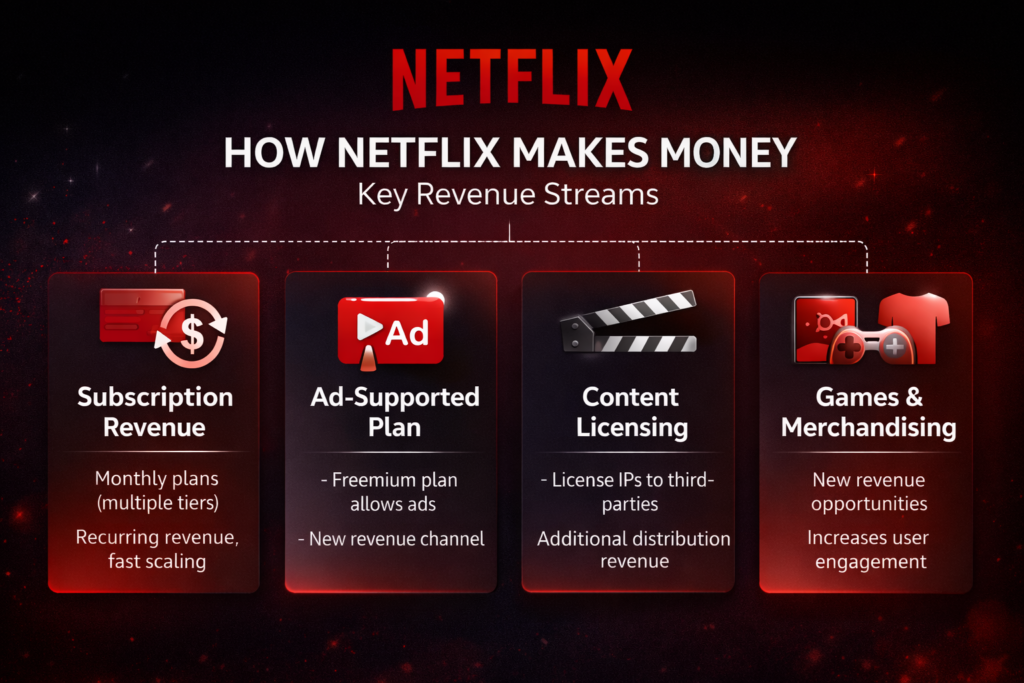
Netflix makes money through three main ways:
- Subscription fees (its biggest revenue source)
- Advertising revenue from its ad-supported plan
- Licensing deals for select content
Most of Netflix’s revenue, we’re talking roughly 98%, still comes from subscriptions. But the ad business is growing fast.
The Netflix Business Model Overview
Netflix runs what I’d call a hybrid subscription model.
At its base, it charges users a monthly fee for access to content. But in 2022, it added an ad-supported tier at a lower price point. That opened up a new revenue stream entirely.
Here’s what makes Netflix’s model smart. It’s not just about getting subscribers. It’s about keeping them.
Netflix is a retention-first business. Every decision, from what shows to greenlight to how thumbnails look, is built around keeping you watching.
The model works like this: more content brings in more subscribers. More subscribers fund more content. More content keeps people from canceling. It’s a flywheel.
How Netflix Makes Money: The Revenue Streams
Subscription Revenue
This is the engine. Subscriptions are what keep Netflix running.
Netflix offers multiple pricing tiers in the US:
- Standard with Ads at around $7 per month
- Standard at around $15 per month
- Premium at around $22 per month
Each tier offers different features. Ad-free. HD vs 4K. Number of screens. That kind of thing.
Globally, Netflix adjusts pricing based on local markets. In India, plans are significantly cheaper. In Europe, pricing is closer to US levels.
This localized pricing strategy is smart. It lets Netflix compete in price-sensitive markets without lowering prices everywhere.
With 270+ million paid subscribers, even small price increases translate to massive revenue jumps. That’s the power of scale.
The Ad-Supported Plan
Netflix launched its ad-supported plan in late 2022. A lot of people were skeptical. Would Netflix users accept ads?
Turns out, yes. Millions of people signed up for the cheaper tier. Advertisers got access to a premium, engaged audience. Netflix got a new revenue stream.
Here’s why this matters. The ad tier brought in users who thought Netflix was too expensive. It expanded the total addressable market.
Advertisers pay a premium to reach Netflix’s audience because Netflix viewers are engaged. They’re not scrolling social media. They’re sitting down and watching.
Netflix’s ad business is still small compared to subscriptions. But it’s growing fast. By some estimates, it could become a multi-billion dollar revenue stream within a few years.
Licensing and Distribution
Netflix licenses some of its content to other platforms and broadcasters. This is not a massive revenue driver, but it adds up.
For example, some Netflix originals have been licensed to local TV channels in certain markets. Netflix also has content partnerships where it distributes third-party studios’ content.
This works both ways. Netflix pays for licensed content. But it also earns from licensing its own content when it makes strategic sense.
The key insight here is that Netflix doesn’t just create content. It manages a content portfolio like a financial asset.
Extended Monetization: Games, Merch, and More
Netflix added mobile gaming to its platform a few years ago. It’s included with your subscription at no extra cost.
Right now, gaming isn’t a standalone revenue stream. But it’s a retention tool. If you’re playing a Netflix game, you’re less likely to cancel.
Netflix has also moved into merchandise and brand collaborations. Think Stranger Things branded products. Squid Game merchandise. These are small revenue streams, but they build brand value.
I think gaming is where Netflix has its biggest untapped opportunity. If it can build a gaming library the way it built a content library, that changes everything.
Netflix Cost Structure: Where the Money Goes
Content Production
This is Netflix’s biggest expense by a wide margin.
Netflix spends billions every year producing original content. We’re talking $17 billion plus annually in content costs. That’s a staggering number.
Why spend so much? Because content is the product. If the content is bad, people cancel. If the content is great, people subscribe and stay.
Netflix Originals like Stranger Things, Squid Game, and Wednesday aren’t just shows. They’re subscriber magnets and brand builders.
The math is interesting. A hit show like Squid Game costs a fraction of what a Hollywood blockbuster costs. But it can drive millions of new subscriptions globally. That’s an insane return on investment.
Technology Infrastructure
Netflix streams billions of hours of video every month. That requires serious infrastructure.
Netflix built its own content delivery network called Open Connect. It works with ISPs around the world to place servers closer to users. This reduces buffering and improves stream quality.
On top of that, Netflix uses cloud services, data centers, and proprietary streaming technology.
The technology spend is high, but it’s what makes Netflix’s user experience better than most competitors.
Marketing
Netflix spends heavily on marketing. Trailers, billboards, social media campaigns, influencer deals, and press events.
For a big show like Bridgerton or The Crown, the marketing spend can be enormous. Netflix knows that getting people to watch the first episode is half the battle.
Once someone starts a show, the algorithm takes over. But first, marketing has to get them in the door.
Licensing Costs
Not everything on Netflix is original content. Netflix pays licensing fees to studios and distributors for third-party content.
Think of shows like Suits or movies from major Hollywood studios. Netflix pays to stream those. These deals can be expensive, especially for popular content.
The shift toward originals is partly about reducing this dependency. If Netflix owns the content, it pays once. If it licenses, it keeps paying.
The Business Model Canvas of Netflix
This is a structured way to see how Netflix works as a whole business.
Key Partners
- Major production studios and independent filmmakers
- Internet service providers who host Open Connect servers
- Smart TV and device manufacturers like Samsung, LG, and Roku
- Telecom companies that bundle Netflix with their plans
- Payment processors and app stores
Key Activities
- Producing and acquiring content at scale
- Developing and maintaining the streaming platform
- Analyzing data to personalize recommendations
- Marketing content globally
- Expanding into new markets
Key Resources
- The content library (this is Netflix’s most valuable asset)
- The recommendation algorithm
- Global brand recognition
- A massive subscriber base of 270+ million users
- Technology infrastructure
Value Propositions
Netflix’s value proposition is simple but powerful:
- Unlimited entertainment for a flat monthly fee
- Personalized recommendations that feel almost magical
- High-quality original content you can’t find anywhere else
- Watch anywhere, anytime, on any device
The core promise is convenience plus quality. Netflix delivers both consistently.
Customer Relationships
Netflix operates on a low-friction subscription model. You sign up in minutes. You can cancel anytime. There’s no long-term commitment.
This sounds risky for Netflix. But it actually builds trust. Because canceling is easy, people don’t feel trapped. And because the content is good, most people don’t actually cancel.
Personalization is also a huge part of the relationship. Netflix’s algorithm knows what you like. It serves up relevant content. That keeps you engaged and coming back.
Channels
Netflix reaches its users through:
- iOS and Android mobile apps
- Smart TV apps on every major platform
- The web browser at Netflix.com
- Gaming consoles like PlayStation and Xbox
- Telecom and ISP bundle deals
Netflix is available on virtually every screen in your home. That’s intentional. The easier it is to watch, the more you watch.
Customer Segments
Netflix serves several distinct groups:
- General entertainment consumers looking for movies and shows
- Binge-watchers who consume entire seasons in one sitting
- International audiences who want local language content
- Families who want a shared platform with diverse content
- Younger audiences who game and stream
Cost Structure Summary
Netflix’s biggest costs in order:
- Content production and acquisition
- Technology and infrastructure
- Marketing and promotions
- Licensing fees
- General and administrative costs
Revenue Streams Summary
- Monthly subscription fees (primary)
- Advertising revenue from ad-supported tier
- Content licensing income
Key Components of Netflix’s Business Model
Content Strategy: Originals vs Licensed
Netflix has shifted hard toward original content. And that shift is strategic.
When Netflix licenses a show, it pays repeatedly and can lose the rights. When Netflix makes a show, it owns it forever.
Owning content means more control, lower long-term costs, and the ability to use that content globally without restrictions.
But licensed content still matters. Popular third-party shows drive subscriptions too. Netflix balances both.
The regional content strategy is also brilliant. Shows like Squid Game from Korea, Money Heist from Spain, and Sacred Games from India proved that local stories have global appeal.
Netflix invests in local content markets and often wins big. That’s a major competitive advantage.
Data-Driven Personalization
This is one of Netflix’s biggest moats. The recommendation algorithm.
Netflix collects data on everything. What you watch. What you skip. What you pause. What time you watch. How you browse.
All of that data feeds into an algorithm that gets smarter over time. The result? A homepage that feels personally curated just for you.
I think the algorithm is underrated. It’s not just a nice feature. It’s a retention tool. It keeps you finding new things to watch so you don’t cancel.
Netflix even uses data to decide what shows to greenlight. If viewers love a certain type of thriller, Netflix knows to make more of them. Data informs creative decisions. That’s unusual in Hollywood.
Global Expansion and Localization
Netflix doesn’t just translate content. It localizes it.
Subtitles and dubbing in local languages. Pricing adjusted to local economies. Content made by local creators for local audiences.
Markets like India, Brazil, and South Korea have been major growth drivers. These are markets where Netflix invested early in local content and built loyal audiences.
The lesson here is that global scale plus local relevance is a powerful combination.
User Experience
Netflix’s UI is clean, fast, and easy to use. That’s not an accident.
Netflix runs thousands of A/B tests every year. It tests everything from thumbnail images to button placements to how autoplay works.
Every small improvement in user experience reduces churn. At Netflix’s scale, even a 0.1% improvement in retention is worth hundreds of millions of dollars.
Netflix Growth Strategy
The Content Flywheel
Here’s how the flywheel works. Netflix spends on content. Great content attracts subscribers. More subscribers mean more revenue. More revenue funds more content.
The flywheel self-reinforces. The more it spins, the faster it goes.
This flywheel is why Netflix has been hard to compete with. You need money to make content. You need content to get money. Netflix got there first.
The Binge Strategy
Netflix popularized binge-watching by releasing full seasons at once. This was a deliberate choice.
When you drop a whole season, people talk about it. They finish it fast. They recommend it to friends. That word-of-mouth is priceless.
Netflix is now experimenting with weekly releases for some shows. This keeps subscribers engaged longer and reduces post-binge cancellations.
Market Expansion
Netflix’s biggest growth opportunities are outside the US now. The US market is relatively saturated.
India, Southeast Asia, and parts of Africa and Latin America are the new frontiers. These are markets with growing middle classes, increasing smartphone penetration, and appetite for entertainment.
Netflix’s strategy in these markets is to localize hard, price competitively, and invest in local creators. It’s working.
Partnerships and Bundles
Netflix has deals with telecom providers around the world. In many countries, you can get Netflix bundled with your mobile or broadband plan.
These deals expand Netflix’s reach to customers who might not have signed up directly. Telecom bundles have been a meaningful subscriber acquisition channel.
Netflix vs Competitors
Let’s be direct. Netflix faces real competition.
Amazon Prime Video comes bundled with Prime membership. That gives it a massive built-in user base. Amazon also spends heavily on content including NFL rights and prestige shows like The Boys.
Disney+ has the most powerful content library in the world. Marvel. Star Wars. Pixar. Disney classics. That’s an incredible catalog. Disney+ also bundles with Hulu and ESPN+, giving it a broader ecosystem.
Here’s my honest take. Netflix wins on original content volume and algorithm. Disney+ wins on franchise power. Amazon Prime wins on bundled value.
Netflix’s advantage is that it’s pure-play streaming. It’s not subsidizing a retail business or a theme park empire. It lives and dies by the quality of its streaming product.
In terms of pricing, Netflix is in the middle. More expensive than some, cheaper than bundled packages. The ad-supported tier has helped it compete at the low end.
Strengths of Netflix’s Business Model
- Recurring subscription revenue creates predictable cash flow
- Strong global brand that is recognized in nearly every country
- Massive content library with thousands of hours of originals
- Best-in-class recommendation algorithm that drives engagement
- Scalable model where infrastructure costs don’t rise linearly with new subscribers
- First-mover advantage in global streaming
Weaknesses and Challenges
Let’s keep it real. Netflix has real problems too.
Content costs are enormous. Spending $17 billion plus per year on content is not sustainable forever. Netflix has to make smart bets, not just big ones.
Competition is intense. Every major media company now has a streaming service. The streaming wars are expensive for everyone.
Password sharing crackdowns. Netflix spent years allowing password sharing. When it cracked down in 2023, there was backlash. But it actually worked. Millions of new paid accounts were created.
Market saturation in the US. Most American households that want Netflix already have it. Future US growth will be slower.
Content quality control. Not every Netflix original is a hit. With so much content, there’s a lot of misses alongside the hits.
The Future of Netflix’s Business Model
Here’s where things get interesting. Netflix is not standing still.
Advertising Growth
The ad-supported tier is Netflix’s biggest near-term growth lever. As more users opt for cheaper ad plans, Netflix builds a massive advertising business alongside its subscription business.
This dual-revenue model could make Netflix significantly more profitable in the next five years.
Gaming Ecosystem
Netflix has over 80 games available to subscribers. It’s acquired several game studios. The gaming push is serious.
I believe gaming is Netflix’s biggest long-term bet. If it can become a serious gaming platform, that massively increases the value of a Netflix subscription.
AI Personalization
Netflix already uses AI for recommendations. But AI is about to get much more powerful.
Imagine AI that generates personalized previews. Or AI that helps create content more efficiently. Or AI-powered dubbing that sounds perfectly natural.
These are real possibilities in the next few years.
Live Streaming
Netflix has dipped into live events. Comedy specials, sports, and reality show finales have been streamed live.
Live content keeps subscribers engaged in real-time. It creates appointment viewing that streaming has largely eliminated. Expect Netflix to invest more here.
Key Lessons for Founders and Business Builders
I think about Netflix a lot when I think about business models. Here’s what I take away:
Build recurring revenue. One-time sales are hard. Subscriptions compound. Get customers to pay you every month.
Focus on retention, not just acquisition. Getting a customer is just the start. Keeping them is the real game. Netflix invests as much in reducing churn as it does in growing subscribers.
Invest in your core product. Netflix spends billions on content because content is the product. Don’t cut corners on what you actually sell.
Use data as a competitive advantage. Netflix’s algorithm is a moat. Collect data. Analyze it. Use it to make better decisions than your competitors.
Localize to globalize. You can’t just export your home market product globally. You have to adapt. Netflix learned this and it’s now a strength.
Conclusion
Netflix is more than a streaming service. It’s a content studio, a technology company, a data business, and a global brand all in one.
Its business model is built on three pillars: content, data, and distribution. Get those three right, and the subscriptions follow.
The real genius of Netflix is that it doesn’t just sell entertainment. It sells a habit. Watching Netflix becomes part of your routine. And habits are incredibly hard to break.
For founders, marketers, and business thinkers, Netflix is a playbook worth studying. Recurring revenue. Retention focus. Data-driven decisions. Global scale with local relevance.
Those aren’t just Netflix principles. They’re good business principles.
FAQs
Netflix makes money primarily through monthly subscription fees from its 270+ million global subscribers. It also earns revenue from its ad-supported plan and some content licensing deals. Subscriptions make up the vast majority of its total revenue.
Yes. Netflix turned a significant corner on profitability. In 2023, it generated over $5 billion in free cash flow. Its crackdown on password sharing and growth of the ad tier both helped improve margins.
Netflix runs a subscription-based business model with an emerging hybrid element through its ad-supported tier. It combines platform economics with content studio operations. Think of it as a subscriber-funded content machine.
Netflix added an ad-supported plan in 2022 to reach price-sensitive customers who found standard plans too expensive. It also created a new revenue stream through advertiser fees. The lower price point expanded Netflix’s total market significantly.
Content is Netflix’s biggest cost by far. Netflix spends over $17 billion per year on content production and acquisition. This includes original shows and movies as well as licensed third-party content.
Netflix uses data to personalize recommendations, decide which shows to greenlight, optimize thumbnail images, and improve user experience. The recommendation algorithm is one of Netflix’s most valuable competitive assets. It keeps subscribers engaged and reduces cancellations.
Discover more from Business Model Hub
Subscribe to get the latest posts sent to your email.

[…] partners under the RealBrands program are an emerging category. Early partners have included Nike, Netflix, Levi’s, and Amazon, all testing how to participate in BeReal’s format […]
[…] Netflix operates on a pure subscription model (SVOD: Subscription Video On Demand). It charges users directly and invests heavily in original content to justify that charge. High revenue per user, but requires constant content investment to prevent churn. […]