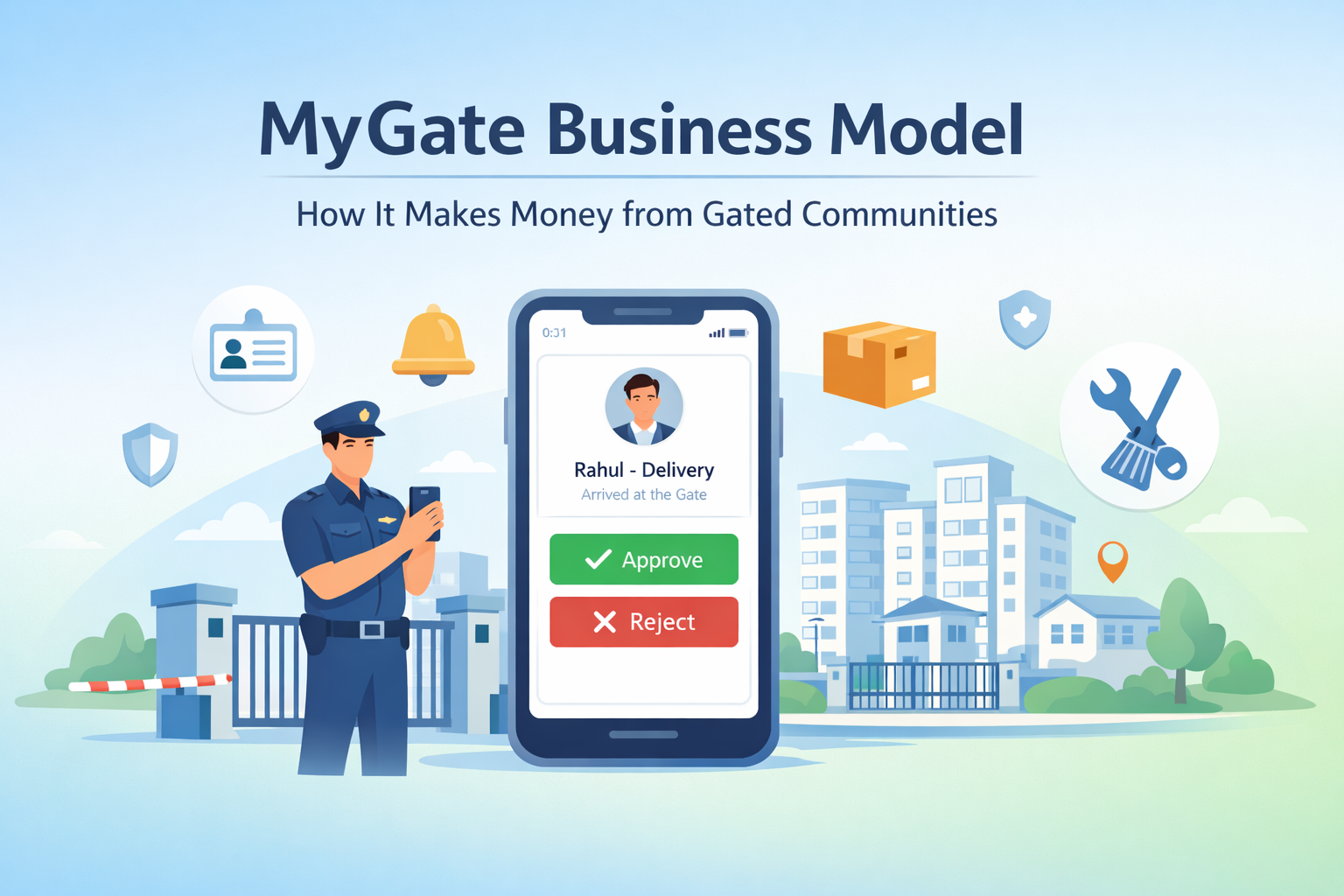
MyGate Business Model And How This App Controls Entry Into Millions of Homes

MyGate makes money through subscription fees from housing societies, along with revenue from local services, advertising, and brand partnerships targeting gated community residents.
It’s a simple idea. But the execution is brilliant.
What Exactly Is MyGate?
Think about the last time you visited a gated society.
You stopped at the gate. The guard called the resident. You waited. Maybe he wrote your name in a dusty register. Maybe he didn’t.
MyGate replaced all of that.
It’s a community management and security platform that connects residents, security guards, and housing committees through a single app. When someone arrives at your gate, you get a notification. You approve or deny entry from your phone. The guard opens the gate. Done.
It sounds small. But when you scale that across thousands of gated communities, it becomes something much bigger.
The Real Problem MyGate Is Solving
Before apps like MyGate, managing a gated society was a mess.
Guards kept paper logs. Nobody checked them. Delivery guys walked in without any verification. Residents had no visibility. Society committees had no accountability system.
It was chaos wrapped in a clipboard.
Here’s what that looked like in practice. A delivery arrives at 2 PM. The guard calls the resident. Resident doesn’t pick up. Delivery guy waits. Guard doesn’t know what to do. Package gets left at the gate or returned.
That’s a terrible experience. And it happened every single day.
MyGate stepped in and said, “We’ll build the system that fixes this.” Not just for deliveries. For visitors, staff, maids, drivers, and everything else happening at the gate.
That’s the foundation of the business model.
How MyGate Actually Works
The flow is simple. Really simple.
A visitor arrives at the gate. The guard opens the MyGate app and logs the visit. The resident gets a real-time notification. The resident approves or denies. Entry gets recorded with a timestamp.
For deliveries, it’s even smoother. Delivery platforms like Zomato or Amazon can send an OTP to the resident. The guard verifies it. No calls needed.
For staff like maids and drivers, MyGate tracks attendance automatically. Society committees can see who’s coming and going without chasing anyone.
It’s not just an app. It’s a digital layer over your entire community’s physical security.
MyGate Business Model Overview
MyGate runs on a B2B2C model.
That means it sells to businesses (housing societies) but the end users are consumers (residents). The society pays. The residents use the app daily. The platform finds ways to monetize that usage.
This is a smart structure.
The society is the customer. The resident is the user. The brand is the buyer of attention.
Once MyGate is installed in a society, every resident is automatically on the platform. They didn’t have to choose it. Their society chose it for them. That’s a powerful distribution hack.
And because the app is used daily for real security needs, engagement is genuinely high. This isn’t some app you open once a month. You’re using it every time a delivery arrives or a guest visits.
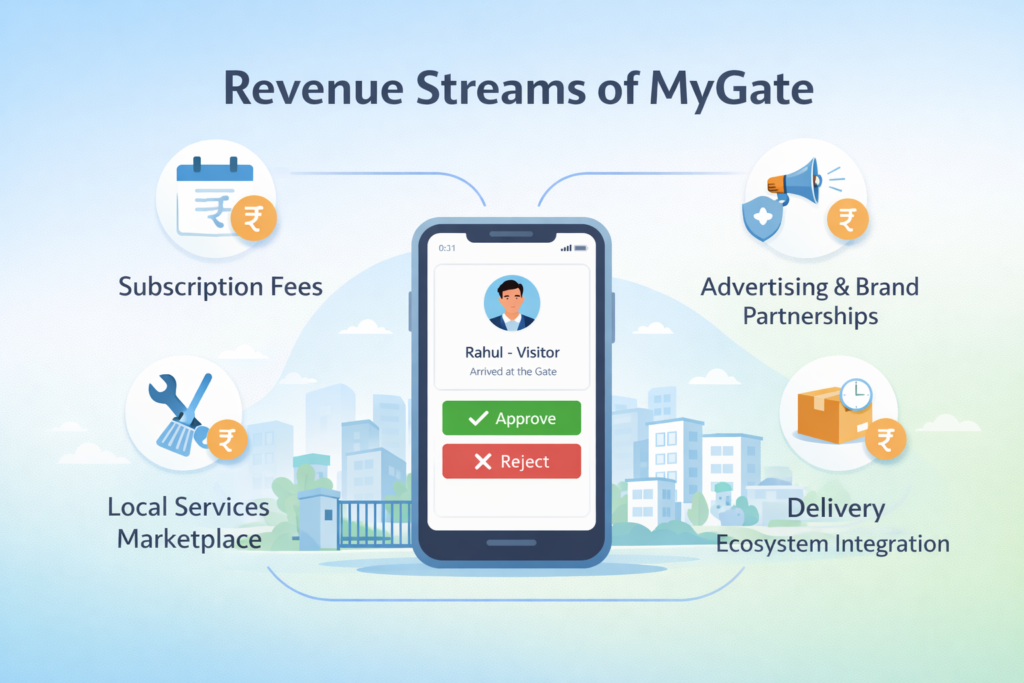
Revenue Streams of MyGate
This is where it gets interesting. Let me break down exactly how MyGate makes money.
Subscription Fees
This is the core revenue engine.
Housing societies pay a monthly or annual subscription to use MyGate. The fee depends on the size of the society, the number of units, and the features included.
Think of it like a SaaS product for residential communities.
A society with 200 apartments pays differently than one with 1,000 apartments. MyGate structures its pricing around that.
This is predictable, recurring revenue. Societies don’t switch easily once they’re onboarded. The switching cost is high because changing a security system mid-year is painful for everyone involved.
That’s exactly what MyGate wants.
Local Services Marketplace
Here’s where it gets clever.
MyGate has built a marketplace inside the app for local service providers. Think plumbers, electricians, cleaners, and carpenters. Residents can find and book them directly through the app.
MyGate earns a commission on every booking.
This is a natural extension. If you’re already inside every gated community, why not also connect residents with services they need? The trust is already built. The platform is already installed.
It’s a smart way to earn from an audience that’s captive and engaged.
Advertising and Brand Partnerships
This one is the most interesting revenue stream for me personally.
Gated community residents tend to be urban, educated, and have high disposable income. That’s a premium audience that brands love.
MyGate sells access to this audience through targeted ads and brand partnerships.
A furniture brand wants to reach people who just moved into a new apartment. A car brand wants to reach upper-middle-class families. A fintech app wants urban professionals.
MyGate can deliver all of those. Because it knows exactly who lives where.
Delivery Ecosystem Integrations
MyGate has integrations with major delivery platforms.
When Zomato or Swiggy or Amazon connects with MyGate for OTP-based deliveries, that’s not just a feature. It’s a partnership that creates value and potentially generates revenue through integration deals.
It also makes the app stickier. If your delivery platforms work through MyGate, you never uninstall it.
Data Insights
This is the future play.
MyGate sits on a goldmine of behavioral data. It knows when residents are home. It knows what services they use. It knows delivery patterns and visitor frequencies.
That data, handled responsibly and with privacy compliance, has enormous commercial value.
Right now this isn’t a primary revenue stream. But it’s clearly part of the long-term picture. Smart companies don’t ignore data assets.
Business Model Canvas of MyGate
Let me put this all together in a simple framework.
Key Partners
MyGate doesn’t operate in isolation. It depends on a strong partner network.
Housing societies and RWAs (Resident Welfare Associations) are the foundation. Without them, there are no users.
Security agencies are critical too. MyGate doesn’t replace guards. It makes them more effective. So the relationship with security agencies matters.
Local service providers fill the marketplace. Brands and advertisers fund the ad revenue. Delivery platforms make the app indispensable.
Key Activities
The core job is building and maintaining a reliable app. Security is not the place for bugs or downtime.
Beyond tech, MyGate constantly onboards new societies. That’s a sales and relationship job. Then comes customer support, data management, and partner management.
The business is part technology company, part sales organization.
Key Resources
The technology platform is obviously central. But the real asset is the user base.
Once you have millions of residents inside your app, you have distribution. That’s incredibly hard to build. MyGate has spent years doing exactly that.
The society network, brand partnerships, and data infrastructure round out the resource base.
Value Propositions
For residents, it’s safety plus convenience. You control who enters your home. That’s powerful.
For societies, it’s digital management and less manual work. No more paper logs. No more accountability gaps.
For brands, it’s access to a high-income, urban audience that’s genuinely hard to reach elsewhere.
Each segment gets something meaningful. That’s why the model works.
Customer Segments
MyGate serves multiple segments at once.
Gated housing societies are the primary paying customer. Residents are the daily users. Local service providers list on the marketplace. Brands pay for access to the audience.
This multi-segment approach is what makes the business model layered and resilient.
Cost Structure
Running a platform like this isn’t cheap.
Tech development and maintenance is the biggest cost. Then comes the sales team for onboarding new societies. Customer support, marketing, and partner management add to the expense.
The good news is that subscription revenue covers operational costs reasonably well. The other revenue streams are mostly margin-accretive.
Key Features That Actually Drive Revenue
Not every feature makes money. But some features are directly tied to revenue growth.
Visitor management is the core feature. It’s the reason societies sign up. No visitor management, no subscription.
Delivery tracking makes residents stay active on the app. Daily engagement is everything for a consumer platform.
Staff attendance tracking is underrated. Society committees love it because it solves a real accountability problem. It also makes the subscription feel essential, not optional.
Society accounting tools add another layer of stickiness. When a society uses MyGate to collect maintenance fees and manage expenses, switching becomes almost impossible.
The in-app communication system keeps residents engaged beyond security. Announcements, complaints, polls. It becomes the operating system of the community.
Why MyGate Works So Well
Here’s my honest take on why this model is genuinely smart.
It solves a daily-use problem. This isn’t an app you use once a year for taxes. You use it every single day. That creates habit and dependency.
Switching cost is enormous. If a society wants to leave MyGate, they have to retrain all guards, move all data, switch payment systems, and face resident pushback. Most societies don’t bother.
Network effects are strong. When delivery platforms integrate with MyGate, it becomes the standard. When service providers list on MyGate, it becomes the go-to. Each new partner makes the platform more valuable.
And resident adoption is organic. The society installs it. Everyone downloads it. No viral marketing needed.
That’s a rare combination in consumer tech.
Growth Strategy of MyGate
MyGate focused on urban cities first. That makes sense. Gated communities are concentrated in metros like Bengaluru, Mumbai, Hyderabad, and Pune.
The go-to-market is smart. MyGate partners with builders directly. When a new apartment complex is built, MyGate is already integrated before residents move in. That’s the ideal onboarding.
They also use free trials to convert societies. Get the society hooked, then move them to a paid plan. Classic SaaS playbook.
RWA partnerships help with credibility. When the official resident body endorses MyGate, individual resident resistance disappears.
Word of mouth also works organically. When residents move to a new society that doesn’t have MyGate, they ask for it. That’s genuinely powerful organic growth.
Competitors of MyGate
MyGate isn’t alone in this space.
NoBrokerHood is probably the biggest competitor. It’s backed by NoBroker and offers similar features. The advantage is the NoBroker ecosystem for rentals and property transactions.
ApnaComplex focuses more on society management and accounting tools. It’s strong in the committee management layer.
ADDA is another player with a focus on community engagement and management.
Each competitor has a slightly different angle. MyGate’s edge is brand recognition and the sheer size of its user base. In consumer tech, scale matters enormously.
Being the category leader means you win partnerships first. That compounds over time.
Challenges in the MyGate Business Model
I want to be honest here. This model isn’t without problems.
Adoption resistance is real. Not every society wants a digital system. Older residents sometimes push back. Guards who aren’t comfortable with smartphones create friction.
Privacy concerns are growing. When an app knows your visitor patterns, delivery habits, and daily schedule, that’s sensitive data. MyGate needs to handle this carefully or face regulatory and reputational risk.
The model depends on society approvals. MyGate doesn’t sell to individuals. It sells to committees. If one committee member blocks the adoption, the deal falls through. That’s a unique sales challenge.
Maintaining service quality across thousands of societies is hard. One bad experience in a society spreads through word of mouth. In a trust-based security product, that’s a serious risk.
The marketplace is competitive too. Urban Company and other local service platforms are also fighting for the same service bookings. MyGate doesn’t automatically win that battle just because it’s installed.
The Future of MyGate
Here’s where I think this gets really interesting.
AI-based security is the obvious next step. Facial recognition at the gate. Automatic entry for known residents. Anomaly detection for suspicious patterns. The tech exists. The data foundation is already there.
Smart home integrations make sense too. If MyGate controls the gate, why not also connect to your smart lock, CCTV, and intercom? That expands the platform into a broader home security ecosystem.
Fintech is a big opportunity. MyGate already handles maintenance fee collection for many societies. That’s the beginning of a financial layer. Imagine insurance products, home loans, or investment options targeted at verified homeowners through the app.
Tier 2 and Tier 3 city expansion is coming. Right now MyGate is metro-heavy. But gated communities are growing fast in cities like Nagpur, Jaipur, Coimbatore, and Indore. That’s a massive untapped market.
The data play will also mature. As privacy regulations stabilize, MyGate will find structured ways to monetize behavioral data ethically. That could become a significant revenue stream.
Conclusion
Here’s how I really think about MyGate.
It’s not a security app. That’s just the entry point.
MyGate is a control layer over physical communities. Once that layer is established, it controls who enters, what services residents use, how communities communicate, and how money moves.
That control layer unlocks transactions, data, and hyperlocal commerce at scale.
Think about it this way. Facebook started as a social network. Then it became an advertising machine. Then a marketplace. Then a payments platform. The social layer was just the entry point.
MyGate’s entry point is the gate. But the destination is much bigger.
If MyGate executes well on services, fintech, and data, it could become the operating system of urban Indian residential life. That’s not a security company. That’s an infrastructure company.
And infrastructure companies, once embedded, are almost impossible to remove.
Summary
Let me pull this together quickly.
MyGate started by solving a simple problem. Manual security logs at gated communities were outdated and inefficient.
They built a clean digital solution. Visitor management, delivery tracking, staff attendance, and community communication. All in one app.
The business model layers multiple revenue streams over a captive audience. Subscription fees from societies. Commissions from services. Ad revenue from brands. Integration income from delivery platforms.
The moat is high switching cost, daily engagement, and network effects from integrations.
The future is AI security, fintech, and hyperlocal commerce.
It’s a small gate. But it opens into a very big market.
FAQs
MyGate primarily earns through subscription fees paid by housing societies. Additional revenue comes from commissions on local service bookings, advertising partnerships with brands, and delivery ecosystem integrations.
Yes. Residents don’t pay anything directly. The housing society pays the subscription on behalf of all residents. That’s the B2B2C model in action.
NoBrokerHood, ApnaComplex, and ADDA are the main competitors. Each has slightly different strengths. NoBrokerHood is backed by a large real estate platform. ApnaComplex is strong in society accounting. MyGate leads on brand recognition and scale.
MyGate focuses on urban metros, partners with builders to get installed in new societies, and uses free trials to convert societies to paid plans. It’s expanding to Tier 2 and Tier 3 cities next.
Not publicly confirmed as a major current revenue stream. But MyGate sits on significant behavioral data about urban residents. As the company grows, this will likely become a structured revenue layer.
Daily delivery notifications, visitor approvals, maid and driver tracking, and society announcements keep residents engaged every day. The more features you use, the harder it is to imagine life without it.
Discover more from Business Model Hub
Subscribe to get the latest posts sent to your email.