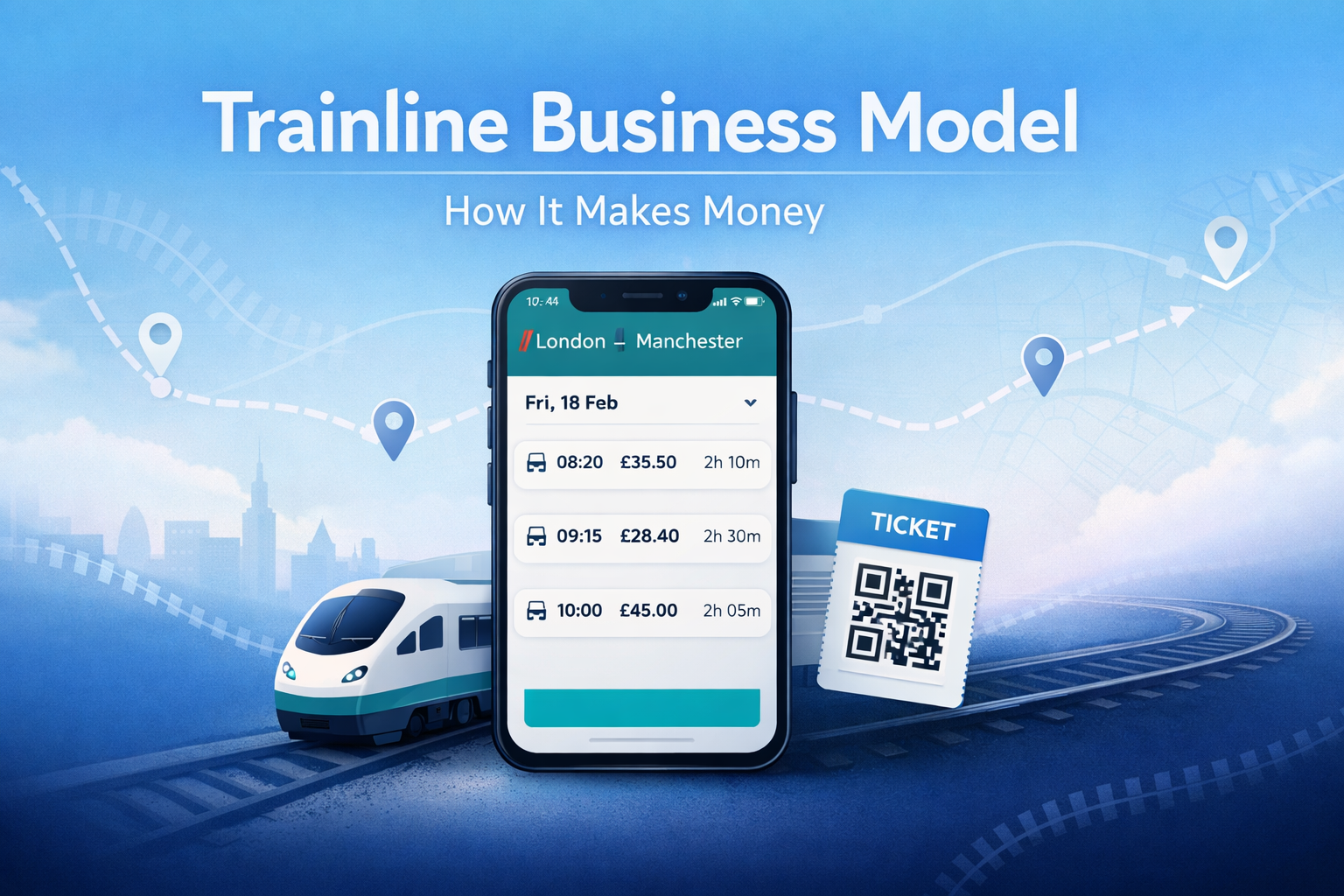

Trainline makes money by acting as the middleman between you and the train companies. It earns commissions on ticket sales, charges booking fees, and generates revenue through partnerships and add-on services. It doesn’t own a single train. It just owns the experience of booking one.
What Is Trainline, Really?
Imagine you need to travel from London to Edinburgh. You could go to each train operator’s website one by one, compare prices manually, and hope you didn’t miss a deal. That’s exhausting.
Trainline solves that problem. It pulls ticket data from dozens of operators, puts it in one place, and lets you book in minutes.
That’s the whole idea. One app. All the trains. No chaos.
Trainline operates across the UK and Europe. It serves everyday commuters, weekend travelers, tourists, and business travelers. And it does all of this without owning any trains, stations, or tracks.
It’s a pure technology business built on top of someone else’s infrastructure.
Quick Answer: How Does Trainline Make Money?
Trainline earns money through:
- Commissions from train and coach operators on every ticket sold
- Booking fees charged to customers for using the platform
- Promotional partnerships with operators and travel brands
- Add-on services like travel insurance and seat upgrades
It’s an aggregator model. Think of it like Booking.com, but for trains. The more tickets it sells, the more it earns. Simple.
The Problem Trainline Solves
Rail travel in the UK and Europe is fragmented. There are dozens of operators, hundreds of routes, and pricing rules that honestly make no sense to normal people.
Before platforms like Trainline, booking a train was painful. You had to know which operator ran which route. You had to visit multiple websites. And pricing? Total mystery.
Trainline came in and said: we’ll handle all of that.
It connects to the backend systems of rail operators, pulls live ticket data, and presents it to you in a clean, easy interface. You search, compare, and book. Done.
The problem it solves isn’t just about tickets. It’s about saving your time and mental energy.
How the Trainline Business Model Works
Here’s the simple flow:
Search → Compare → Book → Pay → Ticket issued
You type in your journey. Trainline fetches options from multiple operators. You pick one. You pay on the app. Trainline passes the booking to the operator and collects a commission. Your ticket shows up on your phone.
That’s it. The whole business runs on that loop.
Trainline is what’s called an aggregation layer. It sits between you and the rail companies. It doesn’t control the trains. But it controls the moment you decide to buy a ticket.
And that moment? That’s where the money is.
The Value Trainline Creates
What Customers Get
Customers get convenience. That’s the real product here.
You’re not buying a train ticket from Trainline. You’re buying simplicity. You’re buying the ability to compare 15 options in 10 seconds instead of spending 30 minutes on three different websites.
- Price comparison across multiple operators
- One app for booking and managing your journey
- Real-time updates like delays and platform changes
- Digital tickets that live on your phone
For frequent travelers, this is genuinely useful. No paper tickets. No queues. Just open the app and go.
What Rail Operators Get
This part is often overlooked. Trainline isn’t just a consumer product. It also provides value to the operators themselves.
For rail operators, Trainline acts as a distribution channel. Instead of spending millions on marketing to reach travelers, operators can list their tickets on Trainline and tap into millions of users who are already searching.
- More ticket sales without extra marketing spend
- Wider reach across customer segments
- Access to demand data and booking trends
It’s a win for operators too. That’s why they work with Trainline instead of blocking it.
Revenue Streams: How Trainline Actually Makes Money
Let’s get into the real stuff.
Commissions From Ticket Sales
This is the core revenue stream. When you buy a ticket through Trainline, the rail operator pays Trainline a commission. It’s typically a percentage of the ticket price.
Trainline processes millions of tickets every year. Even a small commission per booking adds up to serious money at scale.
The beauty of this model is that it scales naturally. More users means more bookings. More bookings means more commissions. No extra cost for each transaction beyond platform maintenance.
Commission revenue is the engine of Trainline’s business.
Booking Fees
Some bookings on Trainline include a booking fee charged directly to the customer. It’s usually small but it adds up across millions of transactions.
This is a simple, direct way to monetize the service. You’re using the platform, so you pay a small fee for the convenience it provides.
Not all tickets carry a fee. But when they do, it’s pure margin for Trainline.
Promotional Partnerships and Advertising
Operators and travel brands sometimes pay Trainline to promote their services. This could be featured placement in search results, promotional banners, or sponsored deals.
Think of it like how Google charges brands for visibility. Trainline does something similar within its own platform.
This is a smaller revenue stream today, but it has real potential as the platform grows.
Add-On Services
Trainline also offers extras at checkout. Things like:
- Travel insurance
- Seat upgrades
- Delay repay assistance
These are high-margin products. You’re already on the platform about to pay. Adding an insurance product or an upgrade is a natural upsell.
This is called ancillary revenue. Airlines have mastered it. Trainline is building it into its model.
B2B and API Partnerships
Trainline has a business-facing side too. It offers its technology through APIs to other platforms and corporate travel tools.
Companies that manage employee travel can integrate Trainline’s data to help their teams book efficiently. This opens a B2B revenue stream that runs parallel to the consumer side.
Trainline isn’t just an app. It’s a platform that other businesses can build on top of.
Business Model Canvas: Thinking Like a Founder
Let me break this down like someone building this business from scratch would think about it.
Customer Segments
Trainline serves two types of customers.
On the consumer side:
- Daily commuters who book the same route every week
- Tourists exploring Europe by rail
- Business travelers who need fast, reliable booking
- Occasional travelers planning weekend trips
On the business side:
- Rail operators who want distribution
- Corporate travel managers who need booking tools
- Travel platforms that want to integrate rail data
This dual-sided market is what makes Trainline powerful. It’s both a B2C product and a B2B platform at the same time.
Value Propositions
The core value is convenience. But let’s break it down more specifically.
For consumers: one place to search all trains, transparent pricing, digital tickets, real-time updates, and a clean mobile experience.
For operators: access to millions of customers without heavy marketing spend, increased ticket sales, and valuable booking data.
Trainline’s real product isn’t tickets. It’s the booking experience. That’s what people are actually paying for.
Channels
Trainline reaches its customers through:
- Mobile app (this is the primary channel and the main growth driver)
- Website for desktop users
- API integrations for partners and corporate clients
The app is the crown jewel. Trainline has consistently pushed mobile-first. Most of its bookings happen on mobile. The app experience is smoother, faster, and stickier than the website.
When your app becomes someone’s default booking tool, you’ve basically won.
Customer Relationships
Here’s something interesting about Trainline’s model. It runs almost entirely on self-service.
You search, compare, and book without talking to anyone. Notifications are automated. Tickets are digital. Refunds are mostly handled in-app.
This is intentional. A self-service model scales without proportionally increasing headcount. You can serve 10 million customers with the same infrastructure you used to serve 1 million, with only marginal cost increases.
That’s what makes tech businesses so attractive. The marginal cost of serving an extra user is nearly zero.
Key Resources
What does Trainline actually need to operate?
- Technology platform (the app, website, backend systems)
- Rail operator integrations (connections to each operator’s ticketing system)
- User data (booking patterns, preferences, demand signals)
- Brand trust (people need to trust Trainline with their money and travel plans)
The integrations are the hardest part to replicate. Building connections into dozens of rail operator systems takes years. That’s a real competitive moat.
Key Activities
What does Trainline do every day to keep the business running?
- Aggregating live ticket data from multiple operators
- Maintaining and improving the platform
- Optimizing the user experience
- Managing partner relationships
- Running marketing campaigns to acquire new users
The two most important? Platform reliability and UX quality. If the app breaks or the experience is bad, users go somewhere else immediately.
Key Partners
Trainline’s business literally cannot exist without partners.
- Rail operators (the source of all the tickets)
- Payment gateways (Stripe, banks, digital wallets)
- Travel partners (hotels, car rentals for bundled offers)
- Corporate clients (for B2B distribution)
This is the biggest structural dependency in the model. If major operators decided to block Trainline or charge higher commissions, it would hurt the business significantly.
Without rail operators, Trainline has no product. That’s a real risk, and it’s worth understanding.
Cost Structure
Where does Trainline spend money?
- Technology development (engineering, infrastructure, product)
- Marketing and user acquisition (ads, brand campaigns, partnerships)
- Partner integrations (maintaining and expanding operator connections)
- Customer support (handling complaints, refunds, edge cases)
Technology is the biggest cost. But it’s also what generates the revenue. It’s a high-fixed-cost, low-marginal-cost model. Once the platform is built, serving more users doesn’t cost much more.
The Key Insight That Changes How You See This Business
Here’s the thing most people miss about Trainline.
It doesn’t own trains. It owns the booking experience.
Rail operators control the supply. They decide schedules, routes, and prices. Trainline controls the demand. It decides where customers look first and what they see.
That’s a massive amount of leverage.
When you control the interface between a customer and a product, you influence every purchasing decision. You decide which options get highlighted. You decide what a “good deal” looks like. You shape behavior without owning anything physical.
This is the same model Amazon uses for third-party sellers. Amazon doesn’t make most of the products on its platform. But it owns the buying experience. That’s where the real power sits.
Trainline owns the moment of decision. And that moment is worth billions.
How Trainline Scales
Trainline’s growth strategy has a few clear pillars.
Geographic Expansion
Trainline started in the UK. It has steadily expanded into European markets like France, Italy, Spain, and Germany.
Each new country means new rail operators to integrate, new languages to support, and new regulations to navigate. But it also means millions of new potential users.
Europe has one of the most developed rail networks in the world. The total addressable market is enormous.
Mobile-First Strategy
Trainline has consistently prioritized the mobile experience. Its app is well-designed, fast, and reliable.
Most people book travel on their phones now. By making the app the best way to book, Trainline builds habit and loyalty. When people install the Trainline app and use it a few times, they tend to keep using it.
App installs are sticky. Browser sessions are not.
Localization
Expanding into Europe isn’t just about translation. It’s about understanding local travel habits, local operators, and local payment methods.
Trainline invests in making the product feel native in each market. French travelers use it differently than British travelers. German commuters have different needs than Italian tourists.
Good localization is what separates genuine expansion from just changing the language setting.
AI and Personalization
Trainline has started using data and AI to improve recommendations. If it knows you usually travel on Friday afternoons, it can surface relevant deals proactively.
This is where the user data really becomes valuable. Millions of bookings create a rich dataset that can be used to make the product smarter and more personal.
Personalization turns a booking tool into a travel companion. That’s a much stickier product.
Competitive Advantages
What makes Trainline hard to compete with?
Strong UX
The app is genuinely good. It’s fast, clean, and easy to use. That sounds simple, but it’s actually hard to build and maintain at scale.
Good UX builds loyalty. People stick with apps they like using.
Aggregation Power
Trainline has integrations with dozens of operators across multiple countries. Building those integrations takes years and significant engineering effort.
A new competitor can’t just replicate this overnight. The time and relationships required create a real barrier to entry.
Network Effects
The more people use Trainline, the more data it has. The more data it has, the better its recommendations and pricing insights. The better those are, the more people use it.
That’s a flywheel. And once it’s spinning, it’s hard to stop.
Brand Trust
In travel, trust matters a lot. People need to know their booking won’t disappear, their refund will come through, and the ticket will work at the barrier.
Trainline has spent years building that trust. It’s not easy for a new entrant to replicate.
Competitors
Trainline isn’t the only player in this space.
Omio is its closest European rival. It covers trains, buses, and flights across Europe. It’s strong in Germany and other continental markets.
Rail Europe focuses specifically on European rail for international travelers. It’s more of a specialist tool than a general booking platform.
National Rail in the UK provides official journey planning. But it redirects to individual operators for booking, which is a worse experience than Trainline’s integrated checkout.
Direct operator apps are also competition. If I always take the same train from Manchester to London, I might just use Avanti’s app directly.
The real competition isn’t just other aggregators. It’s also the default behavior of going direct to the source.
Trainline wins when it offers a noticeably better experience than booking directly. That’s what it has to keep delivering.
Challenges and Risks
Every business has real challenges. Here are Trainline’s.
Dependence on Operators
If a major rail operator decided to stop working with Trainline or raise its commission rates significantly, that would hurt. Trainline doesn’t own the inventory. It’s always at the mercy of the suppliers.
This is the biggest structural risk in the model.
Pricing Pressure
Rail ticket prices are set by the operators, not by Trainline. When fares go up, customers get frustrated. They might blame the booking platform even if it had nothing to do with the pricing.
High prices also reduce booking volumes, which means lower commission revenue.
Competition From Direct Bookings
Rail operators know that Trainline is taking a cut of every sale. They have an incentive to drive customers to book directly. Some operators have tried to make their own apps better specifically to reduce Trainline’s share.
If enough people switch to booking directly, Trainline’s growth slows.
Regulatory Risk
Rail ticketing in the UK and Europe is subject to government regulation. Changes in how operators are allowed to distribute tickets, or new rules around fees, could impact the business model.
Future Opportunities
Despite the challenges, the opportunity ahead is significant.
Multi-Modal Travel
Right now Trainline is mainly trains and coaches. The next step is combining trains with buses, taxis, and flights into seamless multi-modal journeys.
Imagine booking a trip that automatically combines a train from London to Paris, a metro ride to your hotel, and a bus to your conference venue. All in one booking. That’s a compelling product.
Subscriptions
Trainline could introduce a subscription model for frequent travelers. Pay a monthly fee and get reduced booking fees, priority support, or exclusive deals.
This would create predictable recurring revenue and increase user loyalty.
Deeper Personalization
Using AI to make genuinely useful travel suggestions, alert you to price drops on your usual routes, or automatically rebook you when there’s disruption. These features would make Trainline feel less like a booking tool and more like a smart travel assistant.
The companies that win in travel tech will be the ones that make the experience feel effortless.
Wrapping Up
Here’s what I take away from the Trainline story.
You don’t have to build the trains to build a train business. You just have to own the interface between the customer and the journey.
Trainline doesn’t manufacture anything. It doesn’t run any infrastructure. It just makes the booking experience so much better than the alternative that millions of people choose it every time.
The business model is elegant. Aggregation plus commission plus add-ons. It scales well. It has defensible advantages. And it sits at the intersection of travel and technology, two industries that aren’t going anywhere.
The big founder takeaway here: own the interface, not the infrastructure.
You don’t need to control the supply chain. You need to control the decision moment. The moment someone says “I need to book a train” and opens an app. If that app is yours, you win.
That’s what Trainline has built. And it’s a genuinely smart business.
FAQs
Trainline makes money through commissions paid by rail operators on each ticket sold, booking fees charged to customers, and add-on services like travel insurance. It also earns through promotional partnerships and B2B API licensing
Yes, Trainline sometimes charges a small booking fee depending on the ticket type and route. The fee covers the cost of using the platform and is shown clearly before you complete your purchase.
Technically yes. Trainline acts as an aggregator that connects customers with rail operators. It doesn’t own any trains or infrastructure. But calling it “just” a middleman undersells it. The booking experience it provides has real value.
Trainline’s main competitors include Omio, Rail Europe, and direct booking through individual rail operator apps. In the UK, some travelers also use National Rail’s journey planner.
Trainline is a publicly listed company on the London Stock Exchange. Its profitability has varied over the years as it invests in expansion. You can check its latest financials through its investor relations page for current data.
Trainline uses an aggregator and marketplace business model, similar to Booking.com or Expedia but specifically for rail travel. It connects buyers and sellers and earns on each transaction.
Discover more from Business Model Hub
Subscribe to get the latest posts sent to your email.