JustPark Business Model And How It Makes Money by Solving Parking Chaos

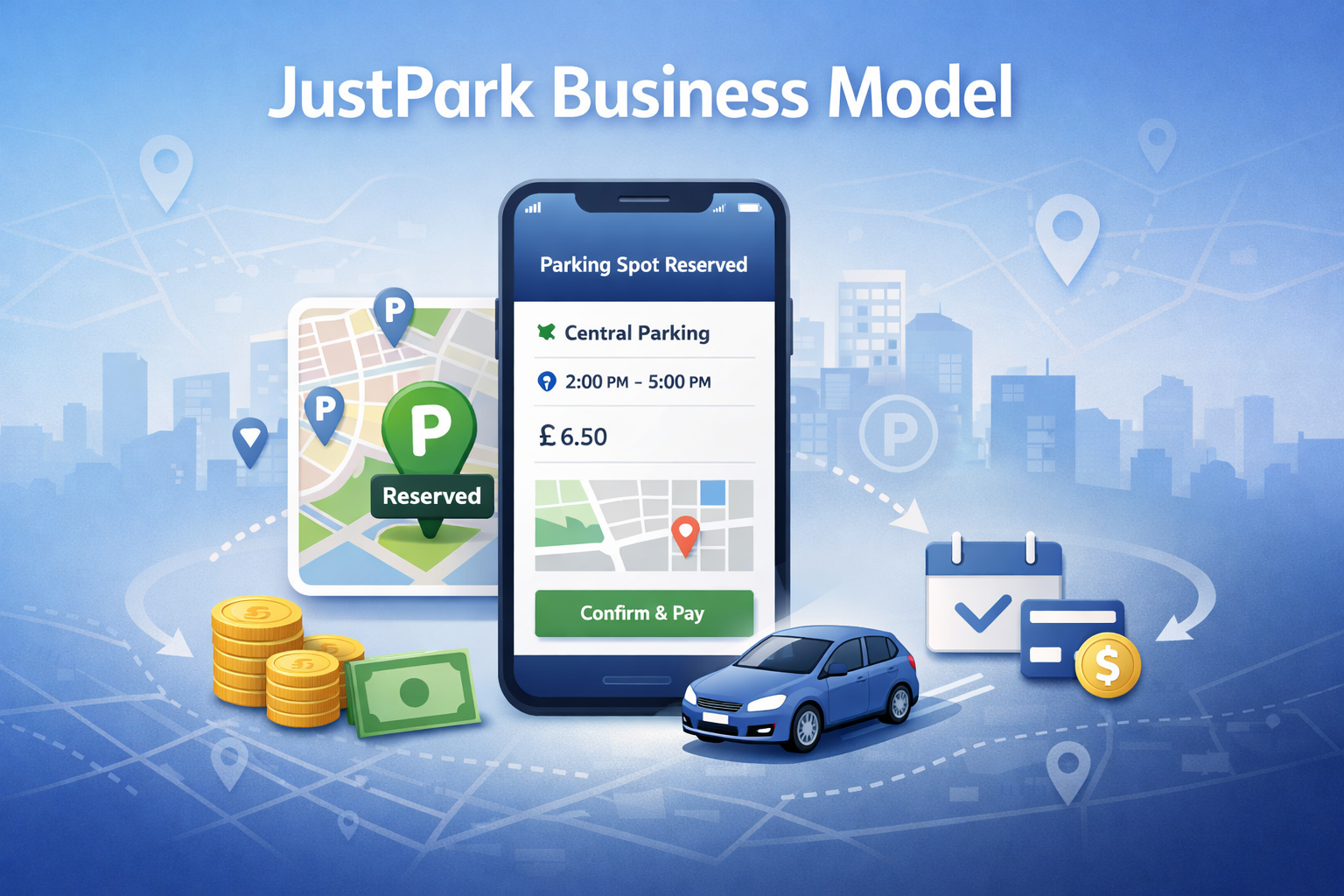
JustPark is a peer-to-peer parking marketplace. Drivers book spaces. Property owners rent out unused spots. JustPark takes a cut from both sides. Simple, scalable, and surprisingly profitable.
Have you ever driven around a city for 20 minutes looking for parking?
I have. It’s maddening.
You’re late. You’re stressed. Every spot is either taken or costs a fortune. And somewhere nearby, a private driveway is sitting completely empty.
That gap, that frustrating disconnect, is exactly what JustPark built its entire business around.
And honestly? It’s a brilliant idea.
Quick Answer: How Does JustPark Make Money?
JustPark makes money through four main streams:
- Booking fees charged to drivers per transaction
- Commission taken from space owners on each booking
- Business and enterprise solutions for offices and commercial operators
- Subscription and premium tools for frequent users and property managers
It’s a two-sided marketplace. JustPark sits in the middle and earns every time a deal happens.
No parking spaces owned. No heavy infrastructure. Just a platform connecting people who need parking with people who have it.
What Is JustPark?
JustPark is a UK-based parking platform founded in 2006.
Back then, it was called ParkatmyHouse. The name was literal. People listed their driveways. Drivers booked them. Everyone was happy.
Over time, it grew into something much bigger.
Today, JustPark connects drivers with thousands of private and commercial parking spaces across the UK. You can use it through their website or mobile app.
The core idea is simple: instead of hunting for parking, you book it in advance.
It sounds obvious. But solving obvious problems in a smart way is exactly how great businesses get built.
The Real Problem JustPark Is Solving
Let me be honest with you. Parking feels like a small problem. But it’s not.
Here’s what actually happens when parking is broken:
- Drivers waste 17 minutes on average looking for parking in busy cities
- Fuel gets burned. Stress goes up. Productivity drops.
- City parking prices are often opaque and unpredictable
- Meanwhile, private driveways and parking lots sit empty most of the day
The insight that drives JustPark’s entire model is this:
Cities don’t lack parking. They lack efficient distribution of parking.
There’s enough physical space. It’s just not being used at the right time, by the right people, at the right price.
JustPark fixes the distribution problem. That’s it.
And when you frame it that way, you realize it’s not really a parking company. It’s a logistics and utilization company in disguise.
How JustPark Works (Step by Step)
The platform works like most marketplaces. Two sides. One platform. Clean and simple.
For Drivers
- You open the app or website
- Search your destination
- Browse available spaces by price, distance, and reviews
- Book instantly (or in advance)
- Show up and park stress-free
No circling the block. No feeding parking meters. No surprises.
For Space Owners
- List your driveway, garage, or parking lot
- Set your own pricing and availability
- Get bookings automatically
- Earn passive income without doing much
It’s genuinely passive. Once you’ve listed the space, JustPark handles the bookings and payments.
This two-sided loop is the engine of the entire business. More drivers bring in more space owners. More space owners attract more drivers. The network grows itself.
JustPark’s Business Model: The Core Structure
Before we dig into how it makes money, let’s look at the foundation.
It’s a Marketplace Model
JustPark doesn’t create the supply. Space owners do.
JustPark doesn’t create the demand. Drivers do.
JustPark just builds and maintains the platform where both sides meet. That’s the marketplace model, and it’s incredibly powerful when it works.
Think of it like eBay for parking. JustPark is the platform. The buyers and sellers show up on their own.
It’s Asset-Light
This is a big deal.
Traditional parking businesses need to buy or lease land. That costs millions. It limits how fast you can grow.
JustPark owns none of the parking spaces. Zero.
That means it can scale into new cities and new countries without massive capital investment. The users bring the assets. JustPark brings the technology and the network.
This is why marketplace businesses tend to have incredible economics at scale.
It Benefits From Network Effects
Here’s something most people overlook.
Every new space listed on JustPark makes the platform more useful for drivers.
Every new driver who joins makes listing a space more attractive for property owners.
This is a classic network effect. The product gets better as more people use it. And once you hit critical mass in a city, it becomes very hard for a competitor to displace you.
How JustPark Makes Money: The Revenue Breakdown
Now let’s get into the actual money part.
1. Booking Fees From Drivers
This is the primary revenue stream.
Every time a driver books a parking space through JustPark, they pay a service fee on top of the parking cost.
It’s similar to how Ticketmaster charges a booking fee on concert tickets, or how Booking.com adds fees to hotel reservations.
The fee is built into the checkout process. Most drivers accept it without thinking too much because the convenience is worth it.
If someone is paying $10 for a parking space, JustPark might collect an extra $1.50 to $2 as a service fee. Multiply that across millions of bookings and you’ve got a serious revenue stream.
2. Commission From Space Owners
On the other side, JustPark takes a percentage of what space owners earn.
So if a driveway owner lists their space for $8 and someone books it, JustPark takes a cut of that $8 before passing the rest to the owner.
This commission model is common in marketplaces. Airbnb does it. Etsy does it. Upwork does it.
The beauty is that JustPark earns from both sides of the same transaction. The driver pays a fee. The space owner gives up a commission. JustPark earns twice per booking.
That’s strong unit economics.
3. Business and Enterprise Solutions
This is where JustPark gets interesting beyond the consumer app.
Many businesses have parking challenges. Office buildings need to manage employee parking. Property managers need tools to run commercial lots efficiently. Event venues need to handle surge parking demand.
JustPark offers tools and services for all of these.
For businesses, this might include:
- Parking management dashboards
- Employee permit systems
- Integration with building access systems
- Data and reporting tools
- Dedicated account support
These enterprise deals tend to involve longer contracts and higher revenue per customer. It’s a different sales motion than the consumer app, but it diversifies the revenue base significantly.
Think of it this way: one enterprise deal with a large office complex might be worth as much as thousands of individual bookings.
4. Subscription and Premium Features
JustPark also offers subscription-style options for frequent users and serious property managers.
For regular commuters who park in the same city every day, a monthly parking pass through JustPark makes a lot of sense. It’s predictable, cheaper than pay-per-use, and it keeps users locked in.
For property owners managing multiple spaces, premium tools give them more control, better analytics, and priority placement in search results.
Subscriptions are valuable to any business. They create predictable revenue. They increase customer retention. They reduce the pressure to constantly acquire new users.
Why This Business Model Actually Works
I’ve seen a lot of marketplace businesses fail. The idea sounds simple. The execution is hard.
JustPark works for a few specific reasons.
The Problem Is Universal and Recurring
Parking isn’t a one-time need. People park every day.
When a product solves a recurring problem, users come back automatically. You don’t have to re-convince them. The habit forms on its own.
This is one of the strongest signals for a healthy consumer business.
The Supply Side Is Fragmented and Untapped
Millions of private driveways, garages, and underused lots exist across every city.
Before JustPark, none of these were accessible to the public. They were invisible. Locked behind private ownership.
JustPark made them visible, bookable, and profitable for their owners.
That’s a genuine unlocking of value that didn’t exist before.
Mobile-First Experience Fits the Use Case Perfectly
Parking decisions are made on the go. You’re in a car. You need to find somewhere to park in the next 10 minutes.
JustPark’s mobile app handles that beautifully.
Quick search. Clear results. Fast booking. You’re done in under 2 minutes.
When the product experience matches the use case this well, conversion rates go up and complaints go down.
Trust Is Built Into the System
Peer-to-peer marketplaces live and die by trust.
If you’re parking your car in a stranger’s driveway, you need to know it’s safe. You need to know the listing is accurate. You need to know there’s support if something goes wrong.
JustPark builds trust through reviews, verified listings, payment protection, and customer support.
It’s not flashy. But it works.
Key Growth Drivers Behind JustPark’s Expansion
Let’s talk about what’s actually driving JustPark’s growth over the years.
Urbanization
More people are moving to cities.
More cars are competing for the same space.
Demand for smart parking solutions goes up naturally. JustPark doesn’t need to create demand. The city does it for them.
This is a tailwind that makes their job easier every year.
Partnerships With Events and Stadiums
This is an underrated growth lever.
When a big event happens at a stadium, tens of thousands of people need parking nearby. JustPark partners with venues and aggregates nearby spaces.
Suddenly, private homeowners within walking distance of the stadium can earn $30 to $50 for a few hours of driveway access.
Everyone wins. Fans get affordable parking. Homeowners earn extra cash. JustPark earns its cut on every booking.
These events drive massive transaction volume in short windows. They’re great for revenue and for acquiring new users who might never have tried the platform otherwise.
The Airbnb Effect on Behavior
Airbnb normalized the idea of staying in a stranger’s home.
Once people got comfortable with that, trusting a stranger’s driveway became much less of a leap.
JustPark benefited from this cultural shift. Peer-to-peer commerce became mainstream. The skepticism that slowed early adoption faded over time.
Timing a business model to a cultural shift is rare and valuable.
JustPark vs. Its Competitors
No business exists in a vacuum. Let’s be honest about where JustPark sits in the market.
Direct Competitors
Parkopedia is probably the closest rival. It aggregates parking data from multiple sources and helps drivers find spaces. But it skews more toward information than booking.
YourParkingSpace is the most direct UK competitor. Same peer-to-peer model. Similar app experience. It’s a real rival.
In a market like the UK, where JustPark has been operating since 2006, the head start matters. Brand recognition and accumulated reviews give JustPark an edge.
Indirect Competition
Navigation apps like Google Maps and Waze now show parking availability. That’s indirect competition for the information side.
Traditional parking operators like NCP run large commercial car parks. They compete on supply, not platform.
The real moat for JustPark is the peer-to-peer supply. No traditional operator can replicate a network of thousands of private driveways. That’s unique to the marketplace model.
Strengths of the JustPark Business Model
Let me give you my honest take on what makes this model strong.
Low operational costs. JustPark doesn’t own, lease, or maintain any physical parking spaces. The cost structure is mostly technology, sales, and marketing. That keeps margins healthy.
High scalability. Adding a new city doesn’t require building anything. It requires listing more spaces and attracting more users. That can happen fast.
Recurring revenue behavior. People who park regularly come back regularly. Once someone uses JustPark and has a good experience, they don’t go back to hunting for parking manually.
Strong unit economics. Earning from both sides of every transaction is a powerful structure. The margin per booking isn’t huge, but the volume potential is massive.
Weaknesses and Risks Worth Knowing
I want to be real here. No business model is perfect.
Trust dependency. If something goes wrong at a listing (damage, inaccurate details, inaccessible space), it damages trust in the whole platform. One bad experience can lose a customer forever.
Location dependency. JustPark works best in cities with parking demand and supply. Rural areas don’t have the density needed for the marketplace to function well.
Regulatory risk. Cities sometimes regulate parking in ways that affect peer-to-peer listings. Zoning rules, permit requirements, and local laws can create friction.
Competition from platforms. If Google or Apple decided to build a full parking booking product into their maps, they’d have instant distribution advantages that would be hard to compete with.
These risks are real. They’re manageable. But they’re worth understanding.
Future Opportunities for JustPark
Here’s where it gets exciting.
EV Charging Integration
Electric vehicles are growing fast.
EV drivers need to charge their cars. If a private parking space has a charger, that space suddenly becomes much more valuable.
JustPark could integrate EV charging into its platform. List spaces with chargers at a premium. Take a commission on charging fees too.
This is a natural extension of the existing model.
AI-Powered Dynamic Pricing
Right now, space owners set their own prices. That’s fine. But it’s not optimized.
What if JustPark used AI to suggest real-time pricing based on demand, events, weather, and time of day?
A space near a stadium earns $10 on a regular Tuesday. It could earn $50 on game day.
Dynamic pricing tools would make space owners more money. And a percentage-based commission means JustPark earns more too.
Everyone benefits from smarter pricing.
Smart City Partnerships
Cities are investing in smart infrastructure. Real-time parking data, sensor networks, digital permits.
JustPark could position itself as the software layer that makes city parking data accessible to drivers.
That’s a massive B2G (business to government) opportunity that most consumer-facing platforms never explore.
International Expansion
JustPark is primarily UK-focused.
But parking chaos exists everywhere. The US, Canada, Australia, Europe. Every dense city has the same problem.
Taking the platform model global, city by city, is a huge growth path if executed carefully.
The Strategic Insight Most People Miss
I want to end with something I think is genuinely underappreciated.
JustPark isn’t a parking company.
It’s a company that converts unused physical space into digital inventory.
That driveway that sits empty from 9am to 5pm? It’s now a bookable product with a price, a listing, and a revenue stream.
That’s what Airbnb did with spare bedrooms. That’s what Uber did with idle car time.
JustPark does it with parking space.
The physical world is full of underused assets. Garages. Driveways. Rooftops. Empty lots. Most of them sit idle for hours every day.
Platforms like JustPark are quietly turning idle into income. And they take a piece every time they do.
That’s a durable, scalable, and genuinely valuable business model.
Summary
Let me pull this all together quickly.
JustPark makes money by:
- Charging drivers a booking fee per transaction
- Taking commission from space owners on every booking
- Selling enterprise parking solutions to businesses
- Offering subscriptions and premium tools
It works because:
- Parking is a recurring, universal problem
- The peer-to-peer supply is unique and hard to replicate
- The mobile experience fits the use case perfectly
- Network effects make the platform stronger over time
The real insight:
JustPark converts idle physical space into digital inventory. That’s the core of its value, its model, and its long-term advantage.
FAQs
JustPark earns through booking fees from drivers, commission from space owners, enterprise parking solutions for businesses, and subscription features for premium users.
Searching for spaces is free. When you book a space, JustPark adds a service fee on top of the parking cost. The base price goes to the space owner, minus JustPark’s commission.
JustPark takes a percentage of each booking. The exact rate can vary depending on the type of listing and agreement, but it’s typically built into the platform’s payment flow automatically.
Yes. JustPark was originally called ParkatmyHouse when it launched in 2006. It rebranded to JustPark as it grew beyond just residential driveways into a broader parking marketplace.
Direct competitors include YourParkingSpace and Parkopedia. Indirect competitors include traditional parking operators and navigation apps that show parking availability.
JustPark is primarily focused on the UK market. International expansion remains a future opportunity but hasn’t been the main focus so far.
JustPark aggregates private spaces that wouldn’t otherwise be available to the public. You get access to driveways, garages, and residential spaces, not just commercial car parks. The prices are often lower and the availability is often better.
Discover more from Business Model Hub
Subscribe to get the latest posts sent to your email.