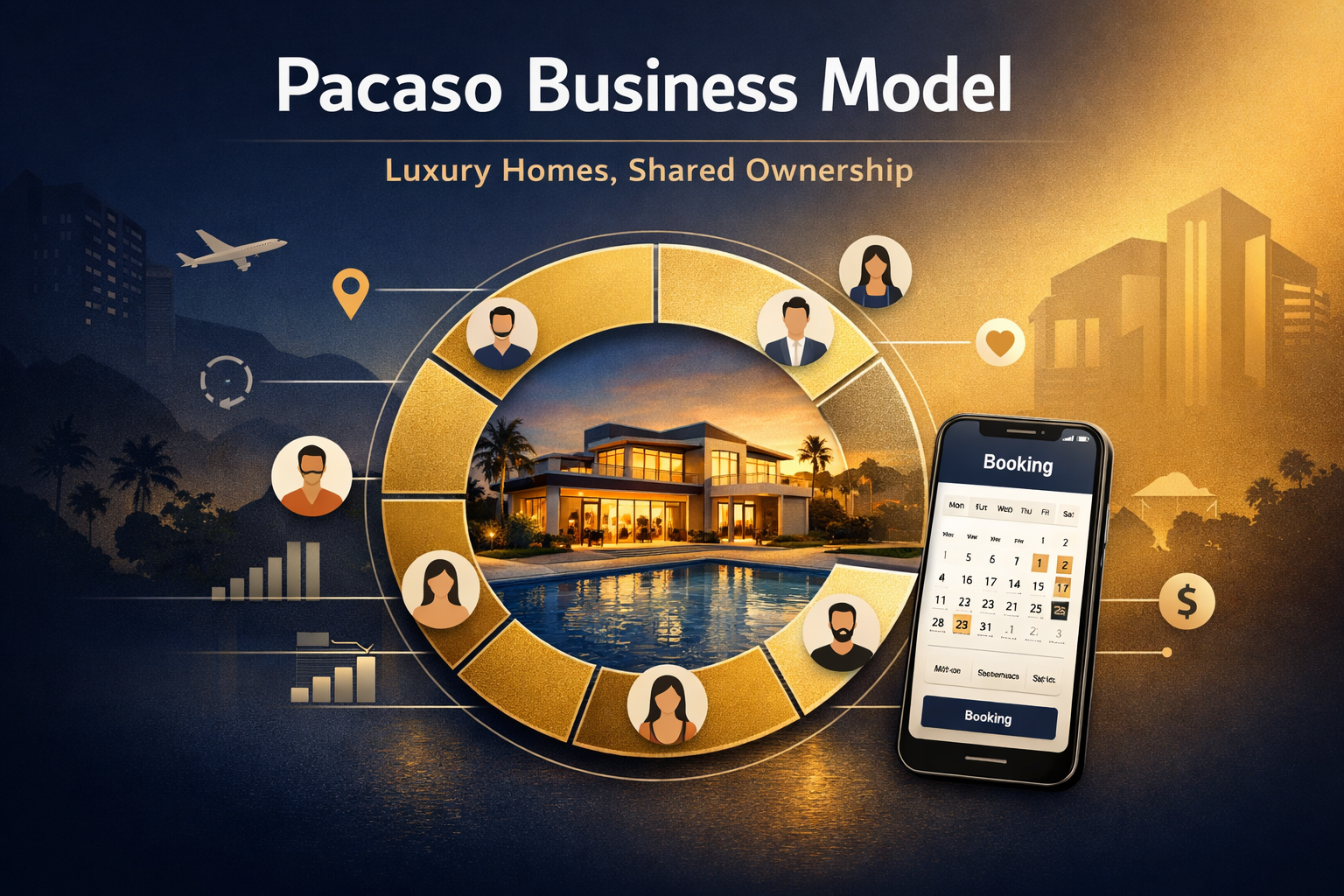
Pacaso Business Model And How This Startup Is Turning Luxury Homes Into Shared Assets

Pacaso lets multiple buyers co-own a luxury vacation home by splitting it into shares. They make money through transaction fees, property markups, and monthly management fees. It’s a smart mix of real estate and tech.
Now let me break down exactly how this works and why it’s such a clever business model.
What Even Is Pacaso?
You’ve probably heard of timeshares. And you probably know someone who regrets buying one.
Pacaso is nothing like that.
It’s a co-ownership platform for luxury vacation homes. Instead of one person spending millions on a home they use a few weeks a year, Pacaso splits that home among eight buyers. Everyone owns a real piece of the property. Everyone gets to use it. And nobody is stuck with a depreciating timeshare disaster.
Think of it this way. Imagine a $2 million beach house in Napa Valley. One buyer would need $2 million plus taxes, maintenance, and a lot of free time to justify it.
With Pacaso, eight buyers each pay around $250,000 for a 1/8th share. That’s the same house. Same luxury. A fraction of the cost.
That’s the core idea. And it’s genuinely brilliant.
Quick Answer: How Does the Pacaso Business Model Work?
Pacaso buys luxury vacation homes, splits them into fractional shares, and sells those shares to multiple buyers. They charge a service fee upfront, build a markup into the property price, and collect monthly management fees from all owners.
It’s part real estate developer, part marketplace, part property manager.
The result is a business that earns big upfront and keeps earning every month.
The Problem Pacaso Is Solving
Here’s the thing nobody talks about enough.
Most luxury vacation homes sit empty most of the year.
A wealthy family buys a lake house. They use it in July. Maybe a long weekend in October. The rest of the year, it sits there. Empty. Costing money. Going nowhere.
That’s a massive inefficiency. And Pacaso spotted it.
Their whole model is built around one core insight: luxury homes are underused assets. If you can restructure ownership, you can fix that.
It’s the same logic behind WeWork (shared office space), Zipcar (shared cars), and Airbnb (shared short-term rentals). Pacaso just applied it to second-home ownership.
And the market is huge. Second homes in the U.S. alone represent trillions of dollars in real estate. Most of it is sitting underused.
How Pacaso Actually Works (Step by Step)
Let me walk you through the full process. It’s simpler than it sounds.
Step 1: Pacaso Buys the Home
Pacaso finds and purchases premium homes in top vacation markets. We’re talking places like Napa Valley, Scottsdale, Aspen, Park City, and Malibu.
They don’t list just any house. They focus on luxury properties in high-demand destinations where wealthy buyers already want to be.
Step 2: They Structure the Ownership
Once Pacaso buys the home, they create an LLC for that specific property. Then they divide ownership into shares, usually 1/8th each.
Each share gives the owner roughly 44 days of usage per year. That’s about six weeks of vacation time.
For most people, six weeks a year at a luxury property is more than enough.
The LLC structure is key here. You’re not buying a timeshare. You’re buying actual equity in a real property. That’s a huge difference legally and financially.
Step 3: Selling the Shares
Pacaso then lists those shares on their platform and sells them to buyers. Each buyer goes through a vetting process. Pacaso makes sure the co-owners are a good fit for the property and each other.
This isn’t like buying a stock. It’s a real estate transaction with real legal weight.
Step 4: Smart Scheduling
Here’s where the tech side comes in.
Pacaso uses a scheduling algorithm to manage who gets the home and when. Owners request dates through the app. The system ensures fair distribution. No owner can dominate the calendar.
This is one of the smartest parts of the model. The biggest fear with co-ownership is conflict. Pacaso reduces that with technology.
Step 5: Full Property Management
After the sale, Pacaso handles everything. Maintenance, cleaning, repairs, furnishing, utilities, HOA fees. All of it.
Owners just show up and enjoy. They pay monthly management fees for this service.
This “white glove” approach is why people choose Pacaso over trying to co-own a property informally with friends or family.
How Pacaso Makes Money (Revenue Streams Explained)
This is the part I find most interesting from a business perspective.
Pacaso doesn’t rely on one revenue stream. They’ve built multiple income layers into their model. Let me break each one down.
Revenue Stream 1: Transaction Fee on Share Purchase
When a buyer purchases a share in a Pacaso property, they pay a service fee. This is typically around 10 to 12 percent of the share price.
So if you buy a $300,000 share, Pacaso earns around $30,000 to $36,000 just from that single transaction.
Multiply that by eight buyers per property. And then multiply that across dozens of properties.
That’s serious upfront revenue.
Revenue Stream 2: Property Price Markup
Here’s the layer most people miss.
Pacaso buys the home at market price. They then sell shares at a slight premium. The total price of all eight shares exceeds what Pacaso paid for the property.
That spread is profit. Built right into the transaction.
It’s similar to how a car dealership buys vehicles at dealer cost and sells them at a markup. Except here, the product is a $2 million vacation home.
Revenue Stream 3: Monthly Management Fees
Every co-owner pays a monthly fee to Pacaso. This covers ongoing costs like maintenance, cleaning, property management, insurance, and platform access.
These fees vary by property but typically range from a few hundred to over a thousand dollars per month depending on the home.
This is recurring revenue. And recurring revenue is the holy grail of any business model.
Once a property is sold and owners are in place, Pacaso earns every single month without needing to close another deal.
Revenue Stream 4: Resale Fees
When an owner wants to sell their share, they can list it through Pacaso’s platform. Pacaso facilitates the resale and charges a fee for that service.
This is smart for a few reasons. It creates a secondary market within Pacaso’s ecosystem. It keeps owners from going elsewhere to sell. And it generates another revenue event every time a share changes hands.
The Unit Economics (Why This Works at Scale)
Let me put some rough numbers together so you can see why this model is compelling.
Say Pacaso buys a $2 million home.
They sell 8 shares at $275,000 each. Total proceeds: $2.2 million. After the purchase price, that’s $200,000 in gross margin just from the markup.
Add 10% transaction fees on $275,000 per share. That’s $27,500 per buyer times 8 buyers. Another $220,000.
So from one property sale, Pacaso can gross around $420,000 or more before costs.
Then the monthly management fees kick in. Say $800 per owner per month. That’s $6,400 per month from one property. Per year, $76,800.
That’s recurring revenue with very low incremental cost once the property is set up.
Scale this to 50 or 100 properties, and you’re looking at serious numbers.
Why This Model Is Appealing to Buyers
From the buyer’s side, Pacaso makes a lot of sense too. And that’s important. A business model only works if both sides of the transaction see value.
It’s Actual Ownership
You’re not renting. You’re not doing a timeshare. You own equity in a real property through an LLC. That equity can appreciate if the home value goes up.
That’s a fundamentally different proposition than anything else in this space.
The Cost Is Accessible (For Luxury Real Estate)
A $275,000 share is still expensive. But compared to buying the entire $2 million home, it’s dramatically more accessible for upper-middle-class buyers or younger wealthy professionals.
Wealthy millennials, in particular, are drawn to this model. They want access to luxury without the full commitment or capital requirement.
Zero Hassle
You don’t manage anything. No dealing with contractors. No finding cleaners. No paying bills. Just show up, enjoy your home, and leave.
For busy professionals, that’s worth a lot.
Portfolio Diversification
Some buyers actually use Pacaso to diversify their real estate investments. Instead of putting $2 million into one vacation home, they might buy fractional shares in two or three different markets.
That’s smart risk management wrapped in a lifestyle product.
Why Pacaso Is Growing Fast
There are a few big tailwinds pushing this business forward.
Remote Work Changed Everything
Before 2020, vacation homes were for vacations. You had two weeks a year, maybe three. A fractional share giving you six weeks sounded like more than enough.
After 2020, everything changed. Remote work means people can work from anywhere. A second home isn’t just for vacation. It’s a legitimate workspace.
That made second-home demand explode. And it made Pacaso’s pitch even more attractive.
The Wealth Transfer Is Happening
Millennials are inheriting and accumulating wealth faster than any generation before. But they think about ownership differently. They’d rather own a share of something premium than full ownership of something average.
Pacaso fits perfectly into that mindset.
Real Estate Is Still Seen as Safe
Even with market fluctuations, people still trust real estate as an asset class. Pacaso gives buyers a way to enter the luxury real estate market at a lower price point.
That broad trust in real estate gives Pacaso a credibility boost that pure tech startups don’t get.
How Pacaso Compares to the Competition
Pacaso vs. Airbnb
These two get compared a lot. But they’re really different.
Airbnb is a rental platform. You pay to stay somewhere for a few days. You own nothing. You leave nothing behind.
Pacaso is an ownership platform. You pay to own a share. That share builds equity. You can sell it later.
The target customer is also different. Airbnb serves travelers. Pacaso serves high-net-worth buyers who want the feeling of a second home without the full price tag.
| Feature | Pacaso | Airbnb |
|---|---|---|
| Ownership | Yes (fractional) | No |
| Revenue Model | Asset + service fees | Commission |
| Target | Wealthy buyers | Travelers |
| Repeat relationship | Long-term | Transactional |
Pacaso vs. Traditional Timeshares
Timeshares have a terrible reputation. And mostly for good reason.
They’re hard to sell. They depreciate. The fees are hidden. And the experience is usually mediocre.
Pacaso is the opposite. Real equity ownership. Professional management. Luxury properties. A real secondary market for resale.
Pacaso has gone out of its way to position itself as the anti-timeshare. And for most buyers, that framing works.
Pacaso vs. Inspirato
Inspirato is more of a subscription model. You pay a monthly fee and get access to a network of luxury properties.
You never own anything. It’s more like a luxury hotel membership.
Pacaso gives you ownership. That’s a fundamentally different value proposition for buyers who want equity, not just access.
The Real Challenges
I’d be doing you a disservice if I only talked about the positives. Pacaso’s model has real challenges.
It’s Capital Intensive
Pacaso has to buy homes before they can sell shares. That means tying up millions of dollars per property.
If shares don’t sell quickly, that capital sits locked up. In a slow market, that’s a serious problem.
Unlike Airbnb, which is truly asset-light, Pacaso needs significant capital to operate. That limits how fast they can scale without external funding.
Regulatory Headaches
Some cities and HOA communities have pushed back against Pacaso’s model.
They argue that co-ownership models bring “too many people” into residential neighborhoods. Some markets have passed rules that restrict or complicate fractional ownership.
This is a real risk that could limit their expansion into certain high-demand markets.
Liquidity Is Not Guaranteed
The pitch says you can sell your share when you want. And Pacaso does facilitate that.
But fractional real estate shares are not like stocks. There’s no public market. Finding a buyer takes time. And if the property market is down, selling at a fair price can be tough.
Buyers need to understand this. It’s not a liquid investment. It’s closer to traditional real estate in that regard.
Market Dependency
Pacaso thrives when luxury real estate is hot. When the market cools, demand for $250,000 vacation shares drops quickly.
Unlike a SaaS company that generates recurring revenue regardless of market conditions, Pacaso’s new sales depend heavily on macroeconomic factors.
The Bigger Picture: What Founders Can Learn From Pacaso
Even if you’re not in real estate, the Pacaso model has lessons worth stealing.
First, look for underused assets. Empty vacation homes were sitting right in front of everyone. Pacaso monetized the gap between what an asset costs and how much it’s actually used.
Second, restructure access. You don’t always need to build something new. Sometimes you just need to change how people access something that already exists.
Third, layer your revenue. Pacaso earns at purchase, earns at resale, and earns every month in between. That’s how you build a durable business.
Fourth, reduce friction to increase adoption. By handling every operational detail, Pacaso removed the biggest reasons people hesitate to co-own property. Less friction equals more buyers.
Fifth, pick a premium niche. Fewer customers at high price points can generate more revenue than millions of low-value transactions. Pacaso doesn’t need everyone. They need the right buyers.
What’s Next for Pacaso?
The model has a few natural growth paths.
International expansion is the most obvious one. Luxury vacation markets exist all over the world. Tuscany, Bali, the French Riviera. Pacaso’s model could translate well globally.
Tokenized ownership is an interesting future direction. If fractional real estate shares could be traded on a blockchain, the liquidity problem gets much smaller. You’d have a real secondary market for shares.
Corporate and wellness retreats could be another angle. Companies are paying a lot for executive retreats and offsite meetings. A corporate co-ownership model for meeting spaces could work similarly.
Wealth management integration is also compelling. If financial advisors could recommend Pacaso shares as part of a diversified portfolio, that opens a whole new distribution channel.
Summary: What Makes Pacaso’s Model Work
Let me bring it all together.
Pacaso works because it solves a real problem for both sides of the market.
For buyers, it lowers the barrier to luxury second-home ownership. You get equity, usage, and zero operational hassle.
For the business, it creates multiple revenue events per property and recurring monthly income once owners are in place.
The model is capital intensive but high margin. It requires strong operational infrastructure but creates real defensibility once established.
Most importantly, Pacaso is selling an identity, not just an asset. The buyer isn’t just purchasing a share of a house. They’re buying the lifestyle of someone who has a second home in Napa.
That emotional component is powerful. And it’s why Pacaso commands premium pricing.
FAQs
Pacaso buys luxury vacation homes, splits them into 8 shares, and sells those shares to buyers. They make money from fees on the purchase, a markup on the property, and monthly management fees.
No. Pacaso is fractional ownership, which means you own real equity in the property through an LLC. Timeshares are usage rights with no real ownership. They’re completely different structures.
Pacaso earns through a 10 to 12 percent transaction fee, a markup built into the share price, monthly management fees from all owners, and resale fees when shares change hands.
It depends. Your share can appreciate if the home value rises. But it’s not as liquid as stocks or REITs. Think of it as luxury real estate investing with lifestyle benefits built in.
High-net-worth individuals, usually in the $500,000 to $5 million net worth range, who want a luxury second home but don’t want to spend $2 million or deal with property management.
Pacaso focuses on top U.S. vacation markets like Napa Valley, Aspen, Park City, Malibu, and Scottsdale. They’re also exploring international expansion.
Discover more from Business Model Hub
Subscribe to get the latest posts sent to your email.