Deel Business Model And How It Actually Makes Money in the Global Hiring Game

If you’ve ever tried to hire someone in another country, you know the nightmare.
Lawyers. Entity setups. Tax registrations. Compliance headaches that cost thousands before a single person is onboarded.
Deel looked at that problem and said, “We’ll handle it.”
And then they built one of the fastest-growing SaaS companies in history around that idea.
This breakdown goes deep into how Deel’s business model actually works, how it makes money, and why it’s harder to copy than it looks.
What Deel Actually Is
Most people hear “Deel” and think payroll software.
That’s underselling it significantly.
Deel is a global employment infrastructure platform. It lets companies hire full-time employees and contractors in 150+ countries without ever setting up a local legal entity. The compliance, the contracts, the tax filings, the benefits, the payroll, all of it runs through Deel.
Think of it this way:
Instead of your company opening a subsidiary in Germany, registering for payroll taxes, hiring a local HR lawyer, and figuring out Works Council laws, you just use Deel. They’ve already done all of that work. You pay them a fee and inherit the infrastructure.
That’s a fundamentally different kind of business than typical HR software. It’s not just a dashboard. It’s a legal and operational layer that sits between you and every country you want to hire in.
The Problem That Created Deel’s Opportunity
To understand why Deel’s model works, you need to understand what it replaced.
The Old Way of Hiring Internationally
Before platforms like Deel existed, global hiring was brutally slow and expensive. If a US company wanted to hire a software engineer in Brazil, the options were:
- Set up a Brazilian entity (six to twelve months, tens of thousands of dollars)
- Hire them as a misclassified contractor and hope nobody notices
- Use an expensive professional employer organization with bad software and worse customer support
- Just… not hire them
None of these options were good. The first was too slow. The second was legally risky. The third was clunky and expensive. The fourth left talent on the table.
Remote work made this problem much bigger. When the entire world went remote in 2020, companies suddenly realized their best candidates weren’t in the same city anymore. They were in Lisbon. In Lagos. In Buenos Aires.
Deel was ready for that moment.
Why This Problem Is Structurally Hard to Solve
Here’s something most people miss about what Deel actually built.
The hard part isn’t the software. The hard part is the compliance infrastructure.
Every country has its own:
- Labor laws (notice periods, severance rules, working hour limits)
- Tax regimes (income tax structures, employer contribution rates)
- Benefits requirements (mandatory health coverage, pension contributions)
- Termination rules (sometimes you legally cannot fire someone without specific cause)
Building a dashboard is relatively straightforward. Building a network of local entities, legal experts, banking relationships, and compliance systems across 150 countries is genuinely difficult. That’s Deel’s real moat, and we’ll come back to it.
How Deel’s Business Model Is Structured
Deel runs what you’d call a hybrid model. There’s a software layer on top and a services layer underneath.
The software layer handles everything users interact with. Contracts, onboarding flows, time tracking, payslips, expense management, HR records. It looks and feels like a modern SaaS product.
The services layer is what actually makes it all work. Local payroll processing, tax filings, legal entity management, compliance monitoring, benefits administration. This is where the real complexity lives.
The key insight is this: The software attracts customers, but the services layer is what keeps them.
Once a company has twenty employees running through Deel’s infrastructure, switching to something else isn’t a software migration. It’s a legal migration. You’re moving employment relationships, tax setups, benefit plans, and compliance obligations across multiple jurisdictions. That’s incredibly sticky.
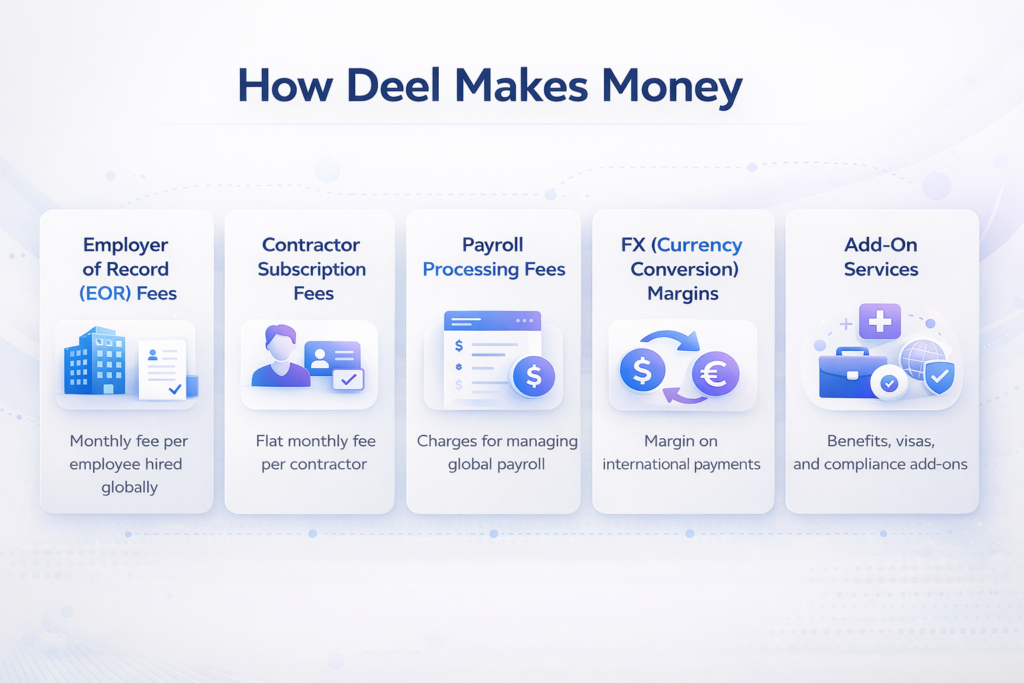
How Deel Makes Money
Let’s get specific. Deel has several revenue streams, and they work together in a way that’s worth understanding.
Employer of Record Fees
This is Deel’s primary revenue driver.
When a company hires a full-time employee in another country through Deel, Deel becomes the legal employer of that person. The client company directs the work, but Deel handles everything else: the employment contract, the payroll, the taxes, the benefits, the legal compliance.
For this, Deel typically charges somewhere between $500 and $600 per employee per month, depending on the country and contract specifics.
This model works well because:
- It’s recurring (companies don’t hire and fire constantly)
- It scales with the client’s team growth
- The value is obvious every month (the alternative is setting up a local entity)
As companies grow their international teams, Deel’s revenue from that customer grows automatically. A startup with three international employees today might have thirty in two years.
Contractor Management Subscriptions
Not everyone needs a full Employer of Record setup. Many companies work with freelancers and independent contractors.
For this, Deel charges a monthly subscription fee per contractor managed on the platform. This covers contract generation, compliant invoicing, payment processing, and contractor classification guidance.
This tier is lower in price than EOR but operates at massive volume. There are a lot more companies managing a few contractors than companies hiring full employees internationally.
It also serves as an entry point. A company might start by managing a handful of contractors through Deel. When they decide to convert some of those people to full-time employees, Deel is already there.
Global Payroll Processing
For companies that already have legal entities in multiple countries but want a better way to run payroll, Deel offers a standalone payroll processing service.
This is different from EOR. Here, the company is the legal employer. Deel just handles the operational complexity of running payroll in multiple jurisdictions simultaneously.
This expands Deel’s addressable market significantly. Larger enterprises that already have local entities don’t need EOR, but they absolutely hate managing twelve different payroll systems. Deel gives them a unified solution.
Foreign Exchange Margins
This one doesn’t show up on a pricing page, but it’s real.
When Deel collects money from a US client in dollars and pays out a French employee in euros, there’s a currency conversion happening. Deel earns a margin on that conversion.
Individually, these margins are small. At Deel’s scale, processing payroll for tens of thousands of employees across hundreds of currencies, it adds up to a meaningful revenue line.
This is common among fintech companies that touch cross-border payments. It’s essentially invisible to customers because the exchange rates are close to market rates, but the aggregate volume makes it profitable.
Add-On Services and Products
Beyond the core offering, Deel layers in additional products that generate revenue:
Deel HR is a full human resources information system (HRIS) that competes with products like BambooHR or Rippling. For companies already using Deel for payroll, it makes sense to centralize HR records there too.
Deel Equity helps companies manage stock options and equity grants across borders, a surprisingly complex compliance challenge.
Deel Immigration handles visa applications and work permits for employees relocating internationally.
Deel Engage covers performance management, learning tools, and team engagement features.
Each of these represents an expansion of the relationship with existing customers. Deel doesn’t just want to be the payroll vendor. It wants to be the HR operating system.
Business Model Canvas of Deel
This is where things get practical.
Instead of looking at Deel like a typical SaaS tool, let’s break it down like a founder would focusing on what actually drives the business.
1. Customer Segments
Deel isn’t built for everyone it’s built for companies dealing with global hiring complexity:
- Remote-first startups
- Tech companies hiring across countries
- Enterprises expanding internationally
- Freelance-heavy businesses
any company hiring across borders is Deel’s ideal customer
2. Value Propositions
This is the real reason Deel exists.
- Hire globally without setting up legal entities
- Stay 100% compliant with local labor laws
- Onboard employees in days, not months
- Run payroll across countries without friction
Deel removes the legal and operational headache of global hiring
3. Channels
How Deel reaches and acquires customers:
- Direct sales (especially for enterprise clients)
- Website with self-serve onboarding
- Partnerships with VCs, accelerators, and startup ecosystems
- SEO and content-driven growth
Strong mix of product-led growth + sales-led expansion
4. Customer Relationships
Deel balances automation with human support:
- Self-serve experience for startups and small teams
- Dedicated account managers for large companies
- Continuous support for payroll, compliance, and legal queries
Retention is naturally high because once a company sets up global payroll, switching becomes painful
5. Revenue Streams
Deel monetizes every layer of global hiring:
- EOR (Employer of Record) monthly fees
- Contractor subscription fees
- Payroll processing charges
- FX (currency conversion) margins
- Add-on services (benefits, visas, compliance support)
Multiple revenue streams, but all tied to one core activity: global employment
6. Key Resources
What actually powers Deel behind the scenes:
- Global legal and compliance infrastructure
- Local labor law expertise
- Payment and payroll systems
- SaaS platform and dashboard
Deel’s real asset isn’t software it’s compliance infrastructure
7. Key Activities
What Deel does every day to deliver value:
- Managing compliance across multiple countries
- Processing payroll and international payments
- Maintaining legal entities globally
- Improving and scaling the platform
8. Key Partnerships
Deel doesn’t operate alone — partnerships are critical:
- Local legal authorities and advisors
- Banking and payment providers
- Benefits and insurance providers
- Immigration and visa service partners
These partnerships enable Deel to operate globally without building everything from scratch
9. Cost Structure
This is where the model gets heavy:
- Legal and compliance operations
- Salaries for experts and specialists
- Payment infrastructure costs
- Technology development
- Global expansion and entity setup
High operational cost + high switching cost = strong long-term moat
Who Deel Is Actually Selling To
Understanding Deel’s customer segments helps explain why the business model is so durable.
Remote-First Startups
This was Deel’s original core market, and it’s still important.
Early-stage startups often can’t afford to hire locally in expensive cities. They want to hire the best person for the role, wherever that person happens to live. Deel makes that possible without requiring a six-month legal setup process.
For a fifty-person startup with team members in eight countries, Deel is basically essential infrastructure.
Mid-Market and Enterprise Companies
This is where Deel has deliberately moved in recent years.
Larger companies have more complexity, more budget, and more countries to manage. The sales cycle is longer, but the contract values are much higher. An enterprise with two hundred international employees represents serious annual recurring revenue.
Deel has built out enterprise-specific features (advanced reporting, SSO, dedicated support) and invested heavily in direct sales teams targeting this segment.
Companies With Contractor-Heavy Workforces
Some industries run primarily on contractor relationships. Media, technology, creative services, research. These companies might have relatively few full-time employees but dozens or hundreds of contractors spread across the world.
Deel’s contractor management product is purpose-built for this use case, and these customers tend to have high volume even if the per-seat revenue is lower.
The Growth Strategy Behind the Business
Deel’s growth didn’t happen by accident. There are a few clear strategic moves that explain how it got from zero to multi-billion dollar valuation so fast.
Riding the Remote Work Wave
Timing matters enormously in business. Deel launched in 2019. The pandemic hit in 2020. Remote work exploded.
Companies that had never thought about international hiring were suddenly discovering that their team was distributed anyway. They needed infrastructure for it.
Deel was positioned perfectly. The product existed, the compliance infrastructure was being built out, and suddenly there was massive demand from companies who had no idea how to hire internationally.
This wasn’t luck, the founders identified the trend before it accelerated, but the acceleration was extraordinary.
Self-Serve as a Growth Engine
Deel invested early in a self-serve onboarding experience that let small companies get started without talking to a salesperson.
This matters because it removes friction for smaller customers who would never agree to a lengthy enterprise sales process. They can sign up, generate a compliant contractor agreement, and send it out within an hour.
Many of Deel’s best enterprise customers started as self-serve users at earlier-stage companies. As those companies grew, so did their Deel contracts.
Content and SEO as Acquisition
Deel has built an impressive content operation around the complexity of international employment law.
If you search for “how to hire an employee in Portugal” or “contractor vs employee Brazil,” there’s a good chance Deel’s content appears near the top. That content attracts exactly the kind of potential customer who’s actively thinking about international hiring.
This is efficient customer acquisition. Someone researching the rules around hiring in Japan is a very warm lead for Deel’s product.
Moving Upmarket Deliberately
Early Deel customers were mostly startups. Over time, Deel has systematically moved upmarket toward larger enterprise contracts.
This required building enterprise features (more robust reporting, compliance controls, integration with enterprise HR systems) and building out an enterprise sales organization.
The economics of enterprise customers are significantly better. Higher contract values, longer retention, more expansion revenue as headcount grows.
What Makes Deel Genuinely Difficult to Copy
This is the most important part of understanding Deel’s business model, because it explains why valuation has stayed high despite competition.
Compliance Infrastructure at Scale
Building a payroll system is a software problem. Building compliant employment infrastructure in 150 countries is an operational and legal problem.
Deel has spent years and enormous amounts of money establishing local legal entities, hiring local compliance experts, building banking relationships, and navigating regulatory frameworks in each market.
A competitor trying to replicate this from scratch faces years of work and significant capital requirements before they can even match Deel’s country coverage. And during those years, Deel keeps expanding.
Switching Costs Are Genuinely High
Once a company’s employees are running through Deel’s infrastructure, moving them is painful.
It’s not just migrating software data. It’s moving legal employment relationships, potentially renegotiating benefits, ensuring continuity of tax filings, and managing the transition carefully to avoid compliance gaps.
Most companies, once embedded in Deel, stay in Deel.
The Full-Stack Advantage
Many competitors are point solutions. One handles EOR. Another handles contractor payments. Another does global payroll.
Deel wants to be all of it in one place. For a company managing a globally distributed team, consolidating everything onto one platform is genuinely valuable. It reduces vendors, reduces complexity, and creates a single source of truth for workforce data.
This full-stack positioning is hard to replicate because it requires building (or acquiring) competency across many different product areas simultaneously.
A Realistic Look at Deel’s Challenges
No business model breakdown is complete without looking at where things could go wrong.
Regulatory Risk Is Real
Deel’s entire business depends on operating within local regulatory frameworks. If a country changes its employment laws, Deel has to adapt quickly. If a regulator decides that Deel’s EOR structure doesn’t comply with local law in a particular market, that’s a serious problem.
Managing regulatory risk across 150 countries simultaneously is genuinely complex. It requires constant monitoring and significant legal resources.
High Operational Costs
Running a global compliance infrastructure isn’t cheap. Deel employs lawyers, compliance specialists, HR experts, and local operations staff in dozens of countries.
This creates a cost structure that’s significantly higher than pure software companies. Revenue has to scale faster than operational costs for the economics to work.
Intensifying Competition
The global payroll and EOR space has attracted significant investment. Remote, Rippling, Papaya Global, Oyster, and others are all competing for the same customers.
Price competition is real. Differentiation becomes increasingly important. Deel has to keep investing in product quality, country coverage, and enterprise features to maintain its position.
The Profitability Question
Deel has prioritized growth over near-term profitability, which is a common and often sensible strategy for high-growth SaaS companies.
But it means that the business is consuming capital. As markets mature and growth rates normalize, demonstrating a path to strong profitability becomes increasingly important for investors and for long-term sustainability.
Where Deel Is Heading
Looking at Deel’s trajectory, a few things are clear about where the business is going.
Building a Global HR Operating System
Deel isn’t trying to be the best payroll vendor. It’s trying to be the operating system for global workforces.
That means payroll, HR records, performance management, equity, immigration, benefits, and anything else a company needs to manage international employees all flowing through one platform.
If Deel can pull this off, the switching costs become even higher and the revenue per customer becomes much larger.
Financial Services as a Revenue Layer
There’s a significant opportunity for Deel to expand into financial services for international workers.
Think banking, savings, insurance, and credit products designed for people who are employed across borders. Workers paid through Deel in developing markets often have limited access to traditional financial services. Deel is well-positioned to offer them.
This would add a high-margin revenue stream that deepens the relationship with both employers and employees.
AI-Powered HR Tools
Like every enterprise software company, Deel is investing in AI capabilities.
The specific opportunity here is compliance automation. Figuring out the right employment structure, benefits requirements, and tax implications for a new hire in a new country currently requires human expertise. AI can help automate significant parts of that analysis, reducing Deel’s operational costs while potentially improving accuracy.
The Bigger Picture
Here’s what’s easy to miss when you look at Deel as just another HR tech company.
Deel is building infrastructure for a world where talent is globally distributed and employment is no longer tied to geography.
That world is already here. Remote work demonstrated that knowledge workers can be productive from anywhere. The question is no longer whether companies will hire internationally. The question is how they’ll manage it at scale.
Deel’s bet is that the answer to that question runs through their platform. Every employment contract, every payroll run, every equity grant, every visa application for a globally distributed team.
If that bet is right, and there’s substantial evidence that it is, the revenue opportunity is enormous. There are hundreds of millions of knowledge workers globally. The infrastructure they’re employed through needs to exist somewhere.
Deel wants to be that infrastructure.
Wrap Up
Most people look at Deel and see a payroll company.
What’s actually being built is something closer to a borderless employment layer for the global internet economy.
The software is the interface. The compliance infrastructure is the moat. The services layer is what generates recurring revenue and creates lock-in. And the expansion into HR, equity, immigration, and potentially financial services is how Deel turns a payroll relationship into something much stickier and more valuable.
The business model works because it solved a genuinely hard problem (legal global employment) in a way that’s operationally difficult to replicate and creates real switching costs once customers are embedded.
Whether Deel becomes the definitive global HR operating system or faces consolidation in a competitive market, its model offers a useful lesson for anyone building in B2B software:
The best moats come from solving the problems that are hard not because of technology, but because of operational complexity.
Deel didn’t win by writing better code. It won by doing the hard, unsexy work of building legal infrastructure in 150 countries before anyone else did it at scale.
That’s what the business model is really built on.
FAQs
Deel uses a hybrid SaaS and services model. The software layer handles user-facing functionality while the services layer delivers compliance, payroll processing, and employment infrastructure.
Deel’s primary revenue comes from Employer of Record monthly fees, contractor management subscriptions, global payroll processing charges, foreign exchange margins on cross-border payments, and add-on services like immigration support and equity management.
Deel serves remote-first startups, mid-market technology companies, enterprises expanding internationally, and businesses managing large contractor workforces across multiple countries.
Deel’s core differentiation is its compliance infrastructure built across 150 countries, its full-stack product approach covering EOR, contractor management, HR, equity, and immigration, and the high switching costs created once a company’s workforce is embedded in the platform.
Discover more from Business Model Hub
Subscribe to get the latest posts sent to your email.