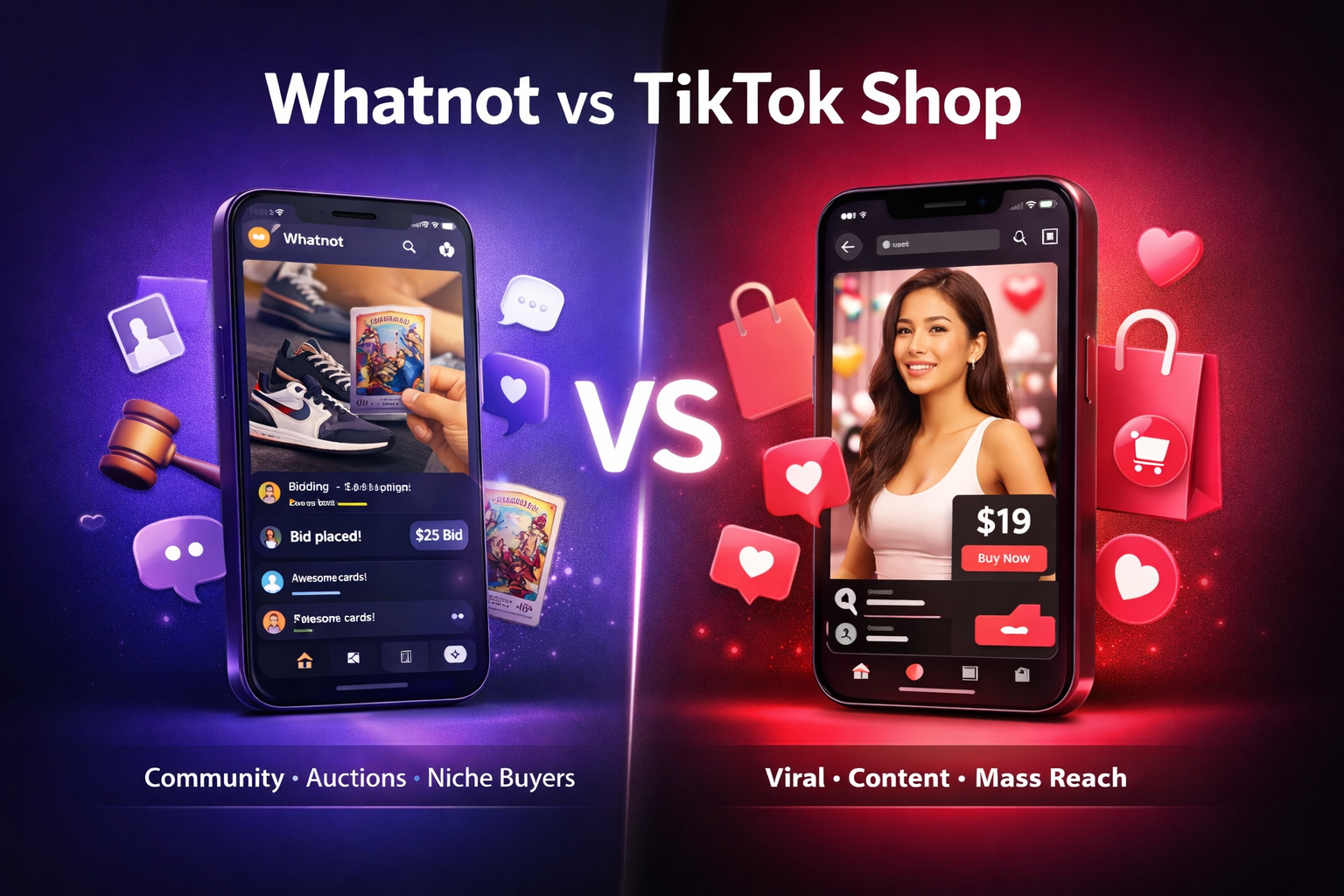

If you want one sentence: Whatnot is built for high-intent niche buyers. TikTok Shop is built for viral mass reach.
- Want fast growth and impulse sales? Go TikTok Shop.
- Want loyal buyers and repeat customers? Go Whatnot.
- Want both? Smart sellers are already using them together.
Introduction: The Live Commerce Revolution Is Here
Something big has been quietly happening in e-commerce.
People are no longer just browsing product pages and adding items to carts. They are watching live streams, bidding in real-time auctions, and buying things they did not even know they needed five minutes ago.
This is live commerce, and it is growing fast.
In the United States alone, live commerce is projected to become a multi-hundred-billion dollar market by the late 2020s. China already proved the model works at scale. Now Western platforms are racing to catch up, and two names keep coming up in every serious seller conversation: Whatnot and TikTok Shop.
These platforms are not the same. They attract different buyers, reward different behaviors, and require different strategies. If you are a seller, a creator, or a founder deciding where to put your energy in 2026, this breakdown will help you choose clearly.
I am going to break this down the way a founder would, not as a platform cheerleader but as someone thinking through where time and money should go.
What Is Whatnot?
Whatnot is a live auction marketplace. It launched in 2021 with a tight focus on trading cards and collectibles, and it has since expanded into categories like vintage clothing, sneakers, comics, toys, and more.
Here is what makes it distinct:
- Live auction format. Sellers host live streams where they pull items and auction them in real time, sometimes dozens of items per session.
- Community-first design. Buyers follow specific sellers, join streams regularly, and build genuine relationships. Repeat buyers are not unusual. They are expected.
- Niche focus. The platform is built around categories where buyers have strong existing knowledge and emotional investment. A Pokemon card collector on Whatnot is not casually browsing. They know exactly what they want.
- Seller verification. Whatnot vets sellers before they can go live, which creates a baseline of trust that general marketplaces often lack.
The core value proposition is trust and community within niche categories.
What Is TikTok Shop?
TikTok Shop is commerce built directly into TikTok’s ecosystem. It launched in the US in 2023 and has since grown aggressively.
Here is what makes it distinct:
- Content is the product listing. Instead of a static page with a photo, your product is embedded inside a video or live stream. The algorithm surfaces it to people who might buy it, even if they have never heard of you.
- Discovery-driven purchasing. Most TikTok Shop buyers were not looking for what they ended up buying. The algorithm brings them to it.
- Creator affiliate network. TikTok Shop has a large ecosystem of creators who can earn commissions promoting other sellers’ products, giving smaller brands access to major distribution without a massive following of their own.
- Scale at speed. Viral products can go from unknown to thousands of orders in 48 hours. Nothing else in e-commerce moves quite this fast.
The core value proposition is reach, virality, and algorithm-powered discovery.
Platform Comparison: Side by Side
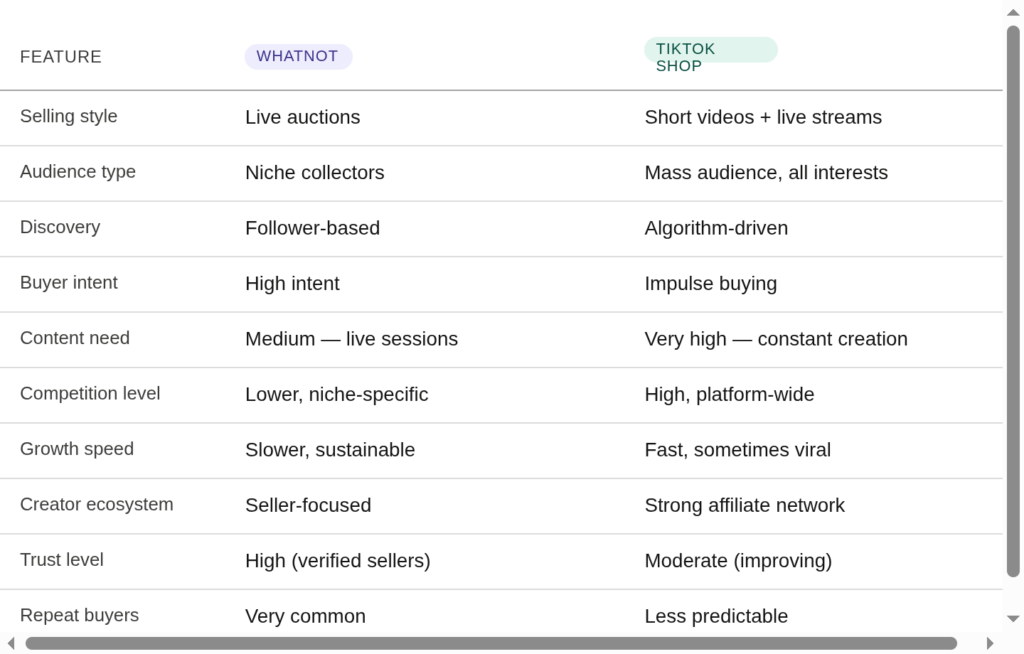
Business Model Breakdown
Understanding how each platform makes money tells you a lot about what behavior they reward.
Whatnot’s Business Model
Whatnot makes money primarily through seller fees and transaction commissions. When a seller completes a live auction, Whatnot takes a percentage of the final sale price. There are also optional featured listing placements that give sellers higher visibility in search results and on the explore page.
This model creates an important alignment: Whatnot wins when sellers successfully sell things. The platform’s revenue is directly tied to transaction volume, which pushes it to build features that help sellers close sales and retain buyers. Community features, seller ratings, and authentication tools all serve this goal.
Whatnot does not run external ads in the traditional sense. Its growth is driven by seller success stories and word-of-mouth within niche communities.
TikTok Shop’s Business Model
TikTok Shop operates on a commission structure, but it sits inside a much larger advertising and attention economy. TikTok makes most of its money from advertising. TikTok Shop layered commerce on top of that.
The key revenue streams for TikTok Shop include:
- Commission fees on completed transactions through the shop
- Promoted listings and ads bought by sellers who want more visibility
- Affiliate payouts managed through its creator marketplace, where TikTok facilitates deals between sellers and content creators
The deeper alignment here is that TikTok benefits when users stay on TikTok longer. A sale is good. A sale that keeps you scrolling and coming back tomorrow is better. This is why the algorithm favors content that drives engagement first, and conversion second.
The Real Seller Experience
Let’s get into what it actually feels like to sell on each platform.
Selling on Whatnot
When you sell on Whatnot, you are building a show. A typical session might last two to three hours, where you pull cards, coins, vintage items, or whatever your niche is, and auction them one by one while chatting with your audience.
What works well:
- Buyers are already warmed up. They joined your stream because they care about your category.
- Loyal viewers show up repeatedly. Some sellers have buyers who attend every stream.
- The auction format creates urgency naturally. No discount codes needed.
- The barrier to entry filters out lower-quality sellers, which keeps buyer trust high across the platform.
What is genuinely hard:
- You need to show up consistently. Going live once a month does not build an audience on Whatnot.
- Your growth is mostly follower-driven. If someone does not already follow you or find you through the category browse, they may never see you.
- The niche requirement is a double-edged sword. Great for collectibles, less ideal for general merchandise.
Selling on TikTok Shop
Selling on TikTok Shop is a content production challenge as much as a commerce challenge.
What works well:
- You do not need a large following to get reach. A well-performing video can go viral from a zero-follower account.
- The affiliate system means you can recruit creators to sell your product without managing every piece of content yourself.
- Product categories that photograph or demonstrate well — beauty, kitchen gadgets, fashion, wellness — perform exceptionally.
What is genuinely hard:
- The algorithm requires constant feeding. A seller who stops posting sees reach drop fast.
- Competition is brutal in popular categories. You are often competing with dozens of similar products all paying creators for the same affiliate slots.
- TikTok’s policies and algorithm changes can shift quickly, creating platform risk that is harder to hedge against.
The Creator Economy Angle
This is where the two platforms diverge most sharply.
Whatnot is fundamentally a seller platform. There is some creator overlap, but the identity is merchant-first. People come to Whatnot to buy specific things from specific sellers. The creator as a character matters, but the inventory is the star.
TikTok Shop has built one of the most sophisticated creator monetization ecosystems in commerce. The affiliate program lets any creator with a TikTok account sign up, browse available products, and earn commissions by tagging them in videos. Some creators make significant income purely through product promotion without holding any inventory.
This creates a different dynamic. On TikTok Shop, a seller can outsource a large portion of their marketing by simply making products available to affiliates. The viral loop looks like this: a creator posts a genuine-seeming review, it goes viral, the product sells out, other creators pile on the winning product, and the cycle repeats.
For brand founders, this affiliate structure represents a fundamentally different approach to customer acquisition. Instead of paying for ads upfront, you pay commissions only on actual sales. The tradeoff is that you cannot fully control the message.
Revenue Streams at a Glance
Whatnot sellers earn through:
- Direct auction sales during live sessions
- Buy-it-now listings between streams
- Featured placement for higher discoverability
- Building a loyal following that returns every week
TikTok Shop sellers earn through:
- In-app purchases triggered by short-form video content
- Live stream commerce (similar concept to Whatnot but less auction-focused)
- Affiliate-driven traffic where creators bring buyers to your listings
- TikTok’s paid promotion tools for boosting top-performing organic content
Pros and Cons: The Honest Version
Whatnot
Pros:
- High-trust environment with vetted sellers and engaged buyers
- Significantly less algorithm dependency — your audience follows you
- Perfect for niche products where buyer knowledge and passion are high
- Repeat buyers are a genuine expectation, not a happy accident
- Lower competition within specific categories
Cons:
- Reach is limited by your follower count and category size
- Growth is slower and requires sustained live streaming commitment
- Not well-suited for generic or non-collectible products
- Smaller total addressable audience than TikTok’s global user base
TikTok Shop
Pros:
- Access to one of the largest social media audiences on earth
- Viral potential is real and can happen quickly
- Built-in affiliate system reduces customer acquisition costs
- Strong for trend-driven, visually compelling products
- Algorithm can work for you without an existing audience
Cons:
- Requires constant content creation to maintain visibility
- Heavy algorithm dependency creates platform risk
- Extremely competitive in most popular categories
- Trust perception is still catching up to more established marketplaces
- Policy changes can significantly affect seller performance overnight
Which Platform Should You Choose?
Choose Whatnot if:
- Your products are collectibles, trading cards, vintage goods, sneakers, comics, or other passion-category items
- You want to build a genuine community around your brand
- Repeat buyers matter more to your model than first-time viral spikes
- You are willing to commit to consistent live streaming
- You prefer a slower but more predictable growth curve
Choose TikTok Shop if:
- You sell products that are visual, demonstrable, or trend-adjacent
- You can produce short-form video content regularly
- You want fast scaling and are prepared for the content treadmill
- You have or can recruit creators to promote through the affiliate program
- You want access to the broadest possible audience
The Hybrid Strategy: What Smart Sellers Are Actually Doing
Here is the real alpha that most sellers overlook: these platforms are not competitors for your attention. They are complementary.
The highest-performing sellers in 2025 and 2026 are not choosing one platform. They are using TikTok Shop for traffic generation and Whatnot for conversion and retention.
The funnel works like this:
- Create content on TikTok that showcases your products, your knowledge, your personality. It does not have to be polished. Authentic expertise works better than production quality in this space.
- Drive your TikTok audience to your Whatnot streams. A CTA at the end of a TikTok video pointing to a live auction creates urgency and specificity that a generic “shop link” never does.
- Convert and retain on Whatnot. Once buyers join your Whatnot stream and have a good experience, they tend to come back. The platform is designed for that retention loop.
- Clip your best Whatnot stream moments for TikTok content, completing the cycle.
This is not theoretical. Sellers in the trading card, vintage clothing, and collectible toy space are already running this exact playbook. The ones doing it well are building sustainable businesses rather than riding a single viral wave.
The Future of Live Commerce
Live commerce is not a trend. It is a structural shift in how people shop.
The progression looks like this: search-based commerce (Google → Amazon) gave way to social commerce (Instagram, Facebook Shops), which is now giving way to live interactive commerce (Whatnot, TikTok Shop, and what comes next).
Several forces are accelerating this:
- AI-powered personalization is making product recommendations inside live streams more accurate. Platforms can now surface the right product to the right viewer at exactly the right moment in a stream.
- Lower production barriers mean anyone with a phone can go live professionally. The entry cost of live selling has dropped to near zero.
- Younger buyer behavior is shifting. Gen Z buyers are more comfortable purchasing inside a live experience than navigating a traditional e-commerce site.
- Platform convergence is happening. YouTube has live shopping. Instagram has it. Amazon is building it. The question is not whether live commerce wins. It is which platforms execute best.
The sellers who figure out live commerce now are building early advantages in a channel that will be significantly larger five years from now.
Final Verdict
After breaking this down from every angle, here is where things land:
If you are a beginner with a general product and limited resources, start with TikTok Shop. The algorithm can work for you even without an audience, and the affiliate system gives you leverage you would not have elsewhere.
If you are a niche seller with deep category knowledge and passion-category products, Whatnot is your platform. The buyers are there, they are serious, and they will pay full price for things they genuinely want.
If you are a founder thinking long-term, build presence on both. Use TikTok as your top-of-funnel content engine. Use Whatnot as your community and conversion platform. The sellers treating these as mutually exclusive are leaving money on the table.
Live commerce is not coming. It is already here. The platforms are maturing, the buyers are trained, and the window for getting in early is still open, but it is not going to stay that way forever.
Pick your platform, commit to the format, and start selling.
Discover more from Business Model Hub
Subscribe to get the latest posts sent to your email.