WeChat Business Model And How This App Became China’s “Everything Platform”

If you had to describe WeChat to someone who has never used it, the simplest explanation would be this: imagine WhatsApp, Paytm, Instagram, and a mini app store all merged into a single application. That’s WeChat. But even that description barely scratches the surface of what Tencent has built since 2011.
WeChat makes money through a blend of payments, in-app services, advertising, and ecosystem monetization. It does not operate as a traditional app. It operates as an infrastructure layer for daily life in China, and increasingly, for Chinese users worldwide.
This post breaks down the full WeChat business model, from its core revenue streams to the strategic logic that makes it nearly impossible to replicate.
Want a quick shortcut instead of reading everything?
Download the WeChat Business Model Canvas and understand its entire strategy in one page.
What is WeChat?
WeChat was developed by Tencent and launched in 2011 as a basic messaging app. Within a few years, it had evolved into something the world had never seen at scale: a super app.
A super app is not just an app with many features. It is a platform so deeply embedded in daily life that users never need to leave it. You can chat with a friend, pay your electricity bill, order lunch, book a doctor’s appointment, and follow your favorite brand’s content, all without switching apps.
By any measure, WeChat is the most successful super app in the world. With over one billion monthly active users, it has become the operating system of daily life for hundreds of millions of people.
The Core Strategy Behind WeChat
Before breaking down the revenue model, it helps to understand the strategic logic behind it. WeChat is built on four ideas:
- Build an all-in-one ecosystem where users never feel the need to leave
- Enable businesses to operate entirely within the platform
- Reduce friction at every touchpoint
- Monetize behavior and activity, not just attention
This last point is important. Many apps make money by selling your attention to advertisers. WeChat certainly has advertising, but the deeper revenue opportunity comes from being the layer through which transactions happen. When you pay at a restaurant, book a ride, or purchase a product, WeChat is the infrastructure. That is a much more durable business than selling ad impressions.
WeChat Business Model: Core Components
Messaging and Social (The User Base Engine)
WeChat’s messaging layer is free. Users can send texts, voice messages, and video calls just like WhatsApp. There is also Moments, a social feed similar to Instagram, where users share photos, videos, and life updates.
This layer generates no direct revenue. But that is not the point. Its function is to build habitual, daily engagement across a massive user base. Without the messaging core, none of the monetization layers that follow would work.
The social layer is the foundation. Everything else is built on top of it.
WeChat Pay (The Primary Revenue Driver)
WeChat Pay is one of the two dominant mobile payment systems in China, alongside Alipay. It supports:
- Peer-to-peer money transfers between users
- Payments at physical merchants via QR codes
- Online purchases within mini programs and official accounts
- Utility payments, government services, and more
Revenue comes primarily from transaction fees charged to merchants. The fee structure is small per transaction, but at the scale of billions of daily payments, the numbers add up to a significant revenue stream.
What makes WeChat Pay particularly powerful is how deeply it is embedded into everyday behavior. In China, cash has become rare in many urban environments. WeChat Pay is used for everything from buying street food to paying taxes. This ubiquity makes it sticky in a way that few Western payment products have achieved.
Mini Programs (The Hidden Powerhouse)
If WeChat Pay is the most visible revenue driver, mini programs are arguably the most strategically interesting component of the entire model.
Mini programs are lightweight apps that run inside WeChat. Users do not need to download anything separately. A business can build a fully functional e-commerce store, food delivery service, or booking platform, and it lives entirely within WeChat.
Examples include:
- Food delivery services
- Retail stores with full product catalogs
- Hotel and flight booking tools
- Healthcare appointment systems
- Educational platforms
Revenue from mini programs flows in through service fees, commissions on transactions processed through WeChat Pay, and the broader growth of the developer ecosystem. Crucially, mini programs benefit Tencent in a way that goes beyond direct fees: they make WeChat indispensable to businesses, which deepens the platform’s lock-in on both the user and merchant sides.
By 2023, the mini programs ecosystem had hundreds of thousands of programs serving billions of interactions per day. This is a platform business at its most powerful.
Advertising Revenue
WeChat serves ads in two main formats:
- Moments ads, which appear in the social feed and look like organic posts from friends
- Banner ads inside articles published through official accounts
The advertising approach is deliberately less aggressive than platforms like Facebook or Instagram. Ads are native and relatively infrequent, which preserves the user experience while still generating meaningful revenue.
The trade-off is intentional. WeChat’s value to users comes from the feeling that it is a useful tool, not a content delivery machine optimized for ad clicks. Maintaining that trust is part of the long-term strategy.
Official Accounts (The Business Monetization Layer)
Official accounts are how brands, media companies, and creators establish a presence on WeChat. Through official accounts, businesses can:
- Publish long-form articles and content
- Run customer service conversations
- Build automated sales funnels
- Send targeted messages to subscribers
For businesses, official accounts function like a combination of email marketing, a content platform, and a customer relationship management system, all inside a single interface.
Monetization comes from businesses paying for promotional tools, enhanced visibility, and advertising within the ecosystem. For many Chinese brands, their WeChat official account is as important as their website, if not more so.
Gaming Integration
Tencent is one of the largest gaming companies in the world, with stakes in dozens of major studios. WeChat sits at the center of its game distribution and social layer.
Users can access Tencent games through WeChat, invite friends to play, and make in-app purchases. This integration drives significant revenue through:
- In-app purchases within games
- Distribution advantages for Tencent’s gaming portfolio
- Social mechanics that increase player retention
Gaming is not a standalone feature of WeChat. It is an extension of Tencent’s broader gaming empire, with WeChat serving as the distribution and social infrastructure.
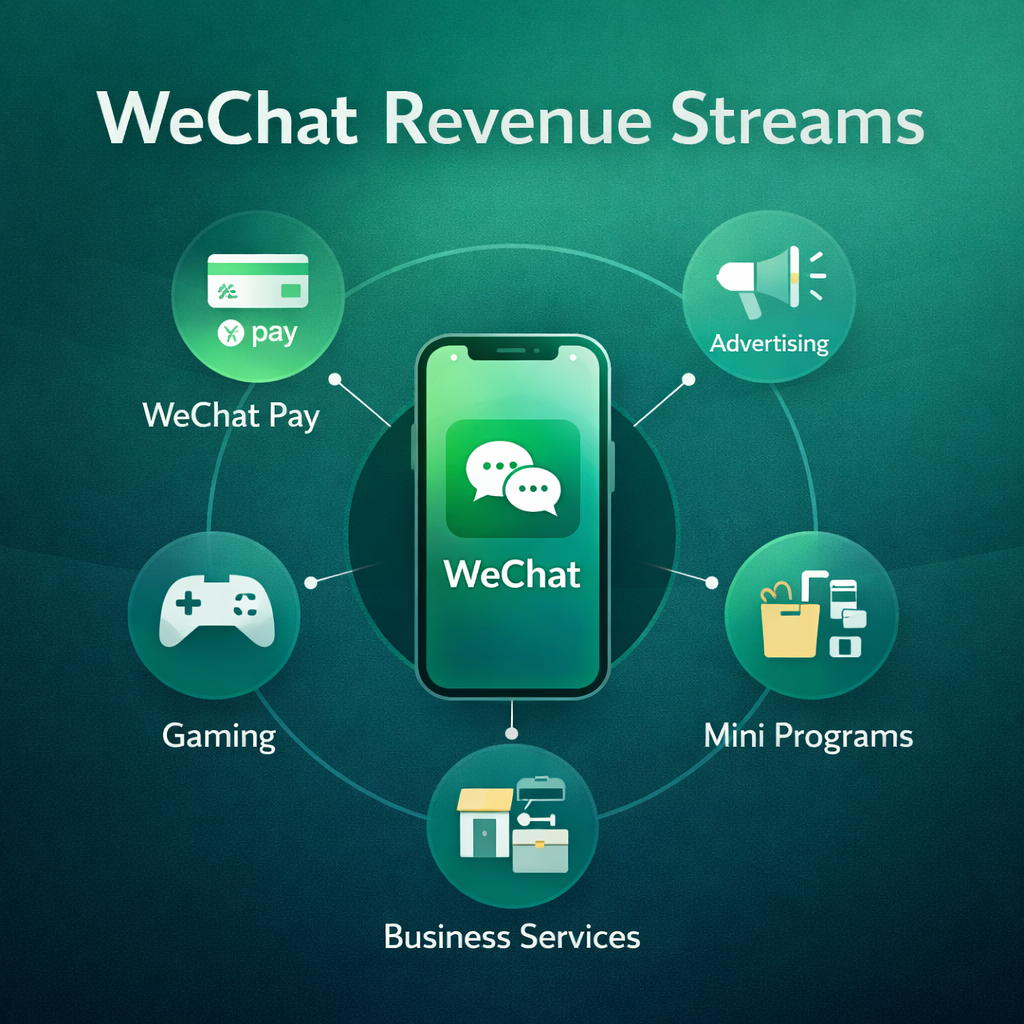
Revenue Streams: A Summary
| Revenue Source | How It Makes Money |
|---|---|
| WeChat Pay | Transaction fees from merchants and transfers |
| Advertising | Moments ads and article banner placements |
| Mini Programs | Service fees and payment commissions |
| Gaming | In-app purchases and game distribution |
| Business Services | Tools, visibility, and platform access for brands |
No single revenue stream dominates in isolation. The power of the model is in how they reinforce each other. Payments enable commerce. Commerce drives mini program usage. Mini programs keep users inside the app. Users inside the app see ads. Ads generate awareness that drives more commerce. The loop is self-reinforcing.
Download WeChat Business Model Canvas
Want a quick, structured breakdown you can save or study later?
Download the WeChat Business Model Canvas as a clean, printable PDF.
WeChat Business Model Canvas
To understand the full business model in a structured way, it helps to view WeChat through the Business Model Canvas framework.
Key Partners
WeChat does not try to do everything itself. Its partner ecosystem includes:
- Merchants and businesses using WeChat Pay
- Mini program developers building services inside the platform
- Content creators and brands using official accounts
- Financial institutions supporting payment infrastructure
- Parent company Tencent, which provides capital, technology, and the gaming portfolio
The core insight here is that WeChat’s value comes partly from what others build on top of it. This platform dynamic is one of the most powerful forces in technology.
Key Activities
WeChat’s operational priorities center on:
- Platform development and technical maintenance
- Payment processing and financial infrastructure
- Supporting the mini programs developer ecosystem
- Managing advertising products
- User data analysis and personalization
Everything points toward the same goal: keeping users engaged inside the app long enough to create value for businesses, which in turn keeps those businesses investing in the platform.
Key Resources
WeChat’s most important assets are not servers or code. They are:
- A user base exceeding one billion active users
- Deep brand trust among Chinese consumers
- A payment network already embedded in the national economy
- The technological infrastructure needed to run all of this at scale
The user base is the moat. Everything else can theoretically be replicated. A user base of this size, this habituated to a single platform, cannot be easily rebuilt.
Value Propositions
For users, WeChat offers a single app that handles most of daily life: communication, payments, entertainment, shopping, and services. The core value is convenience and reduced friction.
For businesses, WeChat offers something even more specific: direct, uninterrupted access to over a billion consumers, with built-in payment infrastructure and marketing tools in one place.
Convenience is the real product. WeChat monetizes the friction it removes.
Customer Relationships
WeChat relationships are largely self-service. Users navigate the app independently, businesses manage their own official accounts and mini programs, and automated systems handle most interactions.
Where human-like relationships emerge is in the official accounts model. Brands can have one-on-one conversations with users through WeChat, similar to WhatsApp Business but with significantly more powerful tools behind it.
Channels
WeChat operates through:
- The mobile app, which is the primary and almost exclusive channel
- The mini programs ecosystem, which brings third-party services into the platform
- Official accounts, which serve as a content and communication distribution layer
There is no meaningful website dependency. WeChat is a mobile-first, closed ecosystem, and that closed nature is a feature, not a limitation.
Customer Segments
WeChat serves:
- Individual consumers using the app for daily life
- Small businesses using WeChat Pay and official accounts
- Large enterprises building mini programs and managing customer relationships at scale
- Developers building products within the mini programs framework
Serving all four segments creates the network effect that makes the platform so defensible. More consumers attract more businesses. More businesses attract more developers. More developers create more services, which attract more consumers.
Cost Structure
WeChat’s major costs include:
- Server and infrastructure expenses at massive scale
- Research and development for new features
- Payment security and regulatory compliance
- Marketing and partnership development
The cost structure is heavy in absolute terms but highly scalable. Each additional user or transaction adds very little marginal cost to a platform that is already built and running.
Why WeChat’s Business Model Works
Network Effects
WeChat benefits from one of the most powerful network effects in technology. More users attract more businesses. More businesses build more mini programs and official accounts. More services attract more users. The cycle compounds over time, making the platform increasingly valuable and increasingly difficult to challenge.
High Switching Costs
Switching away from WeChat in China is not just inconvenient. For many people, it would mean losing access to their payment history, their business contacts, their subscriptions, and dozens of services they rely on every day. The cost of leaving is not just losing a messaging app. It is losing infrastructure.
Deep Integration
Most Western apps are specialized. WhatsApp does messaging. PayPal does payments. Instagram does social content. WeChat does all of it, and the integration between those layers is where the real value lives. A payment that flows through a mini program that was discovered through Moments is a WeChat-native experience that no single Western app can replicate.
WeChat vs Western Apps
| Feature | Western Equivalent | |
|---|---|---|
| Messaging | Yes | |
| Payments | Yes | PayPal (separate app) |
| Social Feed | Yes | |
| Mini Apps | Yes | Very limited |
| Super App | Yes | Does not exist |
The Western app ecosystem is fragmented by design. Different companies own different parts of the stack. In China, Tencent owns the stack, and WeChat is the interface through which users access all of it.
Challenges in WeChat’s Model
WeChat’s model is impressive, but it comes with real constraints:
- The super app model has struggled to replicate outside of China, partly because Western regulators and consumers have different expectations about data privacy and platform consolidation
- WeChat operates in a regulatory environment that is both supportive and unpredictable
- Heavy dependence on the Chinese market creates concentration risk
- Privacy concerns around data collected across payments, communications, and behavior remain a persistent issue, especially for international expansion
WeChat has not cracked the global market in the way that it dominates China. That is one of the most interesting open questions in technology today.
Lessons for Founders
WeChat’s business model contains lessons that apply far beyond China or messaging apps.
Build Ecosystems, Not Just Products
A product solves one problem. An ecosystem becomes the environment in which problems get solved. WeChat did not win by building the best messaging app. It won by building the platform on which an entire economy could operate.
Reduce User Friction Aggressively
The reason WeChat retained users is not because it locked them in with contracts or penalties. It retained them because leaving created friction. Every feature that made WeChat more useful was a feature that made switching more costly. Reducing friction for users is the same as increasing switching cost over time.
Monetize Behavior, Not Just Attention
Most ad-driven business models monetize the time you spend looking at a screen. WeChat monetizes what you actually do: buy, pay, book, order. Revenue tied to behavior scales with the economy, not just with engagement metrics.
Enable Others to Build on Your Platform
Mini programs are the single best example of this principle at work. Tencent did not build every food delivery app, every retail store, or every booking service inside WeChat. It built the platform that let thousands of others do it. The result was a network of services that no single company could have created alone, all flowing value back into WeChat.
The Future of WeChat
WeChat’s roadmap points toward several areas of significant growth:
- Continued expansion of the mini programs ecosystem, particularly in enterprise software and financial services
- Deep AI integration across search, customer service, content discovery, and personalization
- Fintech dominance through WeChat Pay, potentially including wealth management and insurance products
- More enterprise tools for B2B workflows and corporate communication
The platform has already moved well beyond messaging. The next phase appears to be becoming the default infrastructure for Chinese digital commerce and enterprise communication, with AI accelerating capabilities across every layer.
Wrapping Up
WeChat is not an app. It is an operating system for daily life.
Its business model proves something important: the most durable companies in technology are not the ones that build the best individual feature. They are the ones that build the platform on which other features, services, and businesses depend.
WeChat earns money when people do things. It earns loyalty by being indispensable. It defends its position by being cheaper to stay in than to leave. And it grows by making it easier for others to build inside its walls than outside them.
For anyone building a technology product today, the WeChat model offers a blueprint that is worth studying carefully, even if replicating it directly outside China remains one of tech’s hardest unsolved problems.
Get the WeChat Business Model Canvas
A one-page visual breakdown covering key partners, revenue streams, and strategy perfect for founders and students.
Discover more from Business Model Hub
Subscribe to get the latest posts sent to your email.