Roku Business Model And How It Makes Money Without Creating Content

Roku is one of the most quietly powerful companies in the streaming economy. It does not make hit shows. It does not pay actors or directors. It does not license blockbuster movies. Yet it sits at the center of how millions of people watch television every single day.
That is not an accident. It is a deliberate business strategy.
This blog breaks down exactly how Roku makes money, why its model is so defensible, and what entrepreneurs and business strategists can learn from it.
What Is Roku?
At its simplest, Roku is a streaming platform. It connects your television to the internet and gives you a single interface to access dozens of streaming services, like Netflix, Disney+, Hulu, YouTube, and hundreds of others.
But that one-line description does not capture what Roku actually is as a business.
Roku is best understood as a three-sided marketplace:
- Users who want easy access to streaming content
- Content providers who want to reach those users
- Advertisers who want to reach those users while they watch
Roku sits in the middle of all three relationships and charges for access to each of them.
From Hardware to Platform: The Shift That Changed Everything
Roku started in 2008 as a hardware company. Its original product was a small streaming stick that plugged into your TV. Simple, cheap, functional.
For the first few years, the business looked like a consumer electronics company. Make devices, sell devices, earn a margin.
But CEO Anthony Wood recognized something important early: the device was not the business. The audience was.
Every device Roku sold was not just a product sold. It was a user added to the platform. The more users on the platform, the more valuable the platform became to advertisers and content partners.
This realization drove Roku’s transformation from a hardware company into what it is today: an operating system for television, an advertising network, and a content distribution layer all rolled into one.
Roku’s Business Model Overview
Roku reports revenue across two segments:
Platform Revenue is the dominant and fast-growing segment. It includes advertising, content distribution fees, subscription revenue share, and The Roku Channel.
Device Revenue covers the sale of streaming sticks, players, and Roku-branded TVs. It is intentionally kept at thin or near-zero margins.
The key insight is this: Roku does not try to profit from hardware. It sells hardware to acquire users, then monetizes those users through the platform. This is a classic loss-leader strategy applied to a streaming ecosystem.
The company’s financials reflect this clearly. Platform revenue consistently accounts for more than 80% of total revenue, and that share has been growing year over year.
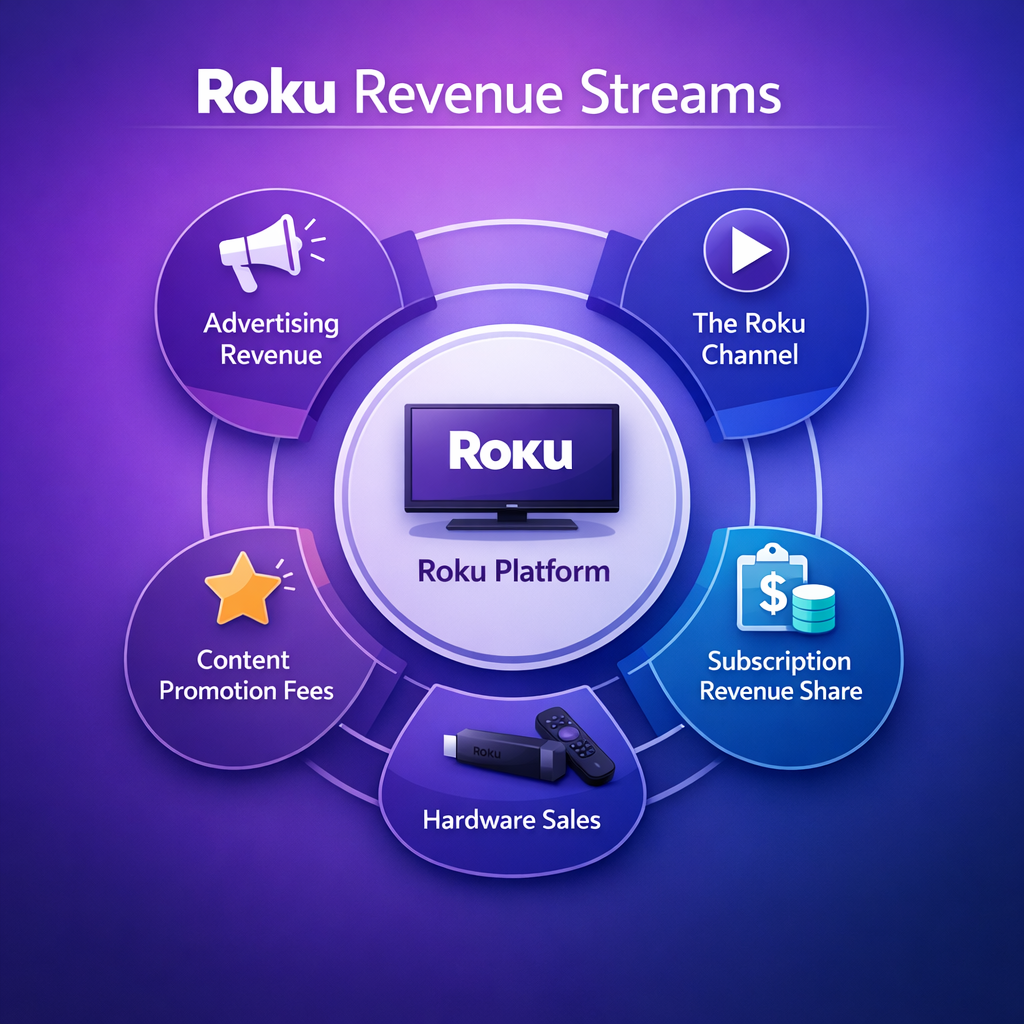
How Roku Makes Money: Revenue Streams Explained
Advertising Revenue: The Core Engine
Advertising is Roku’s most important revenue driver.
Roku serves ads in several places across its ecosystem:
- The Roku home screen shows sponsored content and banner placements
- The Roku Channel serves ads throughout free content
- Partner apps use Roku’s ad infrastructure through its OneView ad platform
What makes Roku’s advertising business particularly powerful is data.
Roku knows exactly what you watch, how long you watch it, what genres you prefer, what time of day you stream, and which ads you respond to. It can match advertisers with audiences at a level of precision that traditional television could never offer.
This makes Roku behave less like a consumer electronics company and more like an ad-tech company with a distribution network attached.
For advertisers, this is compelling. They get the reach of TV combined with the targeting precision of digital. Roku sits squarely in that sweet spot.
The Roku Channel: Free Streaming, Full of Ads
The Roku Channel is Roku’s own free, ad-supported streaming service. It is available directly through the Roku interface and requires no subscription or login.
It operates on the FAST model: Free Ad-Supported Streaming Television.
The Roku Channel carries:
- Licensed movies and TV shows
- News programming
- Live TV channels
- Original and exclusive content (limited)
Every minute a user spends watching The Roku Channel is a minute Roku directly controls the advertising. There is no revenue share with a third-party app. The ad dollars flow entirely to Roku.
This makes The Roku Channel strategically critical. It is not just a content offering. It is a margin-maximizing asset within the platform.
The FAST space is growing rapidly. More viewers are choosing free, ad-supported options over paid subscriptions, especially as subscription fatigue sets in. Roku is well-positioned to capture this shift.
Revenue Share From Subscriptions
When a Roku user signs up for a paid streaming service like Paramount+, Showtime, or Starz directly through the Roku interface, Roku takes a percentage of that subscription revenue.
This is a significant and often overlooked revenue stream.
The mechanics work like this:
- User browses the Roku Channel Store
- User subscribes to a paid channel without leaving the Roku interface
- Roku handles billing and collects a share of the subscription fee (typically around 20 to 30%)
For content partners, this is a tradeoff. They lose a slice of their subscription revenue but gain distribution to Roku’s massive user base and benefit from the frictionless sign-up experience Roku provides.
For Roku, this is a recurring, passive revenue stream that grows as the user base grows.
Hardware Sales: The Low-Margin User Acquisition Tool
Roku sells:
- Streaming sticks and players (under the Roku brand)
- Roku-branded smart TVs (manufactured by partners like TCL and Hisense)
- Accessories and remotes
Hardware pricing is deliberately aggressive. Roku devices are among the most affordable ways to access streaming, often sold at or near cost.
This is not a mistake. It is strategy.
Every device sold:
- Adds a user to the Roku platform
- Creates a long-term advertising and subscription revenue relationship
- Expands Roku’s data pool for ad targeting
The hardware is the funnel. The platform is the business.
Content Distribution and Promotion Fees
Roku also charges content companies and app developers for placement and visibility within its interface.
This includes:
- Featured placements on the home screen
- Promoted rows that highlight a specific service
- Search result prioritization
- Launch campaign fees for new services entering the platform
For streaming services that are fighting for attention in a crowded market, buying prominent placement on Roku’s home screen is a legitimate marketing investment. Roku has tens of millions of active users. Getting in front of them on the main screen has measurable value.
This revenue stream is not Roku’s largest, but it is high-margin and grows with the platform’s influence.
Roku’s Platform Strategy: Why It Keeps Winning
The Aggregator Advantage
Roku’s fundamental strategic position is that of an aggregator.
It does not produce content. It organizes access to content. And because it sits between the user and every app they use, it holds enormous structural power.
Users love Roku because it simplifies their experience. Instead of switching inputs and navigating multiple remotes, everything lives in one place. That simplicity creates habit and loyalty.
Apps and content providers need Roku because that is where the users are. As the platform grows, it becomes harder for any content provider to ignore it.
This is a classic network effect. The more users Roku has, the more content providers want to be on it. The more content on the platform, the more users it attracts. The cycle reinforces itself.
Data and Targeting
Roku’s data advantage is genuinely significant.
Most streaming services know what you watch on their platform. Roku knows what you watch across all platforms. It can see when you switch from Netflix to Hulu to The Roku Channel. It knows your full viewing behavior in a way that no single content company can match.
This cross-platform data makes Roku’s advertising product more valuable than what any individual streaming service can offer.
Advertisers who want to reach a specific audience, say, households with children under 10, or sports fans in specific metro areas, can do so with far more precision on Roku than almost anywhere else in the TV ecosystem.
Roku OS Licensing
One of Roku’s quieter but important growth strategies is licensing its operating system to TV manufacturers.
Rather than partnering with Samsung’s Tizen, LG’s webOS, or Google’s Android TV, brands like TCL and Hisense have chosen to build Roku OS directly into their televisions.
The result:
- Roku expands its user base without building a single TV itself
- Every Roku TV sold is a new platform user
- Roku earns platform revenue from users who never bought a Roku streaming device
This OS licensing model is highly capital-efficient. Roku gets distribution at scale without bearing the manufacturing costs.
Roku’s Business Model Canvas
Here is Roku’s strategy mapped through the Business Model Canvas framework:
Customer Segments
- Cord-cutters and streaming households
- Content companies and streaming services
- Advertisers targeting TV audiences
Value Propositions
- For users: One interface for all streaming apps
- For content providers: Access to a massive, engaged audience
- For advertisers: Precise, data-driven TV advertising
Channels
- Roku devices (sticks, players, smart TVs)
- Roku OS in third-party TVs
- The Roku Channel (direct content delivery)
Customer Relationships
- Free platform access for end users
- Self-serve and enterprise ad buying tools
- Developer and content partner programs
Revenue Streams
- Advertising (display, video, home screen)
- Subscription revenue share
- Content distribution and promotion fees
- Hardware device sales
Key Resources
- User data and behavioral insights
- Roku OS and platform infrastructure
- The Roku Channel content library
- Advertiser and content partner relationships
Key Activities
- Platform development and maintenance
- Ad sales and targeting optimization
- Content licensing for The Roku Channel
- OEM partnerships for smart TV integration
Key Partnerships
- TV manufacturers (TCL, Hisense, etc.)
- Streaming services (Netflix, Disney+, etc.)
- Ad agencies and programmatic buyers
- Content licensors
Cost Structure
- Platform and engineering infrastructure
- Content licensing for The Roku Channel
- Sales and marketing
- Hardware manufacturing (low margin by design)
Roku vs Competitors: How It Stacks Up
Roku is not the only player in the streaming OS space. Here is how it compares:
Roku vs Amazon Fire TV
Amazon’s Fire TV platform is deeply integrated with the Amazon ecosystem. Prime Video gets prominent placement. Amazon-owned services are prioritized.
Roku’s advantage is perceived neutrality. It does not own a major streaming service that competes with the apps on its platform. This makes content partners more willing to cooperate.
Roku vs Apple TV
Apple TV targets a premium segment and integrates tightly with the Apple ecosystem. It is a strong product for Apple households but lacks Roku’s breadth and price accessibility.
Apple also does not depend on advertising revenue the same way. Its model is more about services and ecosystem lock-in.
Roku vs Google TV and Android TV
Google brings search and YouTube integration to its platform. Android TV is widely available on international devices.
But like Amazon, Google has its own content interests. YouTube and Google Play are prominent, and the platform serves Google’s ad ecosystem.
The Key Difference: Neutrality
Roku does not own a streaming service that competes with the apps on its platform. This is a genuine strategic asset.
Netflix, Disney+, and other major services are more willing to share data and cooperate with Roku because Roku is not also their rival. This neutrality allows Roku to build deeper partnerships than its Big Tech competitors can.
Key Business Model Lessons From Roku
Roku’s story contains several sharp lessons for anyone thinking about platform businesses or distribution strategy.
Own the distribution layer, not the content
Content is expensive, competitive, and risky. Distribution is scalable. Roku proved you do not need to create a single show to build a dominant position in the streaming economy.
Use hardware as a user acquisition tool
Selling devices at thin margins is not a failure of the hardware business. It is a deliberate investment in growing the platform audience. Think of it as a customer acquisition cost, not a product margin.
Build recurring revenue from your user base
Roku earns from users through ads every time they watch. It earns from subscriptions every time they sign up for a new service. Revenue compounds as the platform grows.
Control the interface, control the monetization
Whoever controls the home screen controls what users see first. That placement is enormously valuable. Roku turned interface control into a significant revenue stream.
Data is the real product
Roku’s understanding of viewer behavior is what makes its advertising product premium. The platform is the delivery mechanism. The data is what advertisers are actually paying for.
Challenges in Roku’s Business Model
Roku’s model is strong but not without risk.
Ad market sensitivity
Advertising spending is cyclical. During economic downturns, ad budgets are cut, and Roku’s platform revenue takes a hit. This was visible during the post-pandemic slowdown when digital ad markets contracted sharply.
Big Tech competition
Amazon, Google, and Apple have significantly more resources than Roku. They can afford to subsidize their platforms more aggressively and have deeper content investments. Roku has to stay sharp on product and partnerships to maintain its position.
Dependence on third-party content
Roku does not own the content that draws users to its platform. If major streaming services decide to reduce their Roku presence or develop their own TV operating systems, Roku’s value proposition weakens.
International growth challenges
Roku is heavily US-centric. International expansion requires navigating different content markets, regulatory environments, and entrenched local competitors. Growth outside North America has been slower than the domestic story.
Future Growth Opportunities
Despite the challenges, Roku has several significant growth vectors ahead.
FAST market expansion
The free, ad-supported streaming market is growing fast. Consumers are pulling back on multiple subscriptions and turning to free alternatives. The Roku Channel is positioned to capture this behavior shift at scale.
International markets
Roku has been expanding in Europe and Latin America. These markets are earlier in the cord-cutting cycle than the US, which means they represent the growth opportunity that the US represented a decade ago.
Connected TV advertising growth
TV advertising is shifting from traditional broadcast to connected TV (CTV). Advertisers who once bought 30-second spots on network TV are moving those dollars to platforms like Roku. CTV ad spending is projected to grow significantly over the next several years, and Roku is one of the primary beneficiaries.
Ad-tech innovation
Roku has been building out OneView, its demand-side advertising platform. This product competes directly in the programmatic ad-buying market and expands Roku’s revenue beyond just selling ad slots on its own platform.
Retail media and measurement
Roku has been experimenting with partnerships that connect TV ad exposure to actual purchases. If a viewer sees an ad on Roku and then buys that product, Roku can potentially demonstrate that causal link to the advertiser. This kind of attribution capability is extremely valuable and could unlock new advertising categories.
Wrapping Up
Roku is a masterclass in platform strategy.
It does not make content. It does not need to. By owning the interface between users and all the content they consume, Roku has built a business that earns from every hour of streaming, every subscription signed, and every ad watched on its platform.
The model is:
- Asset-light in content
- Data-rich in audience intelligence
- Recurring in its revenue structure
- Scalable through OS licensing and FAST growth
The deepest insight from Roku’s story is that in the attention economy, the company that owns the gateway to content can often be more valuable than the companies that create it.
Roku does not need to win the content wars. It just needs everyone fighting those wars to come through its door.
That is a remarkably durable place to be.
Discover more from Business Model Hub
Subscribe to get the latest posts sent to your email.