Vinted Business Model And How It Makes Money Without Charging Sellers

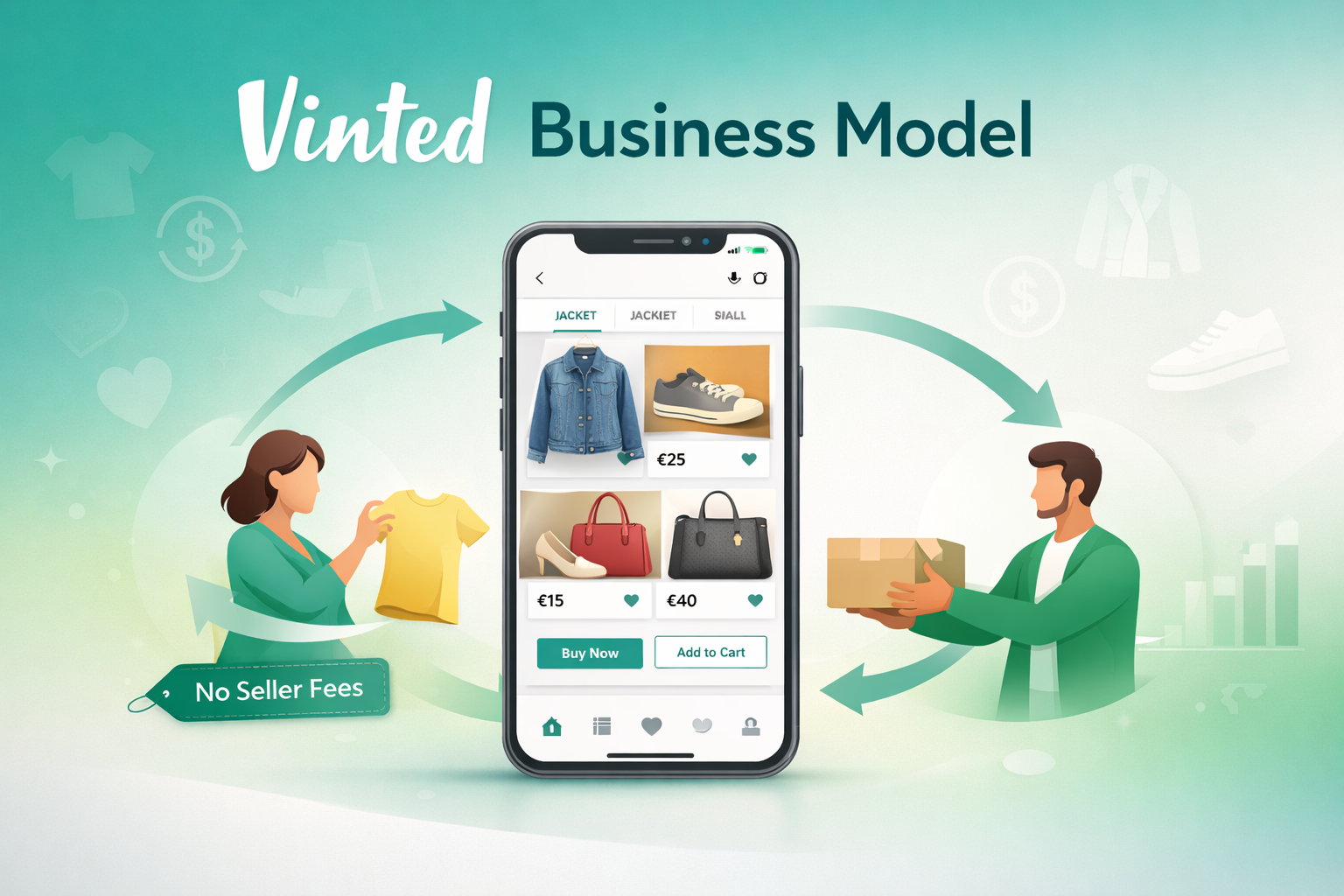
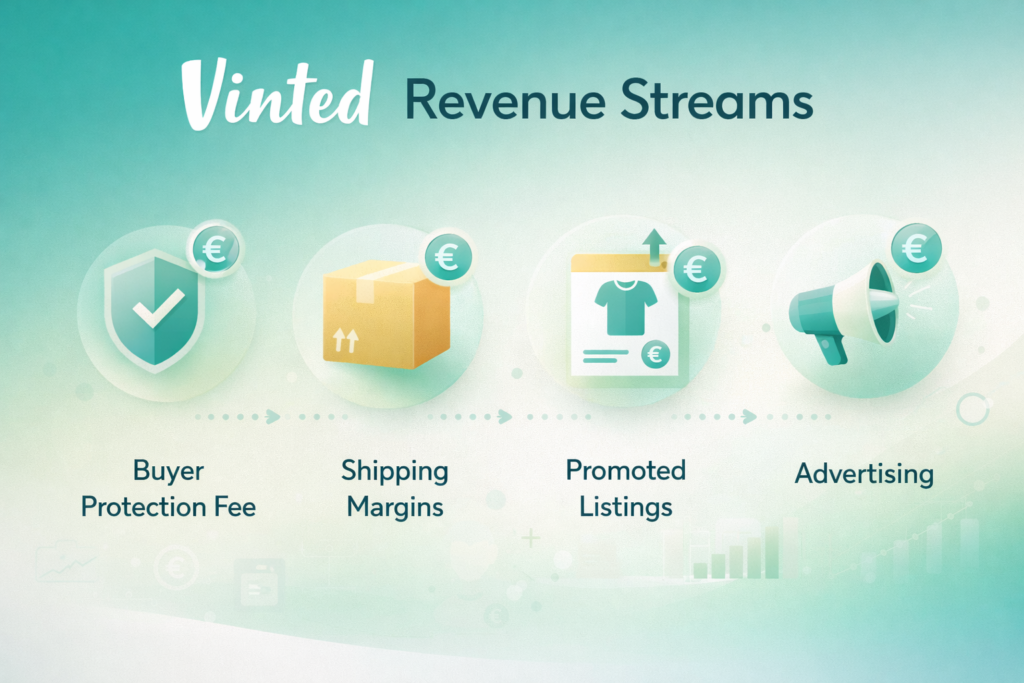
Vinted makes money primarily through buyer protection fees, shipping margins, and promoted listings, all while keeping seller fees at zero. This deliberate choice to flip the traditional marketplace model is what turned Vinted from a small Lithuanian startup into one of Europe’s most dominant second-hand fashion platforms.
Here is exactly how it works.
What Is Vinted
Vinted is a peer-to-peer marketplace where people buy and sell second-hand clothing, accessories, and lifestyle items. It was founded in 2008 in Vilnius, Lithuania, and has grown to become one of the largest recommerce platforms in Europe.
The platform operates primarily through its mobile app and is especially popular in:
- Lithuania (its home market)
- France
- Germany
- The United Kingdom
- Belgium and the Netherlands
Vinted is not a traditional retailer. It does not hold inventory. It connects individual sellers with individual buyers and takes a cut from the transaction in a very specific way.
The key thing that separates Vinted from every other major marketplace is this: sellers pay nothing to list or sell. Not a listing fee, not a commission, not a percentage of the sale. Zero.
That decision changed everything.
The Core Idea Behind the Vinted Business Model
Most marketplaces charge sellers. Amazon takes a referral fee. eBay takes a final value fee. Depop charged a percentage of every sale. Etsy charges both listing fees and transaction fees.
Vinted looked at this model and went in the opposite direction.
The thinking was straightforward. The hardest part of building a marketplace is supply. Without enough items to browse, buyers have no reason to visit. Without buyers, sellers have no reason to list. It is a classic chicken and egg problem.
Vinted solved it by removing every possible barrier for sellers:
- No cost to list an item
- No commission deducted from the sale price
- No subscription required
- No hidden charges
When selling becomes free and frictionless, supply grows fast. When supply grows fast, buyers follow. When buyers show up regularly, the platform becomes valuable, and that value creates room for monetisation on the buyer side.
This is the foundation of the entire Vinted business model.
How Vinted Makes Money: Every Revenue Stream Explained
Buyer Protection Fee
This is the engine that drives Vinted’s revenue. It is the single most important part of the business model.
Every time a buyer makes a purchase on Vinted, they pay a buyer protection fee on top of the item price. This fee is not optional. It is automatically added at checkout.
What does it cover?
- Secure payment processing
- Refund protection if the item does not arrive or does not match the description
- Customer support for dispute resolution
- A holding period where payment is only released to the seller once the buyer confirms they received the item
The fee structure typically follows a fixed charge plus a small percentage of the item price. For lower-value items, the fixed component makes up more of the fee. For higher-value items, the percentage element becomes more significant.
Why does this work so well?
Buyers have genuine reasons to value protection. When purchasing from a stranger online, there is always risk. The item might not arrive. It might look different from the photos. The size might be wrong. Vinted’s protection fee buys peace of mind, which buyers are willing to pay for, especially when the item price itself is lower than retail.
The key insight here is that buyers come to Vinted with purchase intent. They are ready to spend. That is the highest-value moment in any transaction, and Vinted captures it cleanly without ever making the seller feel penalised.
Shipping Margins
Vinted has built partnerships with major logistics and courier providers across its operating markets. Through these partnerships, it offers integrated shipping labels directly within the app.
When a seller selects a shipping option and a label is generated, the actual cost Vinted pays the courier is lower than what the buyer pays. That margin goes to Vinted.
This is a clean, low-friction revenue stream because:
- It simplifies the selling process (no need to arrange your own courier)
- It gives buyers predictable delivery costs
- It scales automatically with transaction volume
- It adds no visible “fee” that feels like a charge
The buyer pays for shipping as part of the checkout. They are already accustomed to paying delivery costs when shopping online. Vinted simply routes that payment through its own logistics infrastructure and retains a margin.
As Vinted expands into more countries, it negotiates more logistics partnerships, which can improve margins further while keeping user experience smooth.
Bumping and Wardrobe Spotlight
This is where Vinted monetises sellers, but on a completely voluntary basis.
Sellers on Vinted list for free. But if they want their listings to appear higher in search results or get more visibility, they can pay for it.
Item Bumping lets a seller push a specific listing back to the top of search results, making it more likely to be seen by active buyers. The effect is temporary. After a period, the item naturally drops again, and sellers can choose to bump again if they want.
Wardrobe Spotlight is a profile-level promotion. Instead of highlighting one item, it promotes the seller’s entire wardrobe or profile, giving them more visibility across the platform for a set period of time.
These are classic freemium upgrades. The core product (listing and selling) is completely free. The paid options exist purely to accelerate results. Sellers who are casually clearing out a wardrobe probably never pay. Sellers who are more active or running a side business are more likely to invest in visibility tools because the return is worth it.
This structure respects both types of users. Casual sellers feel zero pressure. Power sellers have tools to grow.
Advertising and Brand Collaborations
This is a smaller and still-developing revenue stream, but it is growing as Vinted’s user base scales.
Vinted has begun offering:
- Sponsored placements within the app and marketplace
- Brand integrations and collaborations with fashion labels
- Partnerships with sustainability-focused organisations
This is a logical extension of the business model. Vinted has a large, engaged, fashion-conscious audience. Brands want access to that audience, particularly brands targeting budget-conscious or sustainability-focused consumers.
As Vinted’s data capabilities improve, the potential for targeted advertising grows. The company can offer brands a highly relevant audience without compromising the user experience that drives platform engagement.
The Vinted Business Model Canvas
Understanding Vinted’s business model becomes clearer when you look at how all the pieces fit together.
Customer Segments
- Everyday individuals clearing out their wardrobes
- Budget-conscious shoppers looking for affordable fashion
- Sustainability-focused buyers who want to reduce fashion waste
- Collectors and resellers looking for specific brands or styles
Value Proposition for Sellers
- Completely free to list and sell
- Large and active buyer base
- Simple integrated shipping
- Optional paid tools to boost visibility
Value Proposition for Buyers
- Significantly lower prices than retail
- Wide variety of brands and styles
- Transaction protection included at checkout
- Sustainable alternative to fast fashion
Channels
- Mobile app (primary)
- Desktop website
- Social media and influencer marketing
- Word of mouth (especially strong in core markets)
Revenue Streams
- Buyer protection fee (primary)
- Shipping margin (secondary)
- Paid seller tools (freemium)
- Advertising and brand collaborations (emerging)
Cost Structure
- Platform development and maintenance
- Customer support operations
- Logistics infrastructure and partnerships
- Marketing and user acquisition
- Trust and safety systems
How Vinted Scaled So Quickly
Vinted did not become dominant by accident. The growth was driven by deliberate strategic choices.
The Supply-First Approach
Most platforms try to grow buyers and sellers simultaneously. Vinted focused on supply first.
The reasoning is sound. A buyer who visits a marketplace and finds thousands of items to browse will come back. A buyer who visits and finds only a few hundred items will leave and not return.
By eliminating seller fees entirely, Vinted created a flood of listings. People who had never considered selling second-hand clothes before found the decision easy because there was nothing to lose. That volume of supply created a compelling browsing experience, which brought buyers in naturally.
Network Effects at Scale
Once critical mass was reached in each market, Vinted’s network effects became self-reinforcing:
- More listings attract more buyers
- More buyers mean faster sales for sellers
- Faster sales encourage more listings
- The platform becomes the obvious first choice for second-hand fashion
Network effects are the most powerful competitive advantage a marketplace can build. Once they kick in, they are very difficult for competitors to overcome.
Country-by-Country Localisation
Vinted did not try to be a global platform overnight. It expanded deliberately, market by market, with localised versions of the app, local language support, and local logistics partnerships.
This matters for several reasons:
- Shipping and logistics infrastructure varies significantly between countries
- Consumer trust in peer-to-peer transactions varies by market
- Payment methods and preferences differ
- Local marketing is more effective than generic campaigns
By going deep in each market rather than spreading thin globally, Vinted built genuine dominance in each territory before moving to the next.
Why the Vinted Model Is Genuinely Different
The competitive differentiation is clear when you compare it directly to other platforms.
Vinted vs eBay
eBay charges sellers a final value fee on every transaction. Vinted charges sellers nothing. For a fashion seller clearing out their wardrobe, Vinted is immediately more attractive. eBay’s strength is breadth (electronics, collectibles, vehicles, everything), while Vinted’s strength is depth in fashion and lifestyle.
Vinted vs Depop
Depop traditionally charged sellers a percentage of each sale. Vinted charges zero. For fashion resellers, particularly younger sellers in Europe, this made switching straightforward. Depop has stronger brand identity with certain aesthetics (vintage, streetwear, Gen Z fashion), but Vinted has the supply advantage.
Vinted vs Facebook Marketplace
Facebook Marketplace does not charge fees but also does not provide transaction protection, integrated shipping, or dispute resolution. Vinted offers more infrastructure, which makes higher-value transactions safer and more comfortable for both sides.
The key insight is this: Vinted is not just cheaper for sellers. It is also safer for buyers than informal platforms. It found the gap between free-but-risky and structured-but-expensive, and built a business there.
Challenges the Vinted Business Model Faces
No business model is without weaknesses. Vinted has real challenges.
Buyer Fee Resistance
Some buyers feel frustrated that the protection fee is mandatory and non-negotiable. When comparing prices, a buyer might find an item listed at an attractive price only to see it increase at checkout once the protection fee is added.
This can:
- Reduce conversion rates, especially for very low-value items
- Create a perception that Vinted is “less transparent” about true costs
- Push some buyers toward other platforms for bargain hunting
The challenge is that the buyer protection fee is also the product’s core revenue mechanism. Vinted cannot simply remove it.
Quality and Trust Issues
Because Vinted is peer-to-peer, the quality of listings varies enormously. A platform with millions of individual sellers cannot police every item. Common issues include:
- Photos that do not accurately represent condition
- Size inconsistencies across different brands and countries
- Sellers who are slow to ship or communicate
While the buyer protection system handles many disputes, the volume of transactions creates ongoing trust and safety challenges at scale.
Logistics Complexity
Shipping second-hand fashion across borders is complicated. Different countries have different import rules, VAT requirements, and size or weight limitations for parcels. As Vinted expands geographically, managing cross-border logistics without creating a poor buyer or seller experience requires significant investment.
Growth Opportunities Ahead
Despite the challenges, Vinted’s growth trajectory has several clear paths forward.
Geographic Expansion
There are still major European markets where Vinted’s penetration is limited, and opportunities exist beyond Europe entirely. Each new market represents a new supply-demand flywheel to activate.
Premium Seller Tools
The current bumping and wardrobe spotlight features are relatively simple. There is room to develop more sophisticated seller tools:
- Analytics dashboards showing views and engagement on listings
- Pricing intelligence based on comparable sold items
- Scheduled promotions and sale events
Sellers who treat Vinted as a side income stream or small business would pay for tools that help them perform better.
Artificial Intelligence and Pricing Suggestions
Vinted sits on enormous amounts of transaction data. It knows what items sell, how quickly, at what price points, in what conditions. Applying machine learning to help sellers price items competitively would:
- Increase sell-through rates
- Improve buyer satisfaction
- Reduce the number of items that sit unsold and never transact
Better pricing means more completed transactions, which means more buyer protection fee revenue.
Sustainability Partnerships
The second-hand fashion market is growing partly because of increasing consumer awareness around the environmental cost of fast fashion. Vinted is well positioned to partner with:
- Sustainable fashion brands
- Textile recycling organisations
- Environmental certification bodies
These partnerships could add both revenue and brand credibility, particularly with younger consumers who make purchase decisions based on values.
Key Lessons Founders Can Take from Vinted
The Vinted model contains several principles that apply well beyond fashion marketplaces.
Remove friction on the supply side first. The hardest part of a two-sided marketplace is building supply. Do whatever it takes to make supply free, easy, and attractive. Once you have enough supply, demand follows.
Charge the side with higher intent. Buyers come to Vinted ready to spend money. They have purchase intent. That is more valuable than a seller who is just hoping to clear space. Charging for protection at the moment of purchase is natural because the buyer is already in spending mode.
Let the core product be free. Charge for convenience and speed. Listing and selling on Vinted is free. Bumping a listing is paid. This is a healthy freemium model. It respects users who cannot or will not pay while creating genuine revenue from users who benefit most from premium features.
Build trust before you build scale. The buyer protection system is not just a revenue mechanism. It is a trust mechanism. Without it, Vinted would be just another classifieds site. By investing in payment security, dispute resolution, and refund protection early, Vinted made it safe to transact with strangers, which is what allowed scale to happen.
Wrap Up
The Vinted business model is a textbook case of marketplace inversion. While competitors were fighting over seller fees, Vinted asked a more interesting question: what if we made selling completely free and built the business on the other side of the transaction?
The answer turned out to be extremely powerful. Free selling creates abundant supply. Abundant supply attracts buyers. Buyers with purchase intent are willing to pay for protection and convenience. And the platform earns on every transaction without ever making a seller feel taxed for participating.
It is not a complicated model. But it required the conviction to resist the obvious approach and trust that a different structure would create stronger network effects in the long run.
That conviction paid off. Vinted is now valued at several billion dollars and continues to grow, while many of the platforms that charged sellers have had to reconsider their models.
FAQs
Vinted makes money through three main channels. The buyer protection fee is charged on every transaction and is the primary revenue driver. Shipping margins from logistics partnerships contribute secondary revenue. Paid visibility tools for sellers, including item bumping and wardrobe spotlight, add freemium revenue on top.
Removing seller fees was a deliberate strategy to maximise supply. More listings create a better experience for buyers. More buyers create faster sales for sellers. This network effect is what drove Vinted’s rapid growth across Europe.
Vinted has moved toward profitability in recent years. The company reported its first full-year profit in 2022, driven by the scalability of its buyer protection fee model. As transaction volume grows, revenue grows without a proportional increase in costs.
For most individual sellers focusing on fashion, Vinted is more attractive because there are no seller fees. You keep every penny of your listed price. eBay has broader reach for non-fashion categories and auction-format selling, but for straightforward second-hand clothing sales, Vinted’s zero-fee model is hard to beat.
The fee varies by transaction value and market. It typically combines a small fixed amount with a percentage of the item price. The exact amounts are shown clearly at checkout before a buyer confirms their purchase.
Yes, particularly for active sellers. The zero-fee model means sellers retain their full asking price. Combined with optional visibility tools and a large active buyer base across Europe, Vinted is a viable platform for side income from selling second-hand fashion.
Discover more from Business Model Hub
Subscribe to get the latest posts sent to your email.