
The Walt Disney Company business model is built on content creation, intellectual property (IP) ownership, and monetization across multiple channels like movies, streaming, theme parks, and merchandise. Disney creates stories once and earns from them repeatedly across different platforms. It is one of the most efficient content monetization machines ever built.
What is Disney?
Walt Disney and Roy O. Disney founded the company in 1923 as a small animation studio in Los Angeles. What started as a cartoon business quietly transformed into one of the most powerful entertainment empires in history.
Today, Disney is:
- A global entertainment and media giant
- One of the most recognized brands on the planet
- Owner of some of the most valuable intellectual properties ever created
- A company with revenue streams spanning six major business areas
The core idea behind Disney’s entire operation has never really changed: turn stories into long-term revenue assets.
Disney Business Model in One Line
“Create. Own. Expand. Monetize Everywhere.”
Every strategic decision Disney makes traces back to this four-part loop:
- Create compelling characters and stories
- Own the intellectual property rights fully
- Expand those stories across platforms and formats
- Monetize them repeatedly over decades
This loop is the reason Mickey Mouse, created in 1928, still generates billions in merchandise revenue every year.
The Core Pillars of Disney’s Business Model
Content Creation and IP Ownership
At the heart of Disney’s model is content. Not just good content, but owned content. Disney does not just produce films and shows. It acquires full intellectual property rights to every character, storyline, and world it creates or buys.
Some of Disney’s most powerful franchises include:
- The Marvel Cinematic Universe
- Star Wars and the Lucasfilm catalog
- Disney Princess properties (Cinderella, Frozen, Moana)
- Pixar’s library (Toy Story, The Incredibles, Finding Nemo)
Founder insight: Owning IP is not the same as producing content. A service business generates revenue while active. An IP-owning business generates revenue forever. Disney understood this distinction earlier than almost anyone in entertainment.
Media Networks and Streaming
Disney controls a significant media portfolio. Disney+ launched in 2019 and grew to over 100 million subscribers faster than any streaming platform before it.
Revenue sources in this segment include:
- Monthly subscription fees from Disney+
- Advertising on ad-supported tiers
- Bundled subscriptions with Hulu and ESPN+
- Licensing deals for content distribution
Streaming gives Disney a direct relationship with consumers, bypassing traditional cable and theater gatekeepers.
Insight: Recurring subscription revenue is predictable and scalable. Disney turned episodic content into a subscription product, which dramatically extended the lifetime value of each IP property.
Theme Parks and Experiences
Disney’s parks division is consistently one of its largest revenue contributors. With major parks in Florida, California, Paris, Tokyo, Hong Kong, and Shanghai, the physical experience business operates on a completely different model from media.
Revenue sources here include:
- Ticket and admission sales
- On-site hotels and resorts
- Food and dining
- In-park merchandise
- Special events and seasonal experiences
What makes parks unique in Disney’s model is that they transform emotional connection into high-frequency, high-spend consumer behavior. Families do not just visit once. They return, often spending thousands of dollars each trip.
Insight: Physical experiences create emotional memories. Emotional memories drive brand loyalty. Brand loyalty drives repeat spending for life.
Studio Entertainment
Disney’s film studio covers theatrical releases across multiple brands: Disney Animation, Pixar, Marvel Studios, Lucasfilm, and 20th Century Studios (acquired through Fox).
Revenue streams within this pillar:
- Global box office sales
- Home video and digital sales
- Content licensing to other platforms
- Theatrical distribution deals
Films like Avengers: Endgame, which crossed $2.7 billion at the global box office, demonstrate the upper ceiling of what a single Disney release can achieve. But the studio also benefits from older catalog titles through streaming, which have a long shelf life.
Merchandise and Licensing
Disney licenses its characters and IP to third-party manufacturers who pay royalties in exchange for producing branded products. From toys and apparel to stationery and bed sheets, Disney characters appear on millions of products worldwide.
Examples include:
- Mickey Mouse and classic character merchandise
- Marvel superhero toys and clothing
- Star Wars collectibles and apparel
- Disney Princess branded products across categories
Insight: Once the character exists, it requires no additional production cost to appear on a product. Every licensing deal is nearly pure margin. Characters are not just creative assets. They are product lines.
Direct-to-Consumer Strategy
One of Disney’s most important recent shifts has been moving toward owning the customer relationship directly. Instead of depending on movie theaters, cable networks, or retail partners to reach consumers, Disney+ brings the audience directly into Disney’s ecosystem.
Benefits of this approach:
- Disney captures first-party data on viewing habits
- Disney can cross-promote theme parks, merchandise, and upcoming releases
- Disney reduces dependence on third-party platforms
- Disney sets its own pricing and packaging
This shift mirrors what Amazon, Apple, and Netflix have done. Own the distribution, own the relationship, own the data.
Disney Revenue Streams
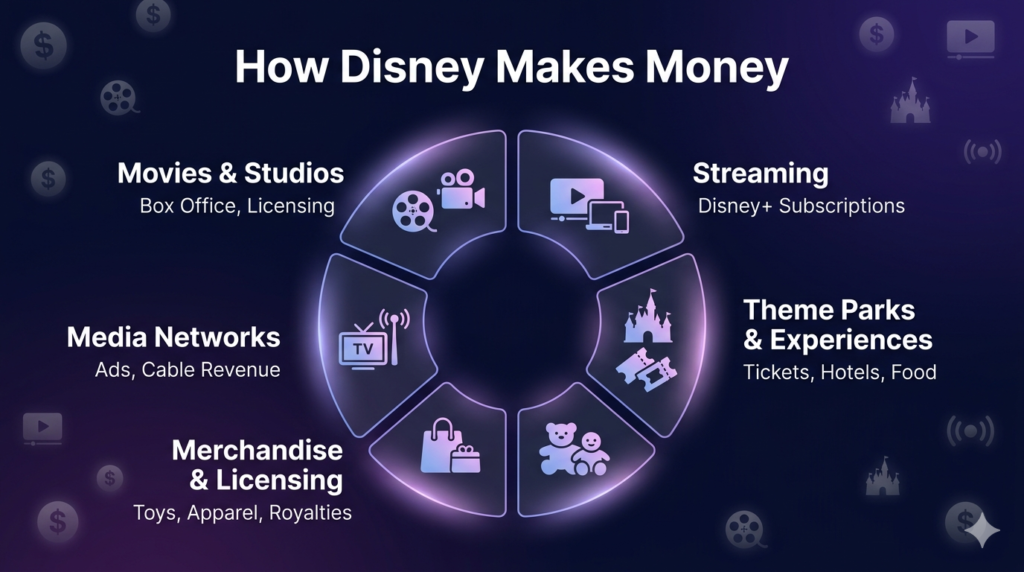
Disney reports revenue across several major segments:
Parks, Experiences and Products
This is typically the largest revenue-generating segment, often contributing more than 40% of total company revenue. Pre-pandemic, this segment was the crown jewel of the business model.
Media and Entertainment Distribution
This covers traditional TV networks like ABC and ESPN, along with theatrical releases. It remains a massive contributor even as cord-cutting has reduced traditional TV audiences.
Streaming (Direct-to-Consumer)
Disney+, Hulu, and ESPN+ form the streaming bundle. While this segment has faced profitability challenges, subscriber growth and ad-tier expansion have moved it toward sustainable margins.
Licensing and Merchandising
This segment flows through both the parks business and the media business. It includes royalties from third-party manufacturers and brand partnership agreements.
Disney’s Growth Strategy
Acquisition Strategy
Disney has built much of its modern dominance through strategic acquisitions. The company does not just buy studios. It buys universes.
Key acquisitions:
- Pixar (2006): Brought Toy Story, Finding Nemo, and a creative pipeline that reinvigorated Disney Animation
- Marvel Entertainment (2009): Added 5,000+ characters and enabled the MCU, one of the highest-grossing film franchises in history
- Lucasfilm (2012): Gave Disney ownership of Star Wars and Indiana Jones
- 21st Century Fox (2019): Added Avatar, The Simpsons, and a global content library
Each acquisition followed the same logic: buy proven IP, scale it through Disney’s global distribution machine.
Insight: Disney does not acquire companies for their teams or their technology. It acquires them for their IP. Then it deploys that IP across every platform it owns.
Franchise Strategy
Disney turns single IP assets into multi-format, multi-decade franchises. The playbook looks like this:
- Release a film
- Spin off sequels, prequels, and Disney+ series
- Build merchandise lines around characters
- Create dedicated theme park attractions
- License to toy manufacturers, apparel brands, and food companies
The Marvel Cinematic Universe is the clearest example. A single interconnected storyline has produced dozens of films, streaming series, merchandise categories, and dedicated park experiences.
Ecosystem Strategy
The most powerful aspect of Disney’s model is that everything connects. A child watches a Disney movie. Their parent subscribes to Disney+. The family plans a trip to Disneyland. At the park, they buy merchandise. Back home, the child wants more content.
Disney earns at every step in that loop.
Films feed streaming. Streaming feeds parks. Parks feed merchandise. Merchandise reinforces brand love. Brand love increases content engagement. The ecosystem is self-reinforcing and deeply difficult for competitors to replicate.
Founder insight: Most businesses sell products. Disney sells an ecosystem. The difference is that in an ecosystem, every product increases the value of every other product. That creates compounding returns over time.
Why Disney’s Business Model Is So Powerful
There are several reasons Disney’s model has proven so durable:
- Strong IP ownership means Disney earns from content it created decades ago and will continue earning for decades ahead
- Multiple revenue streams mean a slowdown in one area (say, box office) does not collapse the entire business
- Emotional storytelling creates bonds that consumers carry from childhood into adulthood and pass to their own children
- Global distribution means a single content investment reaches billions of people across every continent
- High switching costs and brand loyalty mean once a child becomes a Disney fan, the relationship is often lifelong
Problems and Risks in the Disney Model
Disney’s model is powerful but not without vulnerabilities:
- High production costs for blockbuster films and streaming originals make each release a large financial bet
- Dependence on blockbuster success means that a string of underperforming films can significantly impact revenue
- Streaming profitability challenges have been well-documented, with Disney+ taking years to approach sustained profitability
- Economic slowdowns hit the parks business hard, as families cut discretionary spending on vacations and experiences
- Franchise fatigue is a growing risk as consumers show signs of becoming oversaturated with sequels and superhero content
Lessons for Founders
Disney’s business model contains principles that apply well beyond entertainment:
Build assets, not just services. Services generate revenue while you deliver them. Assets generate revenue long after the work is done. IP, software, brands, and data are all assets. Prioritize building things you will own indefinitely.
Focus on brand and story. Disney does not sell movies. It sells emotional experiences that people trust and return to. Your brand is a story. Invest in it early and protect it fiercely.
Create multi-channel monetization. Disney earns from the same character through films, streaming, merchandise, parks, and licensing simultaneously. Look at your core product and ask: where else could this generate value?
Think long-term IP value. Mickey Mouse is nearly 100 years old and still earns. Build products and brands that can compound over decades, not just products that generate revenue this quarter.
Expand one idea into multiple formats. If your core concept is strong, it can probably live in more places than you currently imagine. A book becomes a course becomes a community becomes a product line. Disney proves this principle at scale.
The Future of Disney
Disney is not standing still. Several major shifts are shaping its next decade:
- Streaming expansion into new international markets, particularly India and Southeast Asia, where Disney+ Hotstar is a major platform
- AI in content creation is likely to reduce production costs for visual effects, animation, and localization
- Global theme park growth with continued expansion in Asia and potential new experiences in emerging markets
- More immersive experiences through augmented and virtual reality, particularly as spatial computing matures
- Deepening the bundle by making Disney+, Hulu, and ESPN+ stickier together through personalization and content cross-promotion
Conclusion
Disney is not just a company. It is a content monetization machine that has been running for over a century.
What makes it remarkable is the underlying principle: one great story, fully owned and intelligently scaled, can generate revenue across generations. A character born in 1928 still earns billions. A film released in 1994 still drives merchandise sales, streaming views, and theme park attendance in 2024.
The lesson for founders is not to become Disney. It is to adopt Disney’s core discipline: own what you create, build systems that monetize it across channels, and think in decades rather than quarters.
Great businesses are built on assets that compound. Disney built the most powerful compounding content machine in history. The blueprint is right there to learn from.
Discover more from Business Model Hub
Subscribe to get the latest posts sent to your email.


[…] Disney+ has the most powerful content library in the world. Marvel. Star Wars. Pixar. Disney classics. That’s an incredible catalog. Disney+ also bundles with Hulu and ESPN+, giving it a broader ecosystem. […]