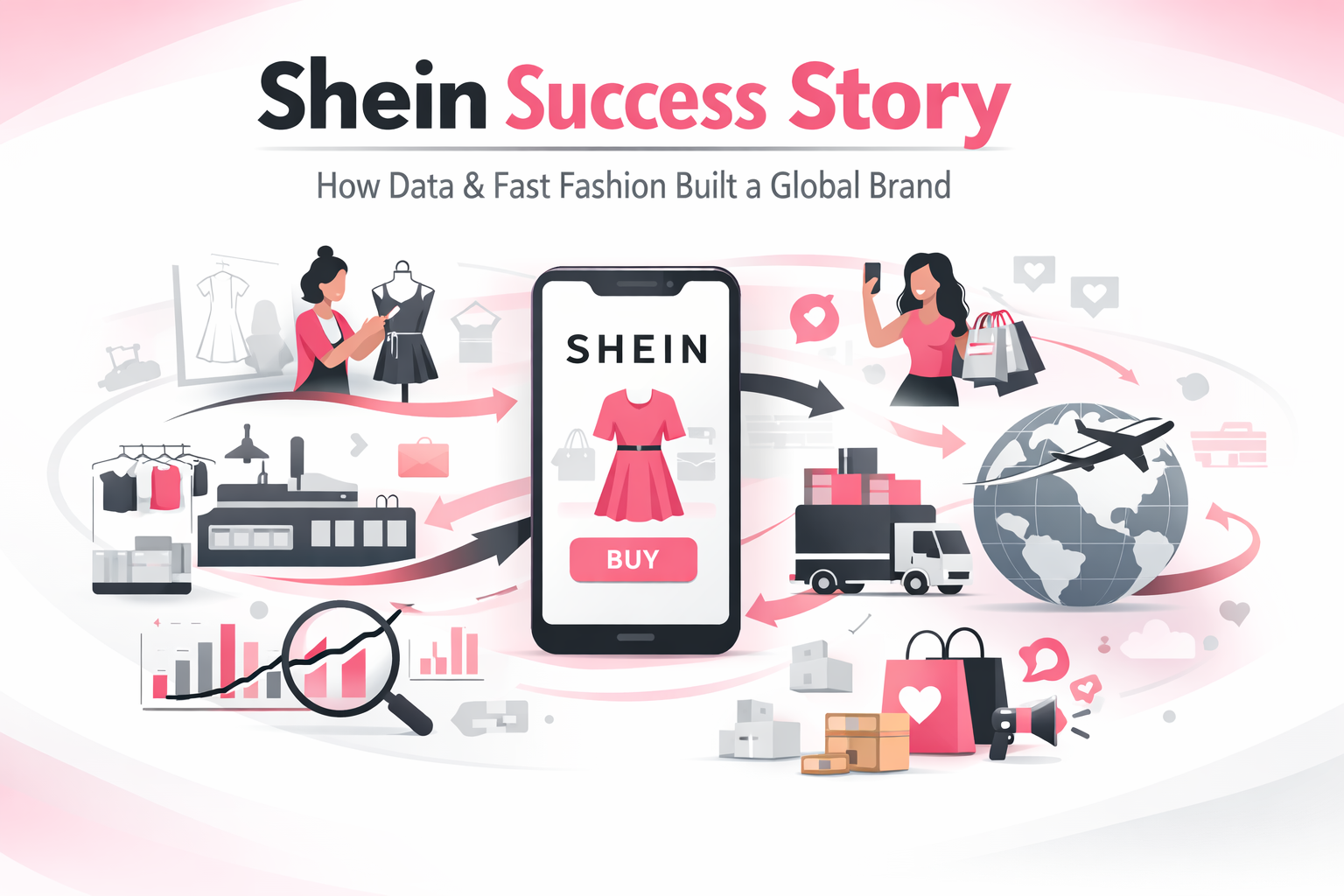

Shein became one of the world’s fastest-growing fashion companies by doing what no one else had done at scale: combining ultra-fast manufacturing, real-time data analysis, and aggressive social media marketing into a single, ruthless growth machine.
Founded by Chris Xu in 2008, Shein went from a small Chinese e-commerce operation to a global giant serving over 150 million shoppers. The secret was not just cheap clothing. It was speed, data, and a supply chain built for the internet age.
Shein at a Glance
Before diving deep, here is a quick snapshot of what Shein looks like today:
- Founder: Chris Xu
- Founded: 2008
- Headquarters: Singapore
- Industry: Fast Fashion and E-commerce
- Business Model: Direct-to-consumer fast fashion
- Global Users: 150 million+ shoppers
- Key Markets: United States, Europe, Middle East, Southeast Asia
These numbers tell a story of rapid, relentless growth. But the more interesting story is how they got there.
The Origin Story: From SEO Specialist to Fashion Mogul
Most people assume Shein was always a fashion company. It was not.
Chris Xu started his career as an SEO specialist in Nanjing, China. He understood how to get websites discovered online, how search engines ranked products, and how to drive traffic without spending a fortune on traditional advertising. That skill set became the foundation of everything Shein would eventually build.
In the early days, Chris was not selling trendy dresses to Gen-Z shoppers. He was selling wedding dresses online through cross-border e-commerce channels. The business was modest, practical, and focused on a very specific niche.
But something clicked.
Chris noticed that global consumers, particularly in the United States and Europe, had an appetite for affordable fashion that was not being met by existing brands. Chinese manufacturers could produce quality clothing at a fraction of Western retail prices. The gap between supply and demand was massive. All it needed was the right bridge.
That bridge became Shein.
The company rebranded from its earlier identity to SHEIN as it shifted from being a marketplace seller to becoming a fully independent fashion brand. Instead of listing products on other platforms, Shein built its own ecosystem, its own website, its own app, and its own supply chain.
The SEO background mattered enormously here. While other fashion brands were buying billboard space and running magazine ads, Shein was optimizing product listings, building organic search traffic, and learning exactly what customers were searching for before they even designed a product.
That is a completely different way of thinking about fashion. And it worked.
The Problem Shein Was Built to Solve
To understand why Shein succeeded, you need to understand what was broken in the fashion industry before it arrived.
Traditional fashion brands had serious structural problems:
- Production cycles that took months from concept to shelf
- Massive upfront inventory orders with no guarantee of sell-through
- Expensive retail stores with high overhead costs
- Slow trend response that left brands selling last season’s styles
- A disconnect between what customers wanted and what brands produced
These were not small problems. They were industry-wide inefficiencies that had existed for decades. The reason they persisted was simple: no one had built the technology or supply chain infrastructure to solve them cheaply and at scale.
Meanwhile, consumers were evolving fast:
- They wanted new styles constantly, not twice a year
- They wanted affordable prices, not luxury markups on basic items
- They wanted the convenience of shopping from their phones
- They were discovering trends through social media, not fashion magazines
- They expected fast shipping and easy returns
The gap between what traditional brands offered and what consumers actually wanted created a massive opening. Shein walked straight through it.
The Business Model: Simple, Brutal, Effective
Shein’s business model sounds straightforward when you describe it. The genius is in the execution.
Direct-to-Consumer at Its Core
Shein sells directly to shoppers through its own website and app. There are no department store partnerships, no wholesale relationships, no retail middlemen taking a cut. Every sale goes directly from Shein’s warehouse to the customer’s door.
This matters because:
- Margins are higher without retail markups
- Customer data flows directly to Shein, not to a third party
- Pricing can be dramatically lower since there is no retail overhead
- The shopping experience is fully controlled and optimized
Mobile First, Always
Shein built its entire customer experience around mobile shopping. The app is fast, addictive, and designed to encourage browsing. Features like daily check-in rewards, flash sales, and personalized recommendations keep users opening the app repeatedly.
This is not fashion. This is behavioral psychology applied to an e-commerce platform.
Global Shipping Without Global Stores
Shein ships to over 150 countries without owning a single retail location. The logistics infrastructure behind this is genuinely impressive, managing cross-border shipping, customs, returns, and customer service across dozens of markets simultaneously.
The result is a brand with global reach and almost none of the fixed costs that come with traditional retail expansion.
The Real Secret Weapon: The Supply Chain
If you want to understand Shein, you need to understand its supply chain. Everything else follows from this.
Traditional fashion brands work with a small number of large manufacturers. They place big orders months in advance, lock in inventory, and then hope the market agrees with their predictions. When it does not, they discount heavily or destroy unsold stock.
Shein does the opposite.
How Shein’s Supply Chain Actually Works:
- Shein works with thousands of small and medium manufacturers, mostly clustered in and around Guangzhou, China
- Orders start at just 100 to 200 pieces per design
- These small batches are essentially paid market research
- If a design sells well, Shein scales production immediately
- If it does not sell, the loss is minimal and the design is dropped
The Speed Factor
Production turnaround at Shein runs between three and seven days for many products. Compare that to the traditional fashion industry where lead times of three to six months are normal.
This speed is only possible because of how tightly Shein is integrated with its manufacturer network. Orders flow digitally. Designs are transmitted electronically. Feedback from sales data reaches manufacturers almost in real time.
Why This Changes Everything
The small batch model fundamentally changes the risk profile of fashion retail.
- Inventory risk drops dramatically because you never overcommit on a design
- Trend accuracy improves because you test before scaling
- Cash flow is healthier because capital is not tied up in slow-moving stock
- New styles can launch daily, keeping the product catalog permanently fresh
Shein reportedly adds thousands of new product listings every single day. That would be impossible with a traditional supply chain. With Shein’s model, it is a core competitive advantage.
Data: The Engine That Drives Everything
Shein is often described as a fashion company. A more accurate description is a data company that sells fashion.
Every decision at Shein, from what designs to create to how many units to produce, is driven by data. This is not marketing language. It is a genuine operational reality.
What Data Does Shein Collect?
- Search trends across Google, social platforms, and its own app
- Browsing behavior on the Shein platform
- Purchase patterns by region, demographic, and season
- Social media engagement with fashion content
- Competitor analysis and trend monitoring
How That Data Gets Used
The data feeds directly into the product development process. When a color, a silhouette, or a print starts gaining traction on social media, Shein’s systems identify it, designers create products around it, and orders go to manufacturers within days.
By the time a traditional brand’s design team has finished discussing a trend in a meeting, Shein has already tested it, confirmed demand, and scaled production.
Demand Forecasting and Inventory Optimization
Beyond product design, data helps Shein manage inventory levels, predict regional demand, and optimize its supply chain in ways that traditional fashion brands simply cannot match.
The technology stack behind this is proprietary and represents years of investment. It is genuinely difficult to replicate, which is one reason competitors have struggled to copy the model despite years of trying.
Marketing: Building a Brand Without Advertising
Shein spends almost nothing on traditional advertising. No glossy magazine spreads, no primetime TV spots, no celebrity brand ambassadors in the conventional sense.
Instead, Shein built one of the most effective social media marketing machines in the world, and it did it largely by paying other people to do the work.
Influencer Marketing at Scale
The core of Shein’s marketing strategy is influencer partnerships. Not just with mega influencers but with thousands of micro-influencers who create content for smaller, highly engaged audiences.
Here is how it works:
- Shein provides free products or commissions to creators
- Creators post outfit videos, hauls, and try-ons
- Content spreads organically through follower networks
- New customers discover Shein through trusted voices, not ads
The genius of this approach is authenticity. A recommendation from a creator someone follows feels different from a paid advertisement. Shein understood this before most brands did.
The Haul Video Phenomenon
TikTok and YouTube are full of Shein haul videos. Someone receives a large order, tries on every item on camera, and shares their honest reactions with their audience.
These videos serve as both entertainment and advertising. They showcase dozens of products in a single piece of content. They demonstrate real sizing, real fit, and real value for money. And they are created entirely by consumers, not by Shein’s marketing department.
The scale of this content production is extraordinary. There are tens of thousands of Shein haul videos online. No advertising budget could replicate the reach and credibility of that content ecosystem.
Affiliate Programs That Drive Sales
Beyond product gifting, Shein runs formal affiliate programs where influencers earn a commission on every sale they drive. This aligns incentives perfectly. Creators are motivated to produce content that actually converts because their income depends on it.
The Gamification of Shopping
Inside the Shein app, marketing continues through gamification. Daily check-in rewards, spin-to-win bonuses, flash sale countdowns, and loyalty points all work together to make shopping feel like entertainment.
This keeps the Shein app at the top of users’ minds and drives repeat visits that organically convert into purchases.
Revenue Model: Where the Money Comes From
Shein’s primary revenue stream is product sales. But the model has expanded significantly beyond basic clothing.
Core Product Categories:
- Women’s fashion (the original and dominant category)
- Men’s clothing
- Children’s wear
- Accessories and jewelry
- Beauty and personal care products
- Home goods and lifestyle products
Marketplace Expansion
In recent years, Shein has opened its platform to third-party sellers. This mirrors the Amazon model and transforms Shein from a retailer into a marketplace. Third-party brands pay fees to access Shein’s 150 million user base.
This is a significant strategic shift. It reduces Shein’s inventory risk further and increases revenue without requiring additional product development investment.
Private Label Brands
Shein produces clothing under multiple private label brands, allowing it to segment its market, maintain pricing differentiation, and protect its core brand identity while still capturing sales across different consumer segments.
Technology: The Foundation Nobody Talks About
Fashion gets the attention. Technology does the work.
Shein operates with the mindset and infrastructure of a technology company. The investments it has made in software, automation, and data systems are what enable everything else to function at the speed and scale it does.
Key Technology Functions:
- Demand forecasting: Predicting what will sell before producing it
- Trend analysis: Identifying emerging styles across global markets in real time
- Inventory optimization: Ensuring the right products are in the right quantities
- Supply chain automation: Digitizing the manufacturing order and fulfillment process
- Personalization: Showing each shopper products most likely to convert
The technology layer is what separates Shein from other brands that have tried to replicate its model. You can copy the idea of small batch production. You cannot easily copy years of proprietary data, algorithms, and manufacturer relationships.
Global Expansion: Going Worldwide Without Going Physical
Shein expanded globally without the slow, expensive process of opening stores in new markets. The playbook was consistent across regions.
The Global Expansion Formula:
- Launch a localized version of the website and app
- Translate and adapt content for local language and culture
- Partner with local influencers to build brand awareness
- Offer region-specific marketing promotions
- Price in local currency with locally relevant payment options
- Optimize shipping routes and timelines for each market
Major Markets:
- United States: The largest and most important market, where Shein consistently ranks as a top fashion app
- Europe: Strong presence across the UK, France, Germany, and beyond
- Middle East: Rapid growth driven by young, mobile-first consumers
- Southeast Asia: A growing market with strong smartphone penetration and fashion appetite
- Latin America: An emerging market showing strong growth signals
The absence of physical stores is not a limitation. It is a strategic choice that keeps the cost structure lean while allowing rapid entry into new markets.
Shein vs Traditional Fashion Brands
The contrast between Shein and legacy fashion brands illustrates exactly why the industry was ripe for disruption.
Production Speed Traditional brands: three to six months from design to shelf. Shein: three to seven days from design to live listing.
Inventory Risk Traditional brands: large upfront orders with significant unsold stock risk. Shein: small batch testing with scale-up only on proven sellers.
Trend Response Traditional brands: seasonal collections designed months in advance. Shein: real-time trend identification with immediate production response.
Marketing Traditional brands: expensive campaigns, celebrity endorsements, glossy media. Shein: creator partnerships, affiliate programs, user-generated content.
Stores Traditional brands: hundreds or thousands of retail locations globally. Shein: zero physical stores, entirely online.
Pricing Traditional brands: retail markups that reflect overhead, wholesale margins, and brand positioning. Shein: direct-to-consumer pricing with minimal overhead, often 70 to 90 percent cheaper than comparable Western brands.
The structural advantages Shein holds over traditional competitors are not small. They are fundamental. Closing that gap would require legacy brands to essentially rebuild themselves from the ground up.
Controversies and Challenges: The Other Side of the Story
No honest analysis of Shein can ignore the serious criticisms the company has faced. These are real issues that go beyond typical business challenges.
Environmental Impact
Fast fashion is environmentally damaging at scale, and Shein operates at an extreme version of that scale. Producing thousands of new designs daily, shipping individual packages internationally, and encouraging a culture of disposable fashion generates significant environmental costs.
Critics argue that the business model is fundamentally incompatible with sustainability, and that the low prices consumers pay do not reflect the true environmental cost of the products.
Labour Concerns
There have been persistent questions about working conditions in the factories that supply Shein. The company has faced accusations of poor pay, excessive hours, and inadequate worker protections across parts of its supplier network.
Shein has responded with supplier audits and published sustainability commitments, but independent verification of these claims remains difficult.
Intellectual Property Disputes
Shein has faced numerous lawsuits from independent designers, artists, and fashion brands who allege that their designs were copied without permission or compensation. This is a recurring and serious legal issue for the company.
Several high-profile cases have resulted in settlements. The sheer volume of new products Shein launches makes design oversight genuinely challenging, but critics argue that the model structurally incentivizes copying over original creation.
Regulatory Scrutiny
As Shein has grown, it has attracted attention from regulators in the United States and Europe around issues including product safety, data privacy, and trade compliance.
The company’s rapid growth and low-cost model have drawn particular scrutiny over the use of de minimis trade exemptions that historically allowed low-value packages to enter markets with reduced customs oversight.
The IPO Question: What Comes Next
Shein has been one of the most closely watched potential IPO candidates in the global business world.
The company explored a US listing before pivoting to consider a London Stock Exchange debut, partly due to regulatory concerns in the United States around its Chinese origins and supply chain.
A Shein IPO would potentially be one of the largest fashion company listings in history. The company’s private valuation has fluctuated between estimates of roughly 45 billion and 100 billion dollars at various points depending on market conditions and investor sentiment.
The IPO path has been complicated by:
- US regulatory scrutiny of Chinese-linked companies
- Ongoing controversies around labour and intellectual property
- Broader challenges in the global IPO market
- Competitive pressure from rivals including Temu
The outcome remains uncertain, but the eventual public listing, whenever and wherever it happens, will be a significant moment for both the fashion and e-commerce industries.
Key Lessons from Shein’s Rise
Whether you are an entrepreneur, a business student, or simply curious about how markets work, Shein’s story contains genuinely useful lessons.
Speed Beats Perfection
Shein did not wait to have a perfect product before launching. It tested constantly, failed quickly, and scaled what worked. The willingness to move fast and accept imperfection as part of the process is core to the model.
Data Should Drive Product Decisions
Shein does not rely on the instincts of senior designers to predict what customers want. It uses actual data about what customers are searching for, engaging with, and buying. Businesses in almost every industry can apply this principle.
Test Before You Scale
The small batch model is not just a supply chain strategy. It is a philosophy. Do not bet big on an untested idea. Run a small experiment, measure the results, and then commit capital based on evidence rather than assumptions.
Build Global From Day One
Shein targeted international markets from very early in its development. Most businesses default to domestic first and international later. Shein showed that digital businesses can address global markets almost from launch if the model is built correctly.
Social Media Is a Distribution Channel, Not a Megaphone
Most brands use social media to broadcast messages. Shein used it to build a community of creators who do the marketing work organically. The difference in cost efficiency is enormous.
Own Your Customer Relationship
By selling direct and building its own app and website, Shein owns the customer data and relationship. It is not dependent on any third-party platform for its core revenue. That independence is a structural advantage that compounds over time.
Wrapping Up
Shein’s story is not really a fashion story. It is a story about what happens when you combine internet-era data capabilities with manufacturing scale and remove every inefficiency that traditional retail was built around.
The controversies are real and cannot be dismissed. The environmental costs, the labour questions, and the intellectual property issues represent genuine problems that growth alone cannot solve.
But as a business case study in speed, data-driven decision making, and global scale without physical infrastructure, Shein is genuinely one of the most instructive examples of the past two decades.
Frequently Asked Questions
Shein was founded by Chris Xu in 2008. He began as an SEO specialist before pivoting into cross-border e-commerce fashion.
Shein succeeded by combining a data-driven product development process with an ultra-fast supply chain, aggressive influencer marketing, and a direct-to-consumer model that removes retail overhead and keeps prices extremely low.
Shein was founded in China but later relocated its official headquarters to Singapore. Its manufacturing and supply chain operations remain heavily centered in China, particularly in the Guangzhou region.
Several factors combine to make pricing extremely low. Shein works with thousands of manufacturers competing for orders, produces in small batches that reduce waste, sells directly to consumers without retail markups, and operates with no physical store overhead. The combination makes pricing that would be impossible for traditional retail brands entirely viable for Shein.
Yes, Shein has been pursuing a public listing for several years. The company explored a New York listing before shifting focus toward the London Stock Exchange. The timeline and final destination for the listing remain subject to regulatory approval and market conditions.
Shein monitors social media platforms, search engines, and its own user behavior data in real time. When a style starts gaining traction anywhere online, the company’s systems identify it and initiate production within days. This is dramatically faster than any traditional fashion brand’s design and production pipeline.
Shein operates as a purely online retailer with no permanent physical store locations. It has experimented with pop-up experiences in select markets, but the core business model is entirely digital and direct-to-consumer.
Discover more from Business Model Hub
Subscribe to get the latest posts sent to your email.