
Duolingo is one of the most remarkable success stories in the history of education technology. What started as a simple idea to make language learning free and accessible has grown into a global platform serving hundreds of millions of learners across every continent. The app turned a traditionally expensive and exclusive activity into something anyone with a smartphone could do for free.
Founded by Luis von Ahn and Severin Hacker, Duolingo cracked a code that had stumped educators and entrepreneurs for decades: how do you make learning genuinely addictive? By combining gamification, bite-sized lessons, and a freemium model, Duolingo built a product that people actually wanted to return to every day. Today, it stands as the world’s most downloaded education app and a publicly traded company worth billions.
The Origin Story of Duolingo
The Idea Behind Duolingo
The story of Duolingo begins with a simple but powerful observation: learning a new language was a privilege, not a right. Before Duolingo, if you wanted to learn Spanish, French, or Mandarin, your options were limited and expensive.
- Rosetta Stone software cost hundreds of dollars
- Private tutors were out of reach for most people globally
- Language schools required physical attendance and significant fees
- Most free alternatives were low-quality, outdated, or deeply boring
Luis von Ahn grew up in Guatemala and understood this inequality firsthand. He had seen how access to English could transform career opportunities, yet quality English learning tools were priced far beyond what most people in developing countries could afford. That personal experience shaped everything about Duolingo’s founding philosophy.
The Founders’ Background
Luis von Ahn was already a celebrated computer scientist before Duolingo existed. He invented CAPTCHA, the distorted text puzzles used to verify that website visitors are human. He later sold reCAPTCHA to Google and pioneered the concept of crowdsourcing human intelligence through small digital tasks. His work demonstrated a genius for turning something mundane into something scalable and impactful.
Severin Hacker brought deep technical research experience from his academic background in Switzerland. Together, the two met at Carnegie Mellon University where Hacker was pursuing his PhD under von Ahn’s supervision. Their collaboration combined von Ahn’s entrepreneurial instincts with Hacker’s engineering precision.
Their shared vision was straightforward but ambitious:
- Build a language learning platform that was completely free
- Make it as effective as paid alternatives
- Design it to scale to millions of users globally
Launch of the App
Duolingo was developed at Carnegie Mellon University and officially launched to the public in 2012. The early product was rough around the edges, but the response was extraordinary. The waiting list before launch swelled to hundreds of thousands of users, which told the founders they had touched a real nerve.
Within months of launch, the app had been downloaded millions of times. The combination of a free price point and a genuinely enjoyable learning experience was unlike anything the education market had seen before.
The Problem Duolingo Wanted to Solve
Before you can appreciate what Duolingo built, you need to understand what was broken.
The cost barrier was enormous. Traditional language education was expensive at every level. Private tutors, classroom courses, and software products all came with significant price tags. For someone in rural Brazil or sub-Saharan Africa, these costs were simply prohibitive.
Engagement was a massive problem. Most language learning tools were built on repetitive drilling and rote memorization. They worked, technically, but they were profoundly boring. Users would start a course with enthusiasm and abandon it within weeks.
Accessibility was deeply unequal. Physical language schools required proximity to urban centers, regular schedules, and social confidence. For introverts, rural learners, or people with irregular work schedules, these barriers were insurmountable.
Progress was painfully slow. Traditional methods offered few ways to measure improvement. Learners often felt like they were grinding through material without any sense of momentum or achievement.
Duolingo’s thesis was that one well-designed mobile app could solve all of these problems simultaneously. It was an ambitious bet, and it paid off.
The Core Product Strategy
Gamification in Learning
The single most important product decision Duolingo ever made was treating language learning like a game. Not a game with violence or competition in the traditional sense, but a game with the psychological mechanics that make games irresistible.
The core gamification elements include:
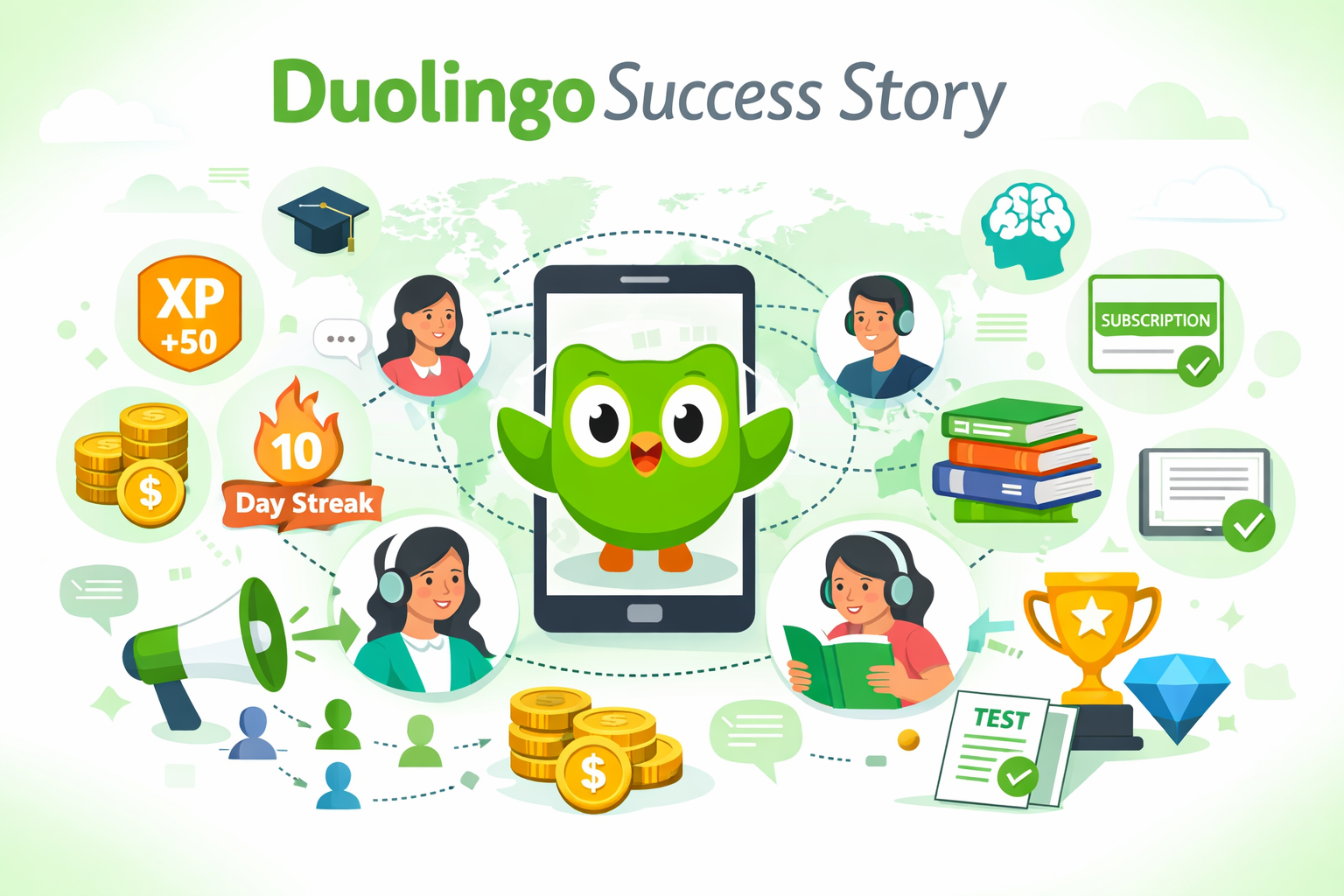
- XP points earned for completing lessons, which give immediate feedback and a sense of progress
- Daily streaks that track consecutive days of practice and create a powerful psychological commitment to keep going
- Leaderboards that let users compete with friends and strangers, adding social motivation
- Levels and badges that reward milestones and signal achievement
- Hearts and lives that create mild stakes and keep attention focused
- Gems and in-app currency that allow users to unlock features and feel rewarded for consistency
Each of these mechanics is borrowed directly from video game design. The result is an app that hijacks the brain’s reward systems in service of genuine learning. Users open Duolingo not because they feel obligated to study, but because they want to extend their streak or climb the leaderboard.
The streak mechanic deserves special attention. When a user has maintained a 100-day streak, they will go to extraordinary lengths not to break it. This single feature likely retains more users than any other element in the app.
Micro-Learning Approach
Duolingo understood something important about modern attention spans: people do not have 30 minutes to dedicate to studying a foreign language every day. But almost everyone has 5 minutes.
The micro-learning approach means:
- Lessons are designed to take between 3 and 5 minutes
- Content is broken into tiny, digestible chunks
- Users can complete a meaningful practice session during a commute or a lunch break
- Progress is cumulative, so small daily sessions add up to significant learning over time
This approach removed the single biggest excuse people had for not studying: lack of time. When the commitment is only five minutes, almost nobody can legitimately claim they are too busy.
Mobile-First Experience
While competitors built desktop-first products that were later adapted for mobile, Duolingo was designed for the smartphone from day one. This was a critical strategic insight.
A mobile-first design meant:
- The app was always in your pocket, removing friction entirely
- Notifications could remind users to practice at the right moment
- Waiting times, commutes, and idle moments became learning opportunities
- The interface was thumb-friendly, clean, and distraction-free
The decision to prioritize mobile over desktop aligned perfectly with where user behavior was heading. As smartphone adoption exploded globally, Duolingo was already perfectly positioned to capture that growth.
The Growth Strategy That Made Duolingo Viral
Free-First Strategy
Duolingo made a choice that frightened many traditional business advisors: give everything away for free and figure out monetization later. This decision was the foundation of its explosive growth.
When a product is free, the barriers to trying it collapse. There is no risk for the user, no credit card required, no commitment. The cost of acquisition drops to nearly zero when users recommend a product to friends, because there is nothing to lose by trying it.
Free access meant Duolingo could grow in markets where paid software had no chance: India, Brazil, Mexico, Indonesia, and dozens of developing countries where language learning demand was enormous but purchasing power was limited.
Social Media Marketing
Duolingo’s marketing strategy is a case study that business schools will be teaching for years. The team made a decision to lean into internet culture rather than fight it.
The Duolingo owl, named Duo, became an internet phenomenon. The brand leaned into memes where Duo was portrayed as a passive-aggressive reminder to complete your daily lesson. Social media users created content around the owl’s threatening personality, and Duolingo’s official accounts played along brilliantly.
On TikTok, Duolingo’s strategy was particularly sharp:
- The account posted absurdist, self-aware content that had nothing to do with language learning
- Duo the owl appeared in trending formats, dances, and viral moments
- The brand voice was irreverent, funny, and surprisingly human
- The account accumulated tens of millions of followers, many of whom had never opened the app
This approach turned Duolingo’s mascot into a genuine cultural figure. Brand awareness spread organically to audiences that no paid advertising campaign could have reached as effectively.
Word-of-Mouth Growth
Duolingo built sharing mechanics directly into the product. When users achieved a milestone, extended a streak, or reached a new level, they were prompted to share their progress on social media. This turned every user into a potential marketer.
The streak mechanic was especially powerful for word-of-mouth:
- A user with a 200-day streak is proud of that achievement
- They share it on Instagram or WhatsApp
- Their friends see it and become curious
- Some of those friends download the app to start their own streak
This loop required no advertising budget. It was built into the product’s social architecture.
Global Language Demand
Duolingo’s timing coincided with an enormous global surge in demand for language skills, particularly English. As the internet connected the world and remote work expanded, English became an economic necessity for hundreds of millions of people.
Duolingo positioned itself perfectly to serve this demand:
- English courses were available for speakers of dozens of native languages
- The app supported over 40 languages at its peak
- Less-common languages like Welsh, Hawaiian, and Esperanto built passionate niche communities
- The platform became a cultural bridge for immigrant communities maintaining heritage languages
Duolingo’s Business Model
How does a company that gives away its core product for free build a billion-dollar business? Duolingo’s answer is a masterclass in freemium economics.
Duolingo Plus and Super Duolingo Subscription
The premium subscription tier is Duolingo’s largest revenue source. Subscribers pay a monthly or annual fee in exchange for:
- No advertisements
- Unlimited hearts (no mistakes limit per session)
- Progress tracking and detailed stats
- Offline access to lessons
- A streak freeze that protects their streak if they miss a day
The key insight is that Duolingo does not lock core learning content behind the paywall. The free experience is genuinely good, which means upgrading is about convenience and comfort rather than access. Users who are deeply engaged with the product convert to subscribers because they want to protect and enhance an experience they already love.
Advertising Revenue
Free users see advertisements between lessons. Because Duolingo has hundreds of millions of daily active users spending significant time in the app, its advertising inventory is enormously valuable.
The placement of ads is carefully managed so that they do not destroy the learning experience. Short ads between lessons feel like natural breaks rather than interruptions.
Duolingo English Test
This product deserves its own discussion. The Duolingo English Test is an online English proficiency certification that costs around $59, compared to $200 or more for traditional tests like TOEFL or IELTS. The test can be taken from home in under an hour and results are delivered within 48 hours.
Hundreds of universities and institutions around the world now accept the Duolingo English Test for admissions. This product:
- Generates direct revenue at high margins
- Reinforces Duolingo’s mission of accessibility
- Builds credibility as a serious educational institution
- Creates a pipeline from language learning to certification
In-App Purchases
Users can purchase gems, streak freezes, and cosmetic items within the app. These microtransactions serve a psychological purpose beyond revenue: they give users a sense of investment in their progress and their account.
Partnerships and Institutional Licensing
Duolingo has explored partnerships with schools, corporations, and language learning programs. While this segment is smaller than consumer revenue, it represents significant long-term growth potential, particularly in enterprise and workforce training markets.
Key Product Innovations
Duolingo English Test
Beyond the app itself, the English Test represents Duolingo’s most ambitious product expansion. It used AI and machine learning to create a test that was both affordable and credible, which was considered nearly impossible in traditional test design.
The test uses adaptive technology to assess reading, writing, listening, and speaking skills in a format that cannot be easily gamed by rote preparation, unlike traditional standardized tests.
AI-Driven Learning
Duolingo has invested heavily in artificial intelligence to personalize the learning experience. The system tracks:
- Which types of questions each user struggles with
- Optimal review intervals based on forgetting curves
- Individual pace and preferred lesson lengths
- Performance patterns across different skill areas
The result is an experience that adapts to each learner rather than forcing every learner through identical content. A user who struggles with verb conjugation will see more conjugation exercises. A user who excels at reading but struggles with listening will get a different lesson mix.
Expansion Beyond Languages
In recent years, Duolingo has expanded its product portfolio:
- Duolingo Math applies the same gamified approach to mathematics
- Duolingo Music teaches music reading and instrument basics
- These expansions test whether the Duolingo model can generalize beyond languages
This diversification signals the company’s longer-term ambition to become a broad educational platform rather than a single-subject app.
How Duolingo Scaled to Millions of Users
Duolingo’s growth can be understood as a self-reinforcing flywheel, where each stage feeds the next:
- Free access lowers the barrier to entry and attracts enormous numbers of users who would never pay for language learning
- Gamification keeps those users engaged daily through streaks, rewards, and social mechanics
- Social sharing turns active users into unpaid ambassadors who bring new users into the system
- Viral marketing on social media amplifies brand awareness at minimal cost
- Some users convert to premium subscriptions, generating the revenue needed to fund operations
- Revenue funds product improvements, which make the app better and increase retention
- Better retention increases engagement metrics, which attract more advertisers and institutional partners
- The flywheel spins faster as the user base grows
The elegant genius of this model is that the free users are not just a cost center. They are the engine of growth, the source of advertising revenue, and the community that makes the premium experience worth paying for.
Major Milestones in Duolingo’s Journey
- 2009: Luis von Ahn and Severin Hacker begin working on the concept at Carnegie Mellon University
- 2011: Duolingo receives significant seed funding and builds a waitlist
- 2012: Public launch of the app, which quickly reaches the top of app store charts
- 2013: Named Apple’s iPhone App of the Year
- 2014: Reaches 25 million registered users and launches the Duolingo for Schools platform
- 2017: Passes 200 million registered users
- 2019: Launches the Duolingo English Test as an affordable alternative to TOEFL and IELTS
- 2020: Reaches 500 million downloads globally during the pandemic learning surge
- 2021: IPO on Nasdaq, raising over $500 million and achieving a valuation above $5 billion
- 2022: Passes 50 million daily active users
- 2023: Launches Duolingo Math and continues AI integration across the platform
Challenges Duolingo Faced
No success story is without friction. Duolingo navigated several serious challenges on its path to dominance.
Monetizing a free product is genuinely hard. For years, Duolingo operated at a loss while growing its user base. Investors had to trust that scale would eventually translate into revenue, which was not guaranteed.
Proving learning effectiveness was an ongoing battle. Critics argued that Duolingo’s gamified lessons were too shallow to produce real language proficiency. The company invested in research to demonstrate outcomes, but the debate persists in academic and language-learning communities.
User retention beyond the early stages proved difficult. Many users downloaded the app, built a streak for a few weeks, and eventually abandoned it. Converting casual users into long-term learners required constant product refinement and notification strategy.
Competing with well-funded rivals including Babbel, Rosetta Stone, and later AI-powered tools like language tutoring chatbots required Duolingo to continuously innovate just to maintain its lead.
Managing the brand’s viral identity was a double-edged sword. The aggressive Duo owl meme was hilarious to some and annoying to others. Balancing brand humor with credibility as a serious educational tool required careful judgment.
Why Duolingo Became a Global EdTech Leader
Duolingo’s dominance is not the result of any single decision. It is the compound effect of many good decisions made consistently over time.
- The freemium model democratized access and created a massive user base from which premium revenue could eventually flow
- Gamification solved the engagement problem that had plagued educational software for decades
- Viral marketing created brand awareness that money alone could not have bought
- Simple and intuitive UX ensured that the app was accessible to users regardless of their technical sophistication
- Continuous innovation meant the product was always evolving, giving users new reasons to stay
- Mission alignment gave the company a story that resonated with users, employees, and investors equally
The emotional connection between users and the Duolingo brand is real and unusual for an educational product. People feel affection for the green owl. They celebrate their streaks. They feel genuine loss when they break one. That emotional stickiness is extraordinarily hard to manufacture and impossible to buy.
Lessons Entrepreneurs Can Learn From Duolingo
If you are building a startup, particularly in education or consumer software, Duolingo offers a curriculum of its own.
Free products scale faster than paid products. The removal of financial friction is one of the most powerful growth levers available. If your unit economics can support a free tier, the growth advantages are enormous.
Gamification is not a gimmick. When applied thoughtfully to genuinely useful activities, game mechanics dramatically increase engagement and retention. The key is aligning the rewards with the actual desired behavior.
Education products must be enjoyable, not just effective. Users will not use a product they find tedious, no matter how good the outcomes are. Engagement is a prerequisite for learning, not an optional extra.
Brand personality builds emotional connection. Duolingo invested in a brand voice and mascot that people found genuinely funny. That investment paid returns that no performance marketing budget could replicate.
Viral mechanics should be built into the product. The best growth is product-led growth. When sharing is a natural consequence of using your product and achieving something meaningful, every user becomes a potential recruiter.
Solve a real problem at massive scale. Duolingo succeeded because language learning inequality was a genuine global problem affecting billions of people. The bigger the problem, the bigger the opportunity.
The Future of Duolingo
Duolingo is not standing still. The company has significant growth vectors ahead of it.
AI tutors and conversational practice represent perhaps the most exciting near-term opportunity. With large language models now capable of sophisticated conversation, Duolingo can offer personalized speaking practice at scale, something that was previously impossible without human tutors.
Expansion into new educational subjects is already underway with math and music. The Duolingo model could theoretically be applied to coding, science, history, and professional skills, creating a broad learning platform rather than a single-subject app.
Enterprise and corporate learning is a massive untapped market. Companies spend billions annually on employee training and language skills for global teams. Duolingo’s brand credibility and product quality make it a natural contender in this space.
Deeper market penetration in Asia, Africa, and South America continues as smartphone adoption grows in these regions. These markets have enormous unmet demand for English and other language skills.
Credential expansion building on the success of the English Test could see Duolingo offering recognized credentials in other subject areas, potentially disrupting traditional certification markets.
Conclusion
Duolingo’s story is ultimately about what happens when a genuinely good idea meets genuine execution. Luis von Ahn and Severin Hacker did not just build an app. They built a philosophy that learning should be free, fun, and available to everyone on earth.
The company proved that a product can be both mission-driven and commercially successful, that freemium can work at extraordinary scale, and that gamification can transform one of the most notoriously difficult habits to build. It also proved that audacious simplicity, an app that teaches you five minutes of Spanish a day, can compound into something world-changing.
For entrepreneurs building the next generation of learning platforms, Duolingo is not just a success story. It is a blueprint. The key ingredients are all visible: radical accessibility, addictive design, community growth, brand personality, and relentless product improvement. The specific subject matter is almost beside the point.
The real lesson is this: if you can make something genuinely difficult feel genuinely easy and genuinely fun, you do not need a huge marketing budget, a prestigious location, or an expensive product. You just need to solve a real problem better than anyone else and let the world discover you.
Discover more from Business Model Hub
Subscribe to get the latest posts sent to your email.