
Duolingo is used by millions worldwide. Every day, people open the app to learn new languages. Yet, the app remains completely free.
So, how does Duolingo actually make money?
In this post, the business model behind Duolingo will be explained. You’ll discover how a free app generates billions in revenue. Additionally, you’ll learn why this strategy works so well.
What Is Duolingo?
First, let’s understand what Duolingo is.
Duolingo is a language-learning platform. It was founded in 2011 by Luis von Ahn. Interestingly, he also created CAPTCHA.
The company’s mission is simple. They want to provide free education for everyone.
Today, Duolingo offers more than 40 languages. Moreover, the platform has over 500 million registered users. It’s available on both mobile apps and web browsers.
Unlike traditional learning apps, Duolingo uses gamification. Instead of boring lessons, users play interactive games. Consequently, learning feels fun rather than tedious.
Why Duolingo Works So Well
Most language apps fail quickly. Users download them, try a few lessons, then quit.
Duolingo solved this problem differently.
The app focuses on habit-building. Therefore, users keep coming back. Several design principles are used:
- Daily streaks are tracked
- XP points are earned
- Levels and leagues are created
- Rewards and reminders are sent
As a result, users don’t feel like they’re studying. Instead, they feel like they’re playing a game. This engagement is the foundation of Duolingo’s business model.
The Core Business Model
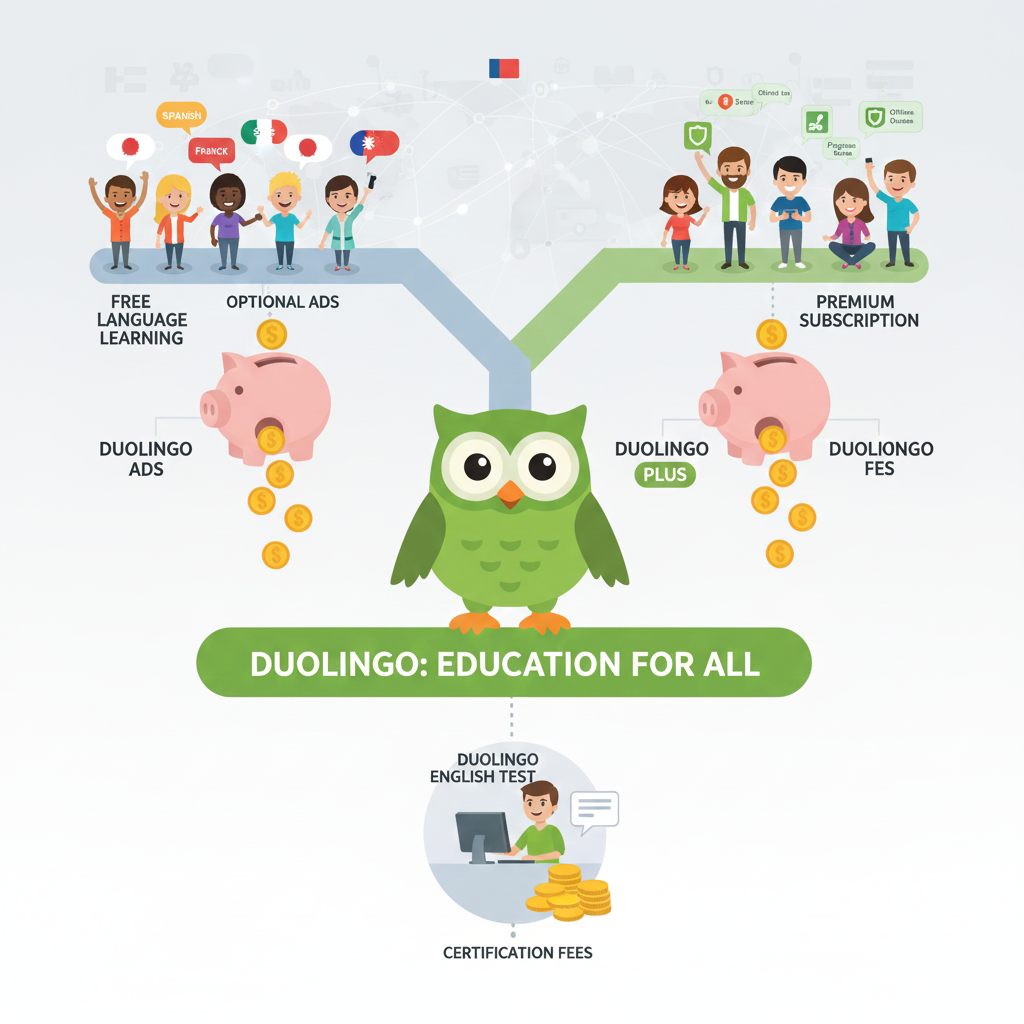
Duolingo follows a freemium model. Additionally, it operates as a platform-based business.
Here’s how it works:
Free users provide massive scale. Meanwhile, paid users generate revenue. Furthermore, engagement drives retention. Finally, data and AI improve the product continuously.
This combination creates a powerful business engine.
Revenue Stream #1: Duolingo Super
Duolingo Super is the biggest revenue source. It’s a premium subscription that removes friction from the app.
Several benefits are included:
- Ads are removed completely
- Unlimited hearts are provided (mistakes don’t stop lessons)
- Offline access is enabled
- Progress tracking is enhanced
- Learning flow becomes faster
Pricing varies by region. Monthly plans are offered. However, yearly subscriptions are most popular. Additionally, family plans are available.
The strategy here is clever. The free version is intentionally limited. Nevertheless, it remains useful. Therefore, power users naturally choose to upgrade.
Revenue Stream #2: Advertising
Ads are shown to free users. However, they’re displayed strategically.
Importantly, ads don’t interrupt lessons. Instead, they appear during natural breaks. Consequently, users stay happy while attention is monetized.
This approach works because:
- Millions of daily active users are engaged
- Short, skippable ads are used
- High engagement leads to better ad value
Therefore, advertisers pay premium rates. Meanwhile, users aren’t annoyed.
Revenue Stream #3: Duolingo English Test
The Duolingo English Test (DET) is underrated. Yet, it’s incredibly smart.
This online English proficiency test is accepted by universities, employers, and immigration programs worldwide.
Several advantages are offered:
- It’s much cheaper than IELTS or TOEFL
- It can be taken from home
- Results are delivered fast
Through this test, Duolingo transformed itself. It went from being just a learning app to becoming a full education platform.
This diversification strengthens the business model significantly.
Revenue Stream #4: In-App Purchases
Small purchases are offered to free users. These include:
- Extra hearts
- Streak freezes
- Power-ups
Individually, these purchases seem minor. However, at massive scale, they add up quickly.
The psychology here is simple. People don’t want to lose their streaks. Therefore, they’ll pay small amounts to protect them.
Revenue Stream #5: Duolingo Max
Recently, an AI-powered tier was introduced. It’s called Duolingo Max.
Advanced features are included:
- “Explain My Answer” functionality
- Roleplay conversations
- Smarter feedback systems
Through this tier, Duolingo positions itself as an AI-first education company. Consequently, it’s no longer seen as just another app.
This move keeps Duolingo competitive and innovative.
The Freemium Strategy
Duolingo’s freemium model is genius. Most apps make critical mistakes. Either they give too little for free, or they give too much and can’t convert users.
Duolingo balances this perfectly.
The free version is:
- Fully usable
- Habit-building
- Genuinely rewarding
Meanwhile, the paid version:
- Removes frustrations
- Saves time
- Improves flow
Natural upgrades are created this way. Users aren’t forced to pay. Instead, they choose to pay because they want a better experience.
Target Audience
Duolingo doesn’t focus only on students. Instead, a broad audience is targeted.
Users include:
- Students learning for school
- Working professionals improving skills
- Travelers preparing for trips
- Immigrants learning new languages
- Hobby learners exploring interests
- Casual learners having fun
This mass-market appeal fuels growth. Because the app is free, mobile-first, and fun, barriers to entry are eliminated.
Cost Structure
Money must be spent to run Duolingo. Major costs include:
- Product development
- AI and engineering teams
- Cloud infrastructure
- Content creation
- Marketing (though mostly organic)
- Research and testing
Interestingly, less is spent on traditional advertising. Instead, growth comes from:
- Word-of-mouth referrals
- App Store visibility
- Social media presence
In fact, Duolingo’s TikTok account is part of the business strategy. The owl mascot has become a viral sensation. Consequently, millions in free marketing are generated.
Growth Strategy
Four key strategies drive Duolingo’s growth.
Strategy #1: Gamification First
Everything is designed to increase daily usage. Habits are built intentionally. Meanwhile, drop-off rates are reduced.
Strategy #2: Mobile-First Approach
Mobile was prioritized early. As a result, Duolingo won the mobile market before competitors caught up.
Strategy #3: Global Expansion
Local languages are supported. The app works well in developing markets. Additionally, it remains lightweight and fast.
Strategy #4: AI Integration
AI is used extensively for:
- Personalized learning paths
- Adaptive difficulty levels
- Faster feedback delivery
Therefore, the product improves continuously.
Competitive Advantages
Duolingo is hard to beat. Several advantages are maintained:
Massive User Base: More users mean better data. Better data means better products.
Strong Brand: The owl mascot is instantly recognizable worldwide.
Habit-Based Learning: Streaks create emotional connections. Users feel committed.
Free at Core: Competitors struggle to match this scale while remaining free.
These advantages compound over time.
Comparison With Competitors
Duolingo stands out clearly. When compared to Babbel and Rosetta Stone:
- Duolingo offers a full free plan (competitors don’t)
- Gamification is highly developed (competitors lag behind)
- Mobile-first design is superior
- AI features are more advanced
- Casual learners are better served
Consequently, Duolingo dominates the market.
Profitability Journey
For years, growth was prioritized over profit. However, things have changed.
Now:
- Revenue grows consistently
- Paid subscribers increase steadily
- AI tiers improve ARPU (average revenue per user)
The transformation is clear. Duolingo is moving from a growth-stage startup to a sustainable public company.
This shift demonstrates long-term viability.
Key Lessons for Founders
Powerful lessons can be learned from Duolingo:
Make the core product free: Eliminate barriers to entry.
Monetize power users: Don’t charge beginners. Instead, let them grow into paying customers.
Build habits, not just features: Design for daily use.
Let users want to pay: Create value they’ll choose to purchase.
These principles apply beyond language learning. They work for any consumer product.
Conclusion
Duolingo isn’t just another language app. Instead, it’s multiple things:
- A habit-building machine
- A freemium success story
- An AI-powered education platform
The business model proves something important. Free products can be highly profitable. However, they must be designed correctly.
Duolingo achieved this through:
- Smart freemium balance
- Multiple revenue streams
- Habit-forming design
- Continuous innovation
As a result, billions in revenue are generated. Meanwhile, millions learn languages for free.
That’s the power of a well-executed business model.
Summary: Duolingo makes money through premium subscriptions (Duolingo Super and Max), advertising to free users, the Duolingo English Test, and in-app purchases. The freemium model attracts millions of users while converting power users to paid plans. Additionally, gamification and habit-building keep users engaged daily, creating a sustainable and profitable business.
Discover more from Business Model Hub
Subscribe to get the latest posts sent to your email.


[…] students seeking knowledge and instructors offering expertise. The platform specializes primarily in language learning but has expanded to include various educational […]
[…] does a company that gives away its core product for free build a billion-dollar business? Duolingo’s answer is a masterclass in freemium […]