Turo Business Model How Turo Turned Idle Cars Into a Multi-Billion Dollar Car-Sharing Marketplace

Turo operates a peer-to-peer car-sharing marketplace that connects car owners with travelers who want to rent vehicles. Instead of owning cars like traditional rental companies, Turo allows individuals to list their vehicles on the platform and earn money when others rent them.
Turo generates revenue primarily through trip commissions, guest service fees, protection plans, and additional trip-related charges. Because the platform does not own most vehicles, Turo follows an asset-light marketplace model, similar to platforms like Airbnb.
What is Turo?
Turo is a peer-to-peer car-sharing marketplace that connects private car owners with people who need to rent a vehicle.
Founded in 2010 under the name RelayRides, the platform has grown into one of the largest car-sharing networks in the world, operating across the United States, Canada, the United Kingdom, France, and Australia.
It is often described as the “Airbnb for cars.”
Instead of walking up to a rental counter at an airport, travelers can browse thousands of locally owned vehicles through the Turo app and book directly from the owner.
The Problem Turo Was Built to Solve
Traditional car rental companies like Hertz and Enterprise operate large fleets of vehicles. That model comes with significant structural limitations:
- High operating costs tied to fleet ownership and maintenance
- Limited vehicle variety across standardised inventory
- Fixed, inflexible pricing models
- Location dependency with airport and city counters
At the same time, privately owned cars sit idle for the vast majority of their lives. Studies suggest the average car is parked roughly 95% of the time.
Turo saw an opportunity in that gap.
The core idea was straightforward: turn idle cars into income-generating assets by connecting owners and renters through a digital marketplace.
This created a new category, peer-to-peer car sharing, that sits between traditional car rental and ride-hailing.
How Turo Works
The platform operates as a two-sided marketplace. It serves two distinct groups of users: hosts (car owners) and guests (renters).
How It Works for Hosts
Car owners, referred to as hosts, can list their vehicles on the platform in a few steps:
- Create a listing with photos, vehicle details, and pricing
- Set availability windows and daily rates
- Choose a protection plan that covers liability and damage
- Accept or decline booking requests
- Earn income after each completed trip
Some hosts treat Turo as a side income stream using one or two personal vehicles. Others operate small professional fleets of five, ten, or more cars, running what amounts to a micro car rental business on the platform.
How It Works for Guests
Travelers and renters, referred to as guests, use the platform to find and book vehicles:
- Search for available cars in a specific city or location
- Filter by vehicle type, price, features, or ratings
- Book and pay through the app
- Pick up the car directly from the host or opt for delivery
- Return the vehicle at the end of the trip
The platform manages payments, identity verification, insurance coverage, and trip management entirely within the app.
The Turo Business Model Explained
Turo follows an asset-light, two-sided marketplace model.
Rather than owning vehicles itself, the company provides the infrastructure, technology, trust mechanisms, and insurance framework that makes peer-to-peer car sharing viable at scale.
This is fundamentally similar to how Airbnb operates in accommodation or how Etsy operates in handmade goods. The platform does not own the supply. Instead, it facilitates transactions between independent supply and demand.
Supply side: Car owners listing vehicles
Demand side: Travelers and renters needing temporary transportation
Turo earns revenue every time a trip is completed on the platform, taking a cut from both sides of the transaction.
The model is notably different from ride-hailing platforms like Uber. Turo enables self-driven rentals where the renter takes the car independently, rather than being driven by the owner.
Turo Revenue Streams
Turo generates income through several interconnected revenue streams, all tied to trip activity on the platform.
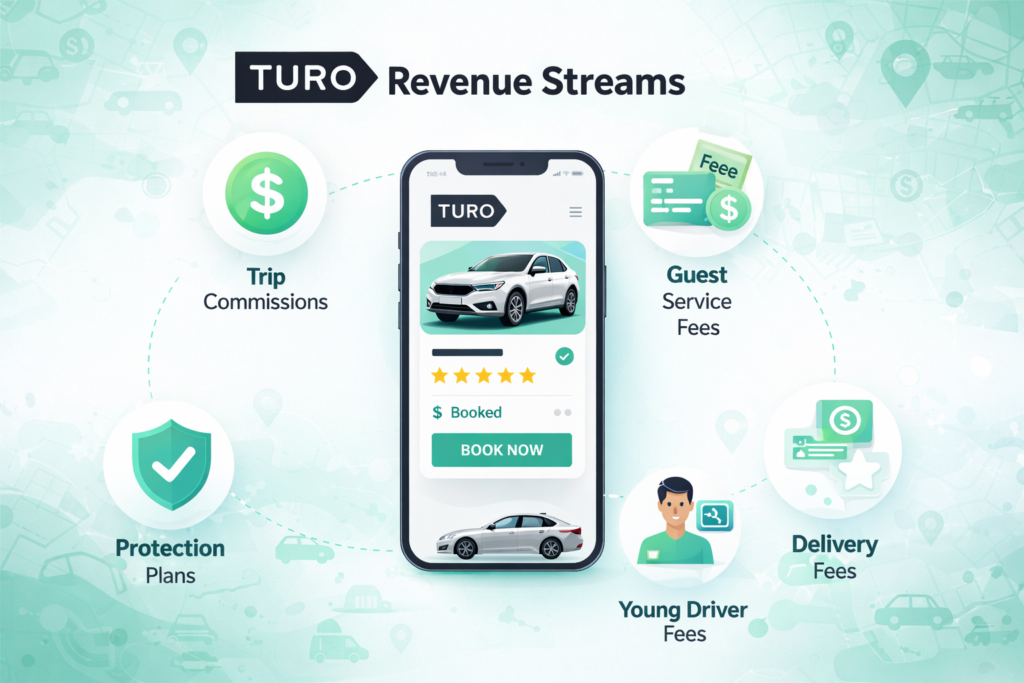
Trip Commissions
This is Turo’s primary and largest revenue source.
Every time a trip is booked and completed, Turo takes a percentage commission from the host’s earnings. That commission typically ranges between 10% and 40%, depending on which protection plan the host has selected.
Hosts who opt for more comprehensive protection plans pay a higher commission. Those who accept more liability risk themselves retain a larger share of the trip price.
Example breakdown:
| Trip Price | Turo Commission (15%) | Host Earns |
|---|---|---|
| $100 | $15 | $85 |
| $250 | $37.50 | $212.50 |
| $500 | $75 | $425 |
Guest Service Fees
In addition to the trip price paid to the host, guests pay a separate service fee directly to Turo at the time of booking.
These fees vary based on:
- Total trip cost
- Booking timing and demand level
- Geographic market
- Risk factors associated with the booking
Guest service fees create a second revenue layer on every transaction, separate from the commission charged to hosts.
Protection Plans
Both hosts and guests can purchase protection plans through Turo that provide coverage for accidents, liability, and vehicle damage.
For hosts, the protection plan tier determines how much of the liability risk Turo absorbs versus how much the host retains. For guests, optional protection adds additional coverage beyond basic liability.
These insurance-related services represent a meaningful portion of Turo’s total revenue, particularly given the inherent risk in car-sharing transactions.
Delivery Fees
Hosts have the option to offer vehicle delivery to specific locations, including airports, hotels, or custom pickup points requested by guests.
Hosts set their own delivery fees for this service. Turo may take a percentage of those fees depending on the arrangement.
Delivery options significantly increase the appeal of Turo listings, especially for airport travelers who would otherwise need to arrange their own transport to a pickup location.
Young Driver Fees
Drivers under the age of 25 are statistically higher-risk from an insurance perspective.
Turo charges additional fees for young drivers to reflect this elevated risk profile. These fees are passed through the platform and contribute to overall revenue, particularly in markets with a younger traveler demographic.
The Turo Business Model Canvas
Breaking down Turo’s business model using the standard Business Model Canvas framework reveals how each component fits together.
Key Partners
- Insurance and underwriting providers
- Payment processing companies
- Vehicle maintenance and roadside assistance services
- Airport operators and parking infrastructure
- Technology and cloud infrastructure partners
Key Activities
- Platform and mobile app development
- Marketplace management and curation
- Risk assessment and fraud prevention
- Customer support operations
- Marketing, SEO, and user acquisition
Key Resources
- The Turo mobile app and web platform
- Brand reputation and trust framework
- Network of active hosts and vehicle listings
- Pricing algorithms and data infrastructure
Value Propositions
For car owners:
- Generate income from a vehicle that would otherwise sit idle
- Full flexibility over pricing, availability, and booking approval
- Option to scale into a small car rental business with multiple vehicles
For renters:
- Often cheaper than traditional car rental companies
- Access to a far wider variety of vehicles, including luxury, vintage, and specialist cars
- Convenient local pickup and optional delivery
Customer Segments
- Leisure travelers needing transportation at a destination
- Business travelers requiring flexible short-term vehicle access
- Local residents needing a temporary car without a long-term commitment
- Car enthusiasts looking to experience specific vehicle models
- Event and occasion renters
Cost Structure
Turo’s major cost categories include:
- Insurance claims and protection program payouts
- Technology infrastructure and platform development
- Marketing and performance advertising
- Customer support operations
- Payment processing fees
- Regulatory and compliance costs
Channels
- iOS and Android mobile apps
- Turo website and web booking
- Search engine optimisation and paid search
- Travel partnerships and integrations
- Word-of-mouth and host community referrals
Turo vs Traditional Car Rental Companies
Understanding why Turo’s model is structurally different from companies like Hertz or Enterprise helps explain its competitive advantages.
| Feature | Turo | Traditional Rentals |
|---|---|---|
| Vehicle ownership | Individual hosts own cars | Company owns the fleet |
| Capital requirements | Low (asset-light) | Very high (fleet purchase and maintenance) |
| Vehicle variety | Extremely wide, host-determined | Standardised and limited |
| Pricing flexibility | Host-set with dynamic options | Corporate fixed pricing |
| Geographic scalability | Scales with host supply | Requires physical branch infrastructure |
| Unique vehicle access | High (luxury, vintage, EVs) | Low |
The asset-light structure is Turo’s most significant structural advantage.
Traditional rental companies must continuously invest capital in purchasing, depreciating, and replacing fleet vehicles. Turo bears none of that cost. Instead, individual hosts absorb vehicle ownership costs, and Turo simply earns a margin on each transaction.
This creates dramatically higher scalability potential with far lower capital intensity.
Turo’s Growth Strategy
Turo has pursued a multi-layered growth strategy since its early days as RelayRides.
Building Marketplace Liquidity
The foundational challenge for any marketplace is the chicken-and-egg problem. You need supply to attract demand, and demand to attract supply.
Turo addressed this by initially focusing on supply growth, making it easy and attractive for car owners to list vehicles. As inventory grew in key cities, renters followed.
More host listings attract more renters. More renters make the platform more appealing to hosts. This self-reinforcing dynamic, known as a network effect, is central to Turo’s long-term competitive moat.
Geographic Expansion
Turo has progressively expanded from its US origins into Canada, the United Kingdom, France, and Australia.
Each new market requires local regulatory navigation, insurance partnerships, and supply acquisition. But the underlying platform model transfers cleanly across geographies.
Professional Host Programme
Encouraging car owners to operate multiple vehicles on the platform dramatically increases supply density.
Professional hosts who run fleets of five or more cars provide reliable, consistent inventory in high-demand markets, particularly around airports and major cities. This segment is increasingly important to Turo’s supply strategy.
Airport Integration
Airport partnerships and pickup options have been a significant demand driver.
Travelers arriving in a new city and needing immediate transportation are a high-intent, high-value customer segment. Making Turo a convenient option at or near airports directly competes with the traditional rental counter experience.
Challenges in the Turo Business Model
Despite its structural advantages, Turo faces several ongoing challenges that affect both growth and profitability.
Insurance and Claims Risk
Car sharing inherently involves accident risk, vehicle damage, and liability exposure.
Managing insurance costs is one of the most operationally complex and financially significant challenges Turo faces. A high volume of claims or large individual payouts can significantly impact unit economics on the protection plan side of the business.
Regulatory Restrictions
Peer-to-peer car sharing sits in a regulatory grey area in many jurisdictions.
Some cities and states have enacted restrictions on how personal vehicles can be commercially rented, creating compliance challenges that slow expansion in certain markets.
Trust and Safety
The entire model depends on trust between strangers.
Hosts must trust that guests will return vehicles undamaged. Guests must trust that listed vehicles match their descriptions. Turo invests heavily in identity verification, ratings systems, and dispute resolution to maintain this trust infrastructure.
Competition
Turo faces competition from traditional rental companies that are increasingly investing in digital platforms, as well as emerging peer-to-peer competitors and adjacent mobility services.
Is Turo Profitable?
Turo has historically prioritised growth over near-term profitability, which is a pattern common among high-growth marketplace platforms.
Key financial observations:
- Annual revenue has grown significantly, crossing hundreds of millions of dollars
- The asset-light model limits capital expenditure compared to traditional rental companies
- Insurance costs and marketing spend remain the largest drag on profitability
- The company has explored an IPO, which has brought greater financial scrutiny and reporting
The path to sustainable profitability for Turo is closely tied to:
- Improving loss ratios on protection plans
- Increasing host and guest retention to reduce acquisition costs
- Scaling revenue per transaction as the marketplace matures
As operating leverage improves with scale, the business model becomes progressively more efficient. The marginal cost of adding a new host or guest to the platform is far lower than the revenue that host or guest eventually generates.
Why the Turo Business Model Works
Three structural advantages explain why Turo’s model has succeeded where traditional car rental models would struggle.
Asset-Light Scalability
Turo does not purchase, depreciate, insure, or maintain a single vehicle in its core marketplace. The entire vehicle supply is owned and managed by individual hosts.
This means Turo can grow its vehicle supply without proportional increases in capital expenditure. It is one of the most significant structural advantages of the marketplace model applied to physical asset categories.
Network Effects
Every new host who joins the platform adds supply that makes Turo more attractive to renters. Every new renter who joins creates demand that makes listing more valuable for hosts.
These compounding network effects create a barrier to competition that strengthens over time as the marketplace grows.
Flexible, Distributed Supply
In a traditional rental company, supply is constrained by fleet purchasing decisions made months or years in advance.
Turo’s supply flexes organically with demand. When demand increases in a city, higher prices attract more hosts to list their vehicles. This creates a naturally self-correcting supply mechanism that traditional companies cannot replicate without significant capital investment.
The Future of the Turo Business Model
Several emerging trends could shape the next phase of Turo’s development.
Electric Vehicle Rentals
As EV adoption accelerates, peer-to-peer platforms like Turo become a natural distribution channel for renters who want to experience electric vehicles without committing to ownership.
Hosts who own EVs can command premium pricing. Turo has already seen growing EV inventory on the platform.
Long-Term Subscriptions
Beyond short-trip rentals, there is an opportunity in longer-term car subscriptions. Rather than renting for a weekend, some users may want vehicle access for weeks or months without the commitment of ownership or a traditional lease.
Travel Platform Partnerships
Deeper integrations with flight booking platforms, hotels, and travel aggregators could significantly increase Turo’s demand funnel by embedding car options directly into the broader travel booking experience.
Autonomous Vehicle Integration
Looking further ahead, the rise of autonomous vehicles could reshape peer-to-peer car sharing entirely. Vehicles that can drive themselves to renters, or that operate continuously without a human owner managing availability, could expand the Turo model into new territory.
Wrapping Up
Turo’s business model is a textbook example of how marketplace platforms can disrupt capital-intensive industries by removing the need to own the underlying assets.
By connecting idle cars with travelers who need transportation, Turo created real economic value on both sides of the market. Hosts earn income from assets they already own. Guests access cheaper, more varied transportation than traditional rental companies offer.
The asset-light structure, combined with compounding network effects and a flexible supply model, gives Turo structural advantages that traditional rental companies find difficult to replicate.
Whether or not Turo achieves long-term profitability depends on how effectively it manages insurance risk and scales its marketplace. But the fundamental model, turning privately owned idle assets into productive economic infrastructure through a trusted digital platform, is one of the most powerful frameworks in the modern economy.
Turo did not invent car sharing. But it built the infrastructure that made peer-to-peer car sharing a mainstream, scalable, and genuinely disruptive alternative to the traditional rental industry.
FAQs
Turo makes money primarily through trip commissions, guest service fees, and protection plans.
Whenever a car is booked on the platform, Turo takes a percentage commission from the host, usually ranging from 10% to 40% depending on the protection plan chosen. In addition, renters pay guest service fees, which vary based on trip cost, timing, and demand.
The company also earns revenue from insurance protection plans, delivery fees, and young driver fees. Because Turo does not own most of the vehicles on the platform, it operates with an asset-light marketplace model, allowing it to generate revenue from every transaction without maintaining a large fleet of cars.
The most profitable cars on Turo are typically economy cars, hybrid vehicles, and affordable SUVs.
Models like the **Toyota Corolla, Honda Civic, and Toyota Prius often perform well because they have high demand, lower purchase costs, and good fuel efficiency.
Luxury vehicles such as the **Tesla Model 3 or BMW 3 Series can generate higher daily rental prices, but they also come with higher maintenance, insurance, and depreciation costs. For many hosts, reliable and affordable vehicles tend to produce the best long-term profitability.
No, Turo does not own most of the vehicles listed on the platform.
Instead, Turo operates as a peer-to-peer marketplace where individual car owners (called hosts) list their vehicles for rent. These hosts set their own prices, availability, and delivery options.
This model allows Turo to scale quickly because the company does not need to purchase or maintain a fleet of vehicles, unlike traditional rental companies.
Turo operates as a two-sided marketplace platform in the sharing economy.
The platform connects two groups:
Car owners (hosts) who want to earn money from their vehicles
Renters (guests) who need temporary transportation
Because the company mainly facilitates transactions between these users, Turo follows an asset-light platform business model, similar to companies like Airbnb and Uber.
The biggest competitor to Turo is Getaround, another peer-to-peer car-sharing platform that allows individuals to rent their vehicles to others.
Turo also competes indirectly with traditional car rental companies such as:
Hertz
Enterprise Rent-A-Car
Avis Budget Group
However, Turo differentiates itself by offering a wider range of vehicles and more flexible pricing, since cars are owned by individual hosts rather than a corporate fleet.
In many cases, Turo can be cheaper than traditional car rental services.
Because individual hosts set their own prices, renters often find lower daily rates and more flexible options compared with rental companies like Hertz or Enterprise Rent-A-Car.
However, the final price may vary depending on service fees, insurance protection plans, and delivery charges. In some situations, traditional rental companies may offer better deals, especially for longer rental periods or corporate bookings.
Discover more from Business Model Hub
Subscribe to get the latest posts sent to your email.