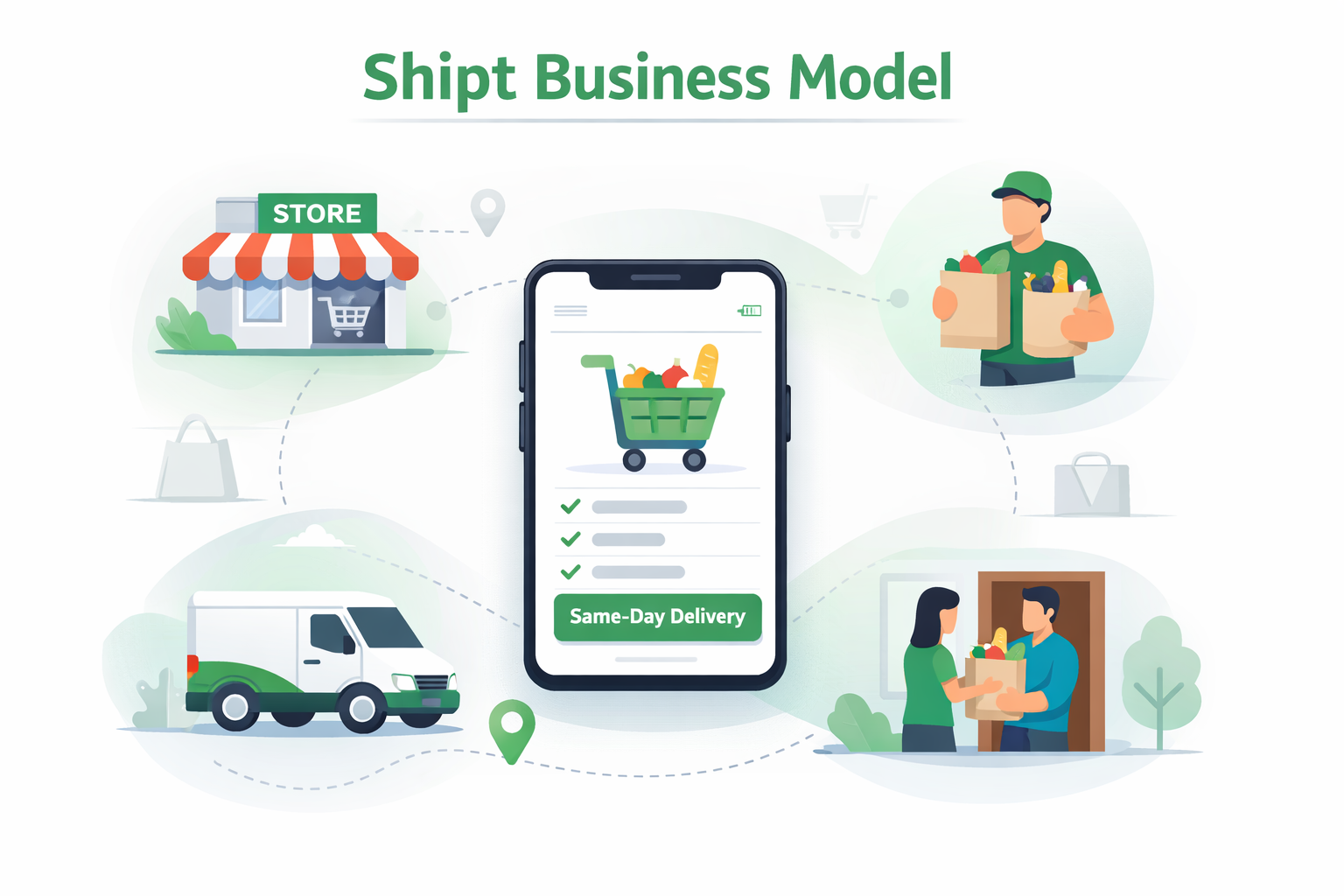
Shipt Business Model How Shipt Makes Money From Same-Day Delivery

Shipt operates a membership-based grocery and retail delivery platform that connects customers with personal shoppers for same-day delivery. Customers pay monthly or annual subscriptions to access unlimited deliveries from local stores. The company generates revenue through membership fees, delivery charges, retail partnerships, and service markups.
What Is Shipt?
Shipt is an on-demand delivery platform that makes it possible for customers to get groceries and retail products delivered to their door within hours, not days.
Founded in 2014 in Birmingham, Alabama, Shipt quickly built a reputation for fast, reliable same-day delivery. The company grew rapidly by focusing on one thing: connecting everyday shoppers with local stores through a simple, easy-to-use app.
In 2017, Target Corporation acquired Shipt for $550 million, a move that signaled just how seriously major retailers were taking the last-mile delivery race. The acquisition gave Target a powerful logistics network and helped Shipt scale its operations nationally.
Today, Shipt operates as a marketplace with three key players:
- Customers who want fast, convenient delivery
- Independent shoppers who fulfill the orders
- Retail partners who supply the products
How Shipt Works
Understanding the Shipt business model starts with understanding how the platform actually operates day to day.
Customers Place Orders Through the App
Customers browse products from local stores directly inside the Shipt app or website. They can order groceries, household essentials, pharmacy items, and more, all in one place.
The experience is designed to mirror walking through a store, just without leaving home.
Personal Shoppers Accept the Order
Once a customer places an order, independent contractors called “personal shoppers” receive the request. Shoppers can browse available orders and choose which ones to accept based on location, payout, and timing.
This gig-based model keeps Shipt’s operational costs flexible while maintaining a large, distributed workforce.
Shopping Happens In-Store
The shopper physically goes to the store, picks out each item on the customer’s list, and communicates in real time if something is out of stock or needs a substitution. Customers can approve or reject swaps directly through the app.
Retail partners include major names like:
- Target
- Costco
- CVS Pharmacy
- Meijer
- H-E-B
- Petco
Same-Day Delivery
Once shopping is complete, the shopper delivers the order directly to the customer’s door, typically within one to two hours of placing the order.
This speed is Shipt’s core competitive advantage.
Shipt’s Value Proposition
Every successful business model solves a real problem. Shipt solves different problems for three different groups.
For Customers:
- Same-day delivery saves time on routine shopping trips
- Wide selection of stores available in one app
- Real-time communication with shoppers adds a personal touch
- Ideal for busy professionals, parents, and elderly consumers who face mobility challenges
For Retailers:
- Ready-built delivery infrastructure without the cost of building it from scratch
- Access to a trained network of shoppers and drivers
- Ability to compete with Amazon and Walmart on delivery speed
- More orders and higher basket sizes from online customers
For Shoppers:
- Flexible work with no set schedule
- Ability to earn on their own terms
- Tip income on top of base pay
- Access to work across multiple retail locations
This three-sided value proposition is what makes the Shipt marketplace model work.
Shipt Business Model Canvas
Breaking down the Shipt business model using a canvas framework makes the structure easy to understand.
Key Partners
- Major retail chains (Target, Costco, CVS)
- Independent gig workers
- Payment processing providers
- Logistics and mapping technology providers
Key Activities
- Managing the order flow from customer to shopper to delivery
- Recruiting and vetting personal shoppers
- Building and maintaining retail integrations
- Ensuring delivery quality and customer satisfaction
Key Resources
- A large, scalable shopper network
- Proprietary mobile app and web platform
- Retail API integrations
- Brand trust and customer data
Customer Segments
- Busy working professionals
- Parents managing household logistics
- Elderly or mobility-limited consumers
- Retail partners seeking delivery infrastructure
Cost Structure
- Shopper payments and incentives
- Technology development and maintenance
- Customer support operations
- Marketing and user acquisition
How Shipt Makes Money
This is the heart of the Shipt business model. The company uses multiple revenue streams, which reduces reliance on any single source of income.
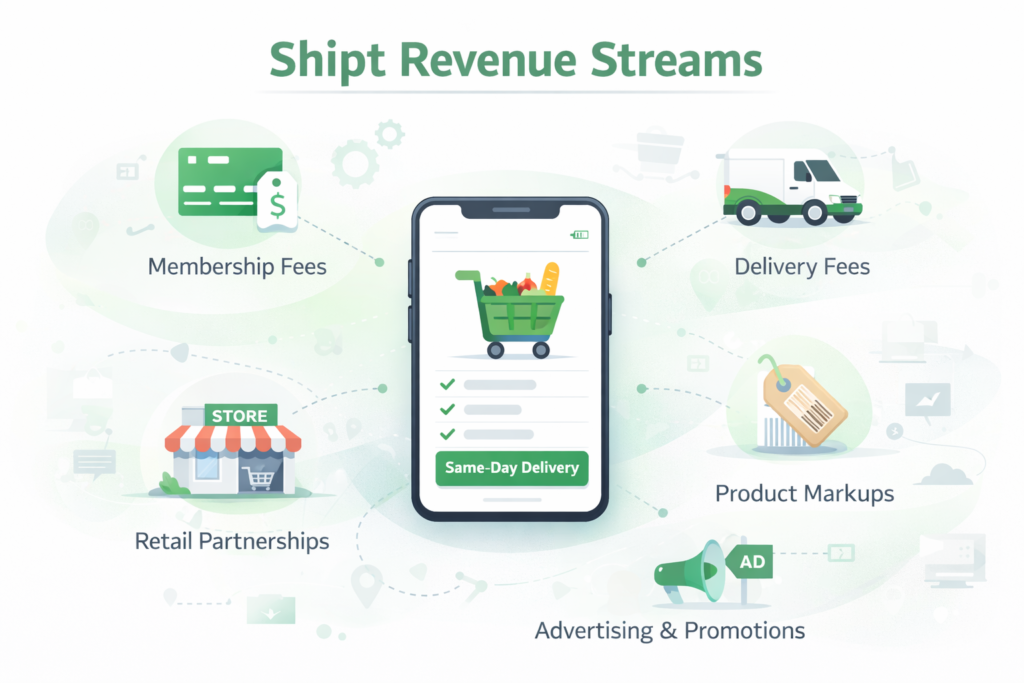
Membership Fees
Membership fees are Shipt’s primary and most predictable revenue driver.
Customers can subscribe to Shipt on either a monthly or annual basis. With a membership, they get unlimited free delivery on orders over a certain threshold. This model encourages repeat usage because members feel they are “getting their money’s worth” by ordering frequently.
Annual members typically pay less per month than monthly subscribers, which incentivizes longer-term commitment and reduces churn.
Key benefits of the membership model for Shipt:
- Predictable, recurring revenue
- Higher customer lifetime value
- Encourages frequent ordering behavior
- Creates a loyal user base less likely to switch to competitors
Delivery Fees
Not every customer chooses a membership. Non-members can still use Shipt by paying a per-order delivery fee.
These fees vary based on several factors:
- The size of the order
- The delivery window selected
- The customer’s location
- Store-specific policies
This pay-per-use option lowers the barrier to entry for new customers, allowing Shipt to capture occasional shoppers who may eventually convert into paying members.
Retail Partnerships
Retailers pay Shipt to power their delivery infrastructure. Rather than building their own last-mile logistics from the ground up, many retailers integrate directly with Shipt’s platform.
What retailers get from this partnership:
- A ready-made shopper network
- Order management technology
- Customer-facing delivery features
- Same-day fulfillment capabilities
This B2B revenue stream is significant because it gives Shipt income beyond what individual consumers pay. It also deepens Shipt’s relationship with retail partners, making the platform harder to replace.
Target, as Shipt’s parent company, benefits most directly from this integration. Target’s same-day delivery capability is largely powered by Shipt’s infrastructure.
Product Markups
In some cases, prices inside the Shipt app may reflect a small markup compared to in-store prices. This margin helps offset the cost of operating the platform and coordinating delivery logistics.
Product markups are common across the delivery app industry. Customers often accept slightly higher prices in exchange for the convenience of delivery. As long as the markup is modest and the value is clear, most customers consider it a fair trade-off.
Advertising and Promotions
As Shipt’s user base has grown, the platform has become an attractive advertising channel for consumer brands.
Retailers and product manufacturers can pay for:
- Sponsored product placements inside the app
- Promotional features that push specific items to the top of search results
- Targeted deals and discounts to drive product discovery
This advertising model is similar to what Amazon has built with its sponsored products ecosystem. For Shipt, it represents a high-margin revenue stream that scales with the size of the platform.
Shipt’s Relationship With Target
The Target acquisition in 2017 fundamentally shaped what Shipt is today.
Before the acquisition, Shipt was growing but competing in a crowded market against well-funded rivals. Target’s $550 million purchase gave Shipt the capital, resources, and retail integration needed to scale much faster.
For Target, the acquisition was a direct response to the competitive pressure from Amazon and Walmart, both of whom were aggressively expanding their delivery capabilities. By owning Shipt outright, Target gained:
- A dedicated same-day delivery network
- Control over the customer experience from order to doorstep
- The ability to offer Drive Up, Order Pickup, and same-day delivery as cohesive services
- A logistics platform that could be offered to other retailers as well
This relationship creates a unique dynamic. Shipt is simultaneously a Target-owned business and a platform that serves competing retailers. Managing that balance is an ongoing strategic challenge.
Shipt vs Instacart
Shipt and Instacart are the two dominant players in the grocery delivery space, but they operate with notably different approaches.
| Feature | Shipt | Instacart |
|---|---|---|
| Ownership | Target Corporation | Independent, publicly traded |
| Primary Revenue | Membership fees | Delivery and service fees |
| Retail Strategy | Deep Target integration | Wide multi-retailer network |
| Shopper Model | Independent contractors | Independent contractors |
| App Experience | Curated, Target-aligned | Broad marketplace |
Instacart operates with a wider retail footprint, partnering with hundreds of grocery chains across North America. Shipt tends to focus on a more curated set of partners, with Target at the center.
For customers, the choice often comes down to which stores they prefer and whether they value depth of one retailer’s experience or breadth across many.
Shipt’s Growth Strategy
Shipt’s growth strategy is built around expanding all three sides of its marketplace simultaneously.
Expanding Retail Partnerships
Adding new retail partners increases the number of products and stores available through the platform. More options attract more customers, which in turn makes the platform more attractive to new retail partners. This is a classic marketplace flywheel.
Growing the Shopper Network
More shoppers mean faster delivery times and broader geographic coverage. Shipt invests in shopper recruitment, training, and retention to maintain service quality as it expands.
Improving Delivery Logistics
Technology is central to Shipt’s ability to coordinate thousands of simultaneous deliveries. Investments in routing optimization, real-time tracking, and order management software directly improve the customer experience and shopper efficiency.
Deepening the Target Integration
As Target continues to invest in its omnichannel retail strategy, Shipt sits at the center of that effort. Tighter integration between Target’s inventory systems and Shipt’s delivery platform creates a seamless experience that is difficult for competitors to replicate.
Challenges in Shipt’s Business Model
No business model is without its vulnerabilities, and Shipt faces several real challenges.
Thin Delivery Margins
Last-mile delivery is expensive. Paying shoppers, managing returns, handling customer service issues, and maintaining technology all eat into margins. Even with membership fees providing recurring revenue, profitability in the delivery business remains difficult.
Gig Worker Management
Shipt depends entirely on independent contractors to fulfill orders. This creates challenges around consistency, availability during peak demand, and regulatory risk as labor laws around gig work continue to evolve in different states.
Intense Competition
The same-day delivery space is crowded with well-capitalized competitors:
- Amazon offers fast delivery through Prime and Amazon Fresh
- Walmart has invested heavily in its own delivery infrastructure
- Instacart continues to expand its retailer partnerships
- DoorDash and Uber Eats have moved beyond food into grocery delivery
Staying competitive requires constant investment in technology, partnerships, and the shopper experience.
Customer Retention
Subscription businesses live and die by churn. If customers stop seeing value in their membership, they cancel. Shipt must continuously prove that the convenience is worth the recurring cost.
The Future of Shipt
The same-day delivery industry is still evolving, and Shipt is well-positioned to adapt alongside it.
Faster Deliveries
Consumer expectations around delivery speed are only moving in one direction. The race to offer one-hour or even thirty-minute delivery windows will intensify, and Shipt will need to optimize its shopper network and store partnerships to keep pace.
AI and Logistics Optimization
Artificial intelligence is already being used to improve delivery routing, predict demand, and match shoppers with orders more efficiently. Deeper AI integration will help Shipt reduce costs and improve the customer experience at scale.
Expansion Beyond Groceries
Shipt has already moved beyond pure grocery delivery into pharmacy, pet supplies, home goods, and electronics. This diversification reduces dependence on any single product category and increases average order values.
Retail Media Advertising
As consumer brands look for new ways to reach shoppers at the point of purchase, Shipt’s in-app advertising potential becomes increasingly valuable. A robust retail media offering could become a significant high-margin revenue stream in the coming years.
Conclusion
Shipt has built a durable business model by sitting at the intersection of retail, logistics, and the gig economy. Its membership-driven revenue, strong Target backing, and expanding retail partnerships give it a solid foundation. The real test going forward will be whether it can maintain margins, keep shoppers engaged, and out-maneuver an increasingly aggressive competitive landscape.
FAQs
Shipt is a same-day delivery platform that connects customers with personal shoppers who pick up and deliver items from local stores including Target, Costco, and CVS.
Shipt generates revenue through membership subscription fees, per-order delivery charges, retail partnership agreements, product markups, and in-app advertising and promotions.
Yes. Target Corporation acquired Shipt in 2017 for $550 million. Shipt continues to operate as a platform serving multiple retailers beyond Target.
Shipt competes primarily with Instacart, Amazon, Walmart’s delivery service, DoorDash, and Uber Eats in the grocery and retail delivery space.
For customers who shop frequently from partner stores, an annual Shipt membership typically pays for itself quickly compared to paying per-order delivery fees. Occasional shoppers may prefer the pay-per-delivery option.
Shipt shoppers earn a base payment per order plus customer tips. Earnings vary based on order size, location, and the number of orders completed.
Shipt is an on-demand grocery and retail delivery platform. It operates as a two-sided marketplace that connects customers with independent personal shoppers who pick up and deliver products from local stores.
The company mainly focuses on same-day delivery services for groceries, household essentials, and retail items through its mobile app and website.
No, Shipt is not owned by Amazon.
Shipt is owned by Target Corporation, which acquired the company in 2017 for around $550 million. The acquisition helped Target compete in the same-day delivery market against companies like Amazon and other grocery delivery platforms.
Shipt works through a personal shopper delivery model. The process typically works like this:
Customer places an order
Customers use the Shipt app or website to order groceries or retail items from local stores.
Personal shopper accepts the order
Independent shoppers on the platform receive the request and accept the order.
Shopper buys the items in-store
The shopper visits the selected store and picks the products on the customer’s list.
Same-day delivery
The shopper delivers the items directly to the customer’s home, usually within a few hours.
Shipt offers a subscription-based membership plan.
Typical pricing includes:
Monthly plan: around $10.99 per month
Annual plan: around $99 per year
Members usually receive free delivery on orders over $35, while smaller orders may include additional delivery fees. Non-members may also pay per-delivery charges depending on the order value and location.
Discover more from Business Model Hub
Subscribe to get the latest posts sent to your email.