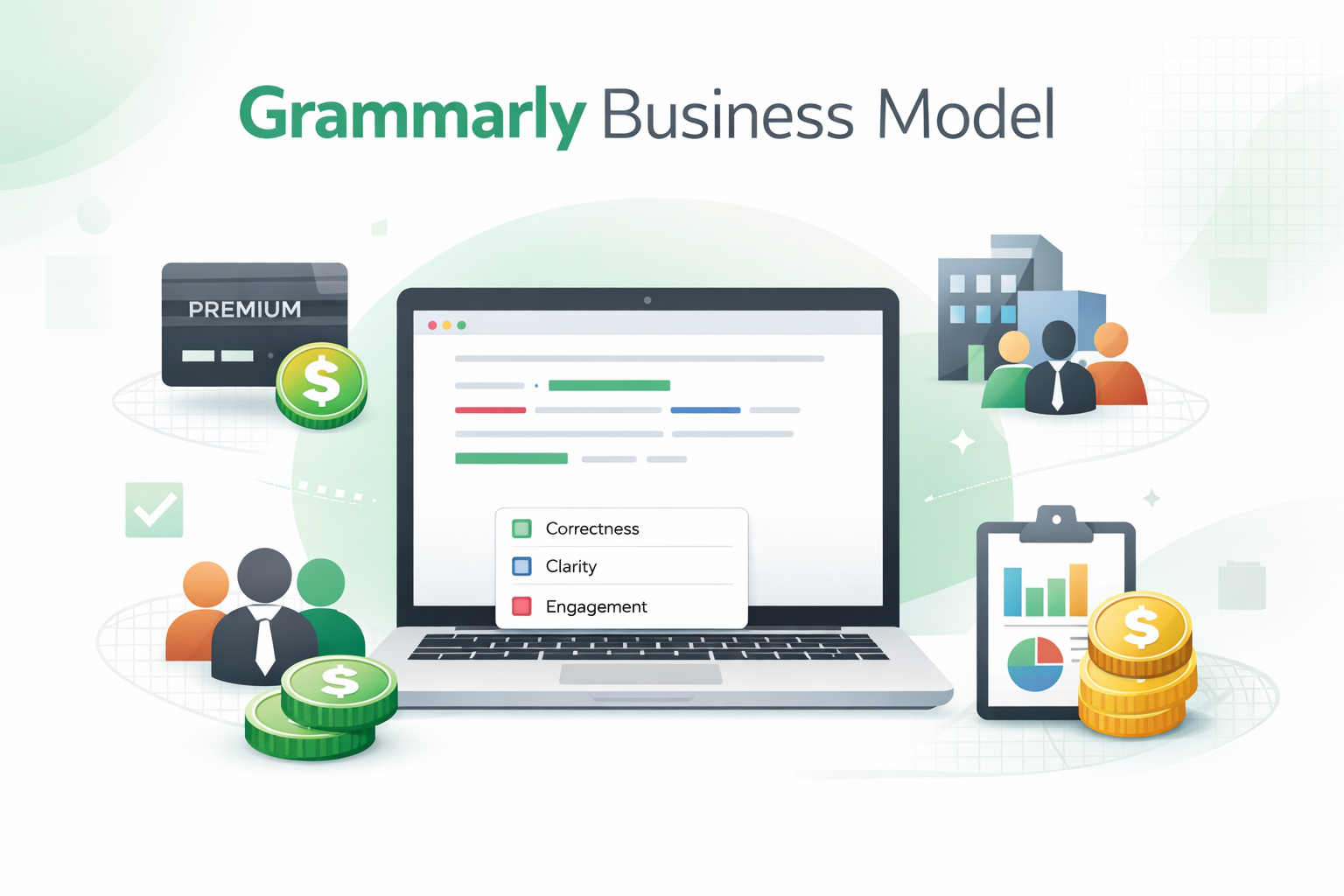

Grammarly makes money primarily through a freemium SaaS model, offering free writing tools with premium subscriptions and enterprise solutions. What started as a simple grammar checker has evolved into one of the most sophisticated AI writing platforms in the world, valued at over $13 billion and used by more than 40 million people daily.
But how exactly does a free tool generate billions in value? This blog breaks down Grammarly’s revenue streams, pricing strategy, growth engine, and the business logic that turned spell-check into a category-defining platform.
What Grammarly Actually Does
Grammarly is an AI-powered writing assistant that helps users write more clearly, correctly, and confidently across virtually every digital surface. It operates as a browser extension, desktop app, mobile keyboard, and web editor, integrating seamlessly into tools like Google Docs, Microsoft Word, Gmail, Slack, and hundreds of other platforms.
Core Features That Drive Value
- Grammar and spelling correction across all writing contexts
- Clarity and conciseness suggestions that improve readability
- Tone detection and adjustment to match communication style
- Plagiarism detection for academic and professional writing
- AI-generated writing assistance through GrammarlyGO
- Style guides and brand voice controls for enterprise teams
What separates Grammarly from a basic spell checker is its contextual intelligence. It does not just flag errors. It understands the goal of your writing, who the audience is, and what tone is appropriate, then offers suggestions accordingly. That depth of product value is what makes it sticky and what fuels its business model.
Who Uses Grammarly: Understanding the Target Audience
Grammarly has built a remarkably wide user base by solving a universal problem. Almost everyone writes, and almost everyone wants to write better.
Individual Users
The largest segment of Grammarly’s user base consists of individual consumers including students writing academic papers, professionals crafting emails and reports, freelance writers producing content, and non-native English speakers looking to communicate more naturally. These users often start on the free plan and convert to premium when they realize how much the tool improves their daily workflow.
Enterprise and Business Customers
Companies represent Grammarly’s most valuable customer segment from a revenue perspective. Marketing teams, HR departments, customer support agents, and executives all benefit from consistent, clear communication. Grammarly Business offers centralized billing, team analytics, style guide enforcement, and admin dashboards that make it a natural fit for organizations focused on brand consistency.
Educational Institutions
Universities and schools use Grammarly to support student writing development, positioning it as both an academic support tool and a plagiarism prevention layer.
The key business insight here is that targeting both individual freemium users and business accounts creates two parallel growth engines. Consumer adoption builds brand recognition and trains users to depend on the product, which then accelerates B2B sales when those same users advocate for Grammarly inside their organizations.
Grammarly’s Business Model Overview
Grammarly operates on a classic freemium SaaS model with a strong product-led growth (PLG) motion layered on top.
The fundamental logic is straightforward. Offer a genuinely useful free product that creates habitual use. Then introduce a premium tier that unlocks meaningfully better features. Over time, convert the most engaged free users into paying subscribers, and separately sell high-value enterprise packages to businesses and institutions.
The Freemium Foundation
The free version of Grammarly is not crippled or frustrating to use. It provides real value: grammar checks, basic spelling corrections, and tone indicators. That generosity is intentional. Grammarly needs users to build the habit of writing with the extension active before they will ever pay for it.
This value-first philosophy distinguishes PLG companies from traditional software businesses that lock features behind paywalls from day one. By giving away a genuinely useful product, Grammarly earns trust before asking for money.
The B2C and B2B Revenue Mix
Grammarly generates revenue from two distinct channels that reinforce each other. Consumer subscriptions provide high-volume, lower-value revenue. Enterprise contracts provide lower-volume but significantly higher-value, longer-duration revenue. Together, they create a diversified income base that reduces dependence on either segment alone.
Grammarly’s Revenue Streams
Grammarly Premium for Individual Users
Grammarly Premium is the flagship paid tier for individual consumers. It unlocks a significantly expanded feature set beyond the free plan, including full clarity rewrites, vocabulary enhancement, advanced style suggestions, tone adjustments, and plagiarism checking.
Pricing is structured around three billing cycles. Monthly plans carry the highest per-unit price, quarterly plans offer a moderate discount, and annual plans deliver the steepest discount, typically saving users around 60% compared to monthly billing. This tiered structure nudges users toward annual commitments, which improves revenue predictability and reduces churn.
The psychological pricing here is deliberate. The monthly price feels manageable for individual use, while the annual price, displayed as a low daily or monthly equivalent, makes upgrading feel like obvious value.
Grammarly Business for Teams and Enterprises
Grammarly Business is the enterprise-facing product tier, designed for teams of three or more. It includes everything in Premium plus centralized billing, team usage analytics, custom style guides, brand voice controls, and dedicated admin dashboards.
Pricing scales per seat, with discounts applied at larger team sizes. Enterprise deals for large organizations typically involve custom contracts negotiated directly with Grammarly’s sales team. These accounts represent a disproportionately high share of total revenue relative to user count, since a single enterprise contract can be worth thousands of dollars annually.
The enterprise product also has much higher switching costs. Once a company has integrated Grammarly into its brand guidelines, onboarded its team, and embedded it into workflows, the cost of migrating to an alternative is significant. That stickiness makes enterprise revenue highly durable.
Affiliate and Partnership Revenue
Grammarly runs an affiliate program that allows bloggers, YouTubers, educators, and platform partners to earn commissions for referring new premium subscribers. This channel effectively turns Grammarly’s most enthusiastic users and content creators into a distributed sales force.
The affiliate program is particularly effective in the education and productivity content niches, where audiences are highly aligned with Grammarly’s target users. Rather than paying for traditional advertising in these spaces, Grammarly pays only for conversions, making it a cost-efficient acquisition channel.
API Licensing and Platform Integrations
While not a primary public revenue line, Grammarly’s technology has potential licensing value for platforms that want to embed writing assistance natively. As AI writing tools become standard infrastructure, API partnerships and white-label arrangements represent a plausible expansion of Grammarly’s revenue base.
GrammarlyGO, the generative AI writing assistant launched in 2023, also opens new monetization possibilities as usage-based pricing models become more common in AI tooling.
Grammarly’s Pricing Strategy
Grammarly’s pricing strategy is built around three core principles: accessibility, perceived value, and commitment incentives.
Free vs. Premium Feature Differentiation
The free plan is useful enough to create habit but limited enough to create genuine friction for power users. Once someone is writing professionally and hitting the ceiling of free features regularly, the upgrade decision becomes almost automatic. Grammarly makes sure that the free plan shows users what they are missing by surfacing locked suggestions with a visual indicator, creating a constant, gentle nudge toward premium.
Annual Commitment Discounts
The aggressive discount on annual plans serves multiple purposes. It improves cash flow by collecting a full year of revenue upfront. It dramatically reduces churn because users who have paid annually are far less likely to cancel mid-year. And it creates a psychological commitment that keeps users engaged with the product throughout the subscription period.
Enterprise Volume Pricing
For business accounts, Grammarly uses a per-seat pricing model with volume discounts built in at scale. This means that the per-user cost decreases as teams grow, giving procurement teams a financial incentive to expand rollout rather than limiting licenses. It is a classic land-and-expand strategy: close a small team contract, prove value, then grow within the organization.
How Grammarly Grows: The Growth Strategy
Product-Led Growth as the Core Engine
Grammarly’s single most powerful growth driver is its product itself. Every person who installs the browser extension and uses it daily is a potential premium subscriber and a potential advocate who recommends it to colleagues and classmates. The product spreads through utility, not advertising.
This PLG motion keeps customer acquisition costs low relative to the lifetime value of users, which is a structural advantage that compounds over time. As the user base grows, so does the word-of-mouth surface area.
Content Marketing and SEO
Grammarly invests heavily in content marketing, publishing educational writing guides, grammar resources, and productivity articles that rank for high-volume search queries. This content serves two purposes: it attracts new users who discover Grammarly while looking for writing help, and it reinforces Grammarly’s brand authority as the expert resource on written communication.
A student searching “how to write a thesis statement” or a professional searching “professional email examples” may land on Grammarly’s blog before ever interacting with the product itself, creating a top-of-funnel content acquisition channel that runs largely on organic traffic.
Referral Programs and Viral Loops
Grammarly’s referral program incentivizes existing users to invite others by offering premium access in exchange for successful referrals. This creates a viral loop where growing the user base directly motivates existing users to participate in acquisition. The program is especially effective in academic environments where peer recommendation carries high trust.
Global Expansion and Language Expansion
While Grammarly built its foundation on English-language writing assistance, expanding into additional languages and markets represents a significant growth frontier. Non-native English speakers are already among the most motivated users of writing assistance tools, and serving markets where English is a second language but still a professional standard represents a massive addressable audience.
User Acquisition and Retention
Acquiring a user through the free plan is only the beginning. Converting them to premium and keeping them subscribed is where the business model succeeds or fails.
The Freemium Conversion Funnel
The journey from free to paid typically follows a pattern. A user installs Grammarly for a specific need, such as editing a resume or improving their email communication. They experience the value of the tool and begin using it regularly. Over time, they encounter enough locked features, or simply value the improvement in their writing enough, that the premium price feels justified. Grammarly accelerates this journey through in-app prompts, usage milestone notifications, and limited-time discount offers.
Retention Through Personalization
Grammarly keeps users engaged through weekly writing stats emails that show how many words were checked, what types of errors were most common, and how writing quality has improved over time. These personalized insights create a sense of progress and investment that makes users less likely to cancel. They are not just paying for a tool. They feel like they are improving a skill.
Enterprise Retention Through Switching Costs
For business accounts, retention is driven less by emotional engagement and more by structural integration. Once a company has embedded Grammarly into its communication standards, trained employees on its use, and built brand guidelines within the platform, the cost of switching is high. This makes enterprise accounts highly sticky with strong net revenue retention.
Key Metrics That Define Grammarly’s Business Health
Understanding how Grammarly measures success reveals the priorities embedded in its business model.
Monthly and Daily Active Users (MAU/DAU) reflect product engagement and the size of the potential conversion pool. A large, active free user base is the foundation from which premium revenue grows.
Free-to-Premium Conversion Rate is the most critical metric for a freemium business. Even a small improvement in this rate has an outsized impact on revenue because of the large free user base.
Average Revenue Per User (ARPU) tracks how effectively Grammarly monetizes its user base. Growth in ARPU can come from price increases, upsells to higher tiers, or expansion within enterprise accounts.
Churn Rate measures how many subscribers cancel in a given period. Low churn is essential for the SaaS model because retention directly determines lifetime customer value. Annual subscribers churn at significantly lower rates than monthly subscribers, which is one reason Grammarly heavily promotes annual plans.
Grammarly’s Competitive Advantage
In a crowded market of writing tools, Grammarly maintains its position through several durable advantages.
The depth and accuracy of its AI writing suggestions go significantly beyond what browser-native spell checkers offer. Its integration footprint, spanning hundreds of platforms and applications, means users get consistent value everywhere they write rather than only within a single tool. Strong brand recognition built over years of consumer marketing means that “Grammarly” has become nearly synonymous with writing assistance for many users. And its enterprise product, with brand voice controls and team analytics, serves needs that general-purpose AI tools do not address with the same specificity.
Challenges and Limitations
Grammarly’s business model is strong, but it faces genuine challenges.
The rise of capable AI writing assistants like ChatGPT, Claude, and Copilot has raised the baseline of what users expect from free writing tools. These tools offer generative capabilities that go beyond correction, and some users may find that a general-purpose AI assistant partially substitutes for a dedicated writing tool.
Grammarly’s dependence on subscription revenue means that growth requires a consistent flow of new users and sustained conversion rates. Saturating the core English-language professional market creates pressure to expand internationally and vertically into new use cases.
Free alternatives, including built-in OS spell checkers, Google Docs suggestions, and browser tools, continue to improve and may reduce the perceived gap between free and paid writing assistance for casual users.
Conclusion
Grammarly’s business model is a textbook example of how to build a scalable, high-value SaaS company on a freemium foundation. By offering genuine value for free, earning user trust and habit, then converting the most engaged users into premium subscribers and enterprise accounts, Grammarly has built a $13 billion platform from what could have been a simple utility tool.
The core takeaway is that Grammarly’s success is not just about grammar checking. It is about the business architecture behind the product: PLG-driven acquisition, smart freemium feature gating, psychological pricing incentives, enterprise stickiness, and a content engine that keeps organic growth compounding.
Discover more from Business Model Hub
Subscribe to get the latest posts sent to your email.