Oura Ring Business Model – How a Smart Ring Turned Sleep Data Into a Subscription Empire

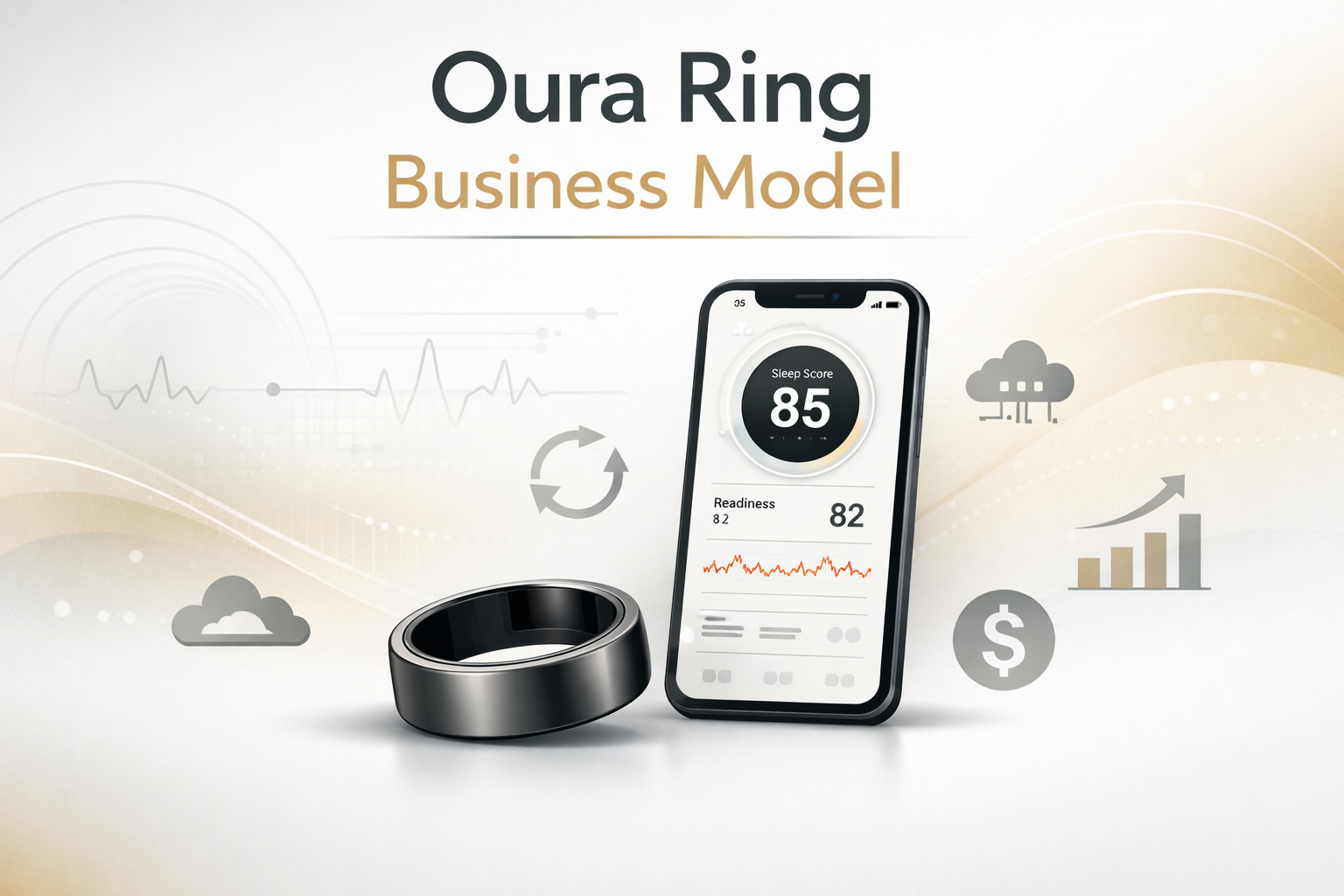
The Oura Ring business model combines premium hardware sales with a recurring subscription model. Oura Health Oy sells its smart ring as a one-time purchase, but users must pay a monthly membership fee to unlock full health insights, analytics, and long-term data tracking. This hybrid model blends hardware margins with predictable SaaS revenue.
What is Oura Ring?
Oura Health Oy was founded in Finland in 2013, and it built something most wearable companies never figured out: a device that disappears into your life while quietly collecting some of the most valuable health data on the planet.
The product itself is a smart ring. Not a watch, not a band, not a chest strap. A ring. It tracks:
- Sleep stages and sleep quality
- Readiness score (how recovered you are)
- Heart rate and heart rate variability
- Body temperature trends
- Activity and steps
The focus is not on counting calories or competing with your gym buddy. Oura is built around preventive health and sleep optimization, which is a fundamentally different value proposition than most wearables.
The target audience reflects that positioning clearly:
- Biohackers who obsess over recovery data
- Athletes who want an edge in performance
- Founders and executives managing high-stress lifestyles
- Health-conscious professionals who take longevity seriously
Now compare that to the competition. Fitbit went mass market and got acquired by Google. Apple Watch is a full-screen computer on your wrist, loud and feature-heavy. Whoop targets serious athletes with an aggressive subscription-first model. Oura carved out a different lane entirely: minimal hardware, premium positioning, and deep data insights. The ring does not scream “tech gadget.” It looks like jewelry.
That choice was intentional, and it has everything to do with the business model underneath it.
The Oura Ring Revenue Model
Hardware Sales: The Entry Ticket
The first revenue stream is straightforward. You buy the ring. Oura Ring 4 currently retails around $349 to $499 depending on the finish you choose. There are options in silver, black, gold, and stealth, each priced slightly differently. This tiered finish strategy is smart because it creates psychological pricing anchors and appeals to buyers who associate premium materials with quality.
This hardware-first entry point is important. It creates a real upfront revenue event and filters for customers who are serious enough to spend real money on their health.
But here is the uncomfortable truth about hardware businesses: margins are brutal. You have manufacturing costs, supply chain complexity, shipping, returns, and retail partnerships eating into every unit sold. Hardware alone is a low-margin, high-risk business. One supply chain disruption, one product recall, or one competitor dropping a cheaper alternative can destroy a quarter’s revenue overnight.
Oura understood this, which is why hardware is only the entry ticket, not the destination.
The Subscription Model: Where the Real Money Lives
This is the engine. Oura charges a monthly membership fee (currently $5.99 per month after a free trial period) that is required to unlock the full value of the product. Without it, you have a ring that tracks data but tells you almost nothing meaningful about it.
The membership unlocks:
- Detailed sleep stage breakdowns
- Daily readiness and recovery scores
- Long-term trend analysis
- Personalized health insights and recommendations
- Cycle tracking and women’s health features
- Integration with third-party health apps
This is a classic razor-and-blade model with a SaaS twist. Sell the hardware at a premium, then build a recurring revenue stream on top of it.
The logic is not unique to Oura. Look at Whoop, which takes it even further by giving the hardware away for free and charging entirely on subscription. Look at Peloton, which sells you a $1,500 bike and then charges $44 per month for the classes that make it worth using. The pattern is clear: hardware companies that win long-term attach recurring revenue to their physical products.
Why does this make investors happy? Predictable monthly recurring revenue (MRR) compounds in a way that hardware unit sales never can. A subscriber who pays $5.99 every month for three years is worth far more to the business than a one-time hardware buyer. Churn can be modeled, lifetime value can be projected, and valuation multiples for SaaS revenue are dramatically higher than for hardware revenue. Oura is not just selling rings; it is building an annuity.
Data Monetization: The Long Game
Oura does not sell your personal data. That would be a brand-destroying move for a company built on trust. But data still creates indirect value in significant ways.
- Research partnerships with universities and health institutions using aggregated, anonymized data
- Sleep science collaborations that generate academic credibility and press coverage
- Enterprise wellness programs where companies pay for employee health monitoring and insights
The data asset is a long-term strategic moat. As Oura collects more data across more users, its AI models get better at prediction and personalization. Better insights increase retention. Better retention grows LTV. The flywheel keeps spinning. No competitor can replicate five years of proprietary health data collected from a highly engaged, health-obsessed user base overnight.
Oura’s Business Model Canvas
To understand the full picture, here is how the business maps across the key dimensions:
Key Partners
- Hardware manufacturing partners in Asia
- Health research institutions globally
- iOS and Android app ecosystems
Key Activities
- Ring hardware design and iteration
- App development and data analytics
- AI model training on health data
- Brand and community marketing
Key Resources
- Proprietary health data at scale
- Brand credibility in the health space
- Technology patents around biometric sensing
Value Proposition
- The most accurate consumer sleep tracker available
- A wearable that does not feel like wearing a device
- Actionable insights, not just raw numbers
- Premium design that doubles as jewelry
Customer Segments
- Health-conscious professionals aged 28 to 50
- Competitive athletes and sports teams
- High-performance founders and executives
- Women tracking hormonal and cycle patterns
Channels
- Direct-to-consumer website (highest margin)
- Influencer and podcast marketing
- Retail partnerships for physical discovery
- Corporate wellness sales teams
Cost Structure
- R&D for hardware and software
- Manufacturing and supply chain
- Cloud infrastructure for data processing
- Marketing and community building
Revenue Streams
- Upfront hardware sales
- Monthly membership subscriptions
Why Oura Made Subscription Mandatory
This is one of the most important strategic decisions in the company’s history, and it deserves honest analysis.
When Oura launched its earlier generations, the app and most features were free. You paid for the ring, you got the insights. Simple. Then in 2021, Oura launched the Ring 3 alongside a mandatory $5.99 per month membership requirement to access detailed features. The community pushed back. Some users were genuinely frustrated. But Oura held the line.
Why? Because the business math was undeniable.
- Hardware margins are volatile. Material costs fluctuate, shipping costs spike, and supply chains break. You cannot build a durable business on a foundation that unstable.
- SaaS valuation multiples are dramatically higher. A company with $50M in predictable subscription revenue is valued very differently than a company with $50M in lumpy hardware sales.
- Continuous product improvement needs continuous funding. The AI models, the new health features, the research partnerships all cost money on an ongoing basis. One-time hardware purchases cannot sustain that.
- Predictable cash flow enables better planning. Knowing roughly how much revenue is coming in each month lets you hire, invest in R&D, and expand without living quarter to quarter.
The founder lesson here is blunt: if you build hardware, attach recurring revenue. The companies that fail to do this end up trapped, constantly needing to launch new hardware just to keep revenue flat.
Oura’s Pricing Strategy
Oura does not compete on price. That is a deliberate strategic choice, not an oversight.
At $349 to $499 for the ring plus a monthly subscription, Oura is firmly in the premium tier. The pricing communicates something important before the customer even uses the product: this is not a commodity fitness tracker. This is a precision health instrument.
Compare the positioning across the market:
- Xiaomi fitness bands sit at $30 to $50. They count steps. They appeal to first-time buyers who want something affordable. Oura is not competing for that customer at all.
- Garmin devices target serious performance athletes with GPS accuracy and multi-sport tracking. The price points overlap with Oura, but the use case is different.
- Apple Watch is the mainstream wearable with everything built in, but it is a screen on your wrist. It competes on features. Oura competes on depth.
Premium pricing also creates a psychological filter. People who spend $400 on a health ring are likely to actually engage with the data. Engagement drives perceived value. Perceived value drives retention. Retention is the whole game in a subscription business.
The Marketing Strategy Behind Oura
Influencer and Community Strategy
Oura did not grow through Super Bowl ads. It grew through trust networks. The marketing playbook relied heavily on:
- Athletes and sports teams (NBA, for example, used Oura during the COVID bubble)
- Biohackers and longevity influencers on YouTube and podcasts
- Elite health communities and forums
- Founders and operators in the startup world
When someone like Andrew Huberman or a professional athlete mentions their Oura data, it carries far more credibility than any paid advertisement. The product became a status signal in certain communities: wearing an Oura ring meant you took your health seriously.
Authority Through Science
Oura has invested heavily in research credibility. Partnerships with academic institutions, published studies on sleep tracking accuracy, and collaborations with medical researchers all serve a dual purpose. They improve the product, and they generate press coverage that positions Oura as a serious health company, not a gadget brand.
This matters enormously when you are asking people to pay a subscription for health insights. You need people to believe the data is real and the recommendations are worth following.
Lifestyle Branding
The visual identity of Oura is calm, minimal, and performance-focused. There is no flashy neon marketing, no aggressive fitness culture imagery. The brand feels like it belongs next to a clean diet and a meditation practice. That aesthetic consistency reinforces the premium positioning and attracts the exact customer segment Oura wants.
Competitive Advantages That Actually Matter
Form Factor
A ring is categorically different from a watch. It does not interrupt you with notifications. It does not have a screen demanding your attention. It does not feel like “wearing technology.” For sleep tracking especially, a ring is far more comfortable and less obtrusive than a wrist device, which directly improves data quality.
Sleep Data Accuracy
This is Oura’s core technical moat. Multiple independent studies have found Oura’s sleep stage tracking to be among the most accurate available in consumer wearables. Accuracy is not a marketing claim here; it is a defensible product advantage that competitors have struggled to replicate in the ring form factor.
Brand Positioning
Oura owns the “premium health intelligence” category in a way that is genuinely hard to dislodge. The brand credibility built through research partnerships, elite user communities, and consistent premium positioning creates a perception advantage that takes years to build and cannot be easily bought.
Real Risks in the Business Model
No honest business analysis skips the risks.
- Supply chain dependency. Manufacturing a precision device with sensors, batteries, and custom materials means you are exposed to disruptions that are entirely outside your control.
- Apple is not sitting still. There are persistent rumors about an Apple Ring product, and Apple has been steadily improving sleep tracking in Apple Watch. If Apple enters the ring category seriously, it brings distribution, brand trust, and an ecosystem that no startup can easily compete with.
- Subscription fatigue is real. Consumers are increasingly resistant to adding another monthly charge to their lives, especially for a product that delivers passive data rather than active entertainment.
- Wearable market saturation. More devices are tracking more things. The differentiation bar keeps rising.
The Apple threat in particular deserves attention. If Apple launches a ring with comparable accuracy and integrates it deeply into the Apple Health ecosystem, Oura’s competitive position becomes significantly harder to defend. This is the low-probability, high-impact risk that keeps smart founders up at night.
What Founders Can Learn From Oura
There are a few lessons here that apply well beyond the wearable category.
Hardware without a subscription layer is a trap. You build a great product, you ship it, revenue spikes, then it flattens. You have to build the next product just to grow again. Attach recurring revenue or you are on a treadmill.
Proprietary data is a compounding moat. Unlike a feature, which competitors can copy, five years of behavioral health data from a million engaged users cannot be replicated. The longer you run, the wider the gap.
Premium niche beats cheap mass market for durable margins. Oura never tried to sell a $49 ring. They built for buyers who would pay for quality and stay subscribed because the value was real.
Health plus SaaS is a powerful combination. People will cancel their streaming service before they cancel something that helps them sleep better and live longer. Health data has stickiness that entertainment subscriptions can never match.
Community builds before scale. Oura grew through credibility in tight communities before going mainstream. That foundation made the mainstream growth much easier to sustain.
Where Oura Goes From Here
The obvious expansion paths are compelling.
- Corporate wellness is a massive market where employers pay for employee health programs. Oura is already moving in this direction.
- AI-driven health predictions that go beyond tracking toward genuinely predictive health intelligence are the natural evolution of the data asset.
- Insurance partnerships where insurers offer discounts or incentives for Oura membership could open up an entirely new distribution channel.
- Women’s health expansion is already underway with cycle tracking features, but there is significant depth still to be developed here.
- Medical-grade diagnostics is the long-term prize. If Oura can achieve FDA clearance for specific health indicators, the product moves from wellness gadget to clinical tool, and the business model transforms accordingly.
Wrap Up
Oura is not selling a ring. It is selling health intelligence on a subscription, and the ring is simply the sensor that makes that possible.
The hardware is the entry ticket. It creates a real purchase event, filters for serious customers, and anchors the brand in the premium tier. But the business runs on recurring memberships, and the long-term moat is built on proprietary health data that no competitor can buy or build overnight.
The strategic pivot to mandatory subscription was the right call, even if it frustrated early users. It transformed Oura from a hardware company with unpredictable revenue into a health data company with predictable, compounding subscription revenue.
That is a fundamentally more durable and valuable business. And it all started with a ring.
Discover more from Business Model Hub
Subscribe to get the latest posts sent to your email.