Dyson Business Model: How Dyson Turned Engineering Into a Premium Profit Machine

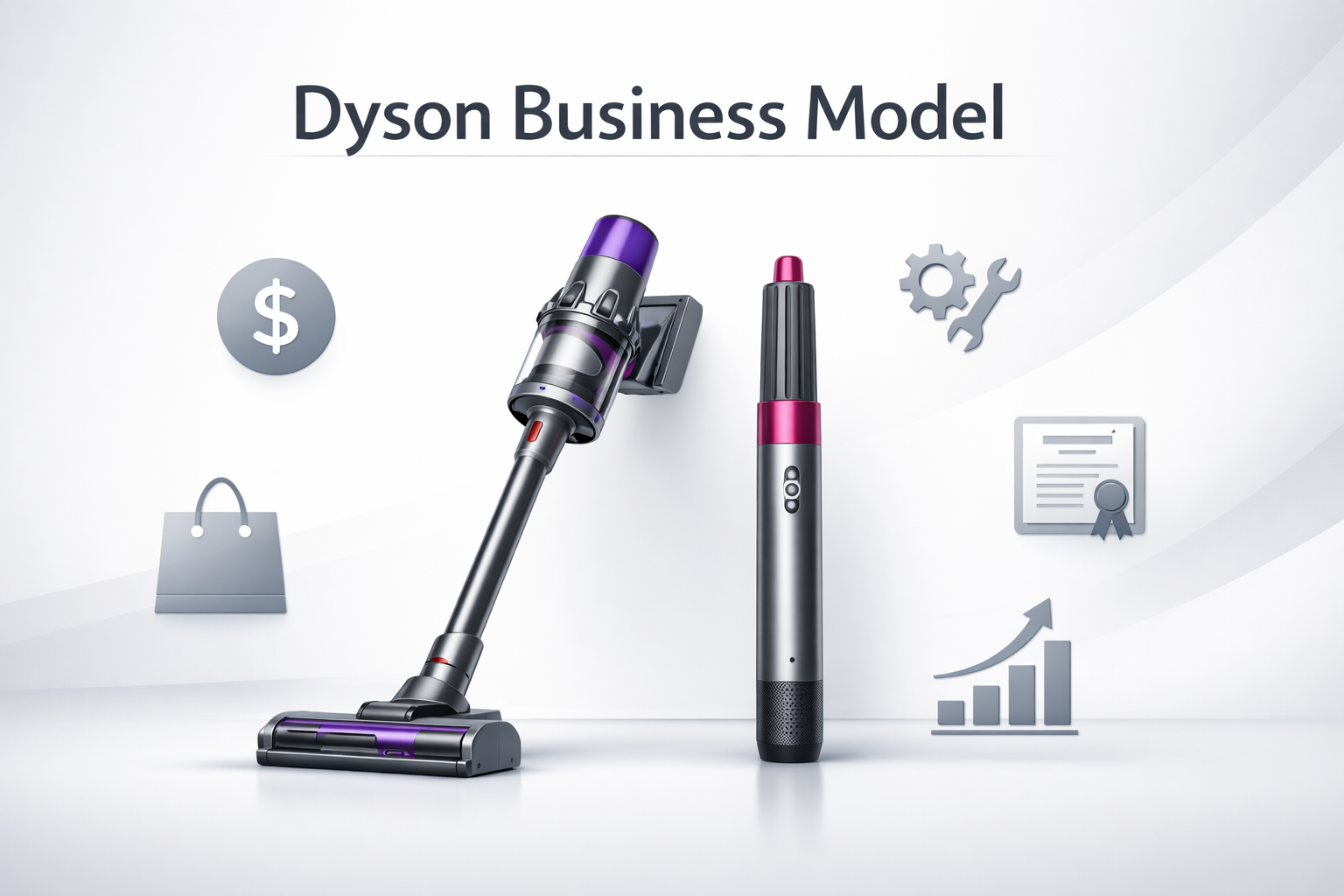
Dyson’s business model is built on premium product innovation driven by proprietary technology, direct-to-consumer sales, and high-margin hardware monetization. Unlike traditional appliance brands, Dyson focuses on engineering differentiation, owns its intellectual property, and sells at premium prices while maintaining iron-tight brand control. It does not chase volume. It chases value.
Quick Answer
If you want the short version: Dyson = Engineering + IP + Premium Pricing + Direct Sales.
That formula has turned a vacuum cleaner company founded in a British workshop into a global technology brand worth billions. Everything Dyson does, from product design to how it sells, flows from that equation.
About Dyson
Dyson was founded in 1991 by Sir James Dyson, a British inventor and entrepreneur who grew frustrated with his vacuum cleaner losing suction. Rather than accept the problem, he spent years building over 5,000 prototypes to solve it. That obsessive approach to engineering became the DNA of the entire company.
Headquartered in Singapore since 2019, Dyson operates in the consumer electronics and home appliances industry. It started with vacuum cleaners, but has since expanded into air purifiers, hair care tools, lighting, hand dryers, and more. Today, it is one of the most recognizable premium appliance brands in the world, known as much for its design as its performance.
The Core Dyson Business Model
Dyson does not compete on price. It competes on technology. That is a deliberate strategic choice, not a limitation.
Most appliance companies fight for shelf space by undercutting each other on cost. Dyson went the opposite direction. It invested heavily in engineering, protected its innovations with patents, and built a brand so strong that customers willingly pay two to three times more than they would for a competitor’s product. Margins are protected not just by cost control, but by brand positioning. When people believe a product is worth more, it is worth more.
The model is simple on the surface but difficult to replicate: create genuinely superior technology, own the intellectual property behind it, sell it at a premium, and control how and where it reaches the customer.
How Dyson Makes Money
Premium Hardware Sales
The core of Dyson’s revenue is hardware. Vacuum cleaners remain its flagship category, with prices ranging from $400 to $800 depending on the model. Its hair styling tools, including the iconic Airwrap and Supersonic hair dryer, retail at $400 and above. Air purifiers, hand dryers, and lighting products round out the portfolio.
These are not budget-friendly price points. They are not meant to be. Dyson positions every product at the top of its category, where margins are highest and brand perception is strongest.
Direct-to-Consumer Strategy
Dyson sells directly through Dyson.com and through its own physical demo stores, where customers can test products before buying. This direct-to-consumer approach cuts out intermediaries and gives Dyson full control over pricing, presentation, and the customer relationship. It also means higher margins per unit compared to selling through third-party retailers.
Retail Partnerships
Dyson does sell through select retail partners, but it manages these relationships carefully. Think of the way Apple products are displayed in Best Buy, given dedicated space, premium placement, and trained staff. Dyson applies a similar philosophy. It does not flood every discount retailer. It chooses distribution partners that reinforce its premium positioning.
Replacement Parts and Accessories
Filters, attachments, and consumables make up a smaller but high-margin slice of Dyson’s revenue. Customers who already own a Dyson product return regularly for replacement parts, creating a recurring revenue stream that requires no additional acquisition cost.
Dyson’s Core Value Proposition
Why do people pay $500 for a vacuum cleaner when a $100 option exists? The answer is not just performance. It is the perception of performance, backed by real performance.
Dyson’s cyclone technology, digital motors, and filtration systems are genuinely engineered to outperform cheaper alternatives. The products look different. They feel different. They carry the weight of over 30 years of innovation branding. Dyson does not sell you a vacuum. It sells you the best possible cleaning experience. It does not sell you a hair dryer. It sells you professional-grade styling technology for your home.
That shift from selling appliances to selling performance is at the heart of why customers pay a premium and feel good about it.
The Real Competitive Advantage: Intellectual Property
Dyson holds thousands of patents. Its proprietary motor technology, cyclone engineering, and air multiplier technology are protected, which means competitors cannot simply copy what makes Dyson products work.
This intellectual property moat does three things. First, it gives Dyson pricing power because there is no direct substitute. Second, it creates barriers to entry that keep cheaper competitors from closing the gap. Third, it makes the business model defensible over the long term. Heavy R&D investment, which Dyson commits to consistently, is not just a cost. It is the engine that keeps the patent portfolio growing and the competitive advantage intact.
Dyson’s Premium Pricing Strategy
Dyson uses a price skimming model. New products launch at high prices to capture early adopters and maximize margin, before prices gradually adjust over time. More importantly, Dyson builds a psychological premium around its brand. Owning a Dyson signals taste, intelligence, and a willingness to invest in quality.
Dyson almost never discounts. This is a conscious decision. Discounting would undermine the perception of premium value that justifies the price in the first place. If a $500 vacuum goes on sale for $200, customers begin to question whether it was ever worth $500. Protecting the price is protecting the brand. Scarcity of discounting creates the perception of scarcity in value, which is exactly where Dyson wants to live.
Distribution Strategy
Dyson runs a hybrid distribution model. It sells through its own website, operates flagship experience stores in key markets, and partners with select high-end retailers globally. The common thread across all three channels is control.
Dyson controls the brand messaging, the pricing, and the customer experience at every touchpoint. A Dyson store is not just a place to buy a vacuum. It is a brand environment designed to communicate innovation, quality, and aspiration. That consistency is part of what makes the premium price feel justified before a customer even picks up a product.
Dyson’s Marketing Strategy
Dyson’s marketing is quiet, product-first, and engineer-led. Rather than saturating the market with celebrity endorsements or lifestyle advertising, it tells the story of the technology. How it works. Why it works better. What problem it solves.
The founder narrative is central to this. James Dyson is not just a figurehead. He is the story. A frustrated inventor who refused to accept a broken product, built thousands of prototypes, and created something genuinely new. That origin story gives Dyson credibility that no advertising budget alone could manufacture.
The approach is similar to Apple and Tesla. Both brands let the product do most of the talking. Both invest more in engineering than in traditional advertising. Both have cultivated communities of loyal customers who advocate on the brand’s behalf. Dyson sits in that same category of brands where the marketing and the product are almost indistinguishable from each other.
Cost Structure of Dyson
Dyson’s biggest costs are R&D, manufacturing, supply chain, retail operations, and marketing. R&D is the most strategically important of these. Dyson reportedly invests hundreds of millions annually in research and development, employing thousands of engineers globally.
This is expensive. But it is offset by the premium margins the business commands on every product sold. A company selling vacuum cleaners at $600 with strong brand equity can absorb R&D costs that would crush a company selling the same category at $80. The high-margin hardware model is what makes the heavy R&D investment sustainable and self-reinforcing.
Why Dyson Does Not Compete on Price
Competing on price is a race to the bottom. Margins shrink, differentiation disappears, and the only winners are the largest companies with the most efficient supply chains. Dyson cannot win that race and has no interest in running it.
Instead, Dyson targets upper-middle and premium consumers, people who prioritize quality over cost and associate higher prices with higher standards. These customers are less sensitive to economic pressure, more loyal to brands they trust, and more likely to buy additional products within the same ecosystem. Positioning over volume is not just a philosophy. It is a financially smarter strategy for a company built on engineering rather than scale.
Dyson Business Model Canvas (Simplified)
Dyson’s key partners include component suppliers and select retail chains. Its key activities are R&D, product engineering, and brand building. The company’s most critical resources are its patent portfolio, its engineering talent, and its brand equity, which has taken decades to build and cannot be purchased overnight.
Revenue flows primarily from hardware sales, with accessories and replacement parts adding a recurring layer on top. Dyson’s core customer segments are premium households, design-conscious buyers, and technology enthusiasts who value innovation and are willing to pay for it.
Expansion Strategy
Dyson grew by taking its engineering philosophy into adjacent categories. It started with vacuums, moved into hand dryers, then air purification, and eventually entered the beauty technology space with hair styling tools that became global hits. Each expansion followed the same logic: find a category where the existing products are underengineered, apply Dyson’s technology and design standards, and price at the premium end.
The company’s relocation of its headquarters to Singapore in 2019 was driven by strategic considerations around proximity to Asian manufacturing hubs and one of its fastest-growing consumer markets. The move signaled Dyson’s long-term commitment to Asia as a core part of its global growth strategy.
Strengths of Dyson’s Business Model
Dyson’s strengths are significant and compounding. Its high margins give it the financial flexibility to keep investing in R&D without depending on outside capital. Its patent moat makes it difficult for competitors to replicate its core technology. Its brand loyalty means customers return, recommend, and upgrade. And its global recognition, particularly in the UK, US, and Asia Pacific, gives it a platform for new product launches that most companies would take decades to build.
Weaknesses and Risks
No business model is without risk. Dyson’s premium pricing strategy limits its addressable market by design. In an economic downturn, discretionary spending on $500 vacuum cleaners and $400 hair dryers is among the first to be cut. The business is also highly dependent on its R&D pipeline. If innovation slows, the justification for premium pricing weakens. And while Dyson’s patent moat is strong, well-funded competitors including Shark, LG, and Samsung continue to narrow the gap on performance and design.
Dyson vs Traditional Appliance Brands
Traditional appliance brands compete on price and distribution scale. They aim to be everywhere, at every price point, reaching as many customers as possible. Their business model depends on volume.
Dyson competes on innovation, brand identity, and a technology moat built over decades. It aims to be the best option in its categories rather than the most accessible. Where traditional brands measure success in units sold, Dyson measures it in margin per unit and brand premium maintained. These are fundamentally different games, and Dyson has built a business model optimized to win the one it is playing.
Lessons for Founders
Dyson offers a masterclass in brand-led business building. A few takeaways worth sitting with:
Own your differentiation. If you compete on price, someone will always undercut you. If you compete on genuine innovation, you control the terms of competition.
Invest in R&D if it builds defensibility. Not all R&D creates moats. Dyson’s does because its innovations are patented, proprietary, and deeply embedded in the product experience.
Control distribution when possible. Every layer between you and your customer is a layer of margin, messaging, and relationship that belongs to someone else.
Premium pricing requires premium storytelling. People do not pay more for products they do not understand. Dyson’s marketing exists to make the technology legible and the price feel rational.
Do not compete where you cannot win. Dyson made a strategic decision to exit categories where its advantages do not apply. That discipline is as important as the innovation itself.
Is Dyson’s Business Model Sustainable?
The case for sustainability is strong. Dyson’s patent portfolio continues to grow. Its brand equity, built over more than three decades, is one of the most durable in consumer electronics. Customer loyalty is high, and the company’s expansion into new categories suggests an innovation pipeline that is not running dry.
The risks are real but manageable. Economic headwinds, rising competition, and the ongoing cost of R&D are all genuine pressures. But the structural advantages, patents, brand, direct distribution, and pricing power, are the kind of moats that take years to erode. Dyson is not resting on them. It continues to invest, expand, and engineer new reasons for customers to pay more.
Future Outlook
The next chapter for Dyson is likely to be shaped by three forces. First, AI-powered appliances that learn usage patterns and optimize performance automatically. Second, smart home integration, connecting Dyson products into broader home ecosystems in ways that create stickiness and justify ongoing investment. Third, sustainability, as consumers and regulators push for products that last longer, use less energy, and are made more responsibly.
Emerging markets, particularly in Southeast Asia and China, represent significant growth opportunities for a brand already well-positioned in the region. As the middle class grows globally, the pool of consumers willing to pay for premium products expands with it.
Final Takeaway
Dyson is not an appliance company. It is an engineering company that sells premium hardware at high margins by controlling innovation, brand, and distribution. Every product it makes, every store it opens, and every patent it files is in service of that single, coherent identity.
The lesson for anyone studying business models is this: sustainable premium pricing is not about charging more for the same thing. It is about building something genuinely different, protecting it fiercely, and telling its story in a way that makes the price feel like the obvious conclusion.
That is what Dyson does. And that is why it works.
Discover more from Business Model Hub
Subscribe to get the latest posts sent to your email.