Postmates Business Model: How It Built a Hyperlocal Delivery Engine Before the Uber Acquisition

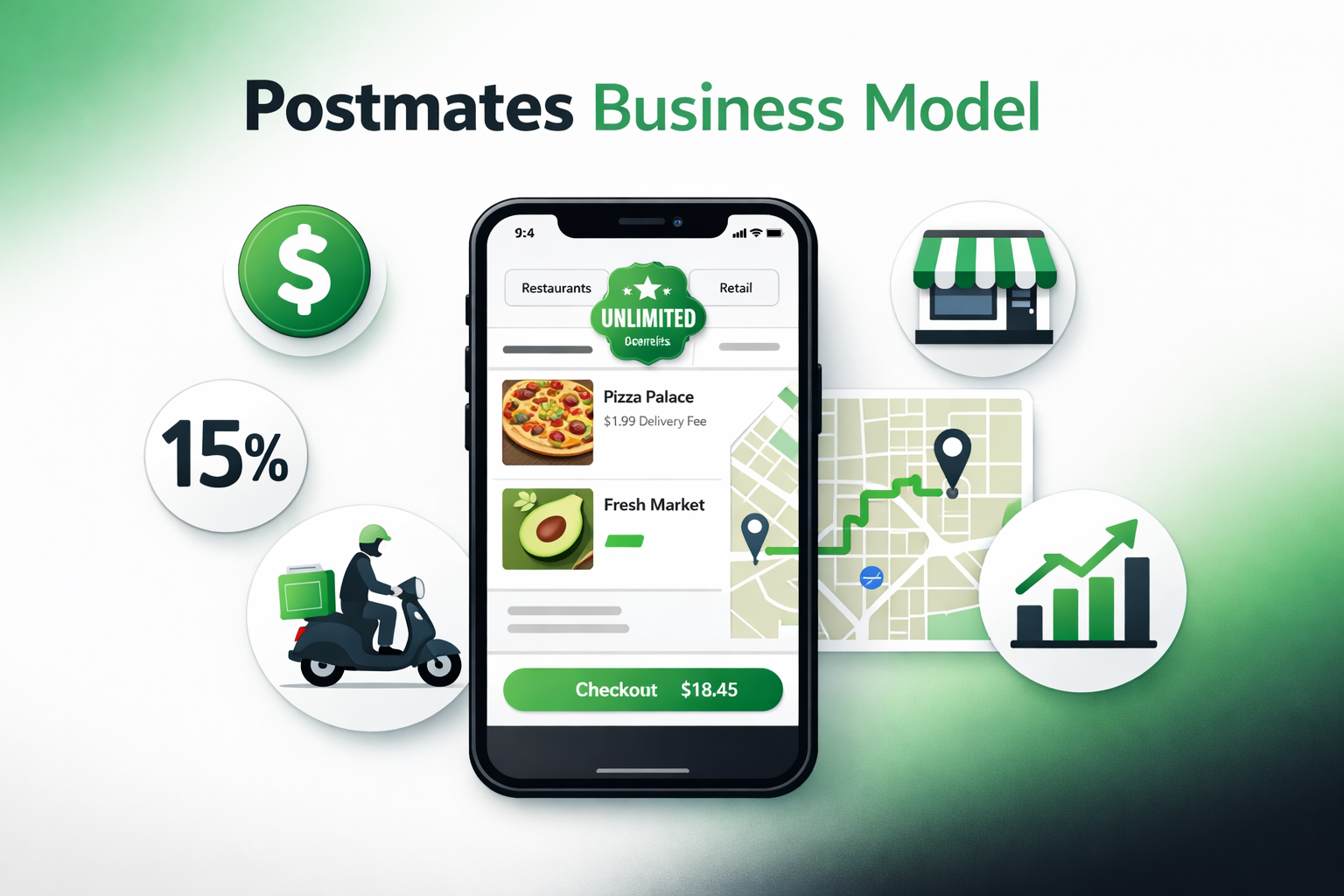
Postmates operated a three-sided marketplace connecting customers, local merchants, and independent couriers. It earned revenue through delivery fees, service fees, merchant commissions, surge pricing, and subscription memberships via Postmates Unlimited. Before being acquired by Uber in 2020, Postmates positioned itself as an “anything delivery” platform not just food competing head-to-head with DoorDash and Grubhub in America’s most densely packed urban markets.
What Was Postmates?
Founded in San Francisco in 2011, Postmates was one of the earliest players in the on-demand delivery space arriving before most people even knew they wanted a stranger to bring them tacos at midnight.
It operated primarily in U.S. urban markets, built its reputation on speed and variety, and was eventually acquired by Uber in 2020 for $2.65 billion in an all-stock deal, after which it was folded into Uber Eats.
What set Postmates apart from the beginning wasn’t just food. While competitors were laser-focused on restaurant delivery, Postmates took a broader swing. It would deliver food, yes — but also groceries, alcohol, retail items, and essentially anything a local store carried. Its unofficial brand promise was simple: if it exists in your city and a courier can carry it, Postmates will get it to you. That “deliver anything” positioning gave it an identity that was distinctly different from the pure-play food delivery apps crowding the same space.
The Core Business Model: A Three-Sided Marketplace
At its foundation, Postmates was a marketplace — and like all marketplaces, it only worked when three groups showed up and found value simultaneously.
Customers (the demand side) ordered through the app, paid a delivery and service fee, and received the convenience of on-demand delivery without leaving home. The more seamlessly that experience worked, the more likely they were to come back. Postmates tried to lock in repeat behavior through its Postmates Unlimited subscription, which offered free deliveries above a minimum order threshold for a flat monthly fee.
Merchants (the supply side) were restaurants, local shops, liquor stores, and grocery outlets that paid Postmates a commission — typically somewhere between 15% and 30% of the order value — in exchange for access to a new stream of customers they wouldn’t have reached otherwise. Beyond just sales, merchants also gained exposure to data and ordering patterns that helped them understand demand in their area.
Couriers — the Postmates Fleet — were independent contractors who accepted delivery jobs through the app, earned a per-delivery rate plus tips, and received bonus incentives during peak hours to ensure supply kept pace with demand.
The flow worked like this: a customer places an order through the app, the platform routes it to a nearby merchant, a courier picks it up and delivers it, and Postmates takes a cut at multiple points along that chain — from the customer via fees, and from the merchant via commission.
How Postmates Made Money
Delivery fees were the most visible charge to customers — calculated based on distance and real-time demand. The further or busier, the more you paid.
Service fees were a percentage-based platform charge layered on top of delivery fees, representing Postmates’ cut for operating the infrastructure connecting all three sides of the marketplace.
Merchant commissions were the core revenue driver. Every order processed through the platform triggered a commission payment from the merchant, typically ranging from 15% to 30%. This was where the bulk of the money came from.
Surge pricing — or Blitz Pricing, as Postmates called it — kicked in during high-demand windows like lunch rushes, Friday nights, or bad weather. Prices rose dynamically to attract more couriers to the network and manage order volume, generating higher revenue per transaction in the process.
Postmates Unlimited was the subscription play a monthly membership that waived delivery fees on orders above a set minimum. It served two purposes: it improved customer retention by giving frequent users a reason to default to Postmates instead of a competitor, and it created a predictable recurring revenue stream that smoothed out the volatility of transaction-based income. The model was directly comparable to DoorDash’s DashPass and Uber’s Uber One all three recognized that subscription revenue was a more stable and defensible business than one-off transactions.
Cost Structure: Where the Money Went
Running a three-sided marketplace at scale is expensive, and Postmates was no exception.
Courier payouts were the single largest cost gig workers needed to be paid competitively enough to stay on the platform and accept orders promptly, especially in competitive markets where DoorDash and Instacart were fishing in the same pool. On top of base payouts, Postmates ran constant incentive and bonus programs to keep courier supply healthy during peak hours, adding another layer of cost.
Marketing and customer acquisition consumed significant capital. In a crowded market with nearly identical core offerings, the platforms competed aggressively on discounts, promotions, and advertising all of which bled margin.
Tech infrastructure, insurance, and compliance costs rounded out the picture, with regulatory battles (particularly around gig worker classification in California) adding unpredictable legal and operational expenses.
The core unit economics challenge the company faced and one that plagued the entire sector was that high growth didn’t equal profitability. More orders meant more courier costs, more customer acquisition spending, and more infrastructure investment. Scaling up often meant losing more money per order, not less.
What Made Postmates Different
The “anything delivery” strategy was the clearest differentiator. By refusing to limit itself to restaurant food, Postmates created a broader use case for its platform. A customer might order dinner one night, grocery items the next morning, and a bottle of wine the same afternoon all through the same app. That versatility was a genuine advantage in building daily habit.
Its hyperlocal urban focus was another strength. Postmates concentrated density in cities like Los Angeles and New York, where order volume was high enough to keep couriers busy and delivery times fast. LA in particular became something of a home market, and that local dominance gave it a real competitive moat in a way that spreading thin across smaller markets never would have.
Brand positioning also played a quiet but real role. Postmates cultivated a younger, lifestyle-oriented identity — less utilitarian, more culturally fluent — that resonated with urban millennials who saw on-demand delivery as part of how they lived, not just a convenience they occasionally used.
The Network Effects at Play
Postmates, like every marketplace, was chasing network effects — the self-reinforcing dynamic where the platform becomes more valuable as it grows.
More customers attracted more merchants who wanted access to that demand. More merchants meant better selection, which attracted more customers. More orders meant couriers could earn more per hour, which brought more couriers onto the platform. More couriers meant faster delivery times, which improved the customer experience and drove more orders.
In theory, this flywheel is powerful. In practice, there’s an important caveat: delivery network effects are local, not global. A dense courier network in Los Angeles does nothing for a customer in Dallas. This meant Postmates had to build the flywheel city by city, neighborhood by neighborhood — a capital-intensive process that never stopped, no matter how well things were going somewhere else.
Why Uber Acquired Postmates
By 2020, the U.S. food delivery market was consolidating fast. DoorDash had pulled ahead nationally, Grubhub was weakening, and Uber Eats was fighting for position. Acquiring Postmates made strategic sense for several reasons.
It gave Uber a significant boost in California Postmates’ strongest market where Uber Eats had less penetration. It added market share at a moment when the gap between the top platforms and everyone else was becoming decisive. And it expanded the overall Uber Eats footprint quickly, without the time and expense of organic growth.
The $2.65 billion all-stock deal closed in December 2020. Postmates’ brand eventually disappeared, absorbed into Uber Eats, but its courier network, merchant relationships, and California customer base became genuine assets inside a larger platform.
Strengths of the Postmates Model
The business had real things going for it. It was a scalable marketplace with an asset-light structure — Postmates didn’t own vehicles, warehouses, or inventory. Its subscription offering created recurring revenue and better retention. Its flexible courier workforce meant it could scale supply up or down in response to demand without carrying fixed labor costs.
Weaknesses and Risks
The model also had structural vulnerabilities that it never fully resolved. Margins were thin across the board, and customer acquisition costs were high in a market where competitors were spending just as aggressively. Its dependence on gig workers created regulatory exposure — California’s AB5 labor law threatened to reclassify couriers as employees, which would have fundamentally altered the cost structure. And the competitive intensity never let up: DoorDash, Uber Eats, and Grubhub were all fighting over the same customers, merchants, and couriers.
Key Business Lessons for Founders
Postmates’ story contains some of the most useful lessons in marketplace building available.
Marketplace liquidity is everything a platform where orders go unfulfilled or wait times are long doesn’t get second chances. Density beats expansion it’s better to dominate one city than to be mediocre in ten. Subscription models improve retention in ways that discounts and promotions never sustainably can. Unit economics matter more than growth rate, especially when investors eventually stop rewarding scale for its own sake. And sometimes the most strategic outcome isn’t an IPO it’s a well-timed acquisition that puts your assets into a platform large enough to fully leverage them.
Postmates Business Model Canvas
| Element | Detail |
|---|---|
| Key Partners | Local restaurants, retail stores, grocery chains, liquor outlets, courier fleet |
| Key Activities | Marketplace operations, courier management, merchant onboarding, tech development |
| Value Propositions | On-demand delivery of anything, speed and convenience, broad merchant selection |
| Customer Segments | Urban consumers, local merchants, independent couriers |
| Revenue Streams | Delivery fees, service fees, merchant commissions, surge pricing, Postmates Unlimited |
| Cost Structure | Courier payouts, incentives, marketing, tech infrastructure, insurance, compliance |
Final Takeaway
Postmates didn’t fail it consolidated. Its model worked, genuinely and demonstrably, in the dense urban environments it was built for. The problem was never the idea. It was the capital required to keep building city-by-city flywheels in a market where two or three well-funded competitors were doing exactly the same thing.
In hyperlocal delivery, the winners are decided by a combination of scale, density, and capital staying power. Postmates had the model right. It just didn’t have enough runway to outrun the consolidation wave it helped create. That’s not a failure story it’s a masterclass in how marketplace businesses live and die by the math of local density.
Discover more from Business Model Hub
Subscribe to get the latest posts sent to your email.