Calm Business Model: How This Meditation App Built a Billion-Dollar Subscription Empire

What is Calm’s business model? Calm operates primarily on a subscription model, offering premium meditation, sleep, and mental wellness content through annual and monthly plans. Beyond individual subscribers, it earns revenue through enterprise wellness programs, healthcare partnerships, and branded content collaborations with celebrities and media companies.
What Is Calm?
Most people discover Calm the same way it’s 1 AM, they can’t sleep, a friend mentions a sleep story narrated by Matthew McConaughey, and suddenly they’re downloading a meditation app they swore they’d never use.
That’s not an accident. It’s a strategy.
Calm was founded in 2012 by Michael Acton Smith and Alex Tew yes, the same Alex Tew who once sold pixels on a webpage for a million dollars. Their core mission was simple but ambitious: make mental wellness accessible to everyone, not just the yoga-studio crowd.
What made Calm different from the start was a deliberate choice to not position itself as a meditation app. Meditation, for most people, carries baggage cross-legged monks, incense, years of practice, spiritual commitment. It’s intimidating. So Calm led with sleep instead. Sleep is universal. Everyone wants better sleep. Nobody feels judged for wanting it.
This reframing was everything. By becoming a sleep-first wellness platform, Calm bypassed the gatekeeping that kept traditional meditation niche and walked straight into the mainstream. The app didn’t ask you to become a meditator. It just offered to help you sleep better tonight.
Calm’s Core Value Proposition
Sleep as the Entry Point
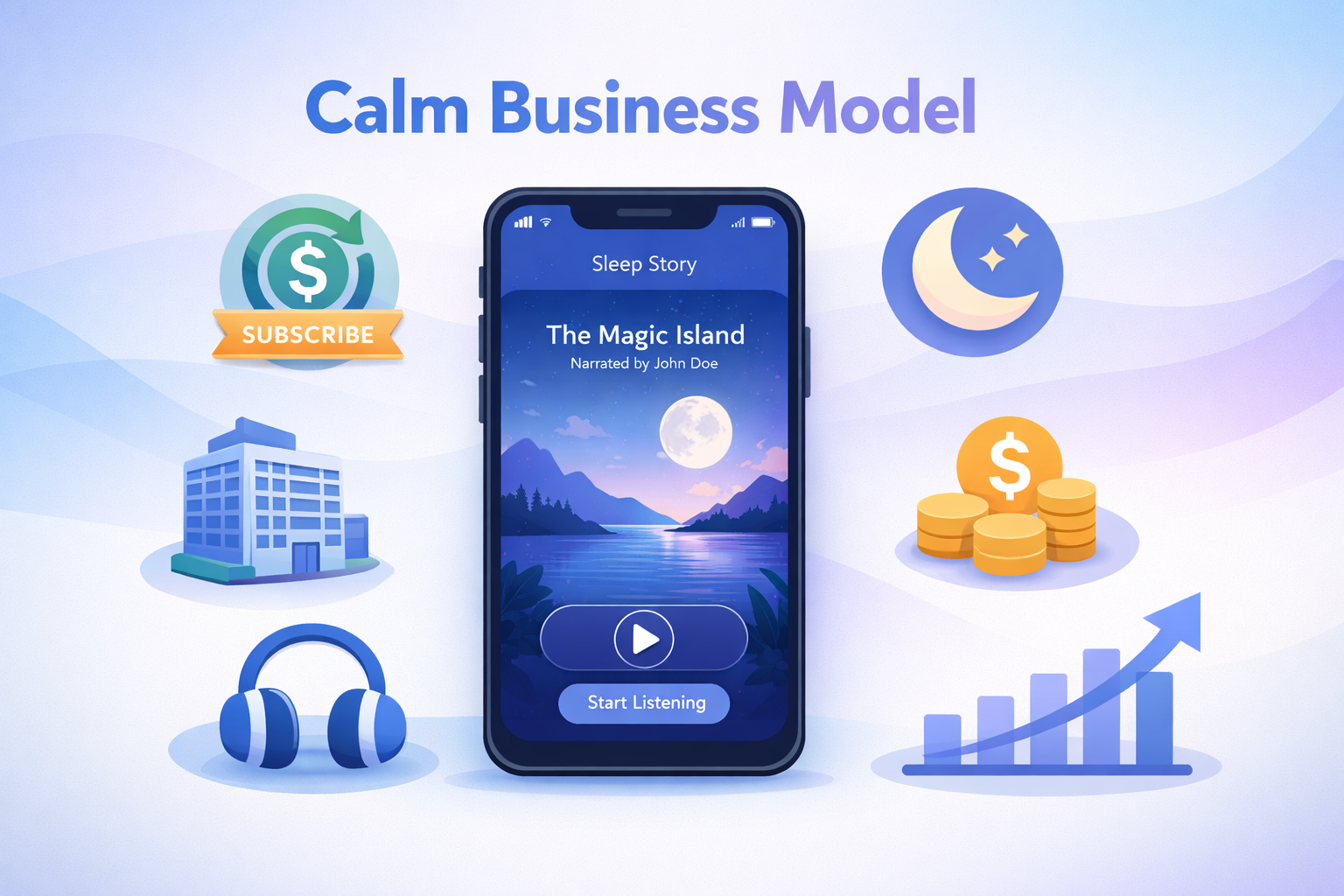
Calm’s Sleep Stories are genuinely one of the most brilliant product decisions in consumer tech of the last decade. The concept is disarmingly simple: bedtime stories for adults, narrated in slow, soothing voices, designed to quiet an anxious mind by giving it just enough narrative to follow without enough stimulation to stay awake.
The celebrity angle amplified everything. When Matthew McConaughey narrated a Sleep Story set on a moonlit train journey through the American West, it went viral. Not because people were desperate for meditation — but because it was genuinely interesting content. It was shareable. It was a story, not a wellness product. That distinction matters enormously in marketing.
Daily Meditation and Mindfulness
Beyond sleep, Calm offers a deep library of guided meditation sessions ranging from two minutes to an hour. The beginner-friendly framing is intentional — sessions are short, the language avoids jargon, and the app rewards consistency with a streak system that borrows directly from the behavioral psychology playbook Duolingo made famous.
Streaks work because they shift the user’s relationship with the product. You’re no longer using Calm. You’re protecting your streak. The sunk cost of consistency becomes a retention mechanism, and the habit becomes self-reinforcing over time.
Mental Health Made Non-Clinical
Perhaps Calm’s most underrated design decision is its aesthetic. The interface is soft blues and greens, nature sounds, gentle animations of rain on leaves or a crackling fire. There are no clinical charts, no therapy terminology, no diagnostic language.
This is emotional branding done well. Calm communicates safety and calm before you’ve even tapped a single button. For a product in the mental health space, where stigma and intimidation remain real barriers, this soft visual language is doing serious conversion work. It tells people: this isn’t scary, this isn’t therapy, this is just a moment of peace. Come in.
How Calm Makes Money
The Subscription Model
Subscriptions are Calm’s engine, and the annual plan is the one the company pushes hardest — typically priced around $70 per year, compared to around $15 per month if you pay monthly. The math is intentional. Annual subscribers are harder to churn. They’ve made a commitment. They’ve mentally amortized the cost to less than $6 a month. And by the time renewal comes around, many have built enough of a habit that cancellation feels like a loss.
The funnel starts with a freemium layer — a selection of free content that’s genuinely good enough to demonstrate value but limited enough to create desire for more. A free trial then converts curiosity into commitment, and the annual plan locks that commitment in place.
Family plans extend the model’s reach by bringing multiple users under one subscription, increasing household penetration and making Calm a shared ritual rather than a personal secret.
Calm for Business
Corporate wellness is Calm’s most strategically important revenue stream after individual subscriptions — and arguably its most stable. Companies pay enterprise licensing fees to offer Calm access as an employee benefit, and the HR buyer is a very different animal from the consumer buyer.
Enterprise deals are larger, stickier, and less sensitive to economic mood. A company that has embedded Calm into its wellness benefits package and promoted it in its employee handbook doesn’t cancel when a competitor runs a promotional offer. The B2B layer also gives Calm something valuable: social proof and institutional credibility that reinforces the consumer brand.
Content Partnerships and Collaborations
Calm has built a content partnership business that functions almost like a media company. Branded sleep stories — where a company sponsors or co-creates content — generate licensing revenue while also serving as marketing. Celebrity partnerships bring new audiences into the app. Media tie-ups extend the content library without bearing the full production cost.
This is a smart model for a content business. Rather than treating every piece of content as a pure cost, Calm has found ways to monetize the content itself, turning what would be an expense line into a revenue line.
Calm Health and Healthcare Expansion
The most ambitious strand of Calm’s revenue strategy is its pivot toward healthcare. Through partnerships with insurers and healthcare providers, Calm is positioning its platform as a legitimate mental wellness tool within clinical ecosystems — one that insurance might cover or reimburse.
This is a long game. The regulatory and partnership complexity is significant. But if Calm succeeds in embedding itself in healthcare the way it has in corporate wellness, it creates a third revenue pillar that is even more durable than the first two. Healthcare contracts are long, sticky, and large.
Calm’s Growth Strategy
Smart Positioning Against Competitors
The two names that come up in every Calm conversation are Headspace and Insight Timer, and the contrast is instructive.
Headspace built its identity around structured meditation — courses, programs, progression. It’s a curriculum. Calm built its identity around feeling — how do you want to feel right now? The difference is product philosophy, and it shapes everything from content decisions to marketing language to who each app attracts.
Insight Timer sits at the other end of the spectrum — free, community-driven, vast. It’s the Wikipedia of meditation apps: enormous, valuable, and not particularly concerned with brand premium.
Calm’s positioning in this landscape is deliberate. It is the lifestyle brand. It prices accordingly, markets emotionally, and curates obsessively. It is not trying to be the biggest or the most comprehensive. It is trying to be the most loved.
App Store Optimization and Emotional Marketing
Calm’s App Store presence leans heavily on its visual identity — the still lake, the soft light, the promise of quiet. Its ads have famously prioritized mood over feature lists. One of its most shared campaigns was simply a two-minute ad that was itself a breathing exercise, requiring nothing of the viewer except to exist quietly for a moment.
This is a sophisticated understanding of who the customer is at the moment of potential conversion. Someone anxious enough about their mental health to search for a wellness app doesn’t want to be sold to. They want to be understood.
Celebrity and Influencer Strategy
The Sleep Story format was purpose-built for celebrity participation, and Calm leveraged this brilliantly. A celebrity narrating a Sleep Story generates press coverage, social sharing, and new user discovery — all for the cost of the partnership, with none of the blunt-instrument awkwardness of traditional celebrity endorsement.
The celebrity lends authority. Calm borrows credibility. Users get a genuinely good product. The viral loop closes itself.
The Pandemic Effect
No honest account of Calm’s growth omits 2020. The pandemic created a mental health crisis at global scale and, simultaneously, sent hundreds of millions of people to their phones looking for relief. Calm’s downloads surged. Its revenue grew. The category it had been patiently building for years suddenly had an enormous, urgent, immediate market.
Remote work normalized digital wellness in a way that would have taken a decade without the pandemic catalyst. Employers who had never thought about employee mental health suddenly had to. Calm was there, ready, with an enterprise product and a consumer brand people already trusted.
Calm’s Cost Structure
Running a content business at scale is expensive in ways that aren’t immediately obvious. Content production — scripting, recording, editing, scoring — is ongoing and labor-intensive. Celebrity licensing isn’t cheap. App development for multiple platforms, constant updates, and a seamless audio experience requires real engineering talent.
Marketing is where content businesses often feel the most pressure. Unlike a SaaS tool that spreads through professional networks or a social app that grows through sharing, a wellness app has to spend to acquire users at scale. Calm’s marketing budget has historically been significant.
The important distinction from pure software businesses is the marginal cost dynamic. Once a piece of software is built, distributing it costs almost nothing. Content businesses face recurring production costs — every new Sleep Story, every new meditation session, every new celebrity partnership is a real expenditure. The catalog grows, but so does the cost of maintaining and expanding it.
Where Calm’s model does scale attractively is on the subscription side. Each new subscriber adds revenue with relatively low marginal cost once the content library exists. The challenge is keeping acquisition costs low enough that subscriber lifetime value — driven by retention — remains healthy. This is why the annual plan, the streak system, and the habit formation mechanics aren’t just nice product features. They’re business model fundamentals.
Calm’s Competitive Advantage
Calm’s real moat isn’t its content library or its technology both of which can be replicated with enough money and time. Its moat is emotional brand identity.
Calm occupies a specific feeling in people’s minds. When life gets overwhelming, certain people reach for Calm the way other people reach for a particular tea or a walk in a specific park. That kind of brand association is slow to build and very hard to dislodge.
Layer on top of that the retention mechanics streaks, habits, the sense of a personal journey — and you have high switching costs that aren’t based on data lock-in or technical friction but on something more powerful: identity. People who use Calm regularly start to think of themselves as someone who does this. Leaving the app feels like abandoning a part of themselves.
The ecosystem expansion into enterprise and healthcare extends this moat by embedding Calm in institutional relationships that are structurally sticky.
Is Calm Profitable?
Here’s where the story gets more complicated, and honesty requires acknowledging that.
Calm reached unicorn status a valuation over a billion dollars and has raised hundreds of millions in funding. Its revenue grew rapidly through the pandemic years. But subscription businesses at growth stage are expensive to run, and Calm has not been publicly transparent about profitability.
The challenges are real. Customer acquisition costs are high in a competitive market. Content costs are ongoing. Marketing a lifestyle brand at scale isn’t cheap. And while the subscription model is inherently recurring, churn in consumer wellness apps remains a genuine problem many people subscribe during a moment of motivation and cancel when life gets busy.
The healthcare pivot is partly a strategic response to these pressures an attempt to find more durable, higher-value revenue relationships that aren’t as exposed to the volatility of consumer sentiment and seasonal motivation patterns.
Whether Calm achieves durable profitability at scale will depend on how effectively it navigates the healthcare channel, how well it retains subscribers through habit formation, and whether its brand premium holds up as more competitors — including, potentially, Big Tech — enter the wellness space.
Calm Business Model Canvas
| Key Partners | Celebrities, enterprise clients, healthcare providers, media companies |
| Key Activities | Content creation, app development, brand marketing, enterprise sales |
| Value Proposition | Better sleep, mental clarity, accessible mindfulness without clinical intimidation |
| Customer Segments | Individual consumers, corporate HR buyers, healthcare systems |
| Channels | App stores, direct sales teams, healthcare partnerships |
| Revenue Streams | Individual subscriptions, enterprise licensing, content partnerships, healthcare integrations |
| Cost Structure | Content production, celebrity licensing, engineering, marketing, infrastructure |
| Key Resources | Brand identity, content library, celebrity relationships, enterprise relationships |
SWOT Analysis of Calm
Strengths — Calm’s brand recall is genuinely exceptional for a wellness app. The subscription model creates recurring, predictable revenue. The content library represents years of production investment that creates real switching costs. Emotional branding gives it pricing power that pure-feature competitors struggle to match.
Weaknesses — Marketing spend is heavy and ongoing. Content dependency means the cost structure never fully scales the way pure software does. The consumer wellness category is notoriously susceptible to motivation cycles people subscribe when they’re stressed, lapse when they feel better. And the app remains deeply English-language and Western-culture centric despite global ambitions.
Opportunities — Healthcare is the big one. If Calm can establish itself as a reimbursable mental wellness tool within insurance ecosystems, it accesses a fundamentally different revenue structure. Global localization genuinely localizing content, not just translating it represents a massive untapped market. The workplace mental health conversation is only deepening, which favors the B2B channel.
Threats — Free apps like Insight Timer provide real value at zero cost, creating permanent price pressure at the low end. Big Tech is the existential question mark: Apple, Google, and Amazon all have the distribution, the platform access, and the capital to enter wellness seriously if they choose to. And mental health remains a category where consumer behavior is hard to predict what feels urgent today may feel less so tomorrow.
Key Lessons Founders Can Learn from Calm
The most important lesson from Calm isn’t about meditation. It’s about framing. Calm didn’t sell a feature — it sold a feeling. It didn’t say “we have 500 guided meditations.” It said “you deserve to feel calm.” That emotional positioning is the difference between a utility and a brand.
The wedge strategy deserves study too. Calm picked sleep as its entry point and went deep before going wide. Sleep was accessible, universal, unintimidating a perfect first door into the broader wellness conversation. Once users were inside for sleep, expanding to meditation, anxiety, focus, and eventually healthcare became natural rather than jarring.
The subscription model over one-time purchases was a foundational choice that has compounded in value every year. Recurring revenue changes how you build, how you retain, and how investors value the business. One-time purchases optimize for acquisition. Subscriptions optimize for relationships.
And perhaps most importantly: mental health is a long-term category. The underlying human need isn’t going away. Stress, anxiety, poor sleep, emotional overwhelm — these are features of modern life, not bugs that will be patched. Calm made a bet on a durable category, and the category has rewarded that bet.
Conclusion
Calm is not, at its core, an app. It is a lifestyle brand that happens to be delivered through an app. The distinction matters because lifestyle brands operate by different rules than software products. They create identity, not just utility. They generate loyalty, not just usage. They can charge premium prices not because they are technically superior but because they make people feel a certain way.
The subscription psychology underneath Calm’s model is particularly well-suited to wellness. Unlike entertainment subscriptions, where you might cancel when you’ve watched everything you want, a wellness subscription is tied to ongoing need. Stress doesn’t end. The need for sleep doesn’t resolve. The habit, once formed, wants to continue.
Whether the model is sustainable long-term is a genuinely open question. The healthcare pivot needs to mature. Profitability needs to be demonstrated. The threat from better-resourced competitors needs to be navigated. But the underlying insight that people will pay, reliably and repeatedly, for something that makes them feel better is not going away. Calm found that insight early, built a brand around it with unusual skill, and created a business model that, at its best, aligns what’s good for the user with what’s good for the company. In wellness, that alignment is everything.
Discover more from Business Model Hub
Subscribe to get the latest posts sent to your email.