Duolingo Business Model: How a Free Language App Became a Billion-Dollar Company

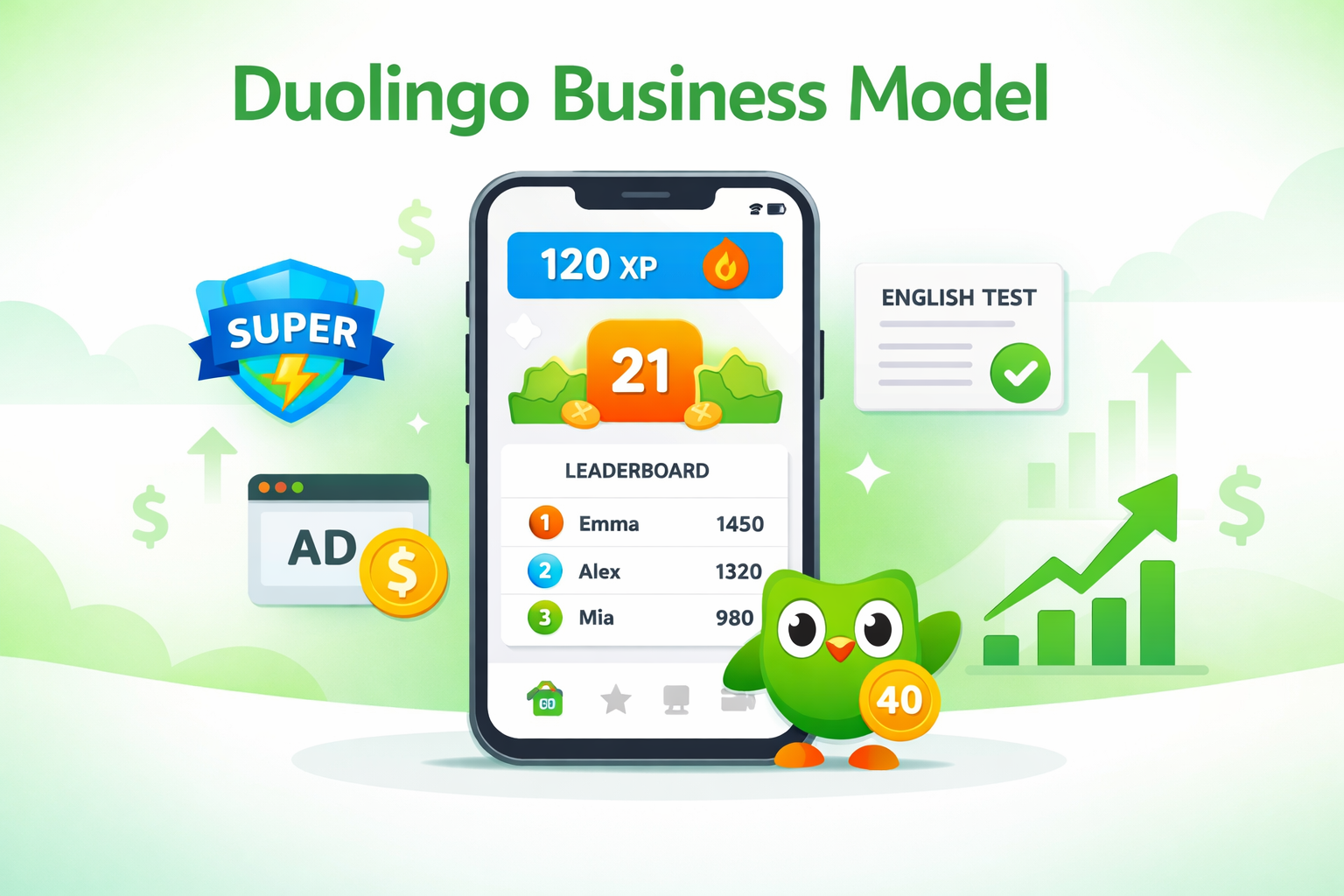
Duolingo makes money primarily through subscriptions (Super Duolingo), in-app advertising, and its English proficiency test. It runs on a freemium model users learn for free, but pay for an ad-free experience and advanced features. But that’s just the surface. The real genius of Duolingo is how it turns habit formation into predictable, scalable revenue.
What Is Duolingo?
Duolingo isn’t your typical education app. It’s a behavior machine disguised as a language teacher.
Founded in 2011 by Luis von Ahn (the same mind behind reCAPTCHA) and Severin Hacker, Duolingo was built on a bold premise: what if learning a language felt less like studying and more like playing a game? That premise turned into one of the most downloaded apps in the world, with over 500 million registered users across 40+ languages.
The company went public on Nasdaq in 2021 under the ticker DUOL, signaling its transition from viral app to serious EdTech business. Today, Duolingo sits at the intersection of education and entertainment — a category often called “edutainment” and it does it better than almost anyone else.
The Core Business Model
The Freemium Foundation
Everything Duolingo does starts with one decision: make the core product completely free.
This sounds counterintuitive for a business, but in consumer apps, free access is the most powerful distribution strategy ever invented. When there’s no cost to try, the barrier to downloading becomes nearly zero. Duolingo has exploited this brilliantly. Hundreds of millions of users have started learning Spanish, French, Japanese, or Hindi without entering a single credit card number.
Freemium works especially well in education because learning itself is the hook. Once you’ve completed ten lessons, hit a five-day streak, and started recognizing words in a foreign language you’re invested. The product has already delivered value before asking for a rupee.
The free tier is genuinely good. That’s intentional. A watered-down free experience would kill word-of-mouth. By making free users love the product, Duolingo turns them into its own marketing department.
Subscription Revenue – Super Duolingo
The real money comes from Super Duolingo (formerly Duolingo Plus), the premium subscription tier. For roughly $6.99 to $12.99 per month depending on the plan, users get an ad-free experience, unlimited hearts (which limit mistakes in the free version), offline access, and advanced progress tracking.
The pricing psychology here is deliberate. At under $10/month, Super Duolingo costs less than a single coffee shop visit. That low price point makes the “why not?” calculation easy. Duolingo also offers annual plans that reduce the per-month cost significantly, pushing users toward longer commitments and reducing churn.
Family plans, which allow up to six members at a discounted rate, are another smart layer. They tap into the social dynamics of learning parents buying subscriptions for children, couples learning together, friend groups competing on leaderboards.
The conversion engine behind all of this is the streak. Once you’ve maintained a 30-day, 60-day, or 100-day learning streak, losing it feels genuinely painful. Super Duolingo’s “Streak Freeze” feature — which protects your streak on days you miss becomes less of a feature and more of an emotional insurance policy. People pay to protect something they’ve built, not just to access something new.
Advertising Revenue
Free users aren’t just charity. They’re inventory.
Duolingo monetizes its massive free user base through in-app advertising. Short ads appear between lessons — similar to how they appear in mobile games. The placement is calculated: ads show up at natural pause points, not mid-lesson, which minimizes friction and keeps the user experience intact.
Advertising in an education context is a tightrope walk. Show too many ads and you signal that you don’t respect the learner’s time. Show too few and you leave money on the table. Duolingo threads this needle by making the ad experience just uncomfortable enough that Super Duolingo’s ad-free promise becomes genuinely appealing. The ads aren’t just a revenue stream — they’re also a conversion tool.
The Duolingo English Test – The Hidden Gem
If Super Duolingo is Duolingo’s bread and butter, the Duolingo English Test (DET) is its most underrated business move.
The DET is an online English proficiency certification that competes directly with IELTS and TOEFL — tests that typically cost $200 to $300 and require scheduling at physical test centers weeks in advance. The DET costs around $65, can be taken from home in under an hour, and delivers results within 48 hours.
Hundreds of universities worldwide — including many in the US, UK, Canada, and Australia — now accept DET scores for admissions. For international students, especially those in price-sensitive markets like India, Nigeria, or Southeast Asia, this is a massive value proposition.
The DET is a high-margin product. It doesn’t require physical infrastructure, it scales digitally, and it addresses a genuine pain point with a dramatically better price-to-convenience ratio than incumbents. As more universities accept it, the network effect strengthens. This is Duolingo’s clearest move beyond the consumer app space into institutional B2B territory — and it’s growing fast.
How Duolingo Actually Acquires Users
Organic App Store Dominance
Duolingo consistently ranks among the top free apps in the Education category on both the App Store and Google Play. Strong ratings, high review volume, and years of algorithmic momentum give it organic visibility that most EdTech companies would pay millions to replicate.
TikTok and Meme Marketing
Few brands have mastered social media chaos as well as Duolingo. Its TikTok account — built around the iconic green owl mascot Duo — became a cultural phenomenon by leaning into absurdist humor, internet trends, and self-aware brand comedy. Duo the owl became a meme, and memes are free advertising at scale.
This wasn’t accidental. Duolingo’s social team made a deliberate bet that personality-driven, lo-fi content would outperform polished brand campaigns in the attention economy. They were right. Millions of followers, billions of organic impressions, and brand recognition that punches far above its marketing budget.
Streak Psychology and Push Notifications
Duolingo’s push notification strategy is legendary in product circles. Notifications range from gentle reminders to guilting messages from Duo himself — “You haven’t practiced today. Don’t make Duo sad.” These aren’t just funny. They’re psychologically engineered re-engagement tools.
The streak mechanic is the backbone of Duolingo’s retention strategy. A streak creates a daily obligation. Once it’s long enough, missing a day feels like a personal failure. This is operant conditioning applied to language learning, and it works at scale.
Gamification Mechanics
Duolingo’s gamification layer is what separates it from every serious language learning alternative. XP points reward effort, not just correctness. Leaderboards create competitive pressure within friend groups and anonymous cohorts. Streak Freezes provide safety nets. Achievement badges mark milestones.
None of these features teach you a language faster. But they keep you coming back tomorrow. And in a product where daily engagement is everything, that retention advantage translates directly into revenue. Duolingo doesn’t sell language learning. It sells the daily habit of feeling like you’re making progress.
Duolingo’s Cost Structure
Running a product at this scale isn’t cheap. Duolingo’s major cost centers include research and development, which consumes the largest portion of its operating expenses as the company continuously builds new features, AI tutors, and language content. AI and product development have become increasingly central — Duolingo has invested heavily in generative AI to power conversational practice features and personalized learning paths.
Marketing, while lower than many consumer apps due to organic virality, still requires investment in social media, influencer partnerships, and app store optimization. Server and infrastructure costs scale with user growth. Content localization building quality lessons across 40+ languages for learners from dozens of native languages requires ongoing investment in linguistic expertise. And like any tech company, competitive compensation for engineering and product talent represents a significant ongoing cost.
Revenue Streams at a Glance
| Revenue Stream | What It Is | Why It Works |
|---|---|---|
| Subscriptions | Super Duolingo monthly/annual plans | Recurring, predictable revenue with high retention |
| Advertising | In-app ads for free users | Monetizes non-paying majority; drives upgrade intent |
| English Test | DET proficiency certification | High-margin, scalable, growing institutional acceptance |
| In-App Purchases | Streak freezes, gem packs, boosters | Micro-monetization that catches non-subscribers |
Why Duolingo’s Model Actually Works
Here’s the honest analysis: Duolingo has built something rare a business where the product’s addictiveness and the revenue model are perfectly aligned.
Most apps face a tension between engagement and monetization. Push too hard on monetization and you damage the experience. Duolingo sidesteps this by letting the product build emotional investment first. By the time a user considers paying, they already have a 40-day streak, a growing vocabulary, and a daily ritual. The upsell isn’t “pay us for education.” It’s “pay us to protect something you’ve already built.”
The free top-of-funnel is massive and global, which means paid conversion doesn’t need to be high to generate serious revenue. Even a 5% conversion rate on 500 million users is 25 million paying subscribers. The brand personality irreverent, funny, slightly threatening via Duo’s passive-aggressive notifications — drives organic sharing in ways that expensive campaigns never could. And streaks create switching costs that Apple and Netflix would envy.
Duolingo doesn’t pressure users to pay. It builds dependency first. Then the payment feels like a rational choice.
Duolingo Business Model Canvas
Customer Segments
Duolingo serves several distinct groups simultaneously. The largest segment is casual learners people who want to pick up a new language for travel, personal enrichment, or curiosity, with no formal learning commitment. The second major segment is students and young professionals, particularly in emerging markets like India, Brazil, and Southeast Asia, who are learning English as a second language for academic or career advancement. A third, high-value segment is international students and visa applicants who need a recognized English proficiency score for university admissions these users are the primary customers of the Duolingo English Test. Finally, there is a small but growing segment of corporate and institutional buyers exploring Duolingo for workplace language training.
Value Propositions
For free users, the core promise is accessible, gamified language learning with zero upfront cost. The experience is designed to feel rewarding in short sessions five to ten minutes a day which removes the “I don’t have time” objection entirely. For paying subscribers, Super Duolingo adds an uninterrupted, ad-free experience with unlimited practice and offline access, essentially buying back the friction that the free tier deliberately introduces. For DET candidates, the value proposition is dramatically sharper a certified English proficiency test at a fraction of the cost and complexity of IELTS or TOEFL, deliverable from home within 48 hours. Across all segments, the underlying promise is the same: language learning that feels like something you want to do, not something you have to do.
Channels
Duolingo’s primary channel is the mobile app itself, available on iOS and Android, which drives the vast majority of engagement and revenue. The App Store and Google Play serve as both distribution and discovery channels Duolingo’s strong ratings and review volume generate significant organic search traffic within both platforms. Social media, particularly TikTok and Instagram, functions as a brand awareness and user acquisition channel, with Duo the owl’s viral presence driving millions of organic impressions at minimal cost. Push notifications serve as a retention channel, re-engaging users who have lapsed. The Duolingo website handles web-based learning sessions, DET registrations, and direct subscription sales. Word of mouth driven by the streak-sharing culture and leaderboard competition — remains one of its most cost-efficient acquisition channels.
Customer Relationships
Duolingo’s relationship with users is built almost entirely on behavioral design rather than human interaction. The streak mechanic creates a self-reinforcing daily ritual that makes the relationship feel personal even though it is fully automated. Push notifications, achievement badges, and leaderboard updates maintain a constant low-grade engagement loop. For Super Duolingo subscribers, the relationship deepens through exclusive features that reward loyalty. For DET users, the relationship is more transactional but still trust-dependent the test’s credibility hinges on Duolingo maintaining its reputation with universities and accreditation bodies. There is no meaningful human support layer for most users, which keeps costs low but also creates a ceiling on how deeply Duolingo can serve serious or advanced learners.
Revenue Streams
Duolingo generates revenue from four primary sources. Subscription revenue from Super Duolingo is the largest and most predictable stream, driven by monthly and annual plans with strong renewal rates anchored to streak psychology. Advertising revenue monetizes the free user base through in-app display and video ads placed between lessons this stream scales directly with daily active users. The Duolingo English Test is a high-margin, high-growth revenue stream with a $65 per test price point, minimal variable cost, and expanding university acceptance. In-app purchases including gem packs, streak freezes, and other consumable boosters generate micro-transaction revenue from users who don’t subscribe but are willing to pay for specific protections or advantages. Of these, subscriptions and the DET represent the most strategically important streams due to their margin profile and growth trajectory.
Key Resources
Duolingo’s most valuable resource is its data hundreds of millions of learners generating behavioral signals that feed better personalization, AI models, and product decisions. The brand and Duo the owl mascot represent significant intangible assets, particularly given their organic cultural reach. The technology platform including the AI and machine learning infrastructure behind adaptive learning, the DET’s remote proctoring system, and the gamification engine is a core resource. Duolingo’s content library, spanning 40+ languages with thousands of structured lessons, represents years of investment in linguistic expertise and localization. Finally, its university and institutional relationships underpin the credibility of the DET as a certification product.
Key Activities
The company’s primary activities cluster around three areas. Product development and AI research consume the largest share of resources continuously improving the learning experience, building new language content, expanding AI tutoring features, and maintaining the technical infrastructure at scale. Growth and retention activities include managing the gamification engine, optimizing push notification strategies, running social media channels, and improving App Store conversion. The third major activity is operating and expanding the Duolingo English Test managing test integrity, remote proctoring, university partnership development, and accreditation maintenance. This last activity is qualitatively different from the consumer app business and requires a more institutionally oriented operational capability.
Key Partnerships
Duolingo’s most strategically critical partnerships are with the universities and institutions that accept DET scores. Every new university that joins the network increases the test’s value to prospective candidates. Apple and Google are unavoidable platform partners and also structural dependencies controlling distribution and taking a 30% cut of in-app subscription revenue. Advertising network partners enable programmatic ad delivery to free users. AI infrastructure providers, including cloud computing platforms, underpin the scalability of the product. Linguists, language educators, and content creators contribute to curriculum development, though much of this is handled in-house.
Cost Structure
Duolingo’s cost base is dominated by research and development, which includes engineering, AI development, and product design the ongoing investment in what makes the product better and stickier. Content creation and localization represent a significant ongoing cost given the breadth of languages and the need to maintain quality across all of them. Marketing and user acquisition, while partially offset by organic virality, still require investment in performance marketing, social media, and DET brand building in international markets. Cloud infrastructure and server costs scale with the user base and grow as AI features demand more compute. General and administrative costs, including competitive engineering talent compensation, round out the structure. Notably, Duolingo’s cost model benefits from the fact that serving an additional free user is nearly zero marginal cost — the heavy fixed investment in content and technology is already made, making scale genuinely accretive.
Where Duolingo Could Struggle
No business model is bulletproof. Duolingo faces several real threats worth examining.
The rise of conversational AI is perhaps the most disruptive. Tools like ChatGPT can already simulate language practice conversations at zero marginal cost. If AI tutors become widely accessible and genuinely effective, Duolingo’s gamified lesson structure may start to feel shallow by comparison. The company is investing in AI features, but the competitive pressure is real.
Free alternatives on YouTube channels with millions of subscribers teaching Spanish, Mandarin, or French in depth offer something Duolingo struggles with: genuine depth for intermediate and advanced learners. Duolingo is widely criticized for being excellent at beginners but thin at upper-intermediate levels. Competitors like Babbel focus on conversational fluency and have carved out a premium segment. Rosetta Stone, despite its decline, still carries institutional credibility in some markets.
User churn after a broken streak is a documented vulnerability. Once the streak is gone, many users simply don’t return the emotional anchor has been severed. App store dependence means Apple and Google each take 30% of subscription revenue and control distribution. EdTech regulation in key markets like China has already disrupted the broader industry once.
SWOT Snapshot
Duolingo’s strengths are formidable: a massive, loyal user base, one of the most recognizable brand mascots in mobile apps, and a data advantage from hundreds of millions of learners that feeds better AI models. Its weaknesses center on limited depth for serious learners and the inherently shallow engagement ceiling of gamified bite-sized lessons.
The opportunities are significant AI-powered tutoring could close the depth gap, and expanding the DET into more certifications or professional language credentials would open new revenue verticals. Internationally, markets like India, Brazil, and Southeast Asia represent enormous untapped subscription potential. The threats, however, are real: AI chatbots as free language tutors, new EdTech startups without legacy structures to defend, and a generation of users who may demand more than points and streaks from their learning tools.
Lessons for Founders
Duolingo’s trajectory holds several lessons that apply well beyond EdTech.
Start with free distribution. Paid acquisition in consumer apps is brutally expensive. Duolingo’s free model gave it a user base that no marketing budget could have bought. Build habits before monetizing. The streak feature existed long before aggressive subscription upsells. By the time Duolingo asked users to pay, the product had already made itself indispensable. Make it fun, not just functional. A hundred apps teach Spanish. Duolingo made learning Spanish feel like a personality trait. That emotional identity — “I’m a Duolingo person” — is worth more than any feature. Add high-margin side products. The DET didn’t emerge from the core product but it leverages the same brand trust and user base at dramatically higher margins. Monetize at scale, not early. Duolingo’s model only works because of the volume of its free user base. Pressuring early users to pay would have killed the growth engine before it reached critical mass.
The Final Take
Duolingo isn’t just a language app. It’s a habit engine wrapped inside education, dressed up as a game, and powered by one of the cleverest freemium models in consumer tech.
It succeeded not by building the best language teaching product serious linguists will tell you there are more rigorous alternatives but by building a product people actually use every day. In EdTech, daily use beats pedagogical excellence every single time, because a lesson you skip teaches you nothing.
A few things to carry away from its story: the best consumer products create emotional investment before asking for money; gamification isn’t a gimmick it’s a retention architecture; brand personality compounds like interest over time; and the most durable moats in software are behavioral, not technical.
Duolingo built a product that makes skipping feel worse than continuing. That’s not just good product design. That’s a business model.
Discover more from Business Model Hub
Subscribe to get the latest posts sent to your email.