AR/VR Gaming Live Stream Startups: Innovations & Business Models Shaping the Future of Interactive Entertainment

AR/VR gaming live stream startups combine immersive gameplay, creator-led streaming, and real-time audience interaction to generate revenue through subscriptions, virtual goods, sponsorships, ads, and in-experience purchases. They don’t just stream games they stream presence.
What Is AR/VR Gaming Live Streaming?
Traditional game streaming operates on a simple premise: one person plays, millions watch a flat screen. It is fundamentally a broadcast medium dressed in gaming clothes. AR/VR gaming live streaming inverts this entirely. Viewers don’t observe a game from the outside they inhabit it. They exist inside the spatial environment, represented as avatars, capable of interacting with both the streamer and the virtual world in real time.
This is not Twitch 2.0. This is spatial entertainment and the distinction matters enormously for anyone building in this space.
The ecosystem sits on three interconnected layers. At the hardware layer, devices like the Meta Quest ecosystem, Sony’s PlayStation VR, and Valve’s SteamVR platform provide the physical gateway into immersive environments. Motion tracking technology translates physical movement into digital presence. The software layer streaming engines, low-latency multiplayer servers, and spatial rendering pipelines handles the enormous computational load of rendering three-dimensional environments for simultaneous audiences. Above all of this sits the audience interaction layer, where real-time 3D engagement transforms passive viewership into participatory experience.
The result is something genuinely new: entertainment infrastructure where the line between performer and audience begins to dissolve.
The Market Opportunity
Growth of VR Hardware
VR hardware adoption has followed a familiar technology curve initially slow, then suddenly rapid as device costs decline and content libraries deepen. Headsets that once cost over a thousand dollars are now accessible to mainstream consumers, and the addressable market has expanded accordingly. Enterprise adoption, fitness applications, and social platforms have broadened use cases well beyond gaming, pulling in demographics that traditional game streaming never captured.
Rise of the Creator Economy
The creator economy generates hundreds of billions annually, with platforms like Twitch and YouTube capturing the lion’s share through relatively flat, passive video content. AR/VR live streaming startups sit at the intersection of creator monetization and immersive technology a combination that neither legacy streaming platform nor standalone VR company has fully exploited. The opportunity isn’t to compete with Twitch on its own terms. It’s to build an entirely different category of entertainment infrastructure beneath it.
Demand for Interactive Experiences
Consumer expectations for digital entertainment have fundamentally shifted. Audiences who grew up with Roblox, Fortnite’s live events, and Discord communities don’t merely want to watch they want to participate, co-create, and belong. Gamification layered over social presence, virtual meetups, and creator-led live events aren’t novelties for this generation. They are baseline expectations. AR/VR streaming startups are building for an audience that already thinks spatially about online interaction.
Core Innovations Driving This Space
The technical innovations powering AR/VR gaming live stream startups aren’t incremental improvements on existing streaming technology. They represent fundamentally different architectural choices that enable new forms of entertainment.
Spatial Live Streaming places the audience inside the game world itself not watching from outside, but present within it. Viewer avatars exist within the game environment, positioned in spectator areas, virtual arenas, or interactive zones the platform architect designs. This transforms the spectator relationship from observer to participant, with enormous implications for how creators perform, how communities form, and how platforms monetize attention.
Interactive Three-Dimensional Chat replaces the text chat feed that defined Twitch’s community experience with avatar-based communication. Viewers express reactions and commentary through spatial gestures, avatar animations, and positional voice. This is dramatically richer than a scrolling chat window and creates social dynamics more analogous to being physically present at a live event.
Real-Time Virtual Gifting upgrades the digital tip jar into a spatial spectacle. When a viewer sends a gift, it doesn’t appear as a notification banner it manifests as a three-dimensional animated object inside the virtual environment. A fireworks display erupts above the arena. A crown materializes over the streamer’s avatar. The gift becomes a social event, visible to everyone present, which dramatically amplifies both the emotional value for the sender and the monetization potential for the platform.
Mixed Reality Integration blends physical and virtual environments in ways that create genuinely novel content formats. A streamer’s real face and body can appear within a virtual game world, grounding the experience in human authenticity while maintaining immersive spectacle. This is particularly powerful for competitive gaming, where seeing a player’s physical reactions while simultaneously viewing their in-game performance creates a richer emotional narrative.
AI-Powered Stream Personalization addresses one of the fundamental challenges of spatial streaming — there is no fixed camera, which means the platform must intelligently surface the most compelling perspectives for each viewer. AI systems that dynamically adjust camera angles, automatically generate highlight reels, and personalize the viewing experience based on individual preferences will become a core competitive differentiator as the space matures.
Business Models of AR/VR Gaming Stream Startups
The business model landscape for AR/VR streaming startups is meaningfully different from traditional streaming platforms, and founders who treat it as identical will misallocate their monetization architecture.
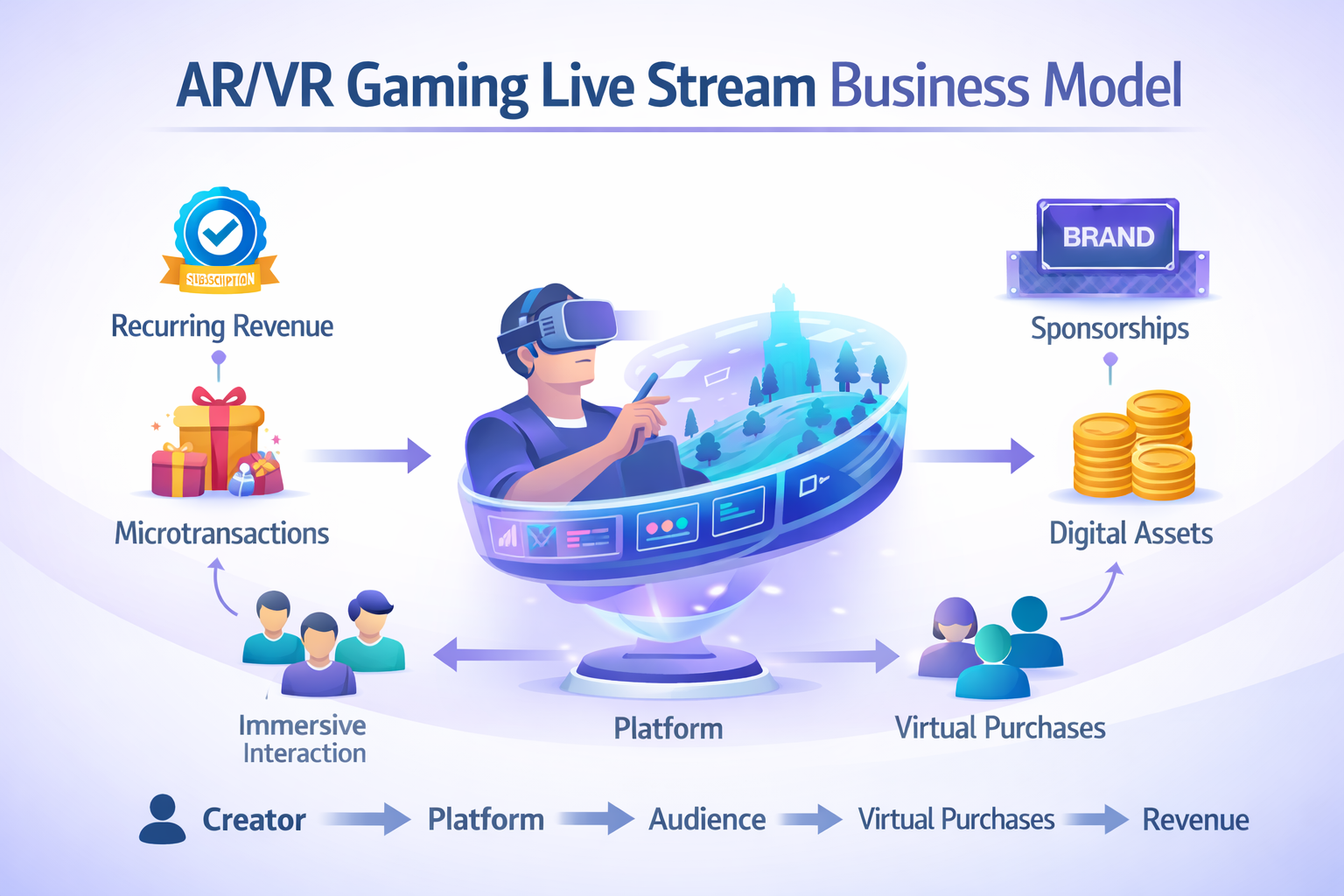
The subscription model grants premium subscribers access to exclusive VR events, private creator sessions, and enhanced spatial features unavailable to free users. The key insight here is that exclusivity in spatial entertainment has more emotional weight than in flat-screen streaming — being physically present in a limited-access virtual arena feels categorically different from watching a subscriber-only VOD.
Virtual goods and microtransactions represent the highest-margin revenue stream and the one most native to the medium. Skins, emotes, avatar upgrades, and limited-edition digital items monetize identity and self-expression in ways that are deeply familiar to the gaming generation. The critical execution factor is creating genuine scarcity and social visibility virtual goods must be seen by others to carry social currency.
The platform commission model follows the Twitch and App Store playbook: take a percentage of all creator revenue generated through the platform, including subscriptions, virtual gifts, and paid event access. The healthier the creator economy on the platform, the more valuable this revenue stream becomes — which means creator acquisition and retention become strategic priorities rather than marketing line items.
Sponsorship and brand placement unlock a revenue category that doesn’t exist in flat streaming: the virtual billboard. Brands can place immersive advertising inside VR worlds stadium sponsorships, branded in-game environments, avatar gear partnerships in ways that are far more contextually integrated than a pre-roll ad. For brands targeting younger, tech-forward demographics, the ability to be present inside the entertainment experience rather than interrupting it represents a fundamentally superior advertising proposition.
The hardware bundling model involves strategic partnerships with headset manufacturers. A VR headset bundled with a platform subscription or exclusive streaming content becomes more valuable to the consumer and creates a distribution channel that bypasses traditional app store gatekeeping. For early-stage startups, hardware partnerships also provide credibility and access to device-level marketing budgets.
Finally, NFT and digital asset ownership models while speculative and currently out of favor represent a potential future layer for rare virtual items, particularly as blockchain infrastructure matures and consumer trust stabilizes. Founders should watch this space without betting the company on it.
Business Model Canvas at a Glance
The customer segments are three distinct groups with different needs: gamers who want richer competitive and social experiences, creators who want better monetization tools and more engaged audiences, and spectators who want participatory entertainment rather than passive viewership. The value proposition is spatial presence the feeling of being somewhere, not just seeing something.
Channels include app stores on headset platforms, creator partnerships, direct community-building, and hardware manufacturer relationships. Revenue streams layer subscriptions, virtual goods, platform commissions, and brand sponsorships. Key resources are the three-dimensional streaming engine, low-latency server infrastructure, and the creator ecosystem. Key partners are game studios, headset manufacturers, and major streaming talent agencies. The cost structure is infrastructure-heavy this is not a light SaaS business, and anyone modeling it as one will run out of capital before finding product-market fit.
Revenue Architecture Compared to Established Players
Roblox built a content ecosystem model user-generated worlds, creator monetization through Robux, and a platform that grows as its creator community grows. Epic Games operates a tool and ecosystem hybrid, generating revenue through Unreal Engine licensing, the Epic Games Store, and Fortnite’s live-service economy. Unity Technologies is a pure tool model infrastructure revenue from developers building on top of their engine.
AR/VR streaming startups occupy a different position than all three. They are building platform businesses with content ecosystem ambitions and infrastructure requirements. The closest analogy is Roblox but with the addition of live entertainment as the core product, and a far higher server cost structure. Founders should model their unit economics against Roblox’s maturity trajectory, not against the leaner margins of software tool businesses.
Go-To-Market Strategy
Creator-led growth is the most capital-efficient acquisition strategy for this category. Onboarding ten influential VR gaming creators with dedicated platform support costs a fraction of equivalent paid acquisition and generates authentic community formation that paid campaigns cannot replicate. The creator’s audience follows them into the new environment and if the platform delivers a meaningfully better experience, they stay.
Exclusive VR events limited-access virtual tournaments, creator summits, and first-of-their-kind spatial entertainment experiences generate the cultural moments that drive organic awareness. Scarcity is a feature, not a limitation. A virtual arena with ten thousand attendee slots is more socially powerful than an unlimited stream.
The Discord-first early adopter strategy builds the community infrastructure before the product is fully scaled. Early adopters who feel ownership over the platform become its most effective evangelists and its most valuable source of product feedback. Hardware partnerships, finally, provide the distribution moat that keeps the platform visible at the point of device acquisition.
Challenges and Risks – Be Clear-Eyed
This category is capital-intensive in ways that demand founder honesty. High infrastructure costs server infrastructure for spatial streaming at scale is orders of magnitude more expensive than traditional CDN delivery create a cost floor that many early-stage startups underestimate. Hardware dependency means the addressable market is gated by headset penetration, which is growing but remains small relative to the smartphone market. Motion sickness and UX friction remain genuine barriers to mass adoption that no software update fully resolves. Bandwidth and latency requirements are demanding in ways that penalize users in markets with poor connectivity. Content moderation in three-dimensional social spaces presents unsolved challenges harassment and abuse in spatial environments are experientially more intense than on flat platforms, and existing moderation tooling is inadequate.
None of these challenges are fatal. All of them require capital, time, and technical investment to address.
Future Trends Through the End of the Decade
Between now and 2030, haptic feedback integration will make spatial entertainment physically sensory, not just visually immersive. AI-generated virtual commentators will personalize the spectating experience at scale, providing dynamic analysis and entertainment tailored to individual viewer preferences. Fully immersive esports arenas virtual venues purpose-built for competitive spectatorship will create new formats for professional gaming events. Cross-platform streaming that bridges VR viewers and mobile audiences will expand the addressable market without requiring full headset adoption. Enterprise and education expansion will pull the infrastructure investments made for gaming into adjacent markets, improving the unit economics for the entire ecosystem.
What Founders Can Learn
Don’t build hardware first build experience. The platform that creates the most compelling reason to put on a headset will win, not the platform that manufactures the headset. Focus on retention over hype the VR entertainment space has a long history of impressive launches followed by rapid user drop-off when the novelty fades. Monetize digital identity, because avatar customization and virtual goods are not peripheral revenue they are the core economic engine of spatial entertainment. Prioritize community over technology, because the social graph formed on your platform is your deepest competitive moat. And control server costs from day one, because the infrastructure bill will arrive before the revenue does.
Final Analysis: Is This the Next Big Platform Wave?
The honest answer is: yes, with significant caveats.
The opportunity is immense a genuine category shift in how humans experience entertainment, built on hardware adoption curves that are accelerating and creator economy dynamics that are well-understood. The infrastructure risk is real this is not a business that can be bootstrapped or scaled cheaply. The adoption curve is longer than the hype suggests, and founders who plan for a five-year platform build rather than an eighteen-month rocket ship will be far better positioned to survive it. The moat, if executed well, is extraordinary the social graph, creator relationships, and technical infrastructure built in this window will be extraordinarily difficult for late entrants to replicate.
The winners in this space will be the founders who build patiently, spend on infrastructure only what community growth demands, retain creators the way streaming platforms once retained sports rights, and never confuse the technology with the experience.
The future of streaming isn’t watching the game it’s standing inside it.
Discover more from Business Model Hub
Subscribe to get the latest posts sent to your email.