Waymo Business Model Explained: How Waymo Makes Money in Autonomous Driving

In Short
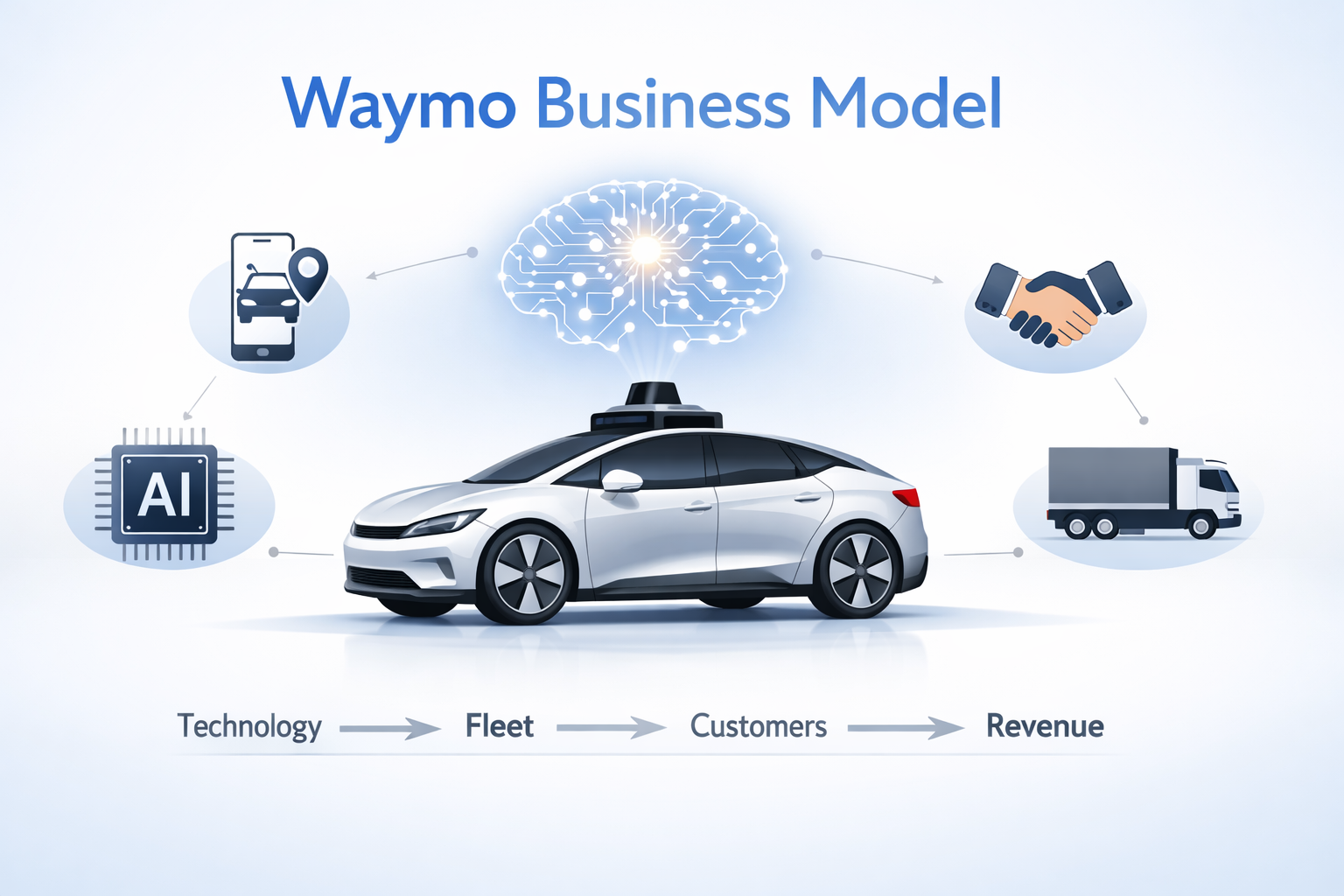
Waymo’s business model is built around autonomous driving technology. It develops self-driving systems and monetizes them through robotaxi services, partnerships with automakers, and autonomous logistics solutions.
The autonomous vehicle industry represents one of the most transformative technological shifts of our time. Self-driving cars promise to reshape urban mobility, reduce traffic accidents, and fundamentally change how we think about transportation.
At the forefront of this revolution stands Waymo, a subsidiary of Alphabet Inc., that has evolved from a moonshot project into a commercial reality. With thousands of autonomous rides completed daily across multiple U.S. cities, Waymo has positioned itself as one of the global leaders in self-driving technology.
Understanding Waymo’s business model matters for several reasons. For startup founders, it offers insights into how deep-tech companies navigate the journey from R&D to commercialization. For tech enthusiasts and investors, it reveals the economics of autonomous systems and the future of mobility. And for entrepreneurs exploring AI-driven businesses, Waymo demonstrates how to build competitive moats through data, infrastructure, and regulatory relationships.
What is Waymo?
Waymo began its journey in 2009 as Google’s self-driving car project, an ambitious initiative within the tech giant’s experimental division. What started as research into autonomous technology gradually evolved into a serious commercial venture.
In 2016, the project was spun out as an independent company under Alphabet’s umbrella, signaling a shift from pure research to business development. This structural change allowed Waymo to operate with greater focus, attract dedicated leadership, and pursue partnerships more aggressively.
Today, Waymo operates commercial robotaxi services through its Waymo One platform, offering fully driverless rides to paying customers. The company has established significant operational presence in three major U.S. markets:
- Phoenix, Arizona – Waymo’s first and most mature market, where fully autonomous rides have been available since 2020
- San Francisco, California – A challenging urban environment that showcases the technology’s sophistication
- Los Angeles, California – The company’s newest major expansion, launched to tap into one of the world’s largest ride-hailing markets
With millions of autonomous miles driven and a fleet that operates without human safety drivers, Waymo has transitioned from experimental technology to a functioning transportation service.
Waymo’s Core Value Proposition
At the heart of Waymo’s business is the Waymo Driver, a fully autonomous driving system that represents years of AI development, sensor technology, and real-world testing. The value proposition is built on four foundational pillars:
1. Fully Autonomous Driving System
The Waymo Driver integrates advanced sensors (cameras, LiDAR, radar), machine learning algorithms, and sophisticated mapping to navigate complex urban environments without human intervention. This isn’t driver assistance—it’s complete autonomy.
2. Safer Than Human Driving
Waymo takes a data-driven approach to safety, leveraging millions of miles of real-world driving and billions of miles of simulation. The system doesn’t get distracted, tired, or impaired. Early data suggests autonomous systems could dramatically reduce accidents caused by human error, which account for over 90% of crashes.
3. Reduces Transportation Costs Long Term
By eliminating the largest variable cost in ride-hailing—the human driver—Waymo’s model promises significantly lower per-mile costs at scale. While current hardware costs are high, the economics improve dramatically as technology becomes cheaper and fleet utilization increases.
4. 24/7 Driverless Mobility
Unlike traditional ride-hailing that depends on driver availability, Waymo’s fleet can operate around the clock. No shift changes, no breaks, no labor shortages. This creates a more reliable and predictable transportation network.
Waymo Business Model Canvas Breakdown
A. Customer Segments
Waymo serves multiple customer segments, each with distinct needs:
Urban commuters – Individuals seeking convenient transportation for daily activities, work commutes, and errands in cities where Waymo operates.
Ride-hailing users – Consumers already comfortable with app-based transportation who are curious about or prefer autonomous options.
Logistics companies – Businesses looking to optimize freight transportation costs through autonomous trucking solutions.
Automakers – Car manufacturers interested in licensing autonomous technology rather than developing their own systems from scratch.
Enterprise fleet operators – Companies managing vehicle fleets who could benefit from autonomous technology for deliveries, campus transportation, or employee mobility.
B. Value Proposition
Safe driverless rides – The primary consumer-facing value is access to transportation without the unpredictability of human drivers, backed by extensive safety data.
Reduced labor dependency – For businesses, autonomous technology eliminates driver recruitment challenges, labor costs, and scheduling complexities.
AI-powered fleet optimization – Intelligent routing, predictive maintenance, and utilization algorithms maximize fleet efficiency and minimize downtime.
C. Channels
Waymo One app – The primary direct-to-consumer channel where users request rides, similar to Uber or Lyft but for autonomous vehicles.
Strategic partnerships – Collaborations with automakers, technology companies, and logistics providers extend Waymo’s reach beyond its own operations.
Fleet integrations – B2B channels where Waymo’s technology is integrated into commercial fleet operations for delivery, trucking, or specialized transportation needs.
D. Customer Relationships
App-based ride experience – Clean, intuitive interface that makes autonomous rides accessible, with features for communicating with remote support if needed.
Automated customer support – AI-driven assistance handles routine questions, while human support manages complex situations or concerns.
Subscription/loyalty potential – Future opportunity to build recurring revenue through membership programs, similar to Amazon Prime for mobility.
E. Revenue Streams
1. Robotaxi Revenue
The most visible revenue stream comes from Waymo One ride fares. Passengers pay per trip, similar to traditional ride-hailing, but without driver costs. Pricing is competitive with Uber and Lyft, though it may command a premium in early markets due to the novelty and perceived safety benefits.
2. Autonomous Technology Licensing
Partnerships with automakers represent a significant long-term opportunity. Rather than every manufacturer developing autonomous systems independently, Waymo can license its technology, creating recurring revenue without operational overhead.
3. Autonomous Trucking (Waymo Via)
Freight logistics through Waymo Via targets the $800+ billion U.S. trucking industry. Autonomous trucks can operate longer hours, reduce fuel costs through optimized driving, and address the ongoing driver shortage.
4. Fleet & Data Services (Future Potential)
The data generated by millions of autonomous miles has immense value. Future revenue could come from selling insights to urban planners, insurance companies, or infrastructure developers. Additionally, white-label fleet management services could serve enterprises.
How Waymo Makes Money
Waymo’s revenue model combines immediate cash flow with long-term strategic positioning:
Per-ride revenue – Like Uber, but with a crucial difference: no driver costs. Once the technology and vehicles are paid for, marginal costs per ride are significantly lower. A ride that costs $20 might have gross margins of 60-70% compared to Uber’s 20-30%, assuming similar pricing.
Long-term B2B partnerships – Multi-year agreements with automakers or logistics companies provide predictable revenue streams. These partnerships often include upfront payments, licensing fees, and revenue sharing arrangements.
Hardware + software integration deals – When Waymo partners with vehicle manufacturers, the deals typically include both technology licensing and hardware component sales (sensors, compute units, etc.).
Potential subscription-based autonomous mobility – While not yet implemented, Waymo could introduce unlimited ride memberships or priority access programs, creating recurring revenue similar to software-as-a-service models.
Unlike Uber, Waymo doesn’t rely on human drivers. This fundamentally changes the economics. Uber must constantly recruit, retain, and pay drivers—their largest expense. Waymo’s costs are primarily upfront (R&D, vehicle acquisition) and fixed (fleet maintenance), which means profitability improves dramatically with scale.
Cost Structure
Understanding Waymo’s costs reveals why the company requires significant capital and why scale is essential:
R&D expenses – Massive ongoing investment in AI development, machine learning, sensor technology (LiDAR, cameras, radar), and simulation platforms. This is Waymo’s largest cost category.
Vehicle manufacturing partnerships – While Waymo doesn’t manufacture cars, it must purchase vehicles and retrofit them with autonomous systems. Current costs per vehicle are estimated at $150,000-$200,000, though this is decreasing.
Fleet maintenance – Autonomous vehicles require specialized maintenance for sensors, cameras, and computing systems beyond standard vehicle service. Cleaning sensors alone is a daily necessity.
Insurance and regulatory compliance – Operating autonomous vehicles requires specialized insurance policies. Legal teams navigate complex and evolving regulations across different jurisdictions.
Infrastructure costs – Data centers for processing driving data, remote operations centers staffed 24/7 to assist vehicles when needed, charging infrastructure for electric fleets, and detailed HD mapping of operational areas.
The cost structure is heavily weighted toward fixed and semi-fixed costs, which means Waymo needs significant scale to achieve profitability. However, once achieved, incremental rides become highly profitable.
Key Partnerships
Waymo’s strategy recognizes that no single company can build the autonomous future alone. Strategic partnerships accelerate development and market access:
Automakers – Waymo has partnered with multiple manufacturers to access vehicle platforms. The Jaguar Land Rover partnership, for example, provides Waymo with I-PACE electric vehicles for its robotaxi fleet, combining Jaguar’s vehicle engineering with Waymo’s autonomous technology.
Technology suppliers – Component manufacturers provide sensors, computing hardware, and specialized equipment. These relationships ensure Waymo can scale production as the fleet expands.
Local governments – Municipal partnerships are crucial for permits, testing approvals, and public infrastructure integration. Cities like Phoenix have been particularly supportive, allowing Waymo to expand operations more rapidly.
Fleet operators – Partnerships with rental car companies, logistics providers, and corporate fleets create distribution channels and testing grounds for autonomous technology in various use cases.
These partnerships create a network effect: each relationship provides data, market access, or technological capabilities that strengthen Waymo’s competitive position.
Competitive Landscape
The autonomous vehicle space is intensely competitive, with well-funded players pursuing different strategies:
Tesla – Takes a camera-first approach with its Full Self-Driving (FSD) system. Tesla’s advantage is massive data collection from millions of customer vehicles, but it currently operates at Level 2/3 autonomy (requiring driver supervision), not the Level 4 full autonomy Waymo targets.
Cruise (backed by GM and Honda) – Operates robotaxis in San Francisco and was Waymo’s closest competitor until recent setbacks following safety incidents. Cruise has temporarily scaled back operations to rebuild public trust.
Baidu – China’s autonomous driving leader operates Apollo Go robotaxis across multiple Chinese cities. Baidu benefits from regulatory support and operates in markets inaccessible to U.S. companies.
Waymo differentiates through full autonomy (Level 4 focus). While competitors like Tesla pursue gradual autonomy with driver assistance features, Waymo has consistently focused on achieving complete autonomy in defined geographic areas. This “geofenced” approach means Waymo operates only where it has detailed maps and testing, but within those areas, vehicles are truly driverless.
This strategy trade-off—deep autonomy in limited areas versus partial autonomy everywhere—represents a fundamental strategic choice. Waymo bets that consumers and regulators will value proven full autonomy over widespread but supervised systems.
Is Waymo Profitable?
The short answer: not yet.
Waymo remains in a heavy investment phase, prioritizing expansion, technology development, and fleet growth over near-term profitability. As a subsidiary of Alphabet, Waymo benefits from access to one of the world’s largest capital reserves, allowing it to sustain losses while building toward scale.
Backed by Alphabet’s capital – Parent company support is crucial. Developing autonomous technology requires billions in R&D, and building a robotaxi fleet demands substantial upfront investment. Alphabet has invested an estimated $5+ billion in Waymo since inception.
Long-term bet on autonomous future – Alphabet’s leadership views Waymo as a strategic investment in a market that could be worth hundreds of billions annually. The timeline to profitability is measured in years, not quarters.
Path to profitability depends on scale – The business model’s economics work at scale. Once technology development stabilizes and manufacturing costs decrease, Waymo’s marginal costs per ride become very attractive. Industry estimates suggest Waymo could achieve positive unit economics (profit per ride) at around 100,000-150,000 daily rides across its network.
Current revenue is likely in the tens of millions annually, while costs run into the hundreds of millions. However, with growing ride volume in Phoenix, San Francisco, and Los Angeles, plus potential licensing deals, the trajectory toward profitability is becoming clearer.
Risks & Challenges
Despite its leadership position, Waymo faces substantial obstacles:
Regulatory barriers – Autonomous vehicle regulations vary by state and country. Expanding to new markets requires navigating complex approval processes, safety certifications, and political concerns. Some jurisdictions remain skeptical or have imposed strict limitations.
Public trust & safety concerns – High-profile accidents involving any autonomous vehicles (even competitors) damage public perception. Building consumer confidence requires not just safety data but also time and positive experiences. Many people remain uncomfortable with driverless technology.
High hardware costs – While decreasing, the sensor suites, computing platforms, and vehicle modifications remain expensive. Until costs drop significantly, Waymo’s fleet expansion will be capital-intensive and scaling will be challenging.
Competition – Well-funded competitors from Tesla to Chinese players are advancing rapidly. If competitors crack full autonomy at lower costs or with different approaches, Waymo’s lead could erode.
Scaling outside limited geographies – Waymo’s technology requires detailed HD mapping of operational areas. Expanding to new cities demands months of mapping, testing, and regulatory approval. This limits how quickly Waymo can achieve national or global scale.
Future Growth Opportunities
Waymo’s long-term potential extends far beyond current operations:
Expansion to more cities – Moving beyond Phoenix, San Francisco, and Los Angeles to major metros like New York, Chicago, Seattle, and eventually international markets. Each city represents millions of potential rides annually.
Autonomous trucking scale-up – Waymo Via’s freight business could eventually dwarf robotaxi revenue. Long-haul trucking on highways is technically simpler than urban driving, and the market is enormous. Partnerships with logistics companies could accelerate adoption.
Licensing technology globally – Rather than operating in every market directly, Waymo could license its technology to automakers and fleet operators worldwide, creating recurring revenue without operational complexity.
Subscription-based mobility – Monthly membership programs could provide unlimited or discounted rides, creating predictable revenue and customer loyalty. This could evolve into “mobility as a service” bundles combining autonomous rides with other transportation options.
AI data monetization – The insights from billions of miles of driving data have value beyond transportation. Urban planning, traffic optimization, insurance modeling, and infrastructure development could all benefit from Waymo’s datasets, creating new revenue streams.
Key Takeaways
Waymo is not just a taxi company it’s an AI infrastructure company. The real value isn’t in providing rides; it’s in the autonomous driving system, the data it generates, and the platform it creates for future mobility services.
Heavy upfront cost, long-term scale advantage. Waymo’s business model requires enormous initial investment but promises exponentially better economics at scale. The marginal cost of each additional ride is far lower than traditional ride-hailing, creating potential for massive profitability once fixed costs are covered.
Focused on replacing drivers with software. Unlike companies augmenting human drivers, Waymo’s strategy is complete replacement. This is more technically challenging but offers greater economic upside and differentiation.
Platform + fleet + data = compounding advantage. Each mile driven improves the AI, better AI attracts more users and partners, more usage generates more data—creating a flywheel effect that becomes increasingly difficult for competitors to overcome.
For entrepreneurs and business strategists, Waymo demonstrates how to build in emerging technology categories: focus on solving the hardest technical problems first, secure patient capital, build regulatory relationships early, and design business models that improve dramatically with scale.
The autonomous vehicle revolution is still in its early innings, but Waymo has positioned itself as a leader in what could become one of the largest industries of the 21st century. Whether that potential translates to market dominance remains to be seen, but the business model framework is now proven and operational.
Discover more from Business Model Hub
Subscribe to get the latest posts sent to your email.

[…] movers in this space have established significant footholds. Waymo, Google’s autonomous vehicle subsidiary, has been operating commercial robotaxi services in […]