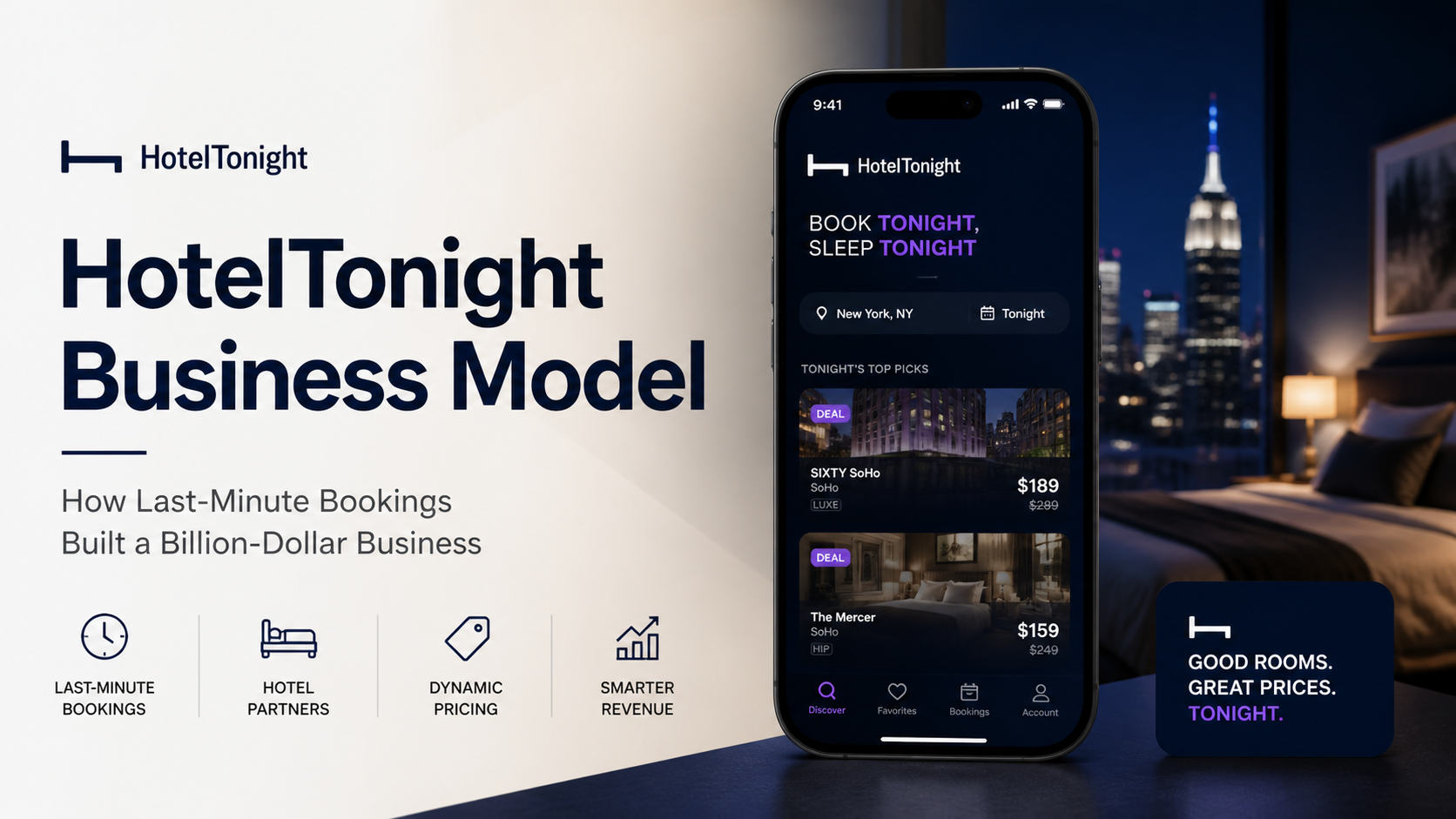
HotelTonight Business Model And How Last-Minute Bookings Became a Billion-Dollar Idea

HotelTonight makes money by helping hotels sell unsold rooms at discounted prices and earning a commission on every booking. It focuses on last-minute travelers and uses dynamic pricing plus curated listings to maximize conversions.
Simple. Focused. Profitable.
What Is HotelTonight?
HotelTonight is a mobile-first hotel booking app founded in 2010. The entire platform is built around one core behavior: booking a hotel room right now, today, without overthinking it.
Most travel apps want you to plan weeks ahead. HotelTonight flipped that. It went after the traveler who needs a room tonight, not next month.
The company was later acquired by Airbnb, which tells you everything about how valuable the niche became.
Key facts:
- Founded: 2010
- Model: Last-minute and same-day hotel bookings
- Primary platform: Mobile app
- Parent company: Airbnb (acquired 2019)
The Real Problem HotelTonight Solves
Before understanding the business model, you need to understand the pain points on both sides of the marketplace.
The Hotel Side
Hotels operate on a brutal economic reality. An unsold room generates zero revenue. You cannot store it, ship it, or sell it tomorrow. Once midnight passes, that inventory is gone forever.
Last-minute rooms are the hardest to fill. Hotels traditionally relied on walk-ins or deep discounting at the front desk, neither of which scales. They needed a channel that could move unsold inventory fast, without tanking their rate integrity across other booking platforms.
The Traveler Side
Last-minute travelers faced the opposite problem. They assumed booking late meant paying more. And on most platforms, they were right. The more urgent your need, the worse the deal.
On top of that, most booking platforms showed hundreds of options. Scrolling through 300 hotels when you need a room in three hours is a terrible experience.
HotelTonight solved both sides at once.
Core insight: They matched urgent demand with wasted supply.
That is the entire business in one sentence.
How HotelTonight Actually Works
The flow is straightforward and that simplicity is a feature, not an accident.
Hotels list their unsold inventory on the platform each morning. HotelTonight curates those listings, not every property makes the cut. A traveler opens the app, sees a small, manageable set of options, picks one, and books instantly. HotelTonight collects a commission. The hotel fills a room it would have otherwise lost.
No room ownership. No inventory risk. Pure marketplace mechanics.
The curation piece matters more than most people realize. By limiting options, HotelTonight removed decision fatigue. Fewer choices means faster decisions. Faster decisions means higher conversion rates. Higher conversion rates means more commission revenue per visitor.
That is not accidental UX. That is deliberate business strategy.
How HotelTonight Makes Money
The revenue model is clean and straightforward.
Commission Per Booking
Every time a traveler completes a booking through the app, HotelTonight takes a percentage of the transaction. This is the primary revenue stream. No booking, no revenue. It keeps incentives perfectly aligned between the platform and its hotel partners.
Dynamic Pricing Optimization
HotelTonight uses pricing algorithms to match supply and demand in real time. As the day progresses and unsold inventory shrinks, prices shift. This benefits both sides. Hotels move rooms. Travelers get competitive rates. The platform captures more value from each transaction.
Hotel Partnerships and Positioning
Hotels pay for premium placement within the app. This is a secondary revenue stream but a real one. When a property wants better visibility in a specific market or on high-demand nights, they can invest in that positioning.
The bottom line: No inventory ownership means the cost structure stays lean and margins stay healthy.
Business Model Canvas of HotelTonight
This is where the model gets interesting. Breaking it down through the Business Model Canvas framework shows exactly why it works and where the real competitive advantage sits.
Customer Segments
HotelTonight serves a few distinct but overlapping traveler types.
Last-minute travelers are the core segment. These are people who need a room tonight or tomorrow. They are motivated by urgency, not loyalty to any particular brand.
Business travelers make up a significant portion of users. A meeting ran long. A flight got delayed. A conference extended. Business travelers frequently need same-day accommodations and often have company cards covering the expense, which makes price sensitivity lower.
Spontaneous planners are travelers who decide to take a trip with minimal lead time. Weekend getaway decided on a Friday morning. Road trip that turned into an overnight stay. These users love the app because it matches their behavior perfectly.
Budget-conscious users treat HotelTonight as a deal-hunting tool. They know hotels discount last-minute inventory aggressively, and they time their bookings to capture that.
Value Proposition
HotelTonight does not compete on breadth. It competes on moment.
For travelers, the value proposition is discounted last-minute deals, a fast booking experience measured in taps rather than pages, and curated listings that remove the paralysis of too many choices.
For hotels, the value proposition is a channel that moves unsold inventory without requiring heavy discounting across their main booking platforms, which would damage rate parity.
The real insight: HotelTonight does not sell hotels. It sells speed and convenience wrapped around a good price.
That repositioning is everything.
Channels
The mobile app is the primary channel and that choice was deliberate from day one. Last-minute bookings are inherently mobile behaviors. Nobody sits at a desktop computer at 4pm deciding they need a hotel tonight. They are already out, already moving, already on their phone.
Push notifications play a huge role in driving repeat usage. A well-timed push on a Friday afternoon reminding users about weekend deals converts at a much higher rate than almost any other marketing format.
App Store and Google Play Store discovery matters significantly because travelers searching for hotel apps are high-intent users. Ranking well in those stores drives organic installs without paid media spend.
Paid advertising on Google and Meta fills the top of the funnel, particularly for user acquisition in new markets.
Customer Relationships
The relationship model is self-service by design. Travelers book through the app with minimal friction and no human interaction required. That keeps support costs low and scales cleanly.
Personalized recommendations based on past bookings, location, and browsing behavior make the app feel tailored over time. A user who always books boutique hotels in urban centers starts seeing those options surfaced first. That personalization increases both conversion and retention.
The minimal friction UX philosophy runs through everything. Account creation is fast. Payment is stored. Booking confirmation is instant. Every extra step you remove from a transaction increases the likelihood the user completes it.
Revenue Streams
Commission from hotels is the primary stream. Dynamic pricing optimization adds value to each transaction. Premium placements represent an additional monetization layer for hotel partners who want visibility.
The model benefits from strong unit economics. Customer acquisition costs can be spread across repeat bookings because last-minute travelers, once they find a tool they trust, tend to return to it.
Key Resources
The mobile app platform itself is a core resource. It needs to be fast, reliable, and easy to use under real-world conditions, like a traveler with spotty airport WiFi trying to book a room in five minutes.
Hotel partnerships are equally critical. Without sufficient inventory in the right markets, the app fails. Supply-side quality directly determines demand-side satisfaction.
Pricing algorithms represent a proprietary resource that improves over time. The more booking data the platform accumulates, the better it gets at predicting optimal pricing windows.
Brand trust matters more in last-minute travel than in planned travel. A traveler booking three months out does extensive research. A traveler booking in three hours relies heavily on platform trust. HotelTonight built that trust through consistent quality curation.
Key Activities
Partner onboarding keeps the supply side healthy. Signing hotels, training them on the platform, and managing those relationships is ongoing operational work.
Pricing optimization is a continuous technical activity. The algorithms need to process real-time inventory data, historical booking patterns, local demand signals, and competitive pricing to set rates that work for both hotels and travelers.
UX improvement is never finished. Every friction point removed from the booking flow is a measurable lift in conversion. The team constantly tests, iterates, and improves.
Performance marketing drives user acquisition at the top of the funnel across paid channels and organic search.
Key Partners
Hotels and hotel chains are the foundational partners. Without them, there is no product.
Payment gateways process every transaction. Reliability here is non-negotiable because a failed payment at the moment of booking is a permanent user loss.
The broader travel ecosystem, including airlines, ride-sharing apps, and travel content platforms, creates partnership opportunities for distribution and cross-promotion.
Airbnb as the parent company provides infrastructure, data, and strategic support that would be expensive to build independently.
Cost Structure
Marketing and user acquisition represent the largest cost category. Marketplaces require investment on both sides of the equation, supply and demand, and that gets expensive.
Tech and app maintenance is an ongoing cost. A mobile-first business lives and dies by app performance. Downtime or bugs during peak booking windows are unacceptable.
Partner management requires dedicated teams to maintain hotel relationships, handle disputes, and onboard new properties.
Customer support handles the inevitable issues: booking errors, property problems, refund requests. Keeping this cost low requires investing in self-service tools and clear policies.
Founder takeaway from the canvas: This is a classic marketplace business, but with one critical twist. It focuses only on time-sensitive inventory. That time constraint is where the real competitive moat comes from.
Why HotelTonight Works at a Strategic Level
The business works because it understood human psychology as well as market economics.
Scarcity-Based UX
When you see a limited set of options with a clear time constraint attached, you act faster. HotelTonight built scarcity directly into the product experience. Rooms are available now. Inventory is limited. Book or lose it.
Scarcity is not just a psychological trick here. It is operationally real. Last-minute inventory genuinely disappears. The UX reflects actual market conditions, which makes the urgency authentic rather than manufactured.
Mobile-First Thinking Before It Was Obvious
In 2010, building a mobile-only booking product was a contrarian bet. Most travel companies treated mobile as an afterthought, a lite version of their desktop experience.
HotelTonight recognized that last-minute booking behavior was inherently mobile. Being mobile-first when nobody else was meant lower competition, better app store rankings, and a user experience actually designed for how the target customer behaved.
Impulse Buying Behavior
Last-minute travel decisions are emotional decisions. You decide to go somewhere on a whim. You get stuck overnight unexpectedly. You want a spontaneous city break.
HotelTonight positioned itself perfectly at the intersection of urgency and impulse. It did not fight against that impulsive energy. It built the entire product to serve it.
Limited Options Drive Faster Decisions
Research consistently shows that reducing choices increases conversion. HotelTonight applied this principle at the product level. By curating a small set of quality options rather than listing everything available, they made the booking decision easier and faster.
A user who sees five good options books quickly. A user who sees 500 options spends an hour comparing, gets overwhelmed, and sometimes abandons the process entirely.
Growth Strategy
HotelTonight grew through a combination of performance marketing and organic discovery.
App Store Optimization
Ranking well in the App Store and Google Play for relevant search terms like “last minute hotels” and “hotel deals tonight” drove consistent organic installs from high-intent users. ASO is one of the highest-ROI channels for mobile-first products because it captures users who are already looking for exactly what you offer.
Paid Advertising
Google and Meta campaigns targeted travelers based on location, travel intent signals, and demographic profiles. Geo-targeting allowed the team to concentrate spend in markets with strong hotel partner coverage, ensuring new users found good inventory from day one.
Push Notifications
For a last-minute booking app, push notifications are not just a marketing channel. They are a core product feature. A well-timed push on a Thursday evening reminding users about Friday night deals drives direct revenue. HotelTonight built a notification strategy that felt helpful rather than spammy, which is a difficult balance to maintain but essential for retention.
Referral Loops
Satisfied users refer other users. HotelTonight built referral mechanics into the product to systematize word-of-mouth growth. Travel is a naturally social behavior. People share trip plans, hotel recommendations, and good deals with friends. Referral programs convert that natural behavior into measurable acquisition.
The Airbnb Acquisition
Airbnb acquired HotelTonight in 2019 for a reported price in the neighborhood of $400 million.
The strategic rationale was straightforward. Airbnb had built a massive business in alternative accommodations but had minimal presence in the traditional hotel segment. HotelTonight gave them an established product, a loyal user base, and a meaningful foothold in last-minute hotel bookings.
The acquisition also positioned Airbnb to compete more directly with Booking.com and Expedia, both of which had strong hotel inventory and were competing aggressively with Airbnb in the accommodations space.
For HotelTonight, joining Airbnb provided access to a much larger user base, deeper data resources, and infrastructure that would have taken years to build independently.
The combination makes strategic sense for both parties. Last-minute hotel bookings and spontaneous travel plans are a natural fit with Airbnb’s overall positioning around flexible, experience-driven travel.
Competitive Landscape
HotelTonight does not compete head-on with the giants. That is part of what makes the positioning smart.
Booking.com has enormous inventory across hotels, apartments, and other property types. It serves planners who want comprehensive options. It is not optimized for last-minute, mobile-first booking behavior.
Expedia is a full-stack travel company covering flights, hotels, car rentals, and vacation packages. Its breadth is its strength and also the reason it struggles to deliver the focused last-minute experience that HotelTonight provides.
Agoda competes on price across the Asia-Pacific region primarily. It is a price-driven platform rather than a speed-and-convenience platform.
HotelTonight’s competitive advantage is not cheaper prices or more inventory. It is a better experience for a specific type of traveler in a specific booking moment. That positioning is defensible in ways that price competition alone is not.
Advantages and Limitations
Where the Model Excels
High conversion rates are a natural outcome of the focused UX and high-intent user base. Someone opening a last-minute hotel app is much closer to a purchase decision than someone browsing travel options six months out.
Strong niche positioning means the brand is memorable and associated with a specific behavior. When a traveler needs a room tonight, HotelTonight is top of mind. That mental association is genuinely valuable.
The asset-light model keeps the business structurally healthy. No inventory ownership means no exposure to unsold rooms and no capital tied up in physical assets.
Where the Model Has Constraints
Limited inventory compared to full-service platforms means that in some markets or on some dates, HotelTonight simply cannot serve every potential customer. If a user opens the app and finds no options in their city, they go elsewhere and may not return.
Partner dependency is a real risk. The business only functions as well as its hotel partnerships. If major hotel chains pull inventory or change their distribution strategy, it directly impacts what users see in the app.
The last-minute positioning, while a strength in most cases, can also be a limitation for travelers who want to plan even a few days out. HotelTonight has expanded its booking window over time, but the brand is still most strongly associated with same-day behavior.
Lessons for Founders
The HotelTonight story carries several lessons worth internalizing if you are building a business.
Niche Markets Beat Broad Markets Early
HotelTonight could have tried to build a full-service hotel booking platform competing with Expedia and Booking.com from day one. Instead, it took a slice of the market that the giants were underserving and built something specifically for that slice.
Owning a niche is more valuable than partially serving a broad market. A user who thinks of your product first for a specific need is worth more than a user who considers you as one of many options.
Simplicity Is a Product Decision
The limited options in the HotelTonight app are not a bug. They are a deliberate product decision with measurable business consequences. More options would reduce conversion rates. Simpler experiences drive faster decisions and higher revenue per visitor.
When you design your product, consider what you are removing, not just what you are adding. Removing friction and reducing choices is often more valuable than adding features.
Urgency Changes Buying Behavior
When users feel time pressure, they act. HotelTonight built a product that serves people at a moment of genuine urgency. That urgency increases conversion rates, reduces comparison shopping, and creates a different competitive dynamic than calm, rational, planned purchasing.
If your product can serve a moment of urgency rather than a moment of research, you will see structurally higher conversion rates.
You Do Not Have to Fight Giants Directly
HotelTonight did not try to out-inventory Booking.com or out-feature Expedia. It found the angle those giants were not optimizing for and built something specifically for that angle.
You rarely beat a giant by playing their game better. You beat them by changing the game entirely.
Future Outlook
The trajectory for HotelTonight under Airbnb’s ownership points in a few interesting directions.
AI-powered pricing represents a significant opportunity. Current dynamic pricing algorithms are already sophisticated, but machine learning applied to real-time demand signals, local event data, competitor pricing, and individual user behavior could make pricing even more precise and profitable for both the platform and hotel partners.
Deeper Airbnb integration is a natural evolution. A traveler who cannot find an Airbnb for a last-minute trip could be seamlessly shown HotelTonight hotel options within the same app. That kind of integrated inventory across accommodation types is a genuinely compelling user experience.
Emerging market expansion is a long-term growth opportunity. The behavior of last-minute hotel booking is universal, but the infrastructure serving it is much less developed in many emerging markets. As smartphone penetration and mobile payment infrastructure mature in those markets, the HotelTonight model translates well.
The fundamental business model, connecting urgent demand with perishable supply through a curated mobile marketplace, remains sound and relevant regardless of how the platform evolves.
Wrapping Up
HotelTonight did not build a better hotel booking site. It built the right booking experience for a specific moment in the traveler’s day.
That distinction is what most founders miss when they look at competitive markets. The question is not how to build something better than what exists. The question is where existing solutions are genuinely failing a real user and what a product designed specifically for that failure would look like.
For HotelTonight, the answer was a mobile-first, curated, urgency-driven experience for travelers who needed a room right now. Every product decision flowed from that single insight.
The billion-dollar outcome was not luck. It was what happens when you take a clear problem seriously, resist the temptation to boil the ocean, and build something that actually fits the moment you are serving.
That is the lesson. Find the moment. Build for it specifically. Do not apologize for the focus.
Discover more from Business Model Hub
Subscribe to get the latest posts sent to your email.