Poppo Live Business Model and How Poppo Live Makes Money

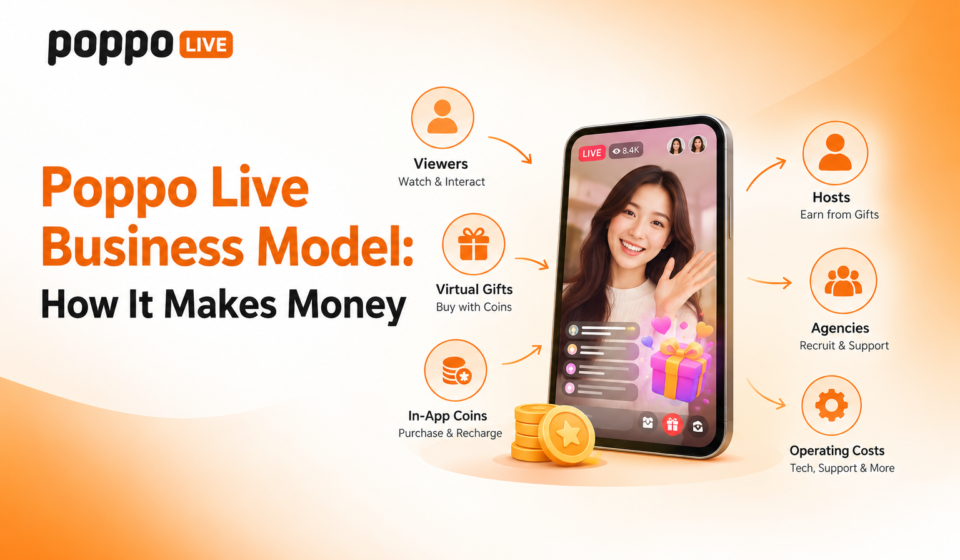
Poppo Live makes money through a livestreaming monetization ecosystem built around virtual gifts, in-app currency, and paid digital interactions. The platform connects viewers with hosts through live shows, party rooms, PK battles, and short-form videos. Its wider ecosystem also includes hosts, agents, and agencies that help attract creators and maintain audience engagement.
The Poppo Live business model combines social entertainment with digital transactions. Viewers can purchase in-app currency and use it to send virtual gifts, while eligible hosts can earn rewards under the platform’s monetization rules. Agents and agencies may also receive commissions or performance-based incentives for recruiting and supporting hosts.
However, the platform’s total customer spending is not the same as its recognized revenue or profit. Host payouts, payment processing, technology infrastructure, marketing, and other operating expenses all affect its financial performance.
This business model offers useful lessons for entrepreneurs studying creator-economy platforms, digital marketplaces, and community-based apps. Understanding how Poppo Live connects audience engagement with monetization reveals both the opportunities and the challenges of running a livestreaming business.
What Is Poppo Live and How Does It Work?
Poppo Live is a social entertainment platform that allows users to watch livestreams, interact with hosts, send virtual gifts, join group conversations, and discover short-form video content. Its official website highlights live shows, gifting, VLOGs, party rooms, and PK battles as key features.
The platform creates value by bringing audiences and content creators together in an interactive environment. Instead of relying only on prerecorded videos, it encourages real-time participation, allowing viewers to communicate with hosts and other community members.
Who Uses Poppo Live?
Poppo Live serves several groups with different motivations.
- Viewers: People who watch livestreams, explore creators, and participate in social entertainment.
- Paying users: Viewers who purchase coins or other eligible digital products to support hosts and participate in monetized experiences.
- Hosts: Creators who broadcast live content, interact with viewers, and may earn rewards through eligible monetization programs.
- Agents and agencies: Participants who recruit hosts, help creators understand platform requirements, and support their performance.
Each group contributes differently to the platform. Viewers provide attention and engagement, paying users generate transaction activity, hosts supply content, and agents or agencies can help expand the creator network.
How Does Poppo Live Work?
The typical user journey begins with account creation and discovering live content. Users can browse available broadcasts, enter interactive rooms, follow creators, and participate in social activities.
When a viewer wants to support a host, the viewer may purchase in-app currency and use it to send virtual gifts. Eligible gifting activity can contribute to host earnings according to the applicable program rules.
The platform also supports party rooms and PK battles, which create opportunities for group interaction and friendly competition. Short-form videos and VLOGs provide another way to discover creators outside live broadcasts.
This combination of discovery, interaction, and monetization helps connect content consumption with digital spending.
The Role of Viewers, Hosts, and Agencies
The business model depends on these participants working together.
Viewers need entertaining content and meaningful interactions. Hosts need an audience and a reliable way to monetize their activity. Agencies can help recruit and support hosts, potentially increasing the volume and consistency of content available on the platform.
The result is a multi-sided platform in which improving the experience for one group can make the service more attractive to others.
How Does Poppo Live Make Money?
Poppo Live’s monetization model centers on in-app purchases and virtual gifting. Its broader ecosystem includes monetized digital interactions and agent incentives, although the precise revenue mix and the company’s retained share are not publicly established by the sources.
1. Virtual Gifts and In-App Coin Purchases
Virtual gifting is one of the clearest monetization mechanisms in Poppo Live’s product experience.
Viewers can purchase coins or other supported in-app currency and use them to send digital gifts during livestreams. These gifts provide a way to recognize a creator, participate in a broadcast, or express appreciation.
The economic process has three main stages:
- A user purchases in-app currency.
- The user spends eligible currency on virtual gifts.
- The host may receive earnings or rewards based on the platform’s applicable monetization rules.
This system connects audience engagement with digital transactions. A viewer who values a creator’s performance or community experience may be more willing to spend money on gifts.
Repeat engagement can create additional purchasing opportunities, although not every viewer becomes a paying customer.
Why this revenue stream matters: Virtual gifts let a platform monetize user participation without requiring every user to pay a subscription fee. Users can watch content without spending, while paying users can choose whether and when to purchase digital goods.
It is important to distinguish the amount a viewer spends from the revenue recognized by the company. Host payouts, refunds, taxes, payment arrangements, and accounting rules can affect the final amount recognized as revenue.
2. Live and Party Interactions
Poppo Live offers live broadcasts, party rooms, and PK battles. These features make the experience more interactive than a conventional video library.
PK battles allow hosts to compete in live sessions, while party rooms support social interaction among multiple participants. These formats can encourage viewers to return, follow particular hosts, and participate more actively.
Greater engagement can create more opportunities for virtual gifting and other eligible transactions.
However, an interactive feature does not automatically represent a separate revenue stream. The financial contribution of party rooms or PK battles depends on how the platform monetizes those experiences and how users respond.
The official website confirms these product features, but it does not establish how much revenue each feature generates.
3. Calls and Chat-Based Monetization
Messaging and communication can support social discovery and ongoing relationships between users and creators.
However, it would be inaccurate to assume that every message, call, or private interaction generates a direct payment for Poppo Live. The availability, pricing, and monetization rules of specific communication features must be verified against the current official product terms.
For business model analysis, it is better to separate confirmed virtual-gifting activity from any additional paid communication services whose financial terms have not been established.
This distinction prevents a common mistake in digital business analysis: treating every feature as an independent source of revenue simply because it creates user engagement.
4. Agency Commissions and Referral Programs
Poppo Live also has an agent ecosystem that can help recruit hosts and expand its creator network.
Its agent cooperation information describes agent earnings linked to signed hosts’ activity, as well as possible rewards for inviting agents or hosts and performance-based ranking incentives. The applicable terms, eligibility requirements, and reward amounts should be checked in the current program before making financial assumptions.
These arrangements can support platform growth by encouraging agents to recruit creators, help them participate, and build active teams.
However, agency commissions are not automatically revenue earned by Poppo Live. They are amounts potentially paid to participating agents under program rules. Depending on the arrangement, commissions and rewards may instead be costs associated with acquiring or supporting creators.
5. Rankings, Tasks, and Promotional Rewards
Performance-based rewards can encourage hosts and agents to remain active, recruit eligible participants, and improve their performance.
For example, a ranking reward may recognize agents who meet specific performance criteria. A promotional event may encourage viewers to participate in a particular activity or send eligible virtual gifts.
Such incentives can support engagement and retention, but their financial effect depends on the results they generate.
If an incentive attracts valuable, recurring activity, it may contribute to a stronger business. If it mainly rewards activity that would have happened anyway, it can increase costs without producing meaningful incremental revenue.
The key business question is whether the additional contribution generated by a reward exceeds its cost.
How Do Poppo Live Coins, Gifts, and Host Earnings Work?
Poppo Live uses an in-app transaction system that connects viewer spending with eligible digital interactions and host monetization.
The exact coin conversion rates, host revenue shares, withdrawal minimums, and settlement schedules should be verified through the current official app terms. They should not be inferred from unofficial agency advertisements.
How Viewers Purchase and Use Coins
Users can access supported recharge options and use in-app currency for eligible digital experiences, including virtual gifts.
Coins and host earnings should not be treated as interchangeable. Coins are a form of platform currency, while host earnings represent rewards or balances governed by the applicable monetization program.
A viewer’s purchase of coins does not necessarily mean that the same amount becomes a host’s withdrawable income.
How Hosts Earn Money
Eligible hosts can earn rewards through the platform’s monetization program. Their earnings may depend on received gifts, activity, eligibility, and the rules applicable to their accounts.
A host’s displayed balance is not necessarily the same as cash already received. Withdrawal eligibility, verification, applicable fees, taxes, and payout rules may affect the amount and timing of payment.
Hosts should consult the current official terms rather than rely exclusively on figures shared by recruiters or third-party agencies.
Why Customer Spending Is Not the Same as Host Income
Consider four separate financial measures:
- Gross customer spending: The amount users spend on relevant in-app purchases.
- Platform revenue: The amount the company recognizes as revenue under its applicable accounting policy.
- Host earnings: Eligible compensation or rewards allocated to creators.
- Operating profit: Revenue remaining after the relevant operating expenses have been accounted for.
These figures answer different questions. Customer spending indicates demand, host earnings show creator compensation, platform revenue measures the company’s recognized income, and profit reflects the overall financial result.
A useful simplified money-flow model is:
Viewer purchases coins → viewer sends virtual gifts → eligible host earnings are credited → payouts, transaction costs, and other expenses affect the platform’s economics.
This is a conceptual explanation rather than a complete accounting statement. The exact treatment depends on the platform’s commercial arrangements and financial reporting policies.
How Do Poppo Live Agencies Make Money?
Poppo Live agencies can earn commissions or eligible performance-based rewards by recruiting and supporting hosts. Their economics depend on the applicable agent program, the activity of their host network, and the conditions attached to commissions and incentives.
What Is a Poppo Live Agency?
An agency is a team or network that organizes and supports hosts on the platform. It may be led by an agent who recruits creators, helps them understand the platform, and monitors their activity.
An individual host primarily focuses on content creation and audience engagement. An agent may coordinate one or more hosts, while a larger agency may manage a broader recruitment and support operation.
The exact structure depends on the program’s current rules.
Host Recruitment and Management
Agency operations may include:
- Finding and onboarding eligible hosts.
- Explaining platform requirements and monetization rules.
- Helping hosts develop consistent streaming schedules.
- Supporting content quality and audience engagement.
- Tracking team activity and performance.
- Communicating platform updates and promotional opportunities.
These activities can help creators navigate the platform, but recruitment alone does not guarantee that hosts will earn money or that an agency will become profitable.
The agency’s results depend on the quality, activity, and retention of its host network.
How Do Poppo Live Agents Earn Commissions?
The agent cooperation page describes percentage-based earnings associated with signed hosts and additional performance-related rewards. It also notes that earnings vary and are not guaranteed.
Agents should check the current program for commission calculations, eligible host earnings, settlement schedules, and reward conditions.
For example, if an agent’s compensation is tied to qualifying activity from a group of hosts, the agent’s earnings may change as those hosts become more or less active. The precise calculation cannot be established without the applicable commission terms.
Avoid assuming that a percentage advertised on an agency website applies to every host, region, or agent tier.
Sub-Agent Networks and Referral Rewards
Where permitted by program rules, agents may be able to invite other agents or build a wider network.
This can expand recruitment capacity, but it also introduces coordination challenges. An agency may need to track performance across several levels, communicate consistent rules, and resolve disputes about eligibility or payouts.
Referral rewards should be treated as conditional incentives, not guaranteed recurring income.
Agency Revenue Versus Platform Revenue
The distinction is important when evaluating the business model.
| Financial measure | What it represents |
|---|---|
| Viewer spending | Purchases made by users |
| Platform revenue | Revenue recognized by the platform |
| Host earnings | Eligible creator compensation |
| Agent commissions | Compensation earned under an agent program |
| Agency profit | Agency income after its own costs |
An agency’s commission is potential income for that agency, not necessarily a separate revenue stream for the platform.
This separation is essential when analyzing creator-economy businesses, because money can move between users, platforms, hosts, and partners without every participant recognizing the same amount as revenue.
How Much Money Does Poppo Live Make?
Poppo Live’s exact company revenue and net profit cannot be established from the public sources used for this article. Third-party app-intelligence services publish estimates, but these should not be presented as audited financial results.
For example, Sensor Tower’s app intelligence page displayed an estimated worldwide revenue range of $500,000 to $1 million for the previous month at the time of its recent October 2026 snapshot. This is a third-party estimate, not a company-reported financial statement. The figure should be interpreted within the provider’s stated measurement scope and methodology.
App estimates can vary because providers use different methodologies, store coverage, geographic scopes, and modeling assumptions. App-store spending estimates also do not necessarily represent all company revenue.
To evaluate Poppo Live’s financial performance, researchers should look for:
- Credible app-intelligence estimates with clear dates and geographic coverage.
- Official company disclosures, where available.
- Evidence about in-app purchases and transaction activity.
- Information about creator payouts and acquisition costs.
- Reliable information about operating expenses and profitability.
Downloads, user counts, rankings, and estimated consumer spending are useful indicators of activity. None of them, by itself, proves that the company is profitable.
Poppo Live Revenue Model and Operating Costs
Poppo Live’s financial performance depends on how effectively it converts user engagement into monetized activity while controlling the costs of operating a social entertainment platform.
Major Operating Costs
1. Streaming infrastructure
Live video requires bandwidth, servers, storage, and reliable delivery systems. Higher viewing activity can increase infrastructure requirements.
2. Payment processing
The platform must support eligible transactions and handle payment processing, transaction disputes, refunds, and related operational work.
3. Host-related payments
Eligible host earnings and other creator-related rewards affect the amount of money available to cover the company’s remaining expenses.
4. Marketing and user acquisition
Advertising, referral programs, promotional campaigns, and other acquisition activities can help attract viewers and creators. Their effectiveness depends on whether acquired users remain active and generate sufficient long-term value.
5. Agency and promotional incentives
Agent commissions, recruitment rewards, and eligible performance incentives may contribute to the cost of growing the creator network.
6. Moderation and user protection
A social livestreaming platform needs systems for reviewing content, responding to reports, preventing abuse, protecting privacy, and enforcing platform rules.
7. Engineering and customer support
Product development, software maintenance, security, customer support, and administration are also part of the operating model.
Hypothetical Financial Example
The following example illustrates how a livestreaming platform might analyze $100,000 in customer spending. These figures are assumptions for educational purposes, not Poppo Live’s actual financial data.
| Illustrative item | Amount |
|---|---|
| Customer spending | $100,000 |
| Assumed host-related payouts | $50,000 |
| Assumed payment and distribution costs | $5,000 |
| Assumed infrastructure costs | $8,000 |
| Assumed marketing and incentives | $15,000 |
| Amount remaining after these selected costs | $22,000 |
In this simplified scenario, $22,000 remains after the listed costs. That amount is not necessarily net profit. Other expenses, taxes, accounting adjustments, and differences between gross customer spending and recognized revenue could change the actual result.
The example demonstrates why a platform cannot evaluate its financial health by looking at customer spending alone.
Its economics depend on the relationship between monetization, creator compensation, acquisition costs, operating expenses, and customer retention.
Poppo Live Business Model Canvas
The Business Model Canvas explains how Poppo Live creates value, reaches its users, operates its platform, and captures economic value.
| Business model block | Poppo Live analysis |
|---|---|
| Customer segments | Viewers, paying fans, hosts, agents, and agencies |
| Value proposition | Live entertainment, real-time interaction, virtual gifting, and creator opportunities |
| Channels | Mobile app, live rooms, creator profiles, short videos, and supported partner channels |
| Customer relationships | Live interactions, creator communities, follows, and audience-host relationships |
| Revenue streams | Monetized digital interactions, including in-app purchases; the exact company revenue mix requires verification |
| Key resources | Streaming technology, host network, audience, payment systems, and platform brand |
| Key activities | Streaming, content discovery, monetization, creator support, moderation, and product development |
| Key partnerships | Hosts, eligible agents, agencies, payment providers, and app distribution partners |
| Cost structure | Infrastructure, payments, host-related costs, acquisition, moderation, engineering, and support |
What Does the Canvas Reveal?
Poppo Live’s model depends on maintaining a balance between content supply, audience engagement, and monetization.
A platform needs enough interesting hosts to attract viewers. It also needs features that make participation valuable, along with a reliable transaction system that supports monetization.
The agency network can contribute to creator acquisition and support, while incentives may encourage continued participation. However, these mechanisms add complexity and may increase costs.
The business model works best when the value generated by retained users and active creators exceeds the cost of attracting and supporting them.
What Makes Poppo Live’s Business Model Work?
Several business mechanisms can support Poppo Live’s model, although none guarantees sustainable growth.
Monetizing Viewer Engagement
Virtual gifts connect user participation with digital spending. Viewers can enjoy content without paying, while those who want to support creators have an optional way to spend.
This creates a flexible monetization model, but its success depends on whether users find enough value to make purchases repeatedly.
Interactive Entertainment and PK Battles
Competitive and group formats give viewers reasons to participate beyond passively watching videos.
These experiences can encourage return visits and create additional gifting opportunities. Their contribution depends on actual user behavior rather than the mere availability of the features.
A Network of Hosts and Agencies
Hosts provide the content that attracts audiences. Agents and agencies can help recruit creators and support their participation.
A larger, active host network can improve content variety and discovery. However, recruiting large numbers of inactive creators will not necessarily create meaningful value.
Multiple Ways to Participate
Live shows, party rooms, short videos, and creator profiles provide different entry points into the platform.
Short-form content can help users discover hosts, while live interactions provide opportunities to build ongoing relationships. This combination can connect content discovery with deeper participation.
Performance-Based Incentives
Commissions and rewards can encourage agents and hosts to meet specific goals.
The key is to measure whether these incentives create incremental value. A reward system that increases costs without improving retention, engagement, or monetization can weaken the business.
Challenges and Risks in Poppo Live’s Business Model
Poppo Live’s model faces risks common to livestreaming platforms and other creator-economy businesses.
Dependence on high-spending users: A small group of customers may account for a significant share of spending in some digital-gifting businesses. If spending is concentrated, changes in the behavior of those users can affect revenue. The extent of this concentration at Poppo Live requires evidence.
Uneven host earnings: Not every creator will attract the same audience or generate the same gifting activity. Unclear expectations about earning potential can make creator recruitment and retention harder.
Fraud and payment disputes: Unauthorized transactions, refunds, account abuse, and payment disputes can reduce the value of purchases and increase support costs.
Content moderation and user protection: Live content creates challenges involving inappropriate material, harassment, privacy, and age-related safeguards. Effective moderation is necessary to maintain user trust.
Agency quality and commission disputes: Differences in recruitment practices, unclear eligibility rules, or misunderstandings about commission calculations can create operational problems.
Competition: Other livestreaming and social platforms compete for viewers, creators, and digital spending. Users may move to services that offer better content, stronger communities, or more attractive experiences.
Platform and regulatory changes: App distribution rules, payment requirements, local regulations, and privacy obligations can affect how the platform operates.
Managing these risks requires transparent terms, reliable payment systems, effective moderation, and continuous monitoring of retention and operating costs.
What Entrepreneurs Can Learn From Poppo Live
Poppo Live offers practical lessons for entrepreneurs considering creator platforms, online communities, or digital marketplaces.
1. Monetize a Clear User Need
Users are more likely to pay when a feature provides meaningful value. Virtual gifting works as a monetization mechanism because it gives viewers a way to recognize creators and participate in the experience.
Entrepreneurs should identify the specific user behavior they want to monetize before building complicated payment features.
2. Build Both Sides of the Platform
A creator platform needs both an audience and a reliable supply of content.
Recruiting creators without attracting viewers creates little economic value. Attracting viewers without maintaining interesting content makes retention difficult.
A practical launch strategy is to focus on one audience segment and a small group of creators before expanding.
3. Make Creator and Agency Terms Transparent
Commission rates, eligibility requirements, payout schedules, and withdrawal conditions should be documented clearly.
Transparent rules help reduce misunderstandings and make it easier for creators and partners to assess whether participation is worthwhile.
Entrepreneurs should avoid promising earnings that depend on uncertain audience behavior.
4. Measure Retention and Unit Economics
Downloads alone do not show whether a platform has a sustainable business.
Useful metrics include:
- Paying-user conversion: The share of active users who make purchases.
- Repeat purchase rate: The share of paying users who purchase again during a defined period.
- Creator retention: The share of creators who remain active over time.
- Customer acquisition cost: The cost of acquiring a new customer.
- Contribution margin: Revenue after the variable costs associated with serving customers and generating transactions.
- Lifetime value: The expected economic contribution of a customer over the relationship.
These measures help determine whether growth creates value or simply increases operating costs.
5. Test Before Scaling
Entrepreneurs do not need to launch a large social platform immediately.
A small pilot with a defined creator group, one target audience, and a simple monetization mechanism can reveal whether users participate and whether the economics are promising.
The pilot should test demand, retention, willingness to pay, creator satisfaction, and the cost of delivering the experience.
6. Treat Trust as an Operating Requirement
Payments, privacy, moderation, and creator compensation should be part of the initial business plan.
Trust is not merely a branding benefit. It can affect user retention, creator participation, transaction disputes, and the long-term viability of the platform.
Conclusion
The Poppo Live business model combines livestreaming, virtual gifts, in-app currency, host monetization, and an agency ecosystem. Its interactive features create opportunities for viewers to support creators, while agents and agencies can help expand the host network through recruitment and performance-based programs.
However, audience engagement and customer spending do not automatically translate into profitability. The platform must balance creator compensation, payment costs, user acquisition, infrastructure, moderation, and other operating expenses.
For entrepreneurs studying digital platforms, Poppo Live illustrates an important principle: a sustainable creator economy requires more than a popular app. It needs valuable content, repeat engagement, transparent earning arrangements, reliable transactions, and measurable unit economics.
The strongest business models connect the interests of viewers, creators, and platform operators while maintaining enough financial discipline to support long-term growth.
Frequently Asked Questions About Poppo Live’s Business Model
Poppo Live uses a social entertainment and livestreaming business model centered on interactive content, virtual gifts, in-app currency, and host monetization. Its agent ecosystem also supports creator recruitment and may provide eligible commissions and performance-based rewards.
Virtual gifts and in-app purchases are central to its monetization system. The platform connects user spending with eligible digital interactions and host rewards. The exact company revenue mix and the amount it retains from transactions require reliable financial disclosures or verified commercial terms.
Eligible hosts can earn rewards through the platform’s monetization program, including qualifying gift-related activity. Actual earnings depend on applicable rules, eligibility, audience engagement, and payout conditions. Earnings are not guaranteed.
Coins are in-app currency used for supported digital transactions. Virtual gifts are digital items viewers can send during eligible interactions, including livestreams. A viewer’s coin balance and a host’s withdrawable earnings are different financial measures.
A Poppo Live agency is a team or network that recruits and supports hosts. Its activities may include onboarding creators, explaining platform requirements, supporting streaming activity, and monitoring team performance.
Eligible agents may receive commissions linked to signed hosts’ activity and may qualify for referral or performance-based rewards. The exact rates and eligibility conditions depend on the current program terms. Earnings are not guaranteed.
Hosts should not assume that participation provides a fixed salary. Monetization generally depends on eligibility and the applicable reward program. The current host agreement should be checked for the exact terms of participation and compensation.
Poppo Live’s exact company revenue is not established by the sources used in this article. Third-party app-intelligence providers publish modeled estimates, but these vary by methodology, geography, platform, and measurement period. Such estimates should not be treated as audited company revenue.
Its profitability cannot be confirmed from the available public information cited here. Profitability depends on recognized revenue, creator payouts, payment costs, marketing, infrastructure, moderation, staffing, and other expenses.
Major cost categories for a livestreaming platform include video infrastructure, payment processing, creator-related payouts, marketing, agent incentives, moderation, engineering, customer support, and administration. The actual cost breakdown for Poppo Live has not been established in this analysis.
Entrepreneurs can learn how interactive content, optional digital purchases, creator incentives, and partner networks can work together. The most important lesson is to validate demand, keep creator terms transparent, measure retention, and confirm that monetization generates enough contribution to support operating costs.
Discover more from Business Model Hub
Subscribe to get the latest posts sent to your email.