Zapier Business Model And How It Built a Billion-Dollar No-Code Automation Business

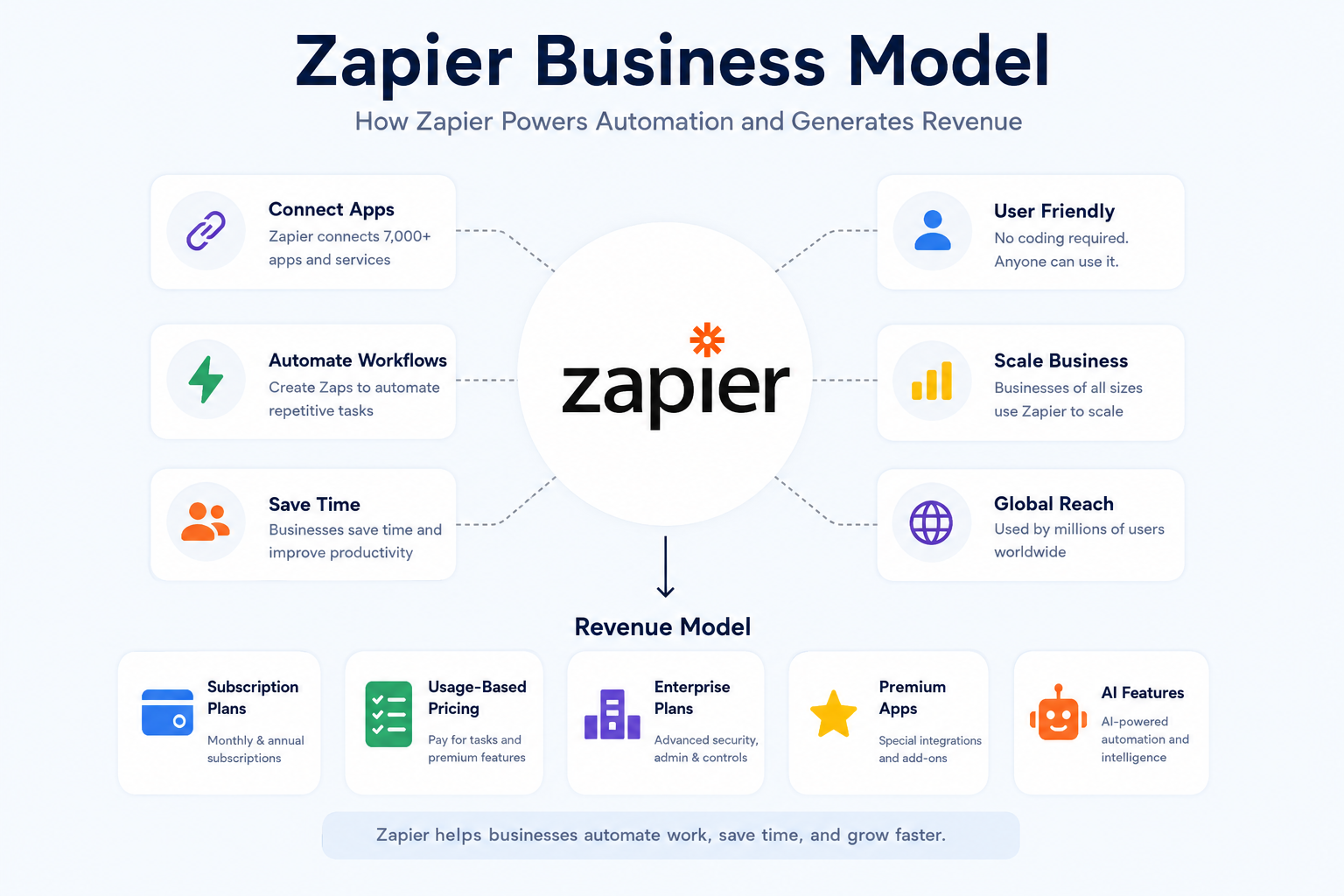
Zapier’s business model is based on a subscription SaaS model that allows users to automate workflows between thousands of applications without coding. It generates recurring revenue through tiered pricing, premium automation features, enterprise plans, and AI powered workflow automation.
This guide breaks down how Zapier makes money, how its business model canvas works, and why it became the most recognized name in workflow automation.
What Is Zapier?
Zapier is an American software company that provides a platform for business process automation and application integration. The company was founded in 2011 and officially launched in 2012 as part of the Y Combinator startup accelerator program.
Zapier began as a side project in Columbia, Missouri, founded by Wade Foster, Bryan Helmig, and Mike Knoop, who attended the University of Missouri. Foster and Knoop were doing freelance work building small integrations for companies when they noticed they kept reusing the same connectors.
Zapier is headquartered in San Francisco, California, but has never had traditional work offices. It has operated fully remotely since its founding.
Company Snapshot
| Detail | Information |
|---|---|
| Founded | 2011, launched publicly in 2012 |
| Founders | Wade Foster, Bryan Helmig, Mike Knoop |
| Headquarters | San Francisco, California |
| Business Model | Freemium SaaS subscription |
| Valuation | Around 5 billion dollars |
| Total Funding | Roughly 1.4 million dollars in outside funding |
| App Integrations | Over 8,000 apps |
| Customers | Millions of businesses worldwide |
Zapier reached profitability while relying almost entirely on its original seed round, which remains close to the total amount of venture capital the company has ever raised. That is unusual for a company at this scale. Most SaaS businesses this size have raised hundreds of millions of dollars. Zapier did not need to.
What Is Zapier’s Business Model?
Zapier runs on a freemium SaaS subscription model. Users can start automating tasks for free, then upgrade to paid tiers as their automation needs grow in complexity and volume.
The core idea is simple. Zapier does not sell software licenses. It sells access to automation capacity, measured mostly in tasks completed per month, along with premium features that unlock as customers move up the pricing ladder.
This model works because revenue scales with usage. The more a business relies on Zapier to run its operations, the more it pays. That creates a natural expansion revenue engine without heavy sales pressure.
Key pillars of the model include:
- Subscription based recurring revenue
- A freemium plan that drives user acquisition
- Usage based pricing tied to automation volume
- A massive integration ecosystem that increases switching costs
- Expansion into AI powered automation and autonomous agents
Zapier Business Model Canvas
| Component | Details |
|---|---|
| Key Partners | SaaS companies, API providers, cloud infrastructure vendors, AI model providers |
| Key Activities | Platform development, API integration maintenance, automation engine reliability, AI feature development, customer support |
| Key Resources | Software platform, integration ecosystem, engineering talent, brand trust, customer base |
| Value Proposition | No code automation that saves time and reduces manual work |
| Customer Relationships | Self serve onboarding, community templates, enterprise account support |
| Channels | Website, SEO content, app marketplace, partner integrations, YouTube |
| Customer Segments | Freelancers, startups, agencies, SMBs, enterprises, developers |
| Cost Structure | Engineering, cloud hosting, API maintenance, support, marketing, AI infrastructure |
| Revenue Streams | Subscription tiers, enterprise plans, premium AI features, add ons |
How Does Zapier Work?
Zapier connects two or more applications so that an action in one app automatically triggers a response in another. No coding is required.
The basic workflow looks like this:
User connects apps → creates a trigger → defines an action → the automation runs → the workflow history is logged → business productivity improves
Zapier’s automation system is built around workflows called zaps, which consist of a trigger, an event in one application, and one or more actions carried out in other connected apps in response.
Users can build workflows using a library of templates or create custom ones. These workflows can include multiple steps, perform actions across different applications, and support data transfers between systems.
Workflows can also be created using Zapier Copilot, a large language model tool that lets users build and troubleshoot automations through natural language prompts instead of manually configuring each step. This removes the last bit of friction for non technical users who want automation without learning workflow logic from scratch.
Zapier Value Proposition
Zapier’s value proposition shifts slightly depending on the user, but the underlying promise stays the same. It saves time by removing repetitive manual work.
For individuals and freelancers
Automation replaces hours of copy and paste work between tools like email, spreadsheets, and calendars.
For startups
Small teams can operate like larger companies by automating lead capture, onboarding, and internal notifications.
For agencies
Agencies use Zapier to manage multiple client workflows, reporting, and communication systems without hiring extra operations staff.
For SMBs
Growing businesses use Zapier to connect sales, support, and finance tools that were never designed to talk to each other.
For enterprises
Larger organizations use Zapier for governance, security controls, and standardizing automation across departments.
For developers
Developers use Zapier’s API and developer platform to build and publish custom integrations for apps not already in the directory.
Who Are Zapier’s Customers?
Zapier serves a wide mix of customer types, which is part of why its revenue base is so diversified.
- Individual professionals and freelancers
- Small and medium sized businesses
- Marketing agencies
- Ecommerce stores
- Marketing teams
- HR teams
- Finance teams
- Sales teams
- Customer support teams
- Software developers
Zapier’s customer base includes well known companies across the Cloud 100 and Fortune 1000, alongside solo freelancers running a single automated workflow.
How Does Zapier Make Money?
This is the core question most people search for, so here is the direct answer. Zapier makes money through tiered subscription plans, usage based task limits, premium AI features, and enterprise contracts.
Subscription Plans
Zapier offers monthly and annual subscription tiers, along with dedicated team and enterprise plans. Annual billing is priced lower than monthly billing, which encourages longer commitments and improves retention.
Usage Based Automation Limits
Paid plans are structured around the number of tasks a user needs each month. Customers who need more tasks, access to premium apps, or multi step workflows must upgrade to higher tiers. This usage based structure means revenue grows naturally as a customer’s automation needs expand.
Enterprise Solutions
Enterprise customers pay for features built specifically for large organizations, including single sign on, advanced security, governance controls, and admin permissions. These features carry higher price points because they solve compliance and scale problems that smaller customers do not face.
AI Automation Features
Zapier has expanded heavily into AI powered functionality, including AI actions, AI agents, and an AI workflow builder. These features are positioned as premium capabilities that justify higher tier pricing and give Zapier a new growth lever beyond basic app to app automation.
Premium Integrations and Add Ons
Certain premium apps and advanced features are gated behind higher pricing tiers. This lets Zapier monetize its most valuable integrations without raising the base price for casual users.
API Services
Zapier’s developer platform allows companies to build and monetize their own integrations, extending the ecosystem while creating additional technical touchpoints that increase platform lock in.
Zapier Pricing Strategy
Zapier uses a classic freemium ladder. The free plan gets users comfortable with the product, and each paid tier removes limits as automation needs grow.
- Free plan – limited tasks, basic single step zaps, good for testing the platform
- Starter tier – multi step zaps and more monthly tasks for individuals and small teams
- Professional tier – unlimited premium apps, advanced logic, and priority support
- Team tier – shared workspaces and centralized billing for growing companies
- Enterprise tier – custom pricing, advanced security, and dedicated support
Pricing scales with automation needs rather than seat count alone, which is different from many SaaS tools. This means a single power user running thousands of automated tasks can end up paying more than a five person team running simple workflows. It aligns price with actual value delivered.
Cost Structure
Running an automation platform at Zapier’s scale requires investment across several major areas.
- Engineering and product development
- Cloud infrastructure to support billions of monthly automated tasks
- Ongoing API maintenance across thousands of integrations
- Customer support across a global user base
- Marketing and content production
- AI infrastructure and model costs
- Employee salaries across a fully remote workforce
- Security and compliance for enterprise customers
Because Zapier depends on thousands of third party APIs, a meaningful portion of engineering resources goes toward keeping those integrations stable as partner platforms change their own systems.
Zapier Growth Strategy
Zapier’s growth strategy centers on product led growth rather than traditional outbound sales.
Freemium funnel
The free plan lowers the barrier to entry and lets users experience value before paying anything.
Product led growth
Users upgrade because they hit real limits in their own workflows, not because a sales rep convinced them to.
SEO strategy
Zapier built individual landing pages for thousands of app to app integration combinations, which made the platform highly discoverable in search results for very specific automation needs.
Template marketplace
Pre built workflow templates reduce setup time and expose users to automation use cases they had not considered.
App ecosystem
Every new integration added to the platform increases the number of possible automations, which increases the platform’s overall value.
Viral sharing
Shared templates and public workflow examples introduce Zapier to new users organically.
Community
Zapier invests in educational content and community resources that build long term trust with non technical users.
AI expansion
Newer AI features are positioned to attract a fresh wave of users interested in agentic and natural language automation.
Zapier Marketing Strategy
Zapier’s marketing strategy leans heavily on organic and educational channels rather than paid acquisition alone.
- Content marketing built around automation use cases
- SEO targeting integration specific search queries
- A large library of automation templates
- Affiliate and partner marketing programs
- Email marketing focused on onboarding and feature adoption
- Product education through guides and tutorials
- YouTube content demonstrating real workflows
- Social media presence across major platforms
- Developer relations to grow the API ecosystem
This mix keeps customer acquisition costs relatively low compared to sales heavy SaaS competitors.
Why Zapier Became So Successful
Several factors combined to make Zapier the default name in workflow automation.
- First mover advantage in the no code automation space
- Thousands of integrations that competitors struggled to match
- A simple user experience that did not require technical skill
- Strong brand recognition built through years of content and SEO
- Predictable recurring revenue from subscriptions
- A product led growth model that reduced reliance on sales teams
- A fully remote culture that helped attract talent from anywhere
- Early and consistent investment in AI features
Zapier Competitive Advantage
Zapier’s moat comes from several reinforcing factors rather than a single feature.
Massive integration ecosystem
With thousands of supported apps, Zapier covers use cases that smaller competitors simply cannot match.
Switching costs
Once a business has built dozens of automated workflows on Zapier, moving to another platform requires rebuilding all of that logic elsewhere.
Brand trust
Zapier is often the first automation tool people learn, which creates lasting brand familiarity.
Automation expertise
Years of experience across countless workflow types give Zapier a depth of automation knowledge that is hard to replicate quickly.
API relationships
Long standing partnerships with software companies make Zapier integrations more reliable and often better maintained than newer competitors.
Enterprise adoption
Zapier has built specific features for large organizations, which strengthens its position beyond the small business market.
AI powered workflows
Newer AI capabilities give Zapier a way to defend its position against automation tools built AI first from day one.
Zapier AI Strategy
Zapier has shifted a significant part of its roadmap toward AI orchestration rather than simple app connections.
The company has introduced AI agents capable of operating across integrated applications, an AI workflow builder for building automations through natural language, and AI chatbots for handling routine tasks. Zapier has also launched official support for the Model Context Protocol, which allows AI assistants to connect directly with thousands of apps without custom integration work.
The long term vision points toward agentic automation, where AI systems do not just move data between apps but make decisions and take multi step actions with minimal human input.
SWOT Analysis
| Strengths | Weaknesses |
|---|---|
| Large integration ecosystem | Heavy dependence on third party APIs |
| Strong recurring revenue | Pricing increases with usage |
| Brand authority in automation | Learning curve for complex workflows |
| Opportunities | Threats |
|---|---|
| AI automation expansion | Native integrations built by competitors |
| Enterprise growth | API policy changes from partner platforms |
| Global expansion | Increasing competition from newer automation tools |
Zapier Competitor Analysis
| Feature | Zapier | Make | Microsoft Power Automate | IFTTT | n8n |
|---|---|---|---|---|---|
| Pricing | Higher at scale | Generally cheaper per task | Bundled with Microsoft plans | Low cost, consumer focused | Open source, self hostable |
| Integrations | Very broad | Broad | Strong within Microsoft ecosystem | Consumer app focused | Growing steadily |
| AI features | Actively expanding | Growing | Backed by Microsoft AI investment | Limited | Flexible for technical users |
| Enterprise readiness | Strong | Moderate | Very strong | Weak | Depends on setup |
| Ease of use | Very beginner friendly | Slightly more technical | Familiar to Microsoft users | Extremely simple | Requires technical comfort |
| Customization | Good | Strong visual logic | Strong within Microsoft tools | Minimal | Very high for developers |
Challenges Facing Zapier
Zapier’s position is strong, but it faces real pressure points.
- Dependence on third party APIs that can change without notice
- Increasing competition from both established players and newer automation startups
- The risk of AI disrupting how automation itself gets built
- Rising expectations from enterprise buyers around security and governance
- Pricing pressure as usage based competitors undercut costs
- Maintaining platform reliability as automation volume keeps growing
Future of Zapier
Zapier’s future direction points toward AI first automation. The company is investing in agentic workflows, deeper enterprise AI capabilities, and broader hyperautomation across business processes.
Rather than positioning itself purely as a connector between apps, Zapier is moving toward becoming a layer of workflow intelligence that can reason about tasks, not just execute predefined steps.
Key Lessons Entrepreneurs Can Learn From Zapier
- Solve one painful problem extremely well before expanding
- Build a business around recurring revenue rather than one time sales
- Grow around an ecosystem instead of an isolated product
- Use freemium pricing to reduce friction in customer acquisition
- Invest early in educational content for long term organic growth
- Let integrations and switching costs become a competitive moat
- Expand gradually into adjacent features like AI rather than rebuilding from scratch
Wrapping Up
Zapier transformed workflow automation by combining a freemium SaaS model, one of the largest integration ecosystems in software, recurring subscription revenue, and a product led growth engine that reduced its need for traditional sales. Its shift toward AI powered automation and autonomous agents looks like the natural next step for a company that has always focused on removing friction from repetitive work. As more businesses look to automate complex processes without writing code, Zapier’s early bet on simplicity and ecosystem depth may end up being the exact advantage that keeps it ahead of a fast growing field of AI native competitors.
FAQs
Zapier uses a freemium SaaS subscription model that charges based on automation usage and premium features.
Zapier earns revenue through subscription tiers, usage based task limits, enterprise plans, and premium AI features.
Yes. Zapier reached profitability years ago while relying on a very small amount of outside funding compared to most companies at its scale.
Make, Microsoft Power Automate, IFTTT, and n8n are among Zapier’s main competitors in the automation space.
Zapier is popular because it removed the technical barrier to automation and built one of the largest integration libraries in the industry.
Yes. Zapier is a software as a service company built around recurring subscription revenue.
Yes. Zapier has expanded into AI agents, an AI workflow builder, and natural language automation tools.
Zapier is used across marketing, sales, ecommerce, HR, finance, customer support, and software development, among many other fields.
Zapier offers a free plan with limited tasks and basic automation. Paid plans unlock higher limits and advanced features.
Zapier’s advantage comes from its large integration ecosystem, high switching costs, strong brand trust, and growing AI capabilities.
Discover more from Business Model Hub
Subscribe to get the latest posts sent to your email.