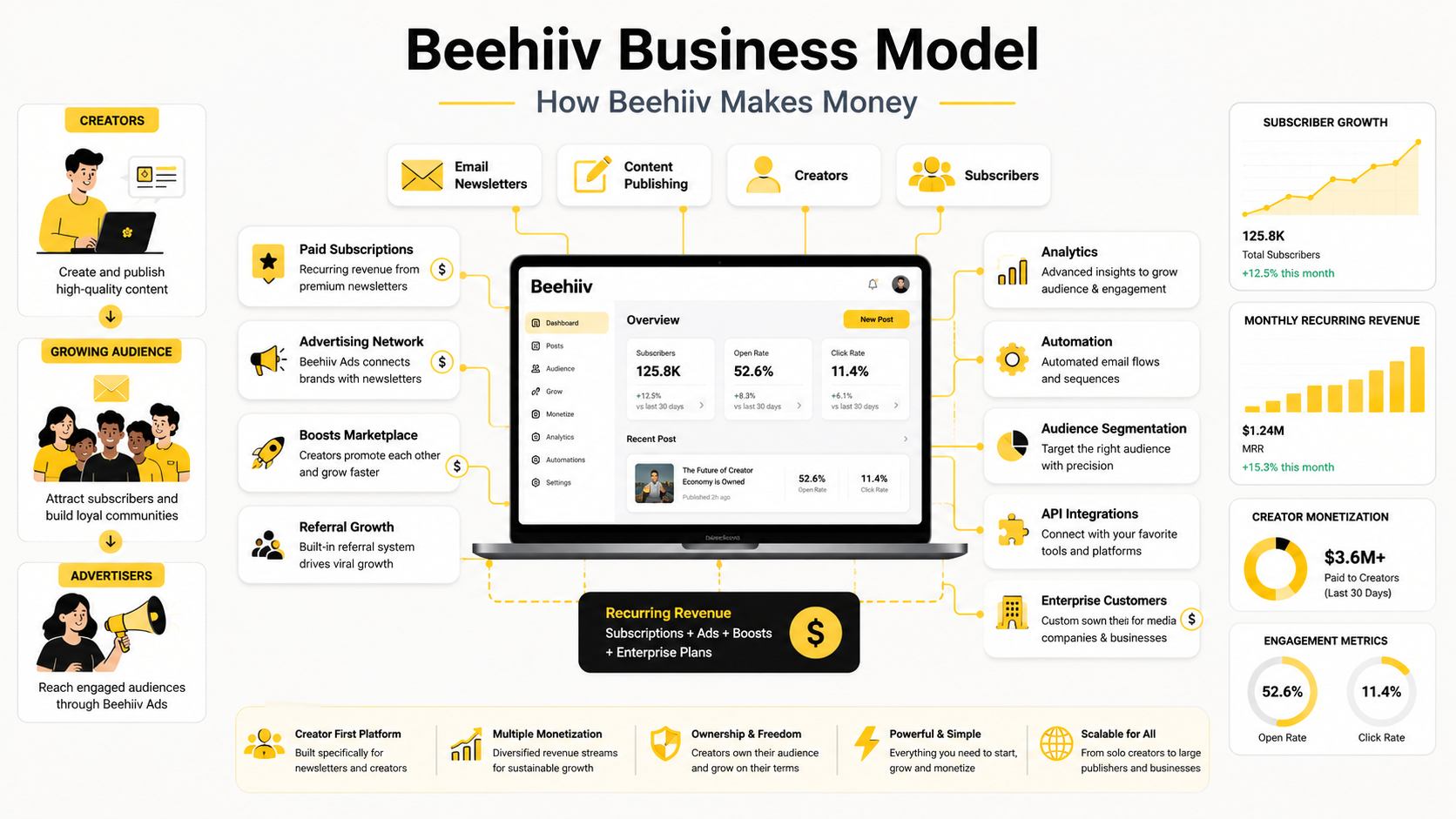
Beehiiv Business Model And How It Makes Money and Built a Creator-First Newsletter Platform

Beehiiv is a newsletter and publishing platform that helps creators build, grow, and monetize email audiences without giving up a cut of their subscription revenue to the platform.
What is Beehiiv’s business model?
Beehiiv runs on a SaaS subscription model layered with an advertising marketplace. Creators pay a flat monthly fee for software access, and Beehiiv earns extra revenue through its ad network and Boosts referral marketplace.
How does Beehiiv make money?
Beehiiv earns through tiered subscription plans, ad placements sold through its native ad network, a commission on Boosts transactions, and enterprise contracts for large publishers.
Why has Beehiiv grown so quickly?
Beehiiv grew fast because it gave writers a flat fee structure instead of a revenue cut, built monetization tools directly into the platform, and added features like podcast hosting to keep creators inside one ecosystem.
Introduction
Newsletter businesses have shifted from a side hobby to a serious revenue channel for independent writers, journalists, and brands. The creator economy keeps expanding as more professionals choose to build owned audiences instead of relying on social platforms.
Beehiiv became one of the most talked about names in this space within a few years of launching. Writers moving away from older tools were drawn to its pricing structure and built-in growth features.
This article breaks down how Beehiiv operates as a business, where its revenue actually comes from, and what other founders can learn from its growth path.
What is Beehiiv?
Beehiiv was founded by a team that previously worked on growth and product at Morning Brew, one of the most recognized newsletter brands in the United States. That background shaped the product from day one, since the founders had already lived through the pain points of scaling a newsletter without proper tools.
The platform launched as newsletter software and has steadily expanded into a broader publishing ecosystem. It now includes website hosting, podcast distribution, advertising, and audience growth tools under one login.
Beehiiv is headquartered in the United States and serves creators, media companies, and businesses across the world. The mission centers on giving writers ownership of their audience and revenue instead of routing both through a platform that takes a cut.
Beehiiv at a Glance
| Category | Details |
|---|---|
| Founded | By former Morning Brew team members |
| Headquarters | United States |
| Industry | Creator economy and email publishing software |
| Business Type | SaaS plus advertising marketplace |
| Revenue Model | Subscription fees, ad network, Boosts commission, enterprise plans |
| Target Customers | Independent writers, media companies, businesses, agencies |
| Website | beehiiv.com |
Beehiiv Business Model Explained
Beehiiv runs as a SaaS business at its core. Creators sign up for a paid plan based on subscriber count and feature needs, and that subscription fee is predictable and recurring.
On top of the SaaS layer, Beehiiv operates as a creator economy platform. It connects writers with advertisers and with each other, turning the platform into a marketplace rather than just a publishing tool.
The growth strategy leans heavily on product-led growth. Writers who use Beehiiv often publish a public, branded web version of their newsletter, which exposes new readers to the Beehiiv name without any paid marketing spend.
Community and referral loops reinforce this. Creators promote each other through Boosts, and many new writers join after seeing a newsletter built on Beehiiv that they personally subscribe to.
Beehiiv Business Model Canvas
Customer Segments
Individual creators form the largest segment, followed by professional newsletter publishers, media companies, businesses running internal or marketing newsletters, agencies managing client publications, and startups using newsletters for audience building.
Value Proposition
Beehiiv offers a flat monthly fee instead of a revenue share, built-in monetization tools, audience growth features, and a publishing stack that covers email, web, and podcast in one place.
Channels
The platform grows through organic search, word of mouth between creators, the Boosts referral network, social media, and a partner program that pays commission for referrals.
Customer Relationships
Relationships are mostly self-serve through the product itself, supported by educational content, customer success outreach for larger accounts, and a dedicated team for enterprise clients.
Revenue Streams
Revenue comes from subscription tiers, advertising placements, a commission on Boosts, and custom enterprise contracts.
Key Resources
The product infrastructure, the advertiser relationships behind the ad network, the creator community, and the brand reputation built through transparent pricing all count as core resources.
Key Activities
Core activities include product development, advertiser sales, creator support, and content marketing that teaches people how to build and monetize newsletters.
Key Partners
Payment processing runs through Stripe. Advertisers ranging from consumer brands to SaaS companies form the demand side of the ad network. Integration partners also extend the platform’s reach.
Cost Structure
Costs include engineering and product development, infrastructure for sending and hosting content, advertiser sales operations, and customer support.
How Beehiiv Makes Money
Paid Subscription Plans
Subscription fees are the foundation of Beehiiv’s revenue. The free plan supports newsletters up to roughly 2,500 subscribers with core features like web hosting and basic analytics.
Paid tiers scale from there. Pricing sits around $43 a month on the lower paid tier and $96 a month on a higher tier when billed annually, with those rates holding flat until a publication crosses 100,000 subscribers. After that threshold, subscriber-based pricing applies.
Annual billing is positioned as the better deal compared to monthly billing, which encourages creators to commit longer term and gives Beehiiv steadier recurring revenue.
Beehiiv Ads Network
The ad network matches advertisers with newsletters based on audience size and topic relevance. Brands that have run campaigns through the network include names like Netflix, Notion, and HubSpot.
Creators need a minimum subscriber count and consistent sending activity to qualify. Once approved, sponsorship opportunities are sent directly to the creator, removing the need to pitch advertisers manually.
This setup benefits creators because it turns an existing audience into income without extra sales work, and it benefits Beehiiv because ad placements are a separate revenue line from subscription fees.
Boosts Marketplace
Boosts function as a referral marketplace between newsletters. Creators pay other creators to recommend their newsletter to new readers, and Beehiiv takes a commission on that spend.
Beehiiv reportedly takes around 20 percent of the gross transaction value moving through Boosts. This creates a growth loop where creators reinvest ad and subscription income into acquiring more subscribers, which then increases the inventory available for future ad sales.
There is also an “earn per send” version of Boosts, where a creator gets paid to feature another newsletter inside their own send, sometimes for several hundred dollars per placement.
Enterprise Plans
Large publishers and media companies that need custom volume, dedicated support, or advanced features fall into Beehiiv’s enterprise tier. Pricing here is negotiated rather than published, since needs vary widely by publisher size.
API and Advanced Features
Higher tiers unlock deeper segmentation, advanced analytics, and more recently, integration through the Model Context Protocol, which lets AI tools connect directly to a creator’s Beehiiv data for reporting and analysis.
Beehiiv Pricing Strategy
The free plan acts as the entry point and lets new creators test the platform before paying anything. This lowers the barrier for trial and gives Beehiiv a large funnel of free users who may eventually upgrade.
Entry-level paid pricing is positioned to undercut platforms that take a percentage of subscription revenue. Because Beehiiv charges a flat fee, creators with larger paid subscriber bases save significantly compared to a revenue-share model.
Pricing scales with subscriber count once a publication grows large, which keeps the model fair for both very small and very large publishers while protecting margins as usage increases.
The overall approach reflects value-based pricing rather than cost-based pricing. Creators are paying for growth and monetization outcomes, not just email-sending infrastructure.
Beehiiv Growth Strategy
Product-led growth drives much of Beehiiv’s expansion. Every newsletter built on the platform includes a public web version with Beehiiv branding, which exposes new readers and potential customers to the product.
Creator referrals add another layer. The Beehiiv Partner Program pays a 50 percent commission on the first year of revenue for referred customers, which gives existing creators a financial reason to recommend the platform.
Viral sharing happens naturally through Boosts, since creators are actively cross-promoting each other’s newsletters as part of their own growth strategy.
SEO plays a meaningful role too. Beehiiv publishes detailed educational content about newsletter monetization and growth, which ranks well in search and pulls in creators who are researching how to start or scale a newsletter.
Word of mouth inside creator communities, newsletter migration tools that simplify switching from Substack or Mailchimp, and partnerships with media collectives all support the broader growth engine.
Beehiiv Marketing Strategy
Content marketing is central to how Beehiiv attracts new users. Long-form guides on topics like newsletter monetization and creator income are designed to answer real questions creators are searching for.
Creator partnerships and success stories reinforce credibility. Public examples of writers earning meaningful income, including cases of newsletters reaching six-figure annual revenue within a year, are used to demonstrate the platform’s earning potential.
Podcast sponsorships and influencer marketing extend reach into creator-focused media. Educational resources, including guides and case studies, double as both marketing and onboarding material.
Social proof shows up throughout Beehiiv’s marketing, with specific revenue figures and creator testimonials used to build trust with prospective users who are evaluating whether to switch platforms.
Beehiiv Competitive Advantages
Beehiiv was built specifically for newsletter businesses rather than adapted from general email marketing software. That focus shows up in features tailored to publishing and monetization rather than bulk email campaigns.
No-code publishing lets writers focus on content instead of design work. Built-in analytics combine engagement data with revenue data, giving creators a single view of how content performance connects to income.
Monetization tools are native to the platform rather than bolted on through third-party integrations. This includes paid subscriptions, the ad network, and Boosts.
Creator ownership stands out as a major differentiator, since writers keep their audience data and keep more of their subscription revenue compared to commission-based platforms. The interface is also generally regarded as modern and fast compared to older email tools.
Beehiiv Competitors
| Platform | Pricing | Monetization | Best For |
|---|---|---|---|
| Substack | Free to use, takes a percentage of paid subscriptions | Paid subscriptions, takes roughly 10 percent | Writers who want simplicity and built-in discovery |
| Kit (formerly ConvertKit) | Subscription based | Limited built-in monetization | Creators focused on email marketing automation |
| Mailchimp | Subscription based | Not creator-focused | Businesses needing general email marketing |
| Ghost | Subscription or self-hosted | Paid subscriptions with lower fees | Writers wanting full content ownership |
| MailerLite | Subscription based | Limited monetization tools | Small businesses on a budget |
Substack remains the closest comparison point because of its size and recognition, though it functions more like a social discovery network while Beehiiv positions itself as a full publishing operating system. Beehiiv’s flat-fee model contrasts directly with Substack’s revenue-share approach on paid subscriptions.
Why Creators Choose Beehiiv
Writers choose Beehiiv mainly because they keep ownership of their audience and their revenue. A flat monthly fee feels more predictable than a percentage cut, especially as subscription income grows.
Built-in monetization options reduce the need to manage separate tools for ads, referrals, and payments. The platform is also seen as simple enough for beginners while still offering depth for larger publishers.
Scalability matters too. Creators starting small can move up through pricing tiers as their list grows without switching platforms, which avoids the disruption of migrating an entire audience later.
Challenges in Beehiiv’s Business Model
Competition in the newsletter space is intense, with Substack holding a larger valuation and stronger brand recognition among casual writers. Beehiiv has to keep differentiating through pricing and features to keep winning switchers.
Creator retention is another challenge. Newsletter audiences can churn quickly, and if creators leave the platform, both subscription and ad revenue tied to those publications disappear.
Platform dependence cuts both ways. Beehiiv promotes creator ownership, but creators still rely on Beehiiv’s infrastructure for delivery, hosting, and monetization tools.
Scaling infrastructure to support growing send volumes and ad inventory takes ongoing investment. Balancing free plan generosity against the need to convert users to paid tiers is also an ongoing tension, since the free plan needs to be useful enough to attract users without removing the incentive to upgrade.
International expansion adds complexity too, particularly around payment processing, since core monetization tools depend on Stripe, which has regional limitations in some markets.
Future Opportunities
AI-powered writing and content tools are a natural next step as creators look for help producing content faster. Beehiiv has already started integrating AI access to subscriber and performance data, which points toward deeper AI features ahead.
Better analytics, particularly around attribution and audience behavior, will likely keep expanding as a way to help creators make smarter monetization decisions.
Enterprise expansion offers a path to larger, more stable revenue from established media companies migrating off legacy publishing systems.
Beehiiv’s recent move into podcast hosting with no revenue cut signals an interest in expanding beyond email into broader creator commerce and audio content. More advertising products, deeper community features, and continued growth in the global creator economy all represent likely areas of expansion.
Lessons Entrepreneurs Can Learn from Beehiiv
Solve one problem exceptionally well before expanding into adjacent features. Beehiiv started with newsletter publishing and only added podcasting and other tools once the core product was strong.
Build recurring revenue into the business model from day one rather than relying on one-time transactions.
Create network effects where users benefit each other, the way Boosts turns individual creators into a referral engine for the whole platform.
Focus on customer success metrics, not just signups, since creators who actually earn money on the platform become its strongest marketing channel.
Design for the people actually using the product. Beehiiv built tools for writers, not for marketing departments, which shaped a very different product than typical email marketing software.
Add monetization options early instead of treating them as a later feature, since income potential is often the deciding factor for serious users.
Grow through the product itself wherever possible, using built-in features like public web pages and referral programs instead of relying entirely on paid advertising.
Key Takeaways
Beehiiv combines a SaaS subscription model with an advertising marketplace, giving it multiple revenue streams beyond software fees alone.
Its core revenue comes from subscription plans, the ad network, Boosts commissions, and enterprise contracts.
Growth has been driven primarily through product-led mechanics, creator referrals, and content marketing rather than heavy paid advertising spend.
Its biggest competitive advantage is the flat-fee pricing structure compared to revenue-share platforms like Substack.
Founders building subscription software can learn from Beehiiv’s focus on recurring revenue, built-in monetization, and growth loops that turn existing users into a distribution channel.
Conclusion
Beehiiv has grown into one of the fastest expanding newsletter platforms by giving creators a financial structure they consider fairer than the alternatives. Its creator-first approach, combined with a SaaS-based recurring revenue model, has built a business that scales alongside the people using it.
For founders building subscription software, Beehiiv offers a clear example of how aligning pricing with customer incentives, layering in additional revenue streams, and investing early in monetization tools can drive sustainable growth in a competitive market.
FAQs
Beehiiv is a newsletter publishing and growth platform that helps creators build, host, and monetize email audiences.
Beehiiv has stated a goal of reaching profitability around 2027 and has enough funding to operate for more than two years while pursuing growth.
Beehiiv earns through subscription plan fees, advertising placements sold through its ad network, a commission on Boosts transactions, and custom enterprise contracts.
Beehiiv was founded by former Morning Brew team members and remains an independent, venture-backed company.
Beehiiv tends to suit creators who want more control over monetization and growth tools, while Substack suits writers who prioritize built-in discovery and simplicity. The better choice depends on a creator’s priorities around fees and features.
No. Beehiiv charges a flat monthly software fee instead of a percentage of subscription revenue, with payment processing fees from Stripe being the only transaction-based cost.
Independent writers, journalists, media companies, businesses, and agencies use Beehiiv to run newsletters and related publishing operations.
Mailchimp is built primarily for general email marketing, while Beehiiv is built specifically for newsletter publishing and creator monetization.
Yes, Beehiiv offers a free plan that supports newsletters up to a limited subscriber count, with paid plans required as a list grows.
Creators who meet subscriber and activity requirements get matched with relevant advertisers, and sponsorship opportunities are sent directly to them without needing to pitch brands manually.
Discover more from Business Model Hub
Subscribe to get the latest posts sent to your email.