Databricks Business Model And How It Makes Money and Built a Multi-Billion Dollar AI and Data Platform

The Databricks business model runs on a cloud-based Software-as-a-Service platform. It helps organizations store, process, analyze, and build AI applications on a single unified system. Databricks earns revenue mainly through usage-based pricing, enterprise subscriptions, AI products, cloud integrations, and premium platform features. As of early 2026, the company crossed a $5.4 billion annualized revenue run rate, growing more than 65% year over year, with AI products alone contributing over $1.4 billion in annualized revenue.
What is Databricks?
Databricks is a data and AI company. It gives organizations one platform to store data, process it, run analytics, and build machine learning and generative AI applications.
The company was built around Apache Spark, an open-source engine for large-scale data processing. Over time, Databricks expanded far past Spark into a full platform known as the Data Intelligence Platform.
What problem does Databricks solve?
Most companies store data across scattered systems. Some data sits in warehouses. Some sits in lakes. Some is locked inside SaaS tools. This creates duplication, high costs, and slow AI development.
Databricks solves this by combining data warehousing and data lake storage into one system, commonly called a Lakehouse. Teams get one place to store, govern, and use their data for both analytics and AI.
Why enterprises use Databricks
Enterprises choose Databricks because it removes the need to run separate systems for business intelligence and AI development. It also scales with usage, so companies avoid paying for idle infrastructure.
More than 20,000 organizations now rely on Databricks, including adidas, AT&T, Bayer, Block, Mastercard, Rivian, and Unilever. Over 60% of the Fortune 500 use the platform in some form.
Industries using Databricks
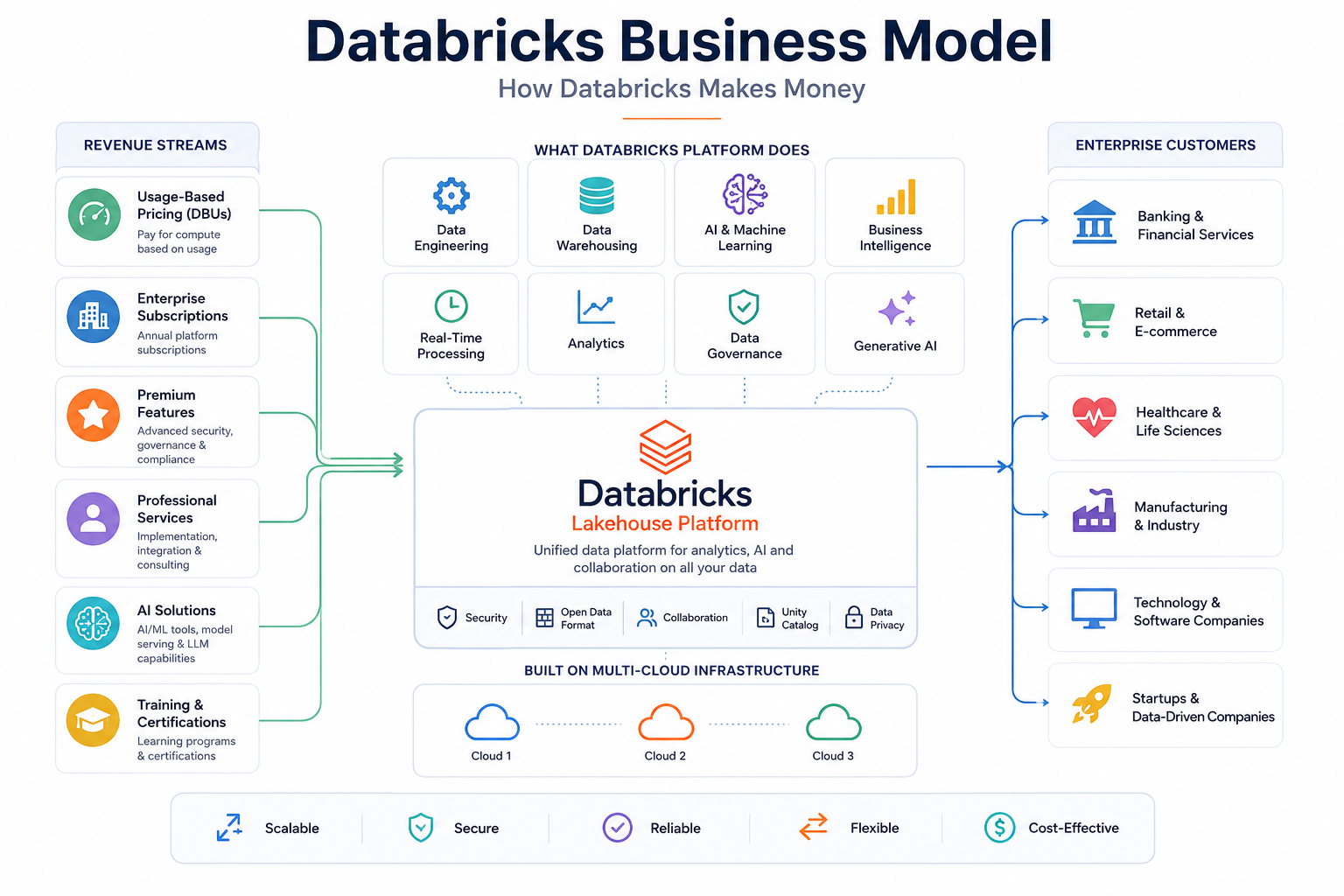
Databricks is used across financial services, healthcare, retail, manufacturing, media, and government. Any industry with large volumes of data and a need for AI adoption is a natural fit.
What is the Databricks Business Model?
The Databricks business model is a hybrid. It blends SaaS subscriptions, consumption-based cloud pricing, and enterprise agreements. Customers pay based on how much computing power and platform capability they use, not a flat license fee.
SaaS model
Databricks is delivered as a managed cloud service. Customers do not install or maintain hardware. They log in and use the platform directly.
Consumption-based cloud platform
Pricing is tied to actual usage, measured in Databricks Units, known as DBUs. This means costs rise and fall with real workload demand.
AI platform
Databricks now positions itself as an AI company as much as a data company. Its AI product line, including Agent Bricks and Genie, is one of the fastest-growing parts of the business.
Enterprise software
Large companies sign annual or multi-year contracts with committed spending. This gives Databricks predictable, recurring revenue on top of pure usage billing.
Open-source ecosystem
Databricks built its reputation on open-source projects like Apache Spark, Delta Lake, and MLflow. This drives developer adoption, which later converts into paid enterprise customers.
Hybrid revenue model
The combination of subscriptions, usage billing, and enterprise contracts gives Databricks flexibility. Small teams can start cheap. Large enterprises can commit to millions in annual spend.
Databricks at a Glance
| Item | Details |
|---|---|
| Founded | 2013 |
| Founders | Ali Ghodsi, Ion Stoica, Matei Zaharia, Patrick Wendell, Reynold Xin, Andy Konwinski, Arsalan Tavakoli-Shiraji |
| Headquarters | San Francisco, California |
| Industry | Data and AI software |
| Business Type | Private company |
| Valuation | Roughly $134 billion as of early 2026, with reports of a new round targeting $165 billion to $175 billion |
| Customers | More than 20,000 organizations worldwide |
| Employees | Several thousand globally, across 30-plus offices |
| Revenue | Over $5.4 billion annualized run rate, growing more than 65% year over year |
| Parent Company | None, Databricks is independently owned and privately held |
History of Databricks
Apache Spark origins
Databricks began as a commercial extension of Apache Spark, a distributed data processing engine created at UC Berkeley. Spark was designed to process large datasets faster than older tools like Hadoop MapReduce.
University research
The founding team developed Spark as part of the AMPLab research group at UC Berkeley. Their academic work became the technical foundation for the company.
Company launch
Databricks was founded in 2013 by seven researchers connected to the Spark project. The company commercialized the open-source technology into a managed cloud service.
Major funding rounds
Databricks has raised more than $20 billion in total funding across equity and debt. Valuation jumped from around $62 billion at the start of 2025, to over $100 billion in August 2025, to $134 billion by December 2025, with a new round reportedly targeting up to $175 billion by mid-2026.
AI expansion
Starting around 2023, Databricks pushed hard into generative AI. It acquired MosaicML to build foundation model training capability, and later launched products like Agent Bricks and Genie to help enterprises build AI agents on their own data.
Recent milestones
In February 2026, Databricks confirmed a $5.4 billion revenue run rate, more than $7 billion in new investment, and AI products generating over $1.4 billion in annualized revenue on their own. The company has also signaled it is preparing for a possible IPO, though CEO Ali Ghodsi has said the timing depends on market conditions.
Who Founded Databricks?
Databricks was founded by Ali Ghodsi, Ion Stoica, Matei Zaharia, Patrick Wendell, Reynold Xin, Andy Konwinski, and Arsalan Tavakoli-Shiraji in 2013.
Background
All seven founders were connected to UC Berkeley and the AMPLab research group. Several of them created Apache Spark before starting the company.
Why they started it
The founders saw growing demand for large-scale data processing outside of academic settings. They believed enterprises needed a managed, reliable version of the technology they had built in the lab.
Spark creators
The founding team is widely credited as the original creators of Apache Spark, which remains one of the most used open-source data processing engines in the world.
Why Databricks Became So Successful
AI boom
Enterprise demand for AI tools created a direct need for platforms that can organize and prepare data for AI training and deployment. Databricks positioned itself early as the infrastructure layer for that work.
Data explosion
Companies generate more data every year than they can manage with older systems. Databricks offers a scalable answer to that growth.
Cloud adoption
As more companies shifted infrastructure to the cloud, Databricks benefited by being cloud-native from the start, with support across AWS, Microsoft Azure, and Google Cloud.
Lakehouse innovation
The Lakehouse architecture solved a long-standing tradeoff between data warehouses and data lakes. This became a core differentiator against competitors offering only one or the other.
Open source trust
Because Databricks built its business on open-source technology, it earned deep credibility with data engineers and developers, which helped drive bottom-up adoption inside companies.
Enterprise focus
Databricks paired its technical strength with serious enterprise sales investment, landing large contracts with major global brands and regulated industries like finance and healthcare.
How Databricks Works
Step by step workflow
- Connect data. Organizations connect data sources, including databases, SaaS tools, and streaming systems.
- Store in Lakehouse. Data lands in a unified storage layer that supports both structured and unstructured formats.
- Process data. Databricks processes and transforms raw data using Spark-based engines.
- Analyze. Business teams run analytics and build dashboards directly on the platform.
- Machine learning. Data science teams train and test models using built-in tools.
- AI deployment. Teams deploy models and AI agents into production applications.
- Governance. Unity Catalog manages permissions, lineage, and compliance across the platform.
- Monitoring. Teams track performance, cost, and reliability across pipelines and models.
Databricks Business Model Canvas
| Element | Details |
|---|---|
| Value Proposition | Unified data and AI platform that reduces complexity and cost |
| Customer Segments | Enterprises, financial institutions, healthcare, retail, manufacturing, government, tech companies, startups |
| Channels | Direct sales, cloud marketplaces, partners, events, online demos |
| Customer Relationships | Account managers, technical support, customer success, community, documentation |
| Revenue Streams | Usage-based compute, subscriptions, AI products, premium governance, managed services, consulting, training |
| Key Activities | Platform development, AI innovation, cloud optimization, security, enterprise support |
| Key Resources | Apache Spark, Lakehouse platform, AI models, engineering talent, brand |
| Key Partners | Cloud providers, technology partners, consulting firms, system integrators |
| Cost Structure | Cloud infrastructure, engineering, AI research, sales, customer success, compliance |
Value Proposition
Unified analytics
Databricks combines business intelligence and data engineering into one system, removing the need to maintain separate tools.
AI development
Teams can build, train, and deploy AI models and agents without exporting data into a separate AI stack.
Faster data engineering
Automated pipelines and managed infrastructure reduce the manual work required to prepare data for use.
Lower infrastructure complexity
Because storage, processing, and AI tools live in one platform, companies avoid managing multiple disconnected systems.
Collaboration
Data engineers, analysts, and data scientists can work inside the same environment, using shared notebooks and shared data.
Scalability
The platform scales computing resources up or down automatically based on workload demand.
Security
Databricks includes built-in governance and access controls through Unity Catalog, which matters heavily for regulated industries.
Customer Segments
Enterprises
Large companies use Databricks to unify data across departments and support AI initiatives at scale.
Financial institutions
Banks and financial firms use the platform for risk modeling, fraud detection, and regulatory reporting.
Healthcare
Healthcare organizations use Databricks for clinical data analysis and drug research support, often under strict compliance requirements.
Retail
Retailers use the platform for demand forecasting, personalization, and inventory optimization.
Manufacturing
Manufacturers apply Databricks to predictive maintenance and supply chain analytics.
Government
Public sector agencies use Databricks for secure, large-scale data analysis.
Technology companies
Tech companies use Databricks to power internal analytics and customer-facing AI features.
Startups
Smaller companies use Databricks to access enterprise-grade infrastructure without building it from scratch.
Revenue Streams
Databricks makes money mainly through usage-based compute billing, enterprise subscriptions, AI products, premium governance features, and professional services.
Usage-based compute charges
Customers pay based on the Databricks Units they consume. This is the core of the pricing model and scales directly with usage.
Enterprise subscriptions
Larger customers commit to annual or multi-year contracts with guaranteed spending levels.
AI products
Databricks now generates over $1.4 billion in annualized revenue from AI products alone, including agent-building tools and generative AI features.
Premium governance features
Advanced security, compliance, and data governance capabilities are sold as premium add-ons.
Managed services
Databricks offers managed infrastructure so customers do not need to operate the underlying compute themselves.
Professional services
Databricks provides implementation and consulting support to help large customers deploy the platform correctly.
Partner ecosystem
Databricks earns indirect revenue through partnerships with cloud providers and system integrators who resell or implement the platform.
Training and certifications
Databricks sells training programs and certifications to individuals and enterprise teams looking to build internal expertise.
Cost Structure
Databricks carries high costs tied to cloud infrastructure, since the platform runs on top of AWS, Azure, and Google Cloud. Engineering and AI research are also major cost centers, given the pace of product development.
Sales and customer success teams support enterprise growth, while security and compliance investment is essential for serving regulated industries. Marketing spend supports brand visibility in a competitive AI infrastructure market.
Key Resources
Databricks relies on its Apache Spark heritage, its Lakehouse platform architecture, and its growing library of AI models and tools. Engineering talent remains a central resource, along with its large enterprise customer base and strong brand recognition in the data and AI space.
Key Activities
Core activities include ongoing platform development, AI innovation, cloud infrastructure optimization, and continuous security updates. Databricks also maintains active open-source contributions and dedicated enterprise support operations.
Key Partners
Cloud providers
Databricks runs on AWS, Microsoft Azure, and Google Cloud, giving customers flexibility in where their data lives.
Technology partners
Databricks integrates with major software vendors to extend its platform capabilities.
Consulting firms
Large consulting firms help enterprises implement Databricks across complex environments.
System integrators
System integrators support large-scale deployments, especially in regulated industries.
Open-source community
The open-source community around Spark, Delta Lake, and MLflow continues to drive adoption and technical credibility.
Distribution Channels
Databricks sells directly through its own enterprise sales team, but also distributes through cloud marketplaces on AWS, Azure, and Google Cloud. Partner-led sales, industry events, and online product demos round out its distribution strategy.
Customer Relationships
Databricks supports customers through dedicated account managers, technical support teams, and customer success programs. It also maintains a strong developer community, along with detailed documentation and training resources.
How Databricks Makes Money
Databricks generates revenue across six main areas: consumption pricing, enterprise platform contracts, AI services, premium features, consulting, and training.
Consumption pricing
Customers pay for the exact compute resources they use, measured in Databricks Units. This aligns cost directly with value delivered.
Enterprise platform
Large organizations sign annual contracts covering broad platform usage across teams and departments.
AI services
Generative AI capabilities, including agent-building tools, are now a major and fast-growing revenue driver.
Premium features
Advanced governance and security tools, including Unity Catalog capabilities, are sold as premium additions.
Consulting
Databricks offers implementation services to help enterprises deploy the platform correctly and quickly.
Training
Certification programs generate additional revenue while building a trained workforce of Databricks users.
Databricks Pricing Model Explained
Databricks pricing is based on Databricks Units, known as DBUs, which measure compute usage. Customers can choose pay-as-you-go pricing or commit to reserved capacity for lower rates.
Pay as you go
Customers are billed based on actual usage, with no upfront commitment required.
Reserved capacity
Customers who commit to a certain usage level in advance receive discounted rates.
Enterprise agreements
Large customers negotiate custom contracts that include committed spending and specific service terms.
Cloud pricing integration
Because Databricks runs on top of cloud infrastructure, customers also pay their cloud provider directly for underlying compute and storage, separate from Databricks Unit charges.
Databricks Units
A Databricks Unit represents a unit of processing capability. Pricing per unit varies depending on the workload type and the level of platform features being used.
AI Strategy Behind Databricks
Databricks has shifted from being a data platform company to being an AI infrastructure company. Its strategy centers on helping enterprises build and deploy AI applications using their own private data, rather than relying only on general-purpose AI models.
Generative AI
Databricks offers tools to build generative AI applications directly on enterprise data.
Enterprise AI
The focus is on giving large organizations tools to build proprietary AI systems, not just access public AI models.
Foundation models
Through its acquisition of MosaicML, Databricks gained capability to help customers train and fine-tune foundation models.
Data intelligence
Databricks markets its platform as a Data Intelligence Platform, meaning the system understands the meaning and context of enterprise data, not just its structure.
AI governance
As AI adoption grows, Databricks has invested in tools that help enterprises manage risk, compliance, and oversight of AI systems.
AI agents
Products like Agent Bricks let organizations build AI agents that can take action on internal data and workflows.
Open source AI
Databricks continues to support open-source AI tools, extending the same community-driven approach it used with Apache Spark.
Lakehouse Architecture Explained
A Lakehouse combines the structured, high-performance querying of a data warehouse with the flexible, low-cost storage of a data lake. It lets organizations run analytics and AI workloads from a single system.
What is Lakehouse?
Lakehouse architecture stores raw and structured data together, while still supporting fast queries and strong governance.
Difference from data warehouse
Traditional data warehouses are optimized for structured data and fast queries, but are expensive and less flexible for unstructured data used in AI.
Difference from data lake
Traditional data lakes are cheap and flexible, but often lack the governance and query performance needed for reliable business reporting.
Benefits
The Lakehouse model reduces data duplication, lowers cost, and simplifies architecture by removing the need for separate systems.
Why enterprises prefer it
Enterprises prefer Lakehouse architecture because it supports both business intelligence and AI development without maintaining two separate data environments.
| Feature | Data Warehouse | Data Lake | Lakehouse |
|---|---|---|---|
| Structured data support | Strong | Weak | Strong |
| Unstructured data support | Weak | Strong | Strong |
| Query performance | High | Lower | High |
| Cost efficiency | Lower | High | High |
| AI and ML readiness | Limited | Moderate | Strong |
Databricks Competitive Advantage
Databricks holds a strong position due to its leadership in Apache Spark and its long-standing open-source credibility. Its multi-cloud support across AWS, Azure, and Google Cloud gives customers flexibility that many competitors cannot match.
Its early and deep investment in AI integration, paired with the Lakehouse architecture, sets it apart from traditional data warehouse vendors. Strong enterprise trust, built through years of serving regulated industries, adds to its scalability advantage.
Databricks Growth Strategy
Databricks continues to expand through enterprise account growth, international market expansion, and heavy investment in AI research and product development. The company has pursued strategic acquisitions, including MosaicML for AI training capability, along with newer deals focused on AI agent security and threat analysis.
Partnerships with major cloud providers and AI labs, including a reported partnership with OpenAI and a multi-year agreement with Anthropic, support its product roadmap and customer reach.
Databricks Marketing Strategy
Databricks invests heavily in developer community engagement, technical content, and conference presence, most notably through its annual Data and AI Summit. Case studies from major enterprise customers support its enterprise sales motion, while cloud marketplace listings extend its distribution reach.
SWOT Analysis
| Strengths | Weaknesses |
|---|---|
| Strong open-source credibility | High cloud infrastructure costs |
| Multi-cloud flexibility | Complex pricing model for new users |
| Deep enterprise trust | Heavy dependence on continued AI demand |
| Fast growing AI product line | Elevated private valuation creates pressure to perform |
| Opportunities | Threats |
|---|---|
| Continued enterprise AI adoption | Competition from Snowflake and hyperscalers |
| International expansion | Rising cloud costs affecting margins |
| IPO potential | AI regulation uncertainty |
| Expanding AI agent market | Vendor lock-in concerns from customers |
Databricks Competitors
| Competitor | Primary Focus |
|---|---|
| Snowflake | Cloud data warehousing and analytics |
| Microsoft Fabric | Unified analytics inside the Microsoft ecosystem |
| Google BigQuery | Cloud-native data warehousing |
| Amazon Redshift | Cloud data warehousing on AWS |
| Cloudera | Enterprise data management and hybrid cloud |
| Oracle Analytics | Enterprise analytics and business intelligence |
Databricks differentiates itself by combining data engineering, analytics, and AI development in one platform, rather than focusing narrowly on warehousing or business intelligence alone.
Challenges Facing Databricks
Databricks faces intensifying competition from Snowflake and major cloud providers building their own AI infrastructure. Rising cloud costs put pressure on margins, even as the company remains free cash flow positive.
AI regulation remains an evolving risk, particularly as enterprises face growing scrutiny over AI governance. Some customers also raise concerns about vendor lock-in, given how deeply Databricks integrates into a company’s data infrastructure. Security expectations continue to rise as more regulated industries adopt the platform.
Future of Databricks
Databricks is positioning itself as a long-term leader in enterprise AI infrastructure. Continued investment in AI agents, expanded data governance tools, and deeper multi-cloud capability are central to its roadmap.
The company has signaled interest in a future IPO, with reports suggesting a possible listing as early as 2026 or 2027, depending on market conditions. Continued open-source innovation and growth in autonomous analytics tools are also expected to shape its next stage of growth.
Lessons Entrepreneurs Can Learn from Databricks
Build your business around trusted open-source technology rather than closed systems alone. Solve expensive, high-friction problems that enterprises already have budget to fix.
Create recurring, usage-based revenue instead of relying on one-time sales. Invest early in ecosystem and community growth, since developer trust often leads to enterprise adoption. Focus on winning developers first, then expand into enterprise sales. Turn strong research into real commercial products, and keep expanding platform capability instead of staying narrow.
Wrapping Up
The Databricks business model works because it ties pricing directly to the value customers get from the platform. Usage-based billing means companies only pay for what they actually consume, which supports adoption at both small and large scale.
The Lakehouse approach removes the need for separate warehouse and lake systems, cutting cost and complexity for enterprise customers. Combined with deep open-source roots, aggressive AI investment, and a growing base of Fortune 500 customers, Databricks has positioned itself as one of the most important companies in the data and AI infrastructure space heading toward a possible public listing.
FAQs
Databricks operates a hybrid SaaS and consumption-based model, earning revenue through usage-based compute pricing, enterprise contracts, AI products, and premium features.
Databricks makes money mainly through Databricks Unit consumption charges, enterprise subscriptions, AI product revenue, governance features, consulting, and training.
Databricks has reported positive free cash flow over the past year, though it remains a private company and does not publicly disclose full profit and loss statements.
Databricks serves major global brands including adidas, AT&T, Bayer, Block, Mastercard, Rivian, and Unilever, along with over 60% of the Fortune 500.
The Lakehouse architecture combines the performance of a data warehouse with the flexibility of a data lake, allowing companies to run analytics and AI from one unified system.
Key competitors include Snowflake, Microsoft Fabric, Google BigQuery, Amazon Redshift, Cloudera, and Oracle Analytics.
Databricks is valuable because it sits at the center of enterprise AI adoption, combining data infrastructure and AI development into one platform used by thousands of large organizations.
Databricks functions as both. It offers software-as-a-service through its managed platform, while also giving developers platform-level tools to build custom data and AI applications.
A Databricks Unit, or DBU, is the measurement used to calculate compute usage and billing on the platform.
Yes. Databricks has built AI directly into its platform, including tools for training models, deploying AI agents, and enabling natural language interaction with enterprise data through products like Genie.
Discover more from Business Model Hub
Subscribe to get the latest posts sent to your email.